' ' Cinema Romantico: Forgotten Great Moments in Movie History
Showing posts with label Forgotten Great Moments in Movie History. Show all posts

Tuesday, October 05, 2021

Forgotten Great Moments in Movie History

There’s a great line in John McNaughton’s under-appreciated “Mad Dog and Glory” (1993) when the Chicago cop, Wayne (Robert DeNiro), goes to see the stand-up comedy set of crime boss Frank (Bill Murray). Afterwards, Frank asks Wayne what he thought. “I heard two Buddy Hackett jokes, a Pat Cooper and a half a Lenny Bruce,” Wayne says. That’s sort of how I think about the Daniel Craig James Bond movies; you’ve got two Christopher Nolan movies (“Casino Royale”, “Skyfall”), a Paul Greengrass (“Quantum of Solace”) and half a Marvel (“Spectre”). I say half a Marvel movie because I assume the last Daniel Craig entry in the series, the forthcoming “No Time To Die”, will be the other half. It’s not that movies can’t have influences, of course, because most of them do. No, it’s how they use those influences, whether they merely duplicate them or expand them upon them, utilizing them to help find their own groove. Bond movies have always been about comfort, adhering to a similar formula but, in the best incarnations, adding distinct flourishes. It’s hard to feel comfortable, though, when you’re just lurching around, trying to glom onto whatever style is fashionable at the moment, hoping to remain relevant. And yet.

I will admit to having come around on the back-to-basics “Casino Royale”, a movie I did not like initially, probably because I was younger and stupider and entered that movie with preconceived expectations. When those expectations were not met, I felt let down. On its own wavelength, more brutal and more soulful than its predecessors, it works. Where it really works, though, is with its 007. In essence, every 007 is a like cat that lands on its feet, but those landings are generally taken for granted. You never exactly feel genuine danger when Sean Connery or Pierce Brosnan get themselves into a pickle, never mind Roger Moore, who sometimes looks like he expects his stunt double to take over for him in the non-stunt scenes. Even Timothy Dalton, who emitted a vibe closest to Craig, had an it’s-all-cool smirk. Craig has a smirk too, but it’s on a different frequency, like a pirate, to quote the esteemed Charlie Pierce, who enjoys his work. And when his Bond jumps, he doesn’t necessarily seem to know he’s going to land on his feet, infused with some of that mania Johnny Utah had when he leapt from the plane parachute-less in “Point Break”, giving the stunts in “Casino Royale” not just an unexpected verisimilitude but aggression. Even in downtime, Craig is not exactly laid-back.

My favorite scene occurs right after Bond has been poisoned during the big card game, barely made it to his Aston Martin, injected himself with Lidocaine, and then, after passing out while trying to defibrillate himself, is saved by the requisite Bond Girl, Vesper Lynd (Eva Green), who administers the shock for him just in the nick of time. Bond quickly suits back up, returns to the card game, and wins a hand. “You know,” he says to Vesper, “I think a celebration’s in order.” “You were almost dead an hour ago,” Vesper points out. “Come on,” he says taking her hand. “I’m famished.”
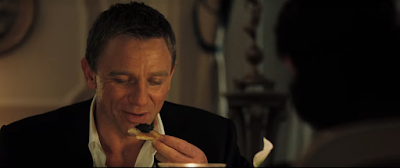
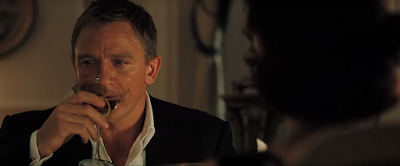

There is something about Craig in the ensuing scene, something that has stayed with me longer than any of his others moments as Bond, something in his behavior, something subtle but huge. That moment before, having just survived a brush with death, would normally be forgotten about as soon as it’s happened in these movies, smirked off. But here, in the low lighting of a late night dinner, it lingers in the air, not just in the conversation but the way Bond behaves, in the way Craig has Bond behave, echoed in that undone collar, a little less fussy than usual. He eats the food with relish; he drinks the martini. Every James Bond, in one way or another, is an epicurean; this James Bond is happy to be alive.

Wednesday, July 08, 2020

Forgotten Great Moments in Movie History


When I revisited “The Naked Gun 2½: The Smell of Fear (1991)”, I was surprised to recall how the plot of such a ludicrous movie turned on something as relevant as clean energy. In this case, the chief villains represented atomic, coal and oil energy, all determined to stop renewable energy before it can get started. That’s not me Reading Too Much Into It; that’s right there on the surface; that’s right there in the text. In one of the multitudinous hilarious moments, the movie’s John Sununu introduces a few energy suppliers at a White House dinner, like Terrence Baggett, “head of the Society of Petroleum Industry Leaders, better known as SPIL.”

That the series’ chief character, Lt. Frank Drebin (Leslie Nielsen) of Police Squad, was a buffoon did not really have anything to do with his being a cop. He had to be a buffoon because that’s what made the jokes work. Still, dig just a little deeper and you find some comically serious shots across the bow, a movie that in its way takes a stronger stand for police reform than ostensible dramas, darkly lampooning rather than just mindlessly lionizing. At that same White House Dinner, in fact, Lt. Drebin is honored by the Washington D.C. Police Commissioner (Jacqueline Brooks) for his 1,000th drug dealer killed. “In all honesty,” he says, “the last two I backed over with my car. Luckily, they turned out to be drug dealers.” It echoes a moment from the first movie in the series, from 1988, when Drebin is briefly relieved of his position. “Just think,” Drebin says in a sorely disappointed tone, “next time I shoot someone, I could be arrested.”


I thought of Frank Drebin the other day when video of Moundsville, West Virginia (population: 9, 318) rolled out a $1m armored tank. After all, when Police Squad and an accompanying SWAT team has surrounded the house where Hector Savage (Anthony James) is making his last stand, Frank climbs into a SWAT tank. “You can’t drive that!” Captain Ed Hocken (George Kennedy) implores. “You’re not checked out on it!” Frank drives it anyway, plowing through the house and then the back wall and, eventually the zoo, freeing the animals who wreak havoc on Washington D.C., making a mess of everything. “Do you realize,” the Police Commissioner asks Frank later that night, “that because of you this city is overrun by baboons?” “Isn’t that the fault of the voters?” Frank asks.

Eh, sometimes.

Wednesday, April 01, 2020

Forgotten Great Moments in Movie History

“The mechanical resolution of a movie’s problems is something we sit through at the end,” the esteemed Roger Ebert wrote in his review of M. Night Shyamalan’s 2002 film “Signs”, “but it's the setup and the buildup that keep our attention.” He concludes: “’Signs’ is all about the buildup.” Indeed, as it opens, strange sounds and creatures dot the landscape of Graham Hess’s (Mel Gibson) farm outside Philadelphia. Those sounds and creatures give way to crop signs in his field and those crop signs give way to crop signs around the globe. The latter is discovered through the magic of television, where Graham and a local cop, Caroline (Cherry Jones), see it. “What in God’s name is going on?” Caroline says, a line reading Jones expertly infuses with as much jaw-on-the-floor confusion as dread. She councils Graham to take his two kids and his brother into town, “get their minds and your mind on everyday things. Good medicine.”

That’s good advice, like Graham says, but is easier said than done. The ensuing shot is my favorite one in the movie, the camera watching the Hess family car as it drives into town from above, as if whatever’s out there is up there watching. Spooky, spooky stuff. In town, the pharmacist (early Merritt Weaver, man) just wants to unload on Graham about what’s going on; Merrill (Joaquin Phoenix), Graham’s brother, pays a visit to the local army recruiter, a creepy scene I’ve written about before; Graham’s kids, Morgan (Rory Culkin) and Bo (Abigail Breslin), visit a bookstore where the proprietor is convinced the crop signs are a network TV scam to sell soda. I laughed then; I laughed harder now. They get away but they can’t get away, you know? It’s Graham, though, who’s most insistent that they take their medicine, telling them to turn off TV, to keep the radio on silent, ignoring the news, trying to steer clear of what’s going on, insisting they all sit down to pizza, even if his eyes, offset by Gibson’s rock solid posture, seem ready to burst.

---------------

Waking up this past weekend, I stayed away from my phone, deliberately stranding it in another room. I didn’t want to refresh any news apps, I didn’t want to scroll Twitter. I poured my coffee and picked up our issue of The New Yorker. Most of the articles concerned the Coronavirus, of course. We turned on The Weather Channel, which is usually innocuous in its own way, polite if meteorological informed chatter about rain in St. Louis or a cold front on the Plains. But they kept, as they should, issuing COVID-19 updates. We went for a walk in the neighborhood, passing the Starbucks on our corner which had tacked up sign to advise it was temporarily closed, lights on but no people, the display case devoid of any items. The bar and restaurant across the street had all its chairs up on the table, like it was 2 AM even though it was 2 PM. When someone came walking up behind us, we instinctively fell into single file, trying to provide her and us the necessary six feet; they crossed the street anyway, 12 or 25 feet better than 6. I tried to take my medicine but it didn’t have much effect.

---------------

After returning home from their medicine-taking excursion, Graham winds up encountering what will soon prove to be an extra-terrestrial in his field. Before he re-enters the home, shaken, Shyamalan sets a scene, this scene, one of cozy domesticity.


The kids are in the background, washing dishes at the sink, sort of, more interested in splashing each other with water, laughing as they do. Merrill sits in the foreground, chewing gum, reviewing the brochure he picked up from the Army recruiter. For a moment, they have, without maybe even realizing it, managed to get their mind off things.


Then Graham enters from the left, head down, not just looking shaken now but beaten.


He slumps into a kitchen chair. As he does, the kids and Merrill all turn to face him.


“Okay,” Graham says. “Let’s turn on the TV.” Try as you might, you can only keep the world at bay for so long. 

Tuesday, March 24, 2020

Forgotten Great Moments in Movie History

For one year or so in the mid-80s, my family got cable before we ditched it for a decade. (In retrospect, I’m thankful we ditched it.) That brief time we had access to a hundred channels, however, was when John Milius’s Cold War slice of surprisingly grim agitprop, imagining a time when other NATO allies ditched the U.S. rather than vice-versa (sigh), “Red Dawn” was all over HBO. My attention span, understandably, was short in those preadolescent days and so I mostly just watched the first fifteen, twenty minutes whenever it would pop up, setting the idyllic Colorado scene before WWIII starts and school is let out forever. As the streets descend into chaos, a few friends hop into the truck of Jed (Patrick Swayze), the emergent Subcomandante Marcos of Calumet, and hightail it out of town. Before vanishing into the Rockies, however, and gradually forming a small resistance, they stop at a convenience store run by the father one of the kids in the pickup’s bed. The father tells them get inside, gather supplies, which they do, in a frenzy. And though in the ensuing montage you don’t see them grab any packs of Charmin, you hear, in dialogue likely recorded post-production, a character demand “And get some toilet paper. I ain’t using no leaves.”


Because I was a typical preadolescent, numb to the complexities of the Cold War if not framed through an Olympic context, and because I rarely made it all the way to the end of “Red Dawn”, I saw it mostly as adventure story where kids ran away into the mountains to play hero. That’s why it was fun to play-act with friends. A few of us on the block would get together and decide who was Jed and who was Matt and who was Robert and who was Danny and if the two sisters a couple houses over were hanging out with us then we could even have Erica and Toni too. (Nobody ever wanted to be Daryl. Traitor.) And so, we’d all escape Calumet and stop for supplies as we fled, getting make-believe Wheaties and guns and toilet paper.

Red Dawn, brought to you by Wheaties & Capri Sun!
That all came flooding back to me Saturday afternoon when My Beautiful, Perspicacious Wife and I took a walk down to CVS ahead of Chicago’s stay-at-home order going into effect to stock up on supplies. My youthful fantasies died off long, long ago, of course, but this wasn’t that; this was being brought face-to-face with a youthful fantasy for real. That’s not in the emotional manual. And I thought of that “Red Dawn” character opining that he didn’t want to use leaves as I made a beeline for the T.P. section and came up dry. We bought some napkins instead. Strange days, these.

Wednesday, February 26, 2020

Forgotten Great Moments in Movie History

Last weekend was the 40th anniversary of the Miracle on Ice – you know, when a bunch of scrappy American college kids beat the Soviet machine in Olympic ice hockey. Though I am a noted Olympics enthusiast, I was not yet even three years old when the U.S. won 4-3, and so the closest I have ever come to experiencing the Miracle on Ice was through “Miracle”, Gavin O’Connor’s 2004 film recounting the improbable victory. I saw some sportswriters in the Twitter-verse over the ruby anniversary weekend call it the best sports movie ever, or one of the best, which are proclamations I always find a little suspect because much how many sportswriters limit discussions of sports’ best to the so-called Modern Era, like history gives them a headache, their declarations about sports movies never seem to include any films from before, like, the 80s, never mind 1950. (Monochrome! Egads!) However, while I will not say “Miracle” the best sports movie ever, I will say Kurt Russell’s turn as the real-life Miracle wrangling coach, Herb Brooks, is right near the top of best sports movie performances.


In E.M. Swift’s story for Sports Illustrated in which the entire team was named 1980 Sportsman of the Year, Brooks is quoted as saying “It was a lonely year for me. Very lonely. But it was by design. I never was close to my university players because they were so young. But this team had everything I wanted to be close to, everything I admired: the talent, the psychological makeup, the personality. But I had to stay away. If I couldn’t know all, I didn’t want to know one, because there wasn’t going to be any favoritism.” Uff da. That is a cold, hard truth, and one that Russell plays straight to throughout. Yes, he coaches, which is to say he shouts and stomps, but he also tempers so much hard-driving with moments of almost impenetrable introspection. In one extraordinary moment, at a Christmas celebration, the whole team gives Coach a whip, a joke gift to make light of all that shouting and stomping. And the way Russell meets the moment, with a little smile, evokes the quote the real Brooks gave Swift, appreciating the joke, yearning to express his appreciation, on the verge of letting his guard down, just a little bit, and then...not. He gets that pointed lack of favoritism just right. And what Russell gets right too, is the Minnesota accent.

We’ve discussed Minnesota accents before, as has every pop culture outlet every time a new season of “Fargo” premieres, but we will reiterate that while Kirsten Dunst – excuse me, the legend Kirsten Dunst – does an exemplary job in “Drop Dead Gorgeous” of going right to the edge of going too far without going over it and though Boston-born Allison Janney’s Minnesota accent is incredibly underrated in Juno (“Juno, did you barf in my urn?”) this blog’s vote for best Minnesota movie accent goes to Kurt Russell as Herb Brooks. My Grandpa Prigge was born, lived, and died a Minnesotan and what always stood out to be and lingers in my mind the most about his voice was not the roly-poly Os but the tense jaw, the way he flattened so many words out, like the last syllables were running into a wall. Listen in “Miracle” to the Big Speech before the Big Game, listen close to how Russell says “not tonight”; that’s the tense jaw.

In a scene before the Big Game between Herb and his archetypal Supportive Spouse (Patricia Clarkson), just there to be supportive, at an ice rink, half-watching his kids, she brings him a cup of coffee. And as she hands it over, he says “There we go.” And that matters. It matters because speaking Minnesotan isn’t just the accent, though Russell impeccably flattens that “There we go” out, but the phrases. There we go isn’t a phrase, exactly, not in the way of a You betcha, but it speaks to what Howard Mohr, author of How To Talk Minnesotan, has professed is the principal motivating factor in all familiar Gopher State phrasing, to be “as noncommittal and as indirect as possible”, the sort of passive-aggressiveness which simultaneously manifests in Russell’s apropos, regionally appropriate lack of eye contact throughout the scene. A standard thanks would do here, certainly, but instead the movie Brooks replies with a turn of phrase that is essentially purposeless, so Minnesota true that while the Big Speech gives me goosebumps, this “There we go” brings a tear to my eye.


Thursday, January 30, 2020

Forgotten Great Moments in Movie History

No movie blog has written about John Frankenheimer’s 1998 thriller “Ronin”, currently registering a perfect score, as it has going on 22 years, per the Cinema Romantico Boysenberry Barometer, as much as this blog. And yet, for all the words we’ve spilled, the character of Seamus O’Rourke has mostly – if not entirely – been absent from the discussion. He’s The Man Behind the Curtain, trying to get the case, the case that everyone wants, even if they don't seem to know what the case contains because it’s the MacGuffin, but using the ringleader of the Ronin – Dierdre (Natascha McElhone) – to get to the case. He’s played by Jonathan Pryce, a recent first-time Oscar nominee for Best Actor.

Ronin, as the title cards explain, were masterless Samurai warriors, wandering the land looking for work, and “Ronin” honors that idea by making the backgrounds of these men and women vague, where details like Dierdre’s “charming Irish lilt”, to quote another character, are meant to fill in blanks, partially. Because Seamus, as his name implies, has an Irish lilt too, we can also assume his background. But his background takes a further twist later in the movie, at a precarious moment in which the all-important case is missing, when coy dialogue suggests he’s been cut out of the IRA loop, quite possibly because of his own dubious machinations. It paints Seamus with the brush of desperation, which Pryce plays to the sweaty hilt when he brings Dierdre back to his hideout where they have a row.

Before having that row, though, he has to rough up Gregor (Stellan Skarsgård), the double-crossing Ronin, and roughing up someone will wear the rougher upper out. So Seamus needs a roughing up digestif; he needs a shot of whiskey.


So he picks up the bottle and the shot glass.


But given the crude conditions, something, who knows what, is still in the shot glass, probably from the night before, so he dumps whatever-it-is on the floor.


And to get rid of the undoubtedly foul remnants of whatever-it-was, he takes his coat and wipes out the shot glass.


Then he pours his shot.

What was it Janis Joplin sang? Ah yes. Wiping out your shot glass with your trench coat’s just another word for nothing left to lose.

Thursday, November 14, 2019

Forgotten Great Moments in Movie History

“Chinatown”, perhaps my favorite screenplay, written by Robert Towne, contains a plethora of punchy lines. The most famous is undoubtedly the last line – you know, “Forget it, Jake, it’s Chinatown”, delivered by Joe Mantello with an emphasis on the concluding word to make it sound less like the L.A. neighborhood where they are than a state of mind. Yet there is a line I have always loved a little more. It happens when Jake Gittes, private eye, pays a visit to Deputy Water Department Chief Russ Yellburton and Yellburton’s secretary tries warding this snoop off, saying Yellburton is in a meeting. Gittes says he’ll wait. The Secretary says Yellburton is liable to be tied up indefinitely. Gittes ripostes: “I take a long lunch hour. All day sometimes.”


The dry spin Nicholson puts on those perfectly penned words lets you know he’s seeking to get under the Secretary’s skin, sure, and quickly he does, but also that his character is telling the truth, which Nicholson emits throughout in his very insouciant air. He’s the kind of guy that takes a long lunch; all day sometimes. That, of course, is the benefit to self-employment, and probably not how most people lived in the 1930s. Yet I’ve come to view it as something like the dream, a future where automation is utilized for good rather than evil, freeing us from the ravages of work and leaving us to, like, ponder the cosmos and have plenty of time to pour over the new Frankie Cosmos LP. Lofty, I know, but I might have thought here, out beyond the gates of the new millennium, we would have made some honest to goodness work/life progress. Instead we’ve drifted further from the Gittes Idyll, into a Corporation First false idyll where companies create their own campuses as a means of entrapment and technology has rendered everyone reachable even during recess; they have analyzed the data, okay, and it should only take you 7-10 minutes to eat your lunch, so scarf it down and get back to work.

In a way, Jerome Facher saw all this coming. Maybe not the real Jerome Facher, retired partner at WilmerHale, but the Jerome Facher played by Robert Duvall in “A Civil Action”, certainly, a defense attorney representing a food company in a lawsuit pertaining to toxic groundwater. Facher is a villain, if an eccentric one, carrying around a ratty briefcase out of superstition, sitting apart from everyone else at a conference table, etc. These eccentricities sort of guard against the character’s ethical quagmire but also lead to my favorite scene in the movie, one where some overly-intrepid young law clerk makes the mistake of delivering a brief to Facher on his lunch break in the darkened bowels of the firm.


Clerk: “Mr Doyle asked me to bring this to you.”
Facher: “When?”
Clerk: “When did he ask me? Just now.”
Facher: “On your lunch break? That hardly seems fair.”
Clerk: “I almost never go to lunch, sir. Too much to do. I just grab something.”
Facher: “You know, I’d make a point of taking an hour or so away from all the noise and insanity of this place. I’d find a place that was relatively quiet and peaceful, have a sandwich, read a magazine. Maybe listen to a game if one was on. I’d make sure everyone knew not to disturb me during that hour. Because that would be my time – my own private time, which no one, if they had any sense of self-preservation, would dare interrupt.”

The way Duvall says my time, underlining “my” by pounding his finger on the table as he says it, oh, that makes me want to stand up and cheer more than any courtroom movie closing monologue. And even if Facher proves smarter than, frankly, everyone around him, on his side or against, they view him as some sort of bizarre dinosaur. And that, I suppose, is true. He’s a dinosaur of a more civilized age, a long time ago, before the efficiency experts helped us internalize lunch breaks as something to be whimsically laughed off.

Wednesday, August 28, 2019

Not-Forgotten Great Moments in Movie History

Forty-eight hours ago, or four months ago, who’s to say anymore, the second trailer for “Star Wars Episode IX – The Rise of Skywalker” dropped to much fanfare. “This is your fight,” we hear Luke Skywalker advising Rey, the Taylor Swift of the Western Reaches. And that may be true, but this is also a nostalgia trip in the guise of a summation of the series and so half the trailer is just a cavalcade of green lights at the end of the pier in the form of images of past “Star Wars.” I got so exhausted I almost laid down for a nap in the middle of it. But I stayed awake, and so I saw the end where Rey, the Taylor Swift of the Western Reaches, is sporting a red lightsaber. That’s red, and that’s a potential problem, see, because red connotes Evil in the “Star Wars” universe and, wait! Is Rey the Katy Perry of the Western Reaches now?! Maybe, who knows, but Reddit’s got some theories which is all you need to know about how “Star Wars”, my beloved “Star Wars”, long ago jumped the shark. I wish a Knight of the Old Republic was an Internet ombudsman.

Anyway. This new lightsaber drop got me to thinking about my favorite use of a lightsaber in the whole “Star Wars” saga – Real Edition and Ersatz Editions I & II. Spoiler Alert: it doesn’t involve Luke or Darth! It doesn’t even involve Obi-Wan, though I’ve always dug his pulling the lightsaber at Mos Eisley like it’s the Jets and the Sharks under the highway. No, my favorite use of a lightsaber involves Han Solo and it happens on Hoth.


You know what I’m talking about. Luke has escaped the Wampa and passed out in the snow and Han goes looking for him by Tauntaun and finds him but then his Tauntaun dies and so Han has to erect the emergency shelter. But he can’t just leave Luke lying out there in the snow; he’ll freeze to death! So he scoops up Luke’s lightsaber, gets the thing turned on, a moment which Ford brilliantly accentuates with a kind of “uh”, as one might in a moment of unsure DIY plumbing, transforming “an elegant weapon for a more civilized age” into nothing more than a shiny tool for ripping up Tauntaun guts, which, frankly, is the kind of unprepossessing vérité nodding at nothing more than primal necessity that could really benefit the summation of Ersatz Edition II.

Thursday, July 25, 2019

Forgotten Great Moments in Movie History


Quentin Tarantino, it goes without saying, though it still needs to be said for context, loves movies. His original Big Kahuna Burger, “Reservoir Dogs”, lifted its Mr. Black/Mr. White/Mr. Pink nomenclature bit from “The Taking of Pelham One Two Three” (1974). And “Pulp Fiction” was just sort of one rolling movie-themed carnival, with a part-cinema wax museum, of sorts, where you could order a Douglas Sirk steak, never mind an all-important, never-explained briefcase that might’ve been pilfered from the set of “Kiss Me Deadly” (1955). In the morning after Butch has gone rogue, even, while Fabienne brushes her teeth, she’s got a motorcyle movie playing in the background, a detail I always loved because in Q.T. land, even when you’re on the run and in danger of being killed, people still watch movies. “Inglorious Basterds”, meanwhile was set in the midst of WWII’s European Theatre but it may as well have been on a movie backlot, with the movie industry itself playing a crucial part and a glorious old Parisian movie theater earning a starring role. Heck, “Django Unchained” and “Kill Bill” just are Blaxploitation and Chop Socky, respectively, duplicated and then expanded into A Band Apart Pictures (taken from a movie!!!) bouillabaisse. And Q.T.’s latest, “Once Upon a Time in Hollywood”, as the title implies, seems more of the same.

For all his references and outright homages to movies, however, the one thing that Tarantino does not serve up in his movies so frequently is the act of going to the movies. I mean, yes, people go to the movies in “Inglorious Basterds”, memorably, allowing for Q.T. to imagine the movie-going experience as something like the savior of the free world, which is a pretty righteous ode to the cinema, though that’s much more heightened than what I’m talking about. I’m talking more about the scene in “True Romance”, which was directed by Tony Scott but written by Tarantino and so just as much his joint, where Clarence goes to a triple kung-fu feature on his birthday and then is joined by Alabama and where, despite her being paid to be there, him and his love for the movies and the movies themselves lifts her higher. Even that, though, is pitched at a more romantic frequency than what I’m seeking in this here post about I’m about to unfold.

One of my favorite lines in Tarantino’s “Jackie Brown” is bail bondsman Max Cherry (Robert Forster) announcing his intention to go catch a movie leading his second-in-command, Winston (Tiny Lister), to ask what he’s going to see. “Something that starts soon,” Max replies, “and looks good.” And I love that line for two reasons. I love that line because it flashes me back to another time, one when you’d just watch wander down to the movie theater and, well, as he says, see what starts soon and looks good. You didn’t check Fandango on your phone; you just looked at a few posters and made a decision. Primitive, perhaps, but thrilling in its own low-key way, putting your fate in the hands of the movie gods. And I love that line because it evokes this man, Max Cherry, who’s his own boss and if he wants, in the middle of the day, can up and go catch a movie. Damn, ain’t that the dream.

That moment, however, comes later in the movie, and Max is saying it as something of an alibi for what he is actually about to go and do – that is, help the eponymous airline stewardess swindle $500,000. Tarantino, however, has set up Max’s ersatz solo movie date with a real solo movie date much earlier, one that we see just as it concludes, beginning with a shot just outside of the movie theater, its door still closed.


But then, the door flies open accompanied by a rush of music, presumably from the closing credits of the unseen movie, and this smiling couple, in the throes of post-movie enjoyment, which is key.


And after that couple passes by, and then another couple patrons, Max exits.


And he walks past a poster for “The American President”-


-and “Wolf”, pinpointing the time.


And...that’s it. We see him leave the movie. This is all set-up so he can run into Jackie Brown at the mall where the movie theater is located, but it’s this brief instant, this leaving the theater that nevertheless stays with me.

“Jackie Brown”, after all, is a movie about motion. It begins with Jackie aboard an airplane walkway, just standing there and letting it take her where she needs to go as the opening credits unspool. Over and over Tarantino just watches people walk, whether it’s Ordell and Beaumont walking and talking or Max following the money or Jackie in a burst of faux-commotion hurrying through the mall or Louis and Melanie haplessly wandering through the parking lot looking for his car or even a brief shot of Ray Nicolette sauntering into the office with his motorcycle helmet tucked under his arm. But none of these walks compare to Max’s. There’s that Bloodstone song dug up for the soundtrack by Tarantino, “Natural High,” “I’ll take to the sky on a natural high”, and what is the post-movie walk but that exactly that.

Thursday, June 20, 2019

Forgotten Great Moments in Movie History

The first Jean-Claude Van Damme movie I ever saw was “Double Team” (1997). I saw it not because of Van Damme, mind you, but because of The Muscles from Brussels’s co-star making his movie debut – Dennis Rodman. The Worm, after all, was and remains my favorite professional athlete, dating back to his days with the Bad Boys-era Detroit Pistons, a defensive genius and rebounding savant, his basketball IQ hovering around 200. Yet I loved him just as much when he went full diva, coloring his hair, dating Madonna, hanging backstage with Pearl Jam, publishing ho-hum books, spouting banalities disguised as inanities. It was in his Diva Period when he made Tsui Hark’s “Double Team”, released as his then-team, the Chicago Bulls, were mounting their (eventually successful) assault on a second consecutive NBA title, like, I dunno, if Draymond Green had starred in the latest Johnnie To joint this spring. Rodman might not have set Hollywood figuratively ablaze with his turn, “mumbl(ing) his way through some unintelligible lines,” as Jeff Vice noted for the Deseret News, but he was, as Vice also wrote, “less wooden than his Chicago Bulls teammate Michael Jordan (“Space Jam”).” Take that, your Airness!


Indeed, while it might be traditional for NBA players moonlighting as actors to play a loose version of their basketball playing self, if not just playing themselves outright, be it Jordan in “Space Jam”, be it Julius Erving in “The Fish Who Saved Pittsburgh”, be it Kyrie Irving in “Uncle Drew”, Rodman both did and did not follow this template. Yes, he was playing an arms dealer named Yaz, but Yaz recolored his hair so frequently and dropped basketball references so incessantly, including his former team (“I don’t play with the bad boys anymore, only the good guys”) that it was difficult not to read him as Rodman. That is why the best moment in “Double Team”, as most cinematic scholars agree, occurs when Rodman’s character, in the throes of an arms sale with Van Damme’s, counters the latter’s observation that “Offense gets the glory” by remarking “But defense wins the game.” No one has ever been more qualified to give that cliché a ring of Socratic truth than Dennis Rodman. In his 1996 profile of the future Hall-of-Famer for The New Yorker John Edgar Wideman wrote that “His helter-skelter, full-court, full-time intensity blurs the line between defense and offense”, suggesting Rodman as the living, breathing embodiment of his “Double Team” wisecrack.

As a hardwood-obsessed international man of mystery, Rodman was, in a way, presaging his bizarre, tragic, dude-you-gotta-stop self-appointment as American emissary to the Democratic People’s Republic of Korea since, his Basketball IQ failing to translate to international diplomacy, he seems to view, a la our current American Ringmaster-in-Chief, the Supreme Leader as a charitable dude. North Korea, of course, hacked Sony Pictures in 2014, and targeted American businesses earlier this year as T*ump and Kim Jong Un were meeting, to say nothing of Russia’s attempts to hack into the American Presidential Election of 2016. It was these attacks, and others, that led, as The New York Times recently reported, and as The New York Time’s Daily Podcast recently recounted, to the United States Defense Department forming a Cyber Command, one that is currently hitting back at Russia, an online arms race of sorts, leading Daily Host Michael Barbaro to summarize “You have to go on the offense to really be on the defense”, at which point I paused and marveled, just marveled, at a current state of affairs so preposterous they were prophesized by Dennis Rodman.

Thursday, December 20, 2018

Forgotten Great Moments in Movie History

Willie Dixon, the eponymous foul-mouthed St. Nick of ill repute in Terry Zwigoff’s 2004 cult classic “Bad Santa”, is, as it no doubt goes without saying, a non-believer. He didn’t celebrate Christmas, he explains in voiceover, not because he was Jewish but because his old man’s idea of a present was a daily punch to the back of the head. It is no wonder, then, that Willie uses his omnipresent Santa costume merely as a ruse to rob shopping malls blind, inverting the reason for the season. Willie’s eventual lady friend (Lauren Graham), meanwhile, is Jewish, or at least her father was, and her love of Christmas stems directly from the holiday being verboten, a perversion of seasonal joy given rise in her Santa Claus fetish.

It is only natural, then, that Willie’s non-beliefs will be juxtaposed against those who do believe, like the immortal Thurman Merman, a woefully uncool teenager of whom Willie, for reasons too convoluted to explain, will become a caretaker of sorts. Thurman’s dad might be in jail, and his grandmother might be constantly passed out in an easy chair, and he might have no friends, but he still believes, joyfully opening windows in an Advent calendar and babbling about his own unique faith system involving a talking walnut. Heck, there’s even Bob Chupeska, mall manager, who might have to endure Willie but nevertheless, in the air of Ritter, is the kind of guy you just know strings too many lights on his house and says thing like “How can anyone not enjoy Christmas?”

In their company, gradually, against all odds, Willie culturally assimilates in his own warped way. He might not want to participate in Thurman Merman’s neighborhood Christmas Eve lumanaria program but he finds himself out in the driveway lighting candles in sacks of sand anyway. And just as Marcus, Willie’s partner, assimilates in so much as the consumerism of Christmas gets a stranglehold him, so does it Willie, as his last act before the cops’ bullets cut him down is valiantly getting the present Thurman Merman wants back to the kid’s house. The epilogue may or may not be “Bad Santa’s” ode to Travis Bickle’s concluding “Taxi Driver” dream state, but Willie’s conversion is real.


There is one character we have not mentioned. He is Gin Slagel (Bernie Mac), security chief at the mall who is enlisted to try and force out Willie and Marcus only to, sort of, go partners with them. If, as the latter suggests, his character occasionally takes the initiative, he is more often presented as hanging back, reacting, sitting at his work desk, listening, chewing orange slices, taking in the world around him. He, unlike the surrounding characters, seems uninterested in and unaffected by Christmas. If initially this suggests Gin is merely a hardass given Mac’s general air, there is a single scene that concisely, comically reveals not so much his motivation as his nature. It happens when he ferrets out a teenager attempting to shoplift, not just taking back what the kid has sought to steal but also absconding with the kid’s own possessions, and bidding the would-be thief a ferocious goodbye by intoning: “Happy Kwanzaa.”

It’s a punchline as peek behind the curtain. Here’s a man who spends the entire movie enveloped in Santa and elves, reindeer and candy canes, Christmas carols as mall muzak, all this secular dogma imposing itself on him, and he has no recourse but to sit there and take it. Finally, however, in the presence of this kid, one no doubt about to get so much under the tree only to still want so much more anyway that he’s willing to steal it, Gin snaps back, spreading his own gospel, even if the late Mac gives it the already defeated ring of a man who knows, contrary to certain carnival barkers, that the war on Christmas ended a long time ago.

Wednesday, October 31, 2018

Forgotten (not so) Great Moments in Movie History


Near the conclusion of the 1980 comic cultural touchstone “Airplane!”, as the eponymous aircraft attempts to make an emergency landing, the scene momentarily cuts to a cityscape highlighted by a broadcast tower with the illuminated red letters bearing the station’s call sign: WZAZ. “WZAZ!” an offscreen dee jay hiply hollers. “Where disco lives forever!” In the instantaneous aftermath of this declaration, however, the airplane clips the broadcasting tower, knocking out the signal. Disco, in other words, is dead. Indeed, in the most recent episode of his podcast Hit Parade, where he performs illuminating, entertaining deep dives into Billboard Chart history, and which got me thinking about everything that led to this post, Chris Molanphy cites this scene as a symbolic representation of when disco faded from the public’s consciousness.

Except, of course, as Molanphy noted later in the episode, eventually, because everything is cyclical, because everything comes back around, the 70s made something of a comeback in the 90s. Fashion trends of the 1970s were revived, just like fashion trends of the 1990s are being revived now, and inevitably “That 70s Show”, which debuted in 1998, epitomized this resurgence. Why my girlfriend my senior year of high school and I rented “Saturday Night Fever” to show the German foreign exchange student in our class because we thought it held the cultural key to America, or something. Quentin Tarantino, 90s auteur wonderboy, took many of his cues from the 70s, and so many other movies of the decade, even those long since forgotten, like “Naked Gun 33⅓: The Final Insult”, got in on the revival too.

“Airplane!”, of course, was written and directed by the triumvirate known as Team ZAZ (David Zucker, Jim Abrahams, Jerry Zucker), hence, ahem, WZAZ. The trio would go on to also write 1989’s stone cold comedy classic “The Naked Gun”, with David Zucker directing alone, and the latter Zucker also wrote and directed the 1991 “Naked Gun” sequel, “The Smell of Fear”, which this blog holds in just as high a regard as the original. Zucker gave up the directorial reigns for 1994’s “The Final Insult”, but he did co-write it, signaling at least one Team ZAZ holdover. That is important. And that is important because a flashback in “Naked Gun 33⅓” meant to fill in the backstory of femme fatale Tanya Peters (Anna Nicole Smith) is set in the 70s, triggered by the immortal Lt. Frank Drebin (Leslie Nielsen) referencing “The big disco shootout” which allows for both Nielsen and George Kennedy as Captain Ed Hocken to don era-appropriate costumes and the soundtrack to make space for The Bee Gees.


The scene itself is funnier in theory than in practice, sort of emblemizing the overall staleness of the proceedings, though it effectively brings home the inadvertent point anyway. Here was Zucker’s “The Naked Gun 33 1/3” referencing disco’s kitschy resurgence fourteen years after Zucker’s “Airplane!” put WZAZ out of business, suggesting their disco is dead punchline was premature.

Wednesday, September 05, 2018

Forgotten Great Moments in Movie History

In his memoir “Love is a Mixtape”, Rob Sheffield wrote about the recurring synth-pop duo fantasy he had about any girl he ever dated. “The girl is up front,” he wrote, “swishing her skirt, tossing her hair, a saucy little firecracker. I’m the boy in back, hidden behind my Roland JP8000 keyboard. She has all the courage and star power I lack.” Even if this might traffic somewhat in gender stereotypes, there is nevertheless a certain truth to the general synth-pop band appearance, not simply in the delineation of Girl and Boy but Star and Not Star. And as someone with a soft spot for synth-pop bands, I often enjoy watching the person on the Roland JP8000 keyboard, or thereabouts, just as much as the person at the front singing the song and working the crowd. There is a visual dichotomy there that I find thrilling. Zola Jesus tends to perform with her limbs majestically akimbo, but it is just as easy to get lost in the rhythmic sways of the upstage keyboardist semi-lost in the shadows. It’s difficult to take your eyes off Lady Gaga during her iconic “Paparazzi” performance on SNL, but look left, over the shoulder of the backup dancer, and the unmistakable Space Cowboy is lording over his surfeit of sound-making machines with hipster cool.


Marc Lawrence’s 2007 rom com “Music and Lyrics” has a positive rating on Rotten Tomatoes though if anyone other than channel surfers who stumble upon the thing on TBS or TNT some hungover Saturday afternoon even really recall its existence I would be surprised. I greatly enjoyed it, whatever its deficiencies, and so did My Beautiful, Perspicacious Wife and our mutual friend. In fact, My Beautiful, Perspicacious Wife and our mutual friend saw it in on the big screen way back when at a showing with only one other person in the theater and My Beautiful, Perspicacious Wife likes to joke that the one other person was probably me. It wasn’t, because I did not see it in the theater, but I like to spiritually think it was, or something. Anyway.

If “Music and Lyrics” is remembered at all it is probably for its opening, which takes the form of a 1980s music video by fictional band PoP and their hit New Wave-y tune “PoP Goes My Heart.” This is because the central character is Alex Fletcher (Hugh Grant), formerly a member of PoP but now obligatorily washed up while his principal bandmate, Colin Thompson (Scott Porter), went onto bigger and better things. Both Colin and Alex were vocalists in the band, as the “PoP Goes My Heart” video will prove, but it opens with Colin on lead while Alex is concocting the beat in the background. It is highlighted in my heart by this shot…..


No one would confuse Hugh Grant with “the boy in back”. He’s generally right up front and on the poster. Not just for “Music and Lyrics” but even for something like “Love Actually”, or “Bridget Jones’s Diary”, which might not be his movies, per se, but which he nevertheless enlivens so memorably with his patented dithering that they kind of just feel like Hugh Grant movies anyway. His pleasingly, tipsily theatrical turn as the narcissistic villain in “Paddington 2” does not steal the movie, per se, but is so stellar that it just sort of exists as a co-equal of the eponymous Peruvian bear. And yet.

In this shot, Alex is merely the producing savant in the background, content to just stay in the shadows and lay down the beat while Colin tells you what’s up. If it becomes visual shorthand for how Alex really was the brains of the band even as he fell on harder times, there is something else happening here. It’s almost a jolting look for Grant, being “the boy in back”, but he rolls with it in these few instants, just playing keys and pressing buttons. And because it is Grant you are drawn to him anyway, an entire alternate universe glimpsed in the space of a screenshot, where Hugh Grant did not comically cater to your every whim but simply let his aura do the talking.

Thursday, June 14, 2018

Forgotten Great Moments in Movie History

Loyal frustrated readers know well the fondness this blog retains in its heart for Jan de Bont’s “Twister.” That softness stems not from the CGI tornadoes nor the ostensible thrill of those chasing all those twisters, but from the peripheral Midwestern atmospherics. You see these in the movie’s opening, which we have written about before, as well as in the truly remarkable shot where Bill Paxton stands beneath a stormy Midwestern sky and runs some dirt through his fingers, like so many idiot men in the central Iowa neighborhood where I grew up who would defiantly go outside whenever a tornado siren wailed on some glorious June evening to gaze at the threatening sky. The film’s atmospherics, however, were not simply limited to the outdoors; they were also felt indoors.

Midway through the movie, after a close call with death and an impressive brushing off of this glimpse of the pearly gates, the whole storm chasing gaggle, captained by Jo (Helen Hunt) and Bill Paxton’s Bill, retires to the nearby home of Jo’s Aunt Meg, played by the legend Lois Smith. “Red meat!” declares Dusty played by pre-immortal Philip Seymour Hoffman in a performance that packs as much glorious wind as any of those fake tornadoes. “We crave sustenance!” That they do, and once at Meg’s, steaks fry in the pan, right alongside eggs, and eventually wind up on ginormous plates alongside glorious mounds of mashed potatoes (with Hoffman getting his pronunciation of potatoes just right, saying “po-ta-TUHS” not, “po-TAH-oes”) slathered in gravy, images that suggest Cézanne Still Life by way of a truck stop diner.


As a character, Aunt Meg mostly exists to be placed in peril, which is why we have to be introduced to her in some sort of friendly scene to ensure we want to see her saved. As such, the steak and eggs and potatoes might merely have been edible background noise. And, in a way, they are, though also, like the movie’s best parts, the food sort of thrusts itself to the forefront anyway, like an oversized Midwestern plate of food should, Whatever else de Bont wants you to be paying attention to, it’s nigh impossible not to have your eyes drawn back to the food.

Food has an illustrious history at the movies for appearing as metaphors when it comes to love, from Luca Guadagnino’s atply titled “I Am Love” to “Like Water For Chocolate.” And one might be tempted to extract metaphorical sustenance from the steak and eggs and mashed potatoes of “Twister.” That is because Dr. Melissa Reeves (Jami Gertz), the fiancé of Bill, does not seem all that eager to eat the steak and eggs and mashed potatoes when placed in front of her. Her character, of course, might be engaged to Bill but she is nevertheless still The Other Woman because Bill and Jo, once married, now about to officially get divorced, have, as they must, re-kindled their affection. And Dr. Melissa Reeves’s refusal to eat this food might well have worked to indicate that she does not have the, uh, shall we say, necessary emblematic appetite.

But then, we already knew that. And for a movie that is all on the surface, so, thankfully, is the steaks and the eggs and the potatoes. As any hearty Midwesterner will tell you, food is food.

Wednesday, April 04, 2018

Forgotten Great Moments in Movie History

In Michael Mann’s 1999 masterpiece “The Insider” there comes a crucial moment late in the proceedings when it seems the tide has irrevocably turned against 60 Minutes producer Lowell Bergman (Al Pacino) in his efforts to air a segment in which Dr. Jeffrey Wigand (Russell Crowe) fingers Big Tobacco for knowing that cigarettes are addictive. This is partly because of an article set to detonate in The Wall Street Journal that will tear Wigand’s cred limb from limb. Lowell, however, knows it’s a smear campaign, and so he calls up Charlie Phillips (the late Paul Butler) at the WSJ and asks to get together to hash this out. “Sure,” Charlie says. “Where?” “P.J.’s,” replies Lowell. “I’ll be there,” says Charlie. And while his simply saying he will be there seems to overlook the all-important question of “When?”, well, the absence of that follow-up question beautifully, intrinsically suggests how P.J.’s – that is, P.J. Clarke’s – is simply the epicenter of journalists. When? Whenever. Him, Her, Whoever, Everyone will be there eventually.

That’s true, of course. P.J. Clarke’s was often the epicenter, whether it was Madison Avenue (m)ad men or the “soused sportswriters”, as Michael Weinreb once put it, who voted for college national champions. It’s a world that Michael Mann and Eric Roth, befitting a solid newsperson’s terse prose, succinctly summarized in their “The Insider” screenplay:

INT. BAR - NIGHT 

CLOSE on Lowell entering, moving through the crowd of sports writers, feature writers, sub-editors, etc. He comes upon a rugged-featured man, JIM COOPER from The New York Times, sitting next to Charlie.

It’s an intro that Mann, naturally, not improbably, captures in the film’s language, where Lowell moves, sure enough, through the crowd, before the crowd half-parts and there are the two men.


And as Lowell moves through the crowd, the sound design is spot-on, ensuring we hear the murmurs of infinite conversations emanating from all angles, where you suspect everyone is dishing on what sort of news everyone else around them is trying to break, an interconnected world evoked in Cooper whispering to Lowell “I hear you guys are sitting on something sensational over there.” Not that everyone knows everything. Because upon getting Charlie alone, Lowell tries to convince him to push the deadline on the WSJ’s Wigand story, decrying it as a mere smear campaign. “If I’m right,” Lowell says, “are you going to put the Journal’s reputation behind a story that’s going to blow up in your face.” “I’ll take a lot at what you got,” says Charlie.


If to many, this room represents The Enemy, purveyors of Fake News, that nebulous catch-all, this scene is here to demonstrate the rigorousness of corroboration and fact-checking that goes into these stories. Still, if “The Insider” was a compelling ode to newsgathering, the news it captured was ultimately compromised by corporate interests, the meaning of veracity becoming twisted for unseemly purposes, foreshadowing a future I failed to consider. And if twenty years ago I regretfully took this scene for granted, now I think of it often, seeing P.J. Clarke’s less as a dark toned nerve center of truth than the remains of a fort from a lost war.

Tuesday, March 13, 2018

Forgotten Great Moments in Movie History

A couple weekends ago I found myself thinking a lot about Bon Jovi. Not because I saw a cover band, or because I stumbled into “Bad Medicine” while listening to my Arena Rock Pandora station, but because of March Shredness, which is, for those not sitting at the cool kids’ lunch table, “a 64-team, March Madness-style tournament of songs.” It was inaugurated in 2016 with March Sadness, pitting the most melancholy college rock songs against one another, and followed last year by March Fadness, in which 90s one-hit wonders squared off. This year, it’s a bracket full of hair metal. My beautiful, perspicacious girlfriend is at into March Shredness as she was into March Fadness as she was into March Sadness. (Loyal frustrated readers might recall we had a big fight about March Sadness. She’s still wrong.) And over the weekend, we spent our mornings drinking coffee and listening to, pontificating over, and reading about hair metal, including the big Bon Jovi v Bon Jovi first-round showdown between “Livin’ on a Prayer” and “Wanted Dead or Alive.”*


I confess, I have always viewed “Livin’ on a Prayer” a little snidely from on high. If I know using Springsteen as a reference point to bludgeon Bon Jovi isn’t exactly fair, as a Bruce fanatic I nevertheless struggle to hear “Tommy used to work on the docks” without thinking of it as Jon’s musty attempts to muster up his own “My name is Joe Roberts / I work for the state.” Such an admittedly snobbish sentiment, I assumed, put me on par with rock critics of era, and, sure enough, in Jimmy Guterman’s original Rolling Stone review he laments Bon Jovi “reducing every emotional statement to a barefaced cliché.” I mean, it’s difficult to disagree, even if you like Bon Jovi and “Livin’ on a Prayer”, but……does reducing every emotional statement to a barefaced cliché have to be a bad thing? Let us now consider the self-proclaimed Dean of Rock Critics, Robert Christgau, often thought of as a crank who doesn’t like anything. And yes, he argues that Bon Jovi goes to show “youth rebellion is toothless enough to simulate and market.” But he continues: “who the hell thought youth was dangerous in the current vacuum? Would you have preferred the band market patriotism?” He concludes: “And are you really immune to ‘Livin’ on a Prayer?’”

Leave it to Xgau to summarize “Livin’ on a Prayer” in a single sentence without really saying anything about “Livin’ on a Prayer” itself. Yes, Lisa M. O’Neill’s righteous accompanying March Shredness essay gets Bon Jovi’s anthem just right, not least because that is precisely what she deems it — an anthem. And not so much the band’s anthem as ours, one the New Jersey rockers created to grant us catharsis night after night after night in arenas across America. That catharsis, however, is not really something you really feel when standing back, looking at the song from afar, analyzing it; that catharsis can only be felt when you are inside of the song and living it.


You probably haven’t given a thought to “Charlie’s Angels: Full Throttle” in, well, fifteen years (it was released in 2003), if ever. Why would you? It wasn’t really a movie so much as a kind of frivolous grab bag, isolated moments strung together to be patched into a sequel to throw into theaters to try and make some money. And though the movie thankfully is never smirking, it’s definitely winking at you, perhaps best emblemized by Jaclyn Smith’s cameo where she appears in a halo of light and dispenses advice to Drew Barrymore’s Dylan by way of every platitude in the book. That sort of sentience makes it difficult to anything seriously, including the flashback scene to young Dylan and young Seamus O’Grady (Justin Theroux) – chief villain – to happier times as they burn rubber while singing along screaming along to “Livin’ on a Prayer.”

We are meant to laugh, and I would cite the Tom Cruise/Kelly McGillis-ish tongue kiss that Dylan and Seamus share midway through as evidence of this theoretical cringe-inducing comedy. Yet even if we are laughing, or staring emptily in place of laughter, the characters are not laughing. More importantly, the characters are not winking. This is a Drew Barrymore specialty. She did this in “The Wedding Singer” where even if nearly every detail was meant to communicate to the audience “Can you BELIEVE the 80s?!”, Barrymore still seemed to organically inhabit the space. And she seems to be organically inhabiting that front car seat in “Charlie’s Angels: Full Throttle”, not standing outside of it, as performers sometimes do, essentially commenting on the moment they are supposed to be in. No, she is living the catharsis the song elicits. Boy, is she, never more so than when she screams “I would die for you, Seamus!”

There are so many deaths in “Charlie’s Angels: Full Throttle”, all of them rudimentary movie masquerade, but if in that moment Drew Barrymore had thrown herself in front of oncoming traffic, I would have believed.

*I voted for “Livin’ on a Prayer”, btw 

Thursday, January 18, 2018

Forgotten Great Moments in Movie History

The other night I was fortunate enough to catch Aziza Barnes’s “BLKS” at Steppenwolf Theatre, which was fantastic and which anyone in the Chicago area should really consider getting out and seeing (it runs until January 28th). One throwaway detail, however, that particularly caught my eye involved Namir Smallwood’s character Justin, who, for reasons too complicated to explain, is about to go to sleep on someone else’s sofa when, before tucking himself in, he sets his glasses – egads! – on the floor. My stomach dropped when I saw this, just as it dropped later when he draped the glasses over the sofa’s arm, as if he was hanging a towel over a flimsy towel rack. Oh, the humanity. This emotionally perturbed me not simply because I am glasses wearer but because I am a glasses wearer who becomes supremely paranoid regarding the condition of his glasses upon removal from his face. I need to know they are in a safe space when I turn in for the evening because if they are not I will not be able to sleep. I will have bad dreams about bad things happening to my glasses, and I will likely wake three, four, five, six, seven, eight times during the course of the night just to confirm that my glasses are where I put them and okay. I mean, I’m practically blind without my glasses, which means the stakes are high when it comes to seeing my glasses through the night, and so to see someone so casually consider his nighttime eyewear safety sent shivers down my spine.

That, as it would, because it’s me, took my mind to Joe Carnahan’s “The Grey”, the 2011 action-adventure film that most people know because it’s the one where Liam Neeson fights a wolf. Of course, his reasons for fighting the wolf, and how the film presents him fighting the wolf, if it even presents it at all (wink, wink), goes beyond what trailers suggest, but that’s neither here nor there. The point is, wolves are the foremost nemesis of “The Grey”, haunting a group of plane crash survivors as they try to reach safety in harsh, remote Alaska, and yet, as scary as those wolves are, something else, to me, was even scarier. I’ll explain.

One of the survivors is Talget (Dermot Mulroney), a friendly guy with a slightly more erudite air than his compatriots, an air evoked in his semi-coke bottle black frame glasses. And Mulroney doesn’t just let those glasses sit there on his face. No, he fidgets with them throughout, much like a glasses wearer might, because even if there are moments when glasses wearers are not at all conscious of their eyewear, there are just as many moments when we absolutely are, constantly adjusting our glasses because when glasses feel weird on your face then your whole face feels weird, your whole body feels weird, your whole mind feels weird. Take this shot, for instance, where you can see how his glasses have sort of slipped down to the edge of his nose, which, oh my God. When it’s hot, or when you’re really working and so your face gets sweaty and your glasses won’t stay up on your nose and they keep slipping down, there are few things more vexing, man. But do not get me started.


As scary as glasses are slipping down on your nose, however, that is not the scary moment I was referencing. The scariest moment occurs when the group happens upon a ravine, which leads them to construct a makeshift rope, of sorts, tie it to a mammoth tree on the other side after one of them improbably jumps across, and then ferry over the chasm one-by-one. Talget volunteers to go last, afraid of heights and worrying that if he freezes up he might doom Liam Neeson’s Ottway too, which might communicate Talget’s inevitable death but also communicates his kindness. And even here Mulroney commits to actorly business, playing a glasses wearer to the end by taking those black frames off his face and blowing on them to clear them up, because smudged glasses are a deathknell even when it isn’t literally life and death.

And as Talget finally gets out onto that line, Carnahan’s camera momentarily forgets about everyone else, lingering on just him, up close and tight, getting right in there.


And, perhaps against his better judgment, perhaps already resigned to his fate, he looks down.


And as he does, his glasses slip off his face.


He instinctively reaches out for them, of course, but they are already long gone.


And Carnahan then, and only then, cuts to a wide shot, evoking The Loneliness of The Glasses Wearer Without His Glasses.


And then Carnahan cuts back up close, implicitly capturing the look of a glasses wearer who, sans frames, not only doesn’t know what to do, knows full well he is already done for.

Wednesday, September 27, 2017

Forgotten Great Moments in Movie History

One of America’s foremost pastimes is living in the past, which is why every autumn “The Great Gatsby” gets re-assigned to kids all over the country, and which is why the legend of the 1916 New York Giants re-surfaced to give context to the Cleveland Indians, and is why no one thinks they make movies or music like they used to. Sure, sure, we garble about the future too, that mystical future, but even the future, as our nation’s current President can tell you, is really just an attempt to raise the past, the whimsical past where everything was perfect, until we truly re-visit it, of course, and are re-reminded it wasn’t all so grand, as this passage in Murray Sperber’s illusion shattering chronicle of college football, “Onward Victory”, I am currently reading goes to show... “When the Rose Bowl signed up the Big Ten for a long-term pact, shutting out southern and southwestern schools, one sportswriter noted that the deal assisted the California land developers on and behind the bowl committee because ‘more real estate can be sold, and at higher prices, to people from the Middle West than to yokels from Dixie.’” Oh.

“Sunshine State” (2002) is set in the present but significantly stained by the past. The opening shot, a pirate ship on fire, makes you think it is the past until the camera pulls back to show you a few flashing lights atop a cop car. The pirate ship is part of Buccaneer Days, a commercial attempt for the Florida community of Delrona Beach to re-visit its past, which is far more murky, of course, than some lamebrain festival would ever let you know, as their neighboring black community of Lincoln Beach goes to show, which once was wondrous and alive but now is rundown and left hanging, refuting the notion that in the wake of the civil rights movement everything was hunky dory for Black America. Marly Temple (Edie Falco), meanwhile, is stuck managing a Delrona motel & restaurant that is part of the family, though a corporation called Exley Plantations (another nod to the fraught past) wants to snap it up, to turn the community into some sort of pseudo-paradise, and Marly’s ex-husband Steve (Richard Edson) has his own grand vision for a waterpark pseudo-paradise that he hopes to fund by borrowing from Marly if she cuts a deal.

Sayles is not really known as a comic filmmaker, but of all the movies of his I have seen, and I have seen quite a few, this is the funniest moment he has put on screen, one that could stand up to any fine satirist, when Steve tries to convince Marly to help him out and Marly curtly cuts him down.

Steve: “You know why you’re stuck running that flophouse? Because you got no vision.”
Marly: “I can’t believe you think I’d loan you money after what you put me through.”
Steve: “That’s all over and done with, Marley. You can’t-”

But wait! Before we actually say the hilarious capping line let us acknowledge that it’s a line that has been employed thousands of millions times. And that it’s a line that has been employed thousands of millions of times is what makes it funny given the context, and that the context relates to his costuming because he is on duty as a re-enactor at an old Civil War fort. The esteemed Roger Ebert once noted, characters wearing funny hats are never as funny as characters who don’t know they are wearing funny hats. And Steve...well, Steve doesn’t know his costume is funny given what he says. And Edson, who, as the immortal Parking Garage Attendant in “Ferris Buller’s Day Off”, told Cameron Frye to relax with a facial expression of amusing incredulity, accentuates what he says with a twisted variation of that same facial expression that in this case becomes the emblem of a comical delusion of a man who thinks he is moving forward without realizing he is actually stuck in cement. He says...


“You cant live in the past.”

Wednesday, August 09, 2017

Forgotten Great Moments in Movie History

Perhaps stemming from my general exhaustion with people whose biggest movie-watching kicks come from picking out plot holes and whining about them, forgoing ruminations on aesthetics and theme, I have a soft spot for moments in movies that, intentionally or unintentionally, derive humor from poking holes in real world logic. Like, the moment in “The Naked Gun 2 1/2” where villainous Quentin Hapsburg (Robert Goulet) is on the very specific lookout for two aging white men, a dude in a wheelchair, and O.J. Simpson, and yet upon encountering a four-person mariachi band consisting of two aging white men, a dude in a wheelchair, and O.J. Simpson cannot quite detect that his desired targets are right in front of him.

This sort of moment was just as ably captured in 2011’s “The Muppets” where Miss Piggy’s Parisian secretary, a sterling Emily Blunt, shoos The Muppets from the office only to be fooled by Muppet Man, wherein all The Muppets stand on one another’s shoulders while hidden in a trenchcoat to give the impression of being a lone individual. I have written this before but the way Blunt plays the moment just slays me; she knows something is amiss but she cannot quite put her finger on what it is. Man, I love when logic gets mocked.

“The Princess Bride” (1987) mocked logic a lot. The book on which it was based, in fact, mocked it even more, with memorable lines like “He was ashamed of his attire, worn boots and tore blue jeans (blue jeans were invented considerably before most people suppose).” I dug the whole Man in Black concept, honest I did, but I’d be lying if I said part of me didn’t wish Westley was wearing tore blue jeans. But I digress. The point is that logic has no place in “The Princess Bride” and the place where logic is least welcome occurs during the infamous of battle of wits.

This battle, as you might recall, involves our dear Westley (Cary Elwes), still masquerading as the Man in Black at this juncture even though the audience obviously knows it’s him (logic!), and Vizzini (Wallace Shawn), he of the self-professed big brain. The battle is wonderful, of course, this goes without saying, full of dialogue as comical as it is snappy as it is witty delivered with great flair. The scene concerns Westley placing iocane powder, “one of the deadlier poisons known to man”, in one of the two goblets before the men and then forcing Vizzini to guess which goblet was iocane-free, making the battle of wits a battle to the death.

But wait. The goblets. See, that is sort of what I want to talk about here. Because the battle of wits takes place at a conveniently table-ish boulder, with a blindfolded Princess Buttercup (Robin Wright), currently at the mercy of Vizzini, just off to the side. The conveniently table-ish boulder, however, is not merely occupied by two goblets; it is occupied by two goblets and three apples and a hunk of bread and a hunk of a cheese and a cheese knife all of which is situated on top of a tablecloth. Now, in the run-up to this scene, we have seen Vizzini carrying a medieval knapsack, nothing more, which naturally prompts the question: wait, where did all that crap come from?


I know. Believe me, I know. I sound like Neil deGrasse Tyson here. But then, that is precisely why I love this scene! No mention is made of how this extravagant spread came to be; no mention is made of this extravagant spread at all; Westley, when deciding what tack to take to thwart Vizzini, simply says “Pour the wine” as if it is the most natural thing in the world for this extravagant spread to be where it is. After all, Vizzini is, as he says, smarter than Plato and Socrates, and since Westley ultimately wins the battle of wits that means he is smarter than Vizzini and Plato and Socrates. This is to say, such men are above plot holes.