' ' Cinema Romantico: My Great Movies
Showing posts with label My Great Movies. Show all posts

Thursday, April 28, 2011

My Great Movies: Boogie Nights (1,000th Post)

Yes, difficult to believe, I know, but Cinema Romantico has now been spewing forth on the movies (with the intermittent tangent on Springsteen or Lady Gaga or Nebraska Football) for a whole 1,000 posts. It's kind of amazing, really, and I want to sincerely, from the oceanic depths of my heart, thank every single person who has ever stopped by here to read one, five, ten, twenty-five, fifty, however many posts, even if you thought I was an idiot (which I pretty much am). It means the world that my melodramatic opinions have reached anyone at all. I really do love writing this blog.

I wanted Post 1,000 to be special, obviously, and there are several favorite films I have not written much about that I considered expounding on but I realized that I wanted Post 1,000 to not merely be about a favorite movie but about the romance of going to the movies, which is just as important. After all, this blog is called Cinema Romantico. And so I leaned back, closed my eyes and drifted off......drifted away......drifted back to......


Iowa City. 1997. A "burgeoning" English major at the U of I. Friday night doubling as Halloween. Due to events involving canned Busch Light I never made it out of the apartment which wasn't actually my apartment but my friend's apartment. The next morning I had recovered completely because I was young then and could recover completely with but a single night's sleep and so my friend, his girlfriend, her friend, and I piled into his girlfriend's friend's car and traversed north to the slightly smelly hamlet of Cedar Rapids for a showing of "Boogie Nights" because it was garnering raves and it wasn't out in the I.C. We had lunch, wandered through the Lindale Mall, bought our tickets, took our seats, and, as the previews started, three people sat down right in front of us, specifically one ginormous dude with a bulbous head who sat right in front of my friend's girlfriend's friend who was never shy about voicing her opinions and combined a loud sigh with a "What the fuck?" before moving from the seat to my right to the seat to my left which I actually sort of dug because it made us look like a couple even though we weren't. Sigh. But I digress.

The movie opens with a tracking shot, though at the time I didn't realize it was a tracking shot until the point the tracking shot ended and I thought to myself, "Wait, was that one take?" I was stunned. I'm still stunned. To this day no one shot in any movie has astonished me more. I've seen the Statue Of Liberty. I like this shot more. Yes, it's ambitious and a technical marvel but it's also thematic, establishing these people the camera tracks as one big, (highly) dysfunctional family and then, right at the end, discovering the about-to-be new member of the brood. (This shot is set to The Emotions' "Best Of My Love" which I therefore became obsessed with which caused me to buy the soundtrack 48 hours later and it's also the shot that led my friend Daryl and I to spend an evening once long ago watching "selected tracking shots" which eventually morphed into simply watching "selected scenes from 'Boogie Nights'", always beginning with the beginning.)

We were introduced to "Eddie Adams from Torrance" (Mark Wahlberg, shattering forevermore the image of Marky Mark), a high school dropout, working two jobs, one at a nightclub called Boogie Nights, where he is first introduced to adult film producer Jack Horner (Burt Reynolds) who with the crucial assistance of one Rollergirl (Heather Graham, shattering forevermore the image of Mercedes Lane) gets him to walk out on his belligerent mother and his passive father to enter the world of "exotic pictures" by hopping a bus straight to Jack's opulent 70's pad where a raging party is in progress. It was at this moment the film seemed to elevate into another, mostly unfrequented realm.


Could a movie really do this? Could it really, twenty minutes or so in, just when it's beginning to rev up, kinda put a hold on the narrative and devote so much time to a booze/drug fueled southern California party, merrily skipping from character to character, situation to situation, episodically, and not only not lose interest, but gain interest, gain power, gain resonance, and make every moment, every fame feel so uniquely true and alive ("I have a look! Chocolate love! One hundred percent!"). It was pure, Kilimanajaro-esque cinema, and when Eddie is introduced to Reed Rothchild (John C. Reilly) at said party, they have this conversation:

Reed: "What do you squat?"
Eddie: "About two."
Reed: "Super, super."
Eddie: "What about you? What do you squat?"
Reed: "Three fifty."
Eddie: "Wow."
Reed: "It's no B.S."
Eddie: "That's a lot."
Reed: "Where do you work out?"
Eddie: "In Torrance, where I live."
Reed: "Cool. Do you ever go to Vince's out here? No, I would have seen you. I'm there every day."
Eddie: "I've always wanted to work out at Vince's."
Reed: "Say, did you ever see that movie 'Star Wars?'"
Eddie: "Four times."
Reed: "People tell me I look like Han Solo."

At this point - this very point - my friend reaches across the empty seat between us, forcefully grabs my arm and says, happily but not quietly, "They're talking about nothing!" My friend, you have to understand, is quite possibly the most sarcastic person I know and, yet, the sound in his voice at that moment was pure joy. One hundred percent.

In a few minutes time when the hapless Little Bill (William H. Macy) happens upon his wife in the driveway committing, uh, misdeeds with a gentleman and then Little Bill walks away only to find himself in a conversation about "the photography of the film" with Ricky Jay while the, uh, misdeeds still go on right there in the background the friend of the girlfriend of my friend to my left laughed so hard and so long I honestly thought she might never stop and just keep going and going until we got back to Iowa City. But I understood, and I understood because later in the film when Melora Walters' Jessie St. Vincent says the line "It's true - you are Brock Landers" I almost laughed as hard and as long as she did.

After the sequence in which Eddie truly becomes Dirk via the filming of his first scene in his first adult picture on the drab set located in Jack's basement where Julianne Moore (shoulda won the Oscar, but don't get me started) as Amber Waves, who speaks in the whole film in some sort of dry, sincere, zoned-out, drug-addled voice that mystically rises above perfection, memorably portrays a casting director - "As you may or may not know, this is an important film for me. If it's not a hit I'm going to get kicked out of my apartment. My landlord's a real jerk." - who essentially says to Dirk, who is there to audition, to quote Marc Bolan of T. Rex, "Bang a gong/Get it on", which is followed by them doing just that for a protracted amount of screen time, the friend of the girlfriend of my friend and I both realized simultaneously the two blonde girls around our age sitting in the row in front of us over to the left had vanished, never to return. (They might have been the first walk-outs but they were not the last.)


For reasons too long and pointless to explain (and that I don't really remember) the word "pantalones" had become some sort of strange, oblique inside joke amongst several of my running mates in The I.C. which is why when there is the moment when the marquee of one of Dirk Diggler's adult features is shown displaying the title "Spanish Pantalones" my friend and I lost it.

I can still remember the sequence when Don Cheadle's earnest Buck Swope enters the donut shop to get some food for his pregnant wife and then the sudden, unexpected robbery and then the guy with the hunting magazine pulls the gun who offs the robber who offs the guy with the hunting magazine who accidentally offs the donut shop clerk which leaves Buck, whose dream of opening his own speaker store had died swiftly several scenes earlier when the bank wouldn't give him a loan, standing, covered in blood, face to face with a sack of cash and the way Paul Thomas Anderson drew that scene out with the camera, zooming in on Buck and then the money and then Buck and then the money and how unbelievably conscientious I was of the beautiful, brilliant editing and how I kept playing that little moment in my mind over and over for days and days afterwards.


And then, of course, The Drug Deal Gone Wrong. Smarmy Todd Parker (Thomas Jane) leading Dirk and Reed on the most awe-inspiringly ignorant, laugh-out-loud comical, indescribably awkward, unforgettably strange robbery attempt in the history of western civilization. If I truly became self-aware at any point during the two-and-a-half hours of just what was happening, this was it. It's not necessarily that I thought to myself "My God, this is a masterpiece", though that's what it was, but that, despite its obvious influences, I was witnessing something completely unlike anything else, something bold and relentless and reckless and trashy and genuine that dared its audience to go right there to the edge with it and those who fled the theater - and there were a few - when all of us in there realized what that last shot was going to be did not go to the edge. And that last shot, I think, was as much Paul Thomas Anderson - who would go on to make frogs rain like cats and dogs and make "There Will Be Blood", which is to say he's ultra-confident and uber-cocky - showing off his cojones to the flabbergasted audience as it was Dirk Diggler.

When it was over the four of us sat there, quietly, and watched all the credits unfold and then staggered out of the theater and to the car in the late-autumn-in-Iowa darkness, and as we made the return trip southbound on I-380 "Sympathy For The Devil" came on the radio which seemed and seems appropriate because dancing to the "woo woos" in "Sympathy For The Devil" is the only possible way I could truly express how "Boogie Nights" made me feel that celestial day in October 1997.

Long live the movies.

Monday, March 14, 2011

My Great Movies: Platoon

A very good friend of mine once told me that “Platoon”, writer/director Oliver Stone’s Best Picture winner (1986), an intense immersion into the Vietnam War, was held back from being a great movie solely on account of Charlie Sheen’s lead performance as Pvt. Chris Taylor, the film’s protagonist, whose performance was merely average. I could not say I agreed. “Platoon” is my favorite war film which, frankly, seems wrong to type. My favorite war film? It’s like saying “The Reader” is my favorite Holocaust film, which it is, because not only could you debate the veracity of it being a "Holocaust film" but because, well, are you allowed to have a “favorite” Holocaust film? Or a “favorite” war film? Are those sins?

The late Samuel Fuller, a maverick who directed his fair share of war movies, once dismissed the majority of them as being “goddam recruiting film(s).” This is in stark contrast to that guy named Steven Spielberg who once said: “Every war movie, good or bad, is an antiwar movie.” Really, Steve? You think so? Did you know that I once knew someone who upon seeing “Saving Private Ryan” said to me (honestly): “That’s the only movie I’ve ever seen that made me want to go to war.” I wasn’t even sure how to respond. I’m still not.


I do not mean, not in any, way, shape or form, to disparage those who risk their lives in the American armed forces. God, no. Those men and women are approximately 925 million times more brave than I could hope to be in my wildest dreams and I thank every single one of them for what they choose to do every day. But I think so many war films - and this is certainly what Fuller was driving at - glorify the entire ordeal, whether they intend to or not. And “Platoon”, more than any other movie centered around war I have ever seen, was the one I have always felt most actively and effectively de-glorified the experience while still actually being a film, a superb film, not merely a slogan.

“Saving Private Ryan” has that gargantuan D-Day re-enactment near its start, sure, that is brutal and real and horrifying but that is not actually how the movie begins, remember? It begins with a shot of the American flag flapping in the wind. “Platoon”, on the other hand, opens with Sheen’s Chris arriving in “the ‘Nam” to the sight of body bags and then that creepy guy walking in the other direction staring at Chris with that creepy smile and, like it or not, the opening to a film so often establishes its true tone and the true tone of each of these films can be found right there in those two moments. Old Glory versus Creepy Guy. Tell me, which one’s anti-war?

The Charlie Sheen of then was an actor primarily of laconic disinterest. Whether or not he was always supposed to be disinterested is another matter, but that is what he tended to project. The disinterest he displays early in "Platoon" is right on the money for the character. There is that scene where Chris and Crawford (Chris Pederson) and King (Keith David) are cleaning out the latrines and only at this point do we get any kind of handle on why Chris has ended up here. Dropped out of college. Volunteered. Asked for infantry, combat, Vietnam, “I figure, why should just the poor kids go off to war and the rich kids get away with it?” But it’s Sheen’s delivery that renders this revelation so striking. His natural disposition makes it sound so insincere, so false, so “This is what I’m supposed to say.” He knows the words, not the tune. He even smiles and laughs a little - at himself. "Can you believe that?" King calls him a “crusader” but I think that we think that Chris knows better.


Famously, Oliver Stone initially wanted to cast Sheen's brother, Emilio Estevez, who turned down the part at which point Stone offered it to Sheen. It's debatable, certainly, that Sheen is doing anything much beyond playing a part squarely in his wheelhouse. Frankly, there is not much difference between Chris Taylor and that guy in the police station in "Ferris Bueller Day's Off" (another 1986 release) who flirts with Ferris's sister. Their demeanors are very much the same. Strange as it sounds, this is a good thing. He mimics the stance of an idealist but he's just fakin' it. He's tethered to nothing.

Remember when the platoon is being sent out on “ambush” into the foreboding jungle at night and Johnny Cash is ominously strumming on the soundtrack and Chris finds himself talking with Pvt. Gardner, a “lard ass”, who shows off a picture of his “Lucy Jean” back on the home front? “She’s the one for me, that Lucy Jean,” proclaims Gardner. Sheen’s reply is classic: “Real pretty. You’re a lucky guy, Gardner.” It’s the way he says it. Total disinterest. Whatever. Whoever. You know we're about to go into the jungle, right?  Chris writes his grandma at home, this much we glean from his voiceover. Why not his parents? The movie never says. The movie, in fact, doesn't say much of anything movies of this sort typically say to not only drive home points but to give the audience its normal bearings. Its intention is to disorient.

Consider that opening title card: "September 1967, Bravo Company, 25th Infantry, Somewhere Near The Cambodian Border." Key word: Somewhere. We don’t really know where they are. We don’t really know what they’re doing. They don’t really know where they are. They don’t really know what they’re doing. You want guideposts and mile markers? Look elsewhere. At base camp we find Chris digging a hole and expressing this very sensation via voiceover: "I don’t even know what I’m doing." His face shows it. Gone. Disconnected. Logistics and strategy are almost irrelevant. Reason seems useless. "I don't think I can keep this up for a year, grandma. I think I made a big mistake coming here." Yeesh. That line gives me the willies, and if the actor had gone for affect on the words, it wouldn't have been as chilling.


Chris doesn't really understand what he's doing, perhaps, until the film's halfway point. This is when platoon enters an ancient village and Chris finds a kid hiding and pulls him up and out of his hole, screaming all the while, and Pvt. Francis (Corey Glover) tries to calm him down: "Be cool. They're scared, man." Chris erupts: "They're scared?! What about me?! I'm sick of this f---ing s---!" Then he really loses it, aiming his machine gun at the kid's feet, spraying bullets, ordering him to "dance". Yet, it's almost like enlightenment. He could kill this kid (and, terribly, Kevin Dillon's unhinged Bunny will do just that) but he doesn't. He walks away. It's a crucial moment. And Sheen is scary convincing in that moment. Later, he helps a village girl being mistreated, shaking his head, disbelieving, intoning to his fellow soldiers, "You just don't get it, do you?"

For much of the film Stone has presented us the simmering rivalry between Sgt. Barnes (Tom Berenger) and Sgt. Elias (Willem Dafoe) and it is here, in the village, in a sort of mini My Lai, that Stone serves up one of the intense, terrifying passages ever captured on film in which Barnes coldly, quickly, matter-of-factly makes a decision that takes the heart right out of you. Later Barnes blathers about when men don't follow orders "the machine breaks down" but, in reality, the machine breaks down right here. Elias confronts him. Afterwards, he will file a report. The movie stops paying attention to the war with the Vietnamese. That's immaterial. Now it's about Elias vs. Barnes. And Barnes will kill Elias. And Chris will kill Barnes.

Chris came to Vietnam, despite what he may have tried to claim, for no good reason. Yet his friendship with Elias, and others, helps him to figure out his reasoning and to gain ideals and so when Elias is gunned down by Barnes it is those very ideals which push Chris to retaliate and that moment between he and Barnes at the end is not one of triumph, not some cinematic precipice that has been scaled, but disillusion, all the ideals stripped away. "All the humanity goes out of you." That's what Dale Dye, an ex marine, the film's technical adviser, says at one point on the commentary track.


Perhaps "Platoon" is best summarized the morning after the last gigantic attack when Pvt. Francis finds himself alone and uninjured in a foxhole. He looks around. No one's watching. This is his chance. He takes a knife and thrusts it into his leg. When we catch up with him again he is laying on his side on a stretcher, as if it's a beach towel in St. Tropez, smoking a cigarette, calling out to the also-injured Chris across the way "We two-timers, man!" meaning that because they both have been wounded twice they get to go home. "Saving Private Ryan" ends with, again, the American flag flapping in the wind. "Platoon" ends with a guy jamming a knife into his own leg. Tell me, which one's anti-war?

I re-watched "Platoon" for the first time in many years for, I think, an obvious reason - that is, to prove to myself that this current bonkers, F-18 Charlie Sheen ("The proof's in the eyes, man!" is what Chris says of Sgt. Barnes and which might be used to describe present day Charlie Sheen) could not assuage the power of my favorite war film. He doesn't. On top of that, I still think the Charlie Sheen of then gives an above average performance and, most significantly, it still doesn't make me want to go to war.

Monday, February 14, 2011

My Great Movies: Eternal Sunshine Of The Spotless Mind

"Blessed are the forgetful for they get the better even of their blunders."

No disrespect but I happen to think Frederich Nietzsche was full of it. You know what movie I kept thinking of while watching "Eternal Sunshine Of The Spotless Mind" (2004) for the first time since I saw "Atonement"? Uh, well, "Atonement." You know that part near the end where the Vanessa Redgrave version of Briony Tallis is giving the interview about her new book and she reveals she has "vascular dementia, which is essentially a series of tiny strokes. Your brain closes down, gradually. You lose words, you lose your memory, which for a writer is pretty much the point." Amen. To lose your memory, that's a frightening prospect. After all, I'm the guy who went to Hawaii, hardly took any pictures and then let the pictures I did take sit untouched on the camera for eight months. Pictures? What pictures? You think those pictures could be as powerful as my own personal mental images and memories? No chance. At my best friend's wedding, after the ceremony and the reception, a big bunch of us had returned to a totally awesome downtown Des Moines bar and I bought myself and this girl who I would kinda, sorta fall in love with for that night each a beer and brought them back to where we were sitting and we were drinking and talking and I spied, just a couple feet away, my best friend talking to my friend Daryl who I had not seen in months and just completely blown off nonetheless because, you know, I had to squire those beers to this girl I had kinda, sorta fallen in love with and, please don’t ask me why, but I will go to the mattresses for that memory. I will claw with my fingernails for that memory. I will kick and scream and punch and filibuster to keep that memory. Do you hear me?!


And all that is appropriate because the protagonist of "Eternal Sunshine Of The Spotless Mind", Jim Carrey's Joel Barish, “constitutionally incapable of making eye-contact with a woman (he doesn’t) know”, finds himself fighting to preserve his own memories, specifically memories of his relationship with hard-charging Clementine Kruczynski (Kate Winslet), she of the ever-changing hair, blue-to-red-to-tangerine-to-green, and whose simple orange sweatshirt becomes a bolder and more beautiful fashion statement than anything even Lady Gaga's ever worn. The film opens with this duo having an extended Meet Cute on a wintry Long Island beach and then aboard a train back into the city before re-uniting again by chance and spending the evening together and the next evening, too. Except this film, directed by Michel Gondry, toning down his trademark visual flare, and written by the grandmaster flash of explorations of the human mind, Charlie Kaufman, will eventually let on that, in fact, this opening is happening much later in the scheme of things. But we’ll return to that later.

Soon after this beginning stanza we catch up with Joel weeping in his car and then explaining to his married pals (David Cross and Jane Adams, who go to show how much care Kaufman takes in sketching these brief supporting characters - we know exactly which type of married couple this is) how he went to see Clementine and how she did not so much as even pretend to recognize him and his friends, in turn, explain, even though they are not supposed to, that Clementine has had her memory erased. Wait, what? Yes, indeedy. Presented entirely real world and matter-of-fact, it seems one Doctor Mierzwiak (Tom Wilkinson), of Lacuna Inc., has perfected the procedure of memory erasure.

-“Is any there danger of brain damage?”
-“Well, technically speaking, the procedure itself is brain damage.”


Angered that Clementine would simply do away with all the everlasting memories of their time spent together, Joel decides to reciprocate and get his mind wiped clean of Clementine, that “vindictive little bitch” (her words). Thus, Mierzwiak advises Joel to gather and bring every object he possesses associated with his ex and to present an oral report on their Meet Cute and their Break Up so a “map” of memories can be made in his mind which, that evening, after Joel has taken a couple pills to pass out hard and fast, a couple of Mierzwiak’s flunkies, Stan (Mark Ruffalo) and Patrick (Elijah Wood), can locate through their high-tech equipment and go through, one at a time, to entirely eradicate.

The film is then presented as Joel and Clementine’s relationship backwards, from the sad, horrible ending when she drunkenly enters his apartment after crashing his car prompting him to tell her off in his own sad-faced way, and it all falls apart to the beautiful opening on a (hmmmm) Long Island beach where she says to him, “I saw you sitting over here by yourself and thought, ‘Thank God, someone who doesn’t know how to interact at one of these things either.’” (Swoon......)

Except, of course, midway through the procedure, Joel realizes what is happening and realizes that, damn it, he doesn’t want to lose all these memories and mental images he has cultivated with Clementine and so, more heroically than John Wayne ever sounded babbling about one thing or the other, the two of them work together to form a kind of resistance to the memory erasure, hopping and skipping into other memories of Joel’s from other time periods to go “off the map”, which also allows for Gondry - to his mighty relief, no doubt - to employ some wackier camera work, though even then the distinct emotional core of this masterpiece stays front and center.

As soon as he goes off the map, Stan, who has invited the office secretary, Mary (Kirsten Dunst), his girlfriend, over for several-to-a-few beers, plus whiskey, and some Clash (“the only band that ever mattered”), has to call in the help of Mierzwiak to discover just where in his own head Joel has gone. But this event turns more problematic than could ever be expected when eventually it becomes clear that Mary has more affection for her boss than for her boyfriend, though this affection goes deeper and further back than we or she realizes. Mary, it seems, was Mierzwiak’s greatest champion. But was she off base? What price is paid to obliterate a person’s mementos?


As Clementine, Kate The Great, throughout, must strike a delicate balance between luminous and unlikeable, considering this is the rise and fall of an entire relationship, and she summarizes this in those opening scenes when she approaches Joel on the train and alternates between flirting with him and frightening him before departing with a vicious “take care” punch to Joel’s arm. Consider the moment in Joel's car when she opines "Sorry if I came off kinda nutso. I'm not really." Her face gives away the fact that, actually, she is really kinda nutso but also gives away the fact that though she may be kinda nutso she's also wholly genuine.

Carrey, meanwhile, is merely giving the performance of his career. In every movie I’ve ever seen him, even if the character is supposed to be separate from his normal persona, you can still occasionally catch him drifting back to his typical rhythms (see: “The Truman Show”) but here he completely breaks free from his showmanship, his exorbitant mugging, his overbearing line readings. This is not to suggest he just does something else which automatically makes him brilliant, no, he melds a whole new persona. He's always been tall but here he becomes gangly. Gondry sets shots so that it appears Joel's parka is threatening to suffocate him. His shyness and introversion can endear but also irritate. He mumbles. Any inquiry into his personality his feelings and he shuts down. “My life just isn’t that interesting.” Both of these people are terribly insecure, they simply show it in different ways - she acts out, he closes off. It's that which pulls them toward one another that very first time at some awkward barbecue and when Joel, in his head, re-lives the Meet Cute as it's being taken away, love dying and blossoming simultaneously, when she led him on a beach front home break-in before he fled the scene in fear, he admits, "I wish I'd stayed." And Clementine calls out to him, "What if you stayed this time?"  

And that might be the film’s greatest piece of significance. Even upon having their memories erased it takes all of what, eight hours, for Joel and Clementine to re-unite. For all its deliberations on the capabilities of the brain it seems the most vital organ to “Eternal Sunshine Of The Spotless Mind” is a different one. The human heart, bless itself, knows what it wants.

Friday, January 28, 2011

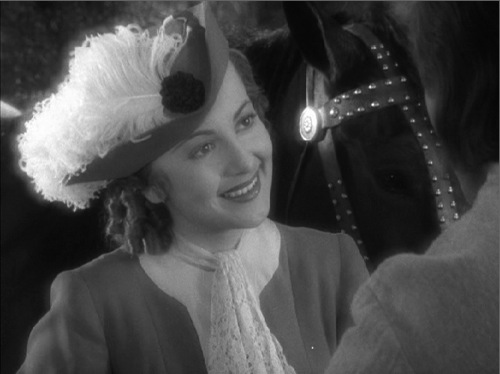
My Great Movies: Captain Blood

About 45 minutes in our valiant hero Doctor Peter Blood, who has been made a slave down Jamaica way, is threatened with a whip by his plantation's owner, villainous Colonel Bishop. "Nothing can save you now!" bellows Bishop as he rears back the whip and at that precise moment, without warning, as if on cue, cannonfire sounds and a lookout shouts "Pirates! Spanish pirates!" And so it is. Nothing could have saved Peter Blood....well, except for pirates. Spanish pirates. And Peter Blood gets a smile and says - actually says out loud - "What a timely interruption this is! And what may come of it the devil himself only knows!" When was the last time you saw a movie where the main character addresses a deus ex machina out loud and without irony? This scene breaks every single rule of screenwriting. Every single one. Yet, I love it. God help me, I do love it so. It summarizes the longtime, unique, momentous relationship I have with this 1935 Michael Curtiz swashbuckler that launched the brief, volatile, celestial career of one Errol Flynn.

Long before the kids of today saw Captain Jack Sparrow and his other Bruckheimery scaliwags loot and pillage their way through Port Royal and eat, drink and be merry in Tortuga, Peter Blood (Flynn) and cohorts were the scourge of these infamous outposts. Well, on second thought, scourge might be too strong a word. Captain Blood and friends were less bloodthirsty buccaneers than benevolent bandits, dignified debaucherers. Once on the run these men form a noble code and stick to it. Rules are rules, not guidelines, not in 1935 on the Warner Brothers backlot, which is to the say the most important code was The Production Code and they stuck to it, come hell or high water.

The background: Peter Blood is an Irish physician in England, content to stay out of the rebellion that seeks to overthrow King James, "a healer, not a slayer." But one dark night a few rebels summon the good Doctor Blood to treat a wounded comrade which he does willingly. "My business was with his wounds, not his politics." But English soldiers storm his practice and arrest him on the charges of aiding and harboring rebels. At his foregone trial he declares his innocence leading to one of the film's many breathless exchanges:

-"Your duty, rogue, is to your King."
-"I thought it was to my fellow man."


Not in the eyes of the court. And so Peter Blood and his fellow convicts are sentenced to be hanged, only in a twist of fate - the movie's first and not its last - they are spared death and instead sold into slavery in the English colony of Port Royal, Jamaica. Once there it seems certain Blood's gentemanly contradictory nature will get him bought and banished to a life of hard labor in the salt mines of a devious dude named Dixon. Enter: Olivia de Havilland as Arabella Bishop, the niece of the colony's governor. Rather than allow this handsome devil to fall victim to a salt mine sentence she swoops in to purchase him. Quite likely this is the only Meet Cute in cinematic history centered around the purcashing of a slave, which might seem in poor taste if not for two inarguable reasons.

This was the first of eight cinematic couplings of Flynn and de Havilland, an ongoing onscreen relationship that was, in the words of John Lichfield, "the most quietly conflagrational in the history of movies." Indeed, the first time de Havilland's Arabella glimpses of Flynn's Blood her eyes sparkle in such a way to suggest it was not necessary for the actress to fake her way through these scenes. No real life memories need be conjured to convey romance. She smiles when she sees him and she smiles when she talks to him and she smiles when she walks with him. No need to tell Arabella to put on a happy face, not even when the situation is dire and frowns abound for never before and never since has a movie character so often smiled when onscreen.


Second, de Havilland proves, as always, she is not some senseless strumpet and out-foxes her own uncle by getting the good doctor Blood off the plantation (uh...never mind the other men) and conscripting him into service of Port Royal's Governor, suffering severely from the gout and fed up with the "ill begotten blunderers" posing as his current physicians.

Ah, but even with his good fortune Peter Blood yearns for freedom and plots escape with his fellow prisoners that at first comes undone but re-awakens via the aforementioned "timely interruption" of Spanish pirates, which allows for Blood and his band of mirthful charletons to hijack a Spanish warship and nobly save the town of Port Royal before turning their attention to a conquest of the high seas which in the outlaw outpost Tortuga leads Blood to make a pact with a fellow buccaneer, the French Captain Levasseur (Basil Rathbone), agreeing to equally divide whatever booty they may take. Of course, 4.7 seconds upon making this pact Captain Blood forlornly says to himself that he regrets making this pact. So....why did he make it?


Duh. Because Captain Levasseur had to intercept the ship sailing from Port Royal to England with (guess who!) Arabella Bishop and her escort Lord Willoughby aboard so that dastardly Captain Levasseur could take her a prisoner and/or prize and upon seeing her at a scenic island rendezvous, Captain Blood, ever clever, tells Captain Levasseur this was not in the spirit of their "sharing" arrangement, convinces him to put Arabella up for auction at which point Captain Blood purchases her. This would be wicked good fun all in the having come full circle to him now having purchased her except, of course, buccaneer squabbles do not end so amicably and, thus, Levasseur draws his rapier, Blood draws his and so commences the first occasion of Errol Flynn getting to stab Basil Rathbone in the heart. (If no one in cinema today can smile as splendidly as Olivia de Havilland, then no one in cinema today can die as dramatically as Basil Rathbone. That's to say, no one. Seriously, man, do Method actors let themselves get stabbed in the heart by a rapier to know what it's like to be stabbed in the heart by a rapier?)

And so Blood points his ship back toward Port Royal which, as it happens, has come under attack by the French, what with Colonel Bishop out and about and on the prowl for Captain Blood himself rather than protecting the colony, and upon learning from Lord Willoughby that King William has deposed tyrant King James upon the throne Captain Blood agrees to once again save Port Royal which he, of course, does by implementing a strategy Russell Crowe's Captain Jack Aubrey would rip off, oh, about 120 years later in "Master and Commander: The Far Side Of The World" which leads to a crazy awesome concluding scene that is as much screwball as swashbuckler in which Captain Blood is named Governor of Port Royal with Arabella at his side....well, actually, literally, on his lap.

A couple years ago there were rumors flying about a possible "Captain Blood" remake, probably in an attempt to cash in on the whole "Pirates of the Caribbean" craze, and it seems these rumors, from what I can tell, burned out and this is good if for no other reason than we have no actors in the here and now comparable to Errol Flynn. I'm not suggesting we don't have actors who are better than Flynn, because we do, but we have no actors who can do the precise things which Flynn did so well. When he and his marauders make off with the Spanish ship, Captain Blood hollers "Up that rigging, you monkeys! There's no chains to hold you now! Break out those sails and watch them fill with the wind that's carrying us all to freedom!" and he as he says it he looks back toward the Port from which they have just escaped, longingly, for Arabella Bishop. It is a moment of absurd melodrama that he convincingly sells with the greatest of ease. It would crumble in the hands of any present day actor. Thank God Flynn worked in a cinematic era that knew not of irony.


Oh, I can't say as an avid film lover that I despise any and all irony. I mean, I lived in the 90's, man. Irony was all the rage and it screwed up a lot people, like the people who watch, hmmmmmm, let's say "Captain Blood" and think the damn thing's so ludicrous for being so (egads!) earnest. There are a few movies you watch very early in your life and, whether you know it or not, these experiences will shape your cinematic beliefs for all time. An earnest romantic, that's me, which is to say I am eternally grateful I saw "Captain Blood" when I did. I often feel that if I were Captain of this celluloid ship I would maroon Irony and give it a pistol with one shot.

Tuesday, December 07, 2010

My Great Movies: From Here To Eternity

The 1953 Oscar Winner for Best Picture, based on the award-winning novel by James Jones, set in and around Schofield Barracks on the Hawaiian island of Oahu, contains a third act featuring the attack on Pearl Harbor way back on that infamous date of December 7, 1941. There are, of course, numerous aspects to that terrible event and this review is not in any way meant to be some sort of historical discourse but there have long been questions as to how America was supposedly caught so off guard. Who knew what, how much did they know, when did they know it, on and on it goes. I do not mean to suggest that significant higher-ups in the U.S. Government knew precisely what was coming but it seems rather certain there was information suggesting an imminent attack. Perhaps it was misunderstood, perhaps it was ignored, or perhaps, in accordance with the theory of the harbor's "inherent invulnerability", people with the power were merely taking part in our nation's grandest pasttime. No, no, no, no, not baseball - Lying To Ourselves.


Robert E. Lee Prewitt (Montgomery Clift), a private in Company G, suggests to his kinda, sorta girlfriend, Alma (my Iowa homegirl Donna Reed), a (cough, cough) "dance hall hostess", who had been claiming her name was the more lyrical Lorene, that they could get married. Lorene....er, I mean Alma....says she doesn't want to be a soldier's wife. Then she steps forward and delivers a blistering, unforgettable monologue: "Nobody's going to stop me from my plan. Nobody, nothing, because I want to be proper. In another year, I'll have enough money saved. I'll go back to my hometown in Oregon. I'll build a house for my mother and myself. Join the country club and take up golf. I'll meet the proper man with the proper position. I'll make a proper wife who can run a proper home. Raise proper children. I'll be happy because when you're proper, you're safe."

The way she says it, the way she looks while she's saying it, however, suggests Lorene....er, I mean Alma....might also be indulging in our nation's grandest pasttime.


As for Prewitt? Man, Prew's got problems of his own. He's just gone AWOL for avenging the murder of a friend. But when Pearl Harbor is attacked he knows he has to return to his unit. After all, he loves the army, loves it more than any soldier his First Sgt. has ever met. Strangely, this is the same army that screws him outta First Bugler's Chair because of a commanding officer's friend at which point he gets a transfer to a unit that wants him solely as a boxer even though he doesn't box anymore and therefore proceeds to give him the "treatment", which consists of lovely activities such as scrubbing god-knows-what and mopping up please-don't-ask and hiking, with a full field pack, up to Kole Kole Pass and back, again and again. Upon hearing of this most unharmonious behavior toward a fellow man in uniform, Lorene....er, I mean Alma....observes, "You must really hate the army." But he says he doesn't. He says he loves it. He says: "You love a thing, you gotta be grateful." Grateful? Really? Is he grateful? Or is he possibly partaking in our nation's grandest pasttime?

That First Sgt.? That's Milton Warden (Burt Lancaster) who essentially runs Company G for his commanding officer, promotion-obsessed Captain Dana Holmes (Philip Ober), who seems to have done nothing to warrant his nickname of "Dynamite" (probably invented it himself and then told some fancy-pants lie to back it up), declaring, "He'd strangle in his own spit if I wasn't here to swab his throat out." Guy seems like he'd make a great officer so why's he choose to be a stooge for Holmes? Well, when he's accused of being just that he replies, "You won't see it much longer. I'm getting sick and tired of it myself. I'm through. Any day now. I mean it." This? This isn't even a tiny bit convincing. You just roll your eyes and shake your head and think, Milton, buddy, you're just wallowing in our nation's grandest pasttime.

And what about Angelo Maggio (Frank Sinatra)? Goodness gracious sakes alive, he's the hard-drinking, fast-living Private who talks tough and threatens to pound on ol' Fatso Judson (Earnest Borgnine), head of the stockade, because, uh, why again? Because he doesn't like how Fatso plays the piano? I suppose that's a reason but has Angelo really seen Fatso? This dude didn't make up his nickname, not like "Dynamite" Holmes back at the ranch. Angelo wouldn't have a chance in a ruckus and when he and Fatso threaten to go at it in this barroom it's Warden who stops it and dismisses the both of 'em: "Killers, huh? I'd trade the pair of you for a good campfire girl." Yup. That's about the size of it. Maybe Maggio isn't quite the bad boy he believes himself to be. Maybe he's not quite as tough as he acts. Maybe, just maybe, he's joining in on our nation's grandest pasttime?


This, of course, brings us to iniquitous Karen Holmes, Captain Holmes' wife, the reputation on base of being promiscuous hovering over her like the Hualālai volcano hovers over Kailua Kona. Her affair with the usually straight-laced Warden, though, which takes shape after this riveting sequence in her kitchen with the rain pouring outside symbolizing that the two of 'em are....woah, let's not go any further. Like I was saying, this affair seems like something different. Seems, I said. She pushes Warden to apply to for an officer's position because if he can become an officer then Karen can divorce her husband and marry Warden, but heck, man, why can't Karen divorce her husband, anyway, if that's how she feels about the whole thing? Why's she gotta have someone else all lined up and ready to go? And why when Warden admits he never put in his commission to be an officer and that their little foolproof plan fell by the wayside does she say she's staying with her husband because "there's nothing else for me to do." Nothing else for her to do?! There's plenty else for her to do! But, you know, that's what happens when you fall under the spell of our nation's grandest pasttime.


Matter of fact, the concerns over casting Jones' novel were legendary and seem to suggest that perhaps those behind the scenes might have drank just a little too laboriously from the canteen of our nation's grandest pasttime. Most everyone knows the whole Sinatra deal where Ol' Blue Eyes was considered washed up and he fought and screen tested and slashed his salary and found himself with the role after Eli Wallach dropped out and good thing, too, because, sure, Frank's range may not have been like the Himalayas but, come on, the guy knew how to play brash boozehound and then there was Joan Crawford initially being cast in the role that went to Kerr which apparently indicates the producers wanted the film to be even more of a melodrama than it already was but the real folly was how producer Harry Cohn wanted Aldo Ray (who?) for Prewitt, not Clift, and how he denounced Clift but director Fred Zinnemann fought like Sinatra for Clift and won. And thank God, too, because Clift's ornery nature made him perfect for the part. "Maybe in the days of the pioneers a man could go own his own way," says Warden to Prewitt, "but today you gotta play ball." Do you? Prewitt is, in a sense, defined as much by what doesn't do as what he does do and so, too, was Clift, famous for turning down roles in "Sunset Boulevard" and "East of Eden" and "Mrs. Miniver", the latter because he refused to sign a long term contract with MGM.

And that brings us to Donna Reed as the (cough, cough) "dance hall hostess", who Cohn wanted and Zinnemann did not. To this day you will often hear the sentiment that Reed was miscast, that perhaps she was too virginal, too bounteous. But was she a (cough, cough) "dance hall hostess" or was she a (gasp!) "turner of the tricks"? The movie is vague on that count....eh, kind of. There is one shot of Ms. Reed in the (cough, cough) "dance hall", reposed on a couch, cigarette in hand, and, of course, we all know what a smoldering cigarette in repose in the 50's cinema meant and, after all, as Lorene....er, I mean Alma....says, "Mrs. Kipfer pays us to be nice to all the boys." (Yeah, I'll bet she does.) So okay. So let's say she's a "turner of the tricks"? Is she really as virginal and bounteous as the naysayers would have you believe? Isn't she sort of a manipulator and/or user and abuser? Consider that first meeting with poor Prew when she spins the yarn of the fiancé back home who left her ("They could write a story about it." - "They did. Thousands of 'em.") which prompted her to light out for the islands and then contrast it against the yarn she spins in the film's final astonishing sequence aboard the boat to, yes, Karen Holmes as they both leave Oahu behind. It's the curtain being pulled back, the lady getting sawed in half, it reveals Lorene....er, I mean Alma....for who she is and you realize she was merely acting virginal and bounteous all the while and now is set to use the memory of Robert E. Lee Prewitt for personal gain. It smashes my soul to smithereens.


But why? Why, Lorene....er, I mean Alma? Why must you resort to such acrimonious depths? "We do not always like the world we live in, our place in the world, the world's demands. We substitute a preferred version," writes Sallie Tisdale. "With the lie, we can temporarily create a new world."

There is but a single instance in the two hours "From Here To Eternity" runs in which honesty prevails. It's right after Lorene....er, I mean Alma....has delivered that blistering, unforgettable monologue regarding a "proper" life. She tells Prewitt, "I do mean it when I say I need you. Because I'm lonely." She smiles, wistfully, and finishes, "You think I'm lying, don't you?" And then he replies with that line, that line in a movie filled up and overflowing with exquisite lines that trumps 'em all, that line that's like a wicked shot to the solar plexus, that line that cuts like a Mariano Rivera pitch, that line that leaves all of us gasping like those mountaineers who scale Everest sans oxygen, that line we all feel deep down in those places we don't talk about at parties: "Nobody ever lies about being lonely."

No. They sure don't. And that, of course, is exactly why Lying To Ourselves so very, very long ago became our nation's grandest pasttime.

Monday, November 29, 2010

My Great Movies: Serendipity

"If you don't believe in destiny then take what you're given." - Jenny Lewis, "My Pet Snakes"

Don't sigh. Don't roll your eyes. You! All the way in back! Don't try and sneak out! I want to set the record straight. I want to conclusively clarify the reasons for my All Time #1 Guilty Pleasure Movie. I want to put to rest once and for all why I cherish "Serendipity" so and why I so adamantly believe it is a romantic comedy so classic it lays waste to that humorless flimflam "The Lady Eve" with Henry Fonda and Barbara Stanwyck (film historians now have permission to shoot me).

Of course, to present my case it really does no good to discuss the plot. It does no good to tell you that one fairytale December evening in New York City Jonathan (John Cusack) and Sara (Kate Beckinsale) Meet Cute via the whimsy of Christmas shopping which, through a most serendipitous occurrence at a cafe called Serendipity, will prompt the duo to experience snowfall-infused romance beneath the brightly lit skyscrapers of Manhattan which leads to Sara writing down her phone number on a scrap of paper only to watch that scrap of paper blow away in the cold wind an instant before Jonathan was about to take it which leads to Sara claiming "the universe is telling us to back off" which leads to her leading him on a karmatic obstacle course through the lobby of the Waldorf which leads to Sara deciding they are not meant to be together which leads to several years in the future where both Jonathan and Sara are facing impending marriages and only now begin to realize that perhaps they really were meant to be together which leads to a calamitous chase through the Big Apple with Jonathan's wedding hovering right there on the horizon. So if it wouldn't do any good for me to tell you all that what do I tell you to convince you of my requited amore with "Serendipity"?

How about if I explain why I finally went against my principles and joined Facebook? Because I had spent 48 hours in the company of friends insisting I join Facebook and then the very next day learned that the actual, real life Tift Merritt had sent a comment to me via Facebook - I say again, SHE sent a comment to ME - even though it was really only to someone she thought was me (long story) regarding the blog post I had made about her Lincoln Hall show and, thus, I took this as an obvious sign from the universe and immediately signed up for Facebook.

How about if I explain that my formative years in the 90's in the visual arts realm were shaped primarily by the movie "Last of the Mohicans", the TV show "Seinfeld" and Uma Thurman as Mia Wallace in "Pulp Fiction" and then explain how Daniel Day Lewis (star of "Last of the Mohicans") and Jerry Seinfeld and Uma Thurman all share the same birthday - April 29.

How about if I explain my first trip to New York City? How my friend and fellow Springsteen disciple Rory tried to convince me one summer evening to attend the final show of Bruce & The E Street Band's Reunion Tour on July 1, 2000 at Madison Square Garden and how I was reluctant because I'd already seen him three times on that tour and I'd have to drop a ton of money to do it but the next day in my car heard the Sarah McLachlan song "I Will Remember You" (a song I don't even like) and how the line "Don't let your life pass you by" was obviously a sign telling me I had to go to New York City to see Bruce and so I told Rory that, yes, I'd go and how a month or so later when I was driving to his house from where his aunt would ferry us to the airport for the plane ride to NYC "I Will Remember You" came on the radio (I swear to God) which all by itself would have been a sign of serious serendipaciousness except the song that immediately followed "I Will Remember You" (honestly - I'm not making this up) was "Born In The U.S.A."

There are people who would see all these things as mere coincidences and these are people whose brainwaves I do not and will not ever understand and, well, that's why I love "Serendipity"!

"Destiny, I'm hip to your persuasion, your solid reputation." - Kylie Minogue, Rippin' Up The Disco


I love it so much. I love it so much in spite of all the flaws everyone feels the need to point out all the time. I love "Serendipity" even though....

I have no idea where Jonathan gets the marker from in the middle of Central Park at night when he draws the "constellation" on Sara's arm.

I have no idea how at the end Sara has apparently managed to toss a Bloomingdales glove from, what, 30 feet away into the wind and snow and somehow have it flutter down like a heavenly butterfly directly above where Jonathan is laying.

I hate, hate, HATE the moment when Sara's fiancé Lars (John Corbett) says "How does Bora Bora sound?" for their honeymoon and she says "Very sexy sexy." How did Kate Beckinsale say that line? Was she drunk?

I hate, hate, HATE the lesbian couple jokes at the end between Beckinsale and her best friend Eve (Molly Shannon). Complete, utter, awful crap. Cringe every time I see it.

I can't stand Molly Shannon. In general. I don't think she's funny, I don't think she can pull off dramatic roles, she just doesn't work for me. Not in anything. I'm sure she's a very nice person in real life but onscreen it's always a no go.

I hate, hate, HATE that when you see the golf driving range in the middle of Manhattan for the first time you think to yourself "Well, someone's getting hit with a golf ball - probably Molly Shannon" and then a little while later Molly Shannon gets hit with a golf ball.

I refuse to believe the character of Sara would ever end up with someone like Lars. He's a self-involved douche who doubles as a New Age flutist. New Age! Sara would never ever groove to New Age. Are you kidding me?! (Sara Thomas's Favorite Album Of All Time: "All Over The Place", The Bangles. And, by the way, don't debate this. No one is more qualified to know this than me.)

I hate, hate, HATE how they use the "misunderstanding" device with Sara's sister after Jonathan has flown cross country to find her.

I hate, hate, HATE how the kid on the elevator that pushes all the buttons that screws up the timing for poor Jonathan is dressed in a....wait for it....devil costume. A DEVIL COSTUME??? It's Christmas, not Halloween! I mean, I'm all for crappy symbolism....wait. No. I'm not.

I don't actually think the Meet Cute is all that great.

I am the only person on the entire planet who when watching "The Wire" at the first sight of Bubbles' druggie pal Johnny (Leo Fitzpatrick) shouted: "Hey! That's the temp from 'Serendipity!'"

The only decent review it received was from (gulp) Gene Shalit. "I’ve been reviewing movies for 35 years and Serendipity joins my personal list of matchless romantic comedies. Thrilling, most wonderful and beyond compare!"

Yet, my love, in sickness and in health, in good times and in bad, persists. The heart knows what it wants and my heart is attached to Marc Klein's wobbly script and Peter Chelsom's basic direction. Every single time John comes back up those steps at the cafe to retrieve his scarf to see Kate already there retrieving the Bloomingdale's bag and then the scene shifts to the snow at Wollman Rink with that Bap Kennedy song goin' I feel my heart flutter and, yes, I know it's syrupy or hokey or whatever else you pragmatists want to call it and I don't care - I don't care - because, well, love is blind and lovers cannot see.


"When I was a child I figured out that I was 1 person, the son of 2 parents and was the 3rd child, born 4 years after my sister and 5 years after my brother, in 1942 (four and two are 6), on the 7th day of the 8th month, and the year before had been 9 years old and was now 10. To me, it spelled Destiny." - Garrison Keillor, "Lake Wobegon Days"

If you know me and can't see me and my best friend on the night before my wedding finding ourselves in a ludicrous "Agatha Christie-like pursuit for (my) long-reputed soulmate" then you don't really know me at all. And if you know me and don't believe that I believe "that if we are to live life in harmony with the universe we must all possess a powerful faith in what the ancients used to call 'fatum'" then you don't really know me at all. And if you know me and don't believe that when my time on this earth is up that my obituary will be far less important than the answer to the simple question "Did he have passion?" being a resounding yes than you don't really know me at all.

As a film "Serendipity" is rather suspect, sure, but then to me "Serendipity" isn't so much a film as an ideology.

Wednesday, October 27, 2010

My Great Movies: Fever Pitch

All seems lost. Ben and Lindsey have broken up because in a horrific moment of extreme selfishness Ben has essentially admitted that missing an unbelievable Boston Red Sox victory over the evil New York Yankees for a beautiful romantic evening with her was not worth it. Depressed, nearly catatonic, Ben has holed up in his Red Sox shrine of an apartment and covered the windows with tin foil where he sits, strewn with hot wing sauce, watching the end to the most devastating Red Sox defeat in history over and over. His friends burst in. "The Buckner Game?!" shouts one. "I thought you took that tape away from him?!" hollers another. Yet, oddly, in this lowest moment of the low, Ben has reached a certain form of enlightenment. "It wasn't just Buckner," he remarks, referring to the infamous moment in the 1986 World Series when Boston first baseman Bill Buckner allowed a slow rolling ball to trickle between his legs, sealing his team's defeat. "Stanley screwed him-" Stanley being the Boston pitcher "-he didn't cover first." It's a team game, as we all know, and no one man can do it alone.


Flash back to earlier in the film when Lindsey has learned her kind-hearted father has dyed his gray hair black in frightened response to turning 60. He is so unrecognizable the family dog barks at him, wanting to know just who the heck this stranger in his house is. "How can you stand it?" Lindsey asks her mother. "He fanned me with a magazine for four years when I was going through menopause," she explains. "I can put up with this."

"Fever Pitch", directed by The Brothers Farrelly, is a baseball movie, sure, but in the face of so many recent romantic comedies ("Leap Year", "The Proposal", "The Bounty Hunter", "When In Rome", etc.) that have left movie fans wondering how the genre has gone so wrong, it is important to remember that well made rom coms are not restricted just to cinema's Golden Age but were glimpsed as recently as 2005 in the form of this very film.

Jimmy Fallon, squarely in the only wheelhouse he has, is Ben Wrightman (could have done without the last-name symbolism, thank you), a math teacher but that is simply what he does and not who he is because who he is happens to be "one of God's most pathetic creatures - a Red Sox fan." Ever since he was moved to Boston by his mother when he was just a little kid, Ben has followed the Red Sox with a passion that straddles the border of psychotic. His home is "like a gift shop", from the Red Sox bed sheets to the Red Sox shower curtains.

Drew Barrymore is Lindsey Meeks, an "ultra-comptetive" executive of some kind in some sort of high-end company, the basics of which don't matter as much as the fact she is a workaholic who daydreams about a different life - well, until the mere mention of a promotion, that is.

The point here is that from the earliest moments this relationship does not feel force-fed; both of these people are intensely focused and capable of stunningly single-minded investments. This is not a politican and a curiously glamorous hotel maid nor an uber-organized, no-nonsense American taking a road trip with a scruffy bartending/cab-driving/hotel-owning Irishman. These are two people cut of the same cloth in a believable situation generating certifiable chemistry. Oh, screenwriting professors will harangue that conflict drives all scripts, and this is true, but too many apple-faced scribes seem to interpret that all conflict in romantic comedies stems from the ancient standby opposites attract when the inherently obvious fact that men and women all on their own are opposites goes unnoticed. "It is a movie," the esteemed Roger Ebert writes, "about how men and women, filled with love and motivated by the best will in the world, simply do not speak the same emotional language."

"Fever Pitch" is based on Nick Hornby's memoir, though based is not really the right word. How about Took Its Title From instead? Hornby's book is fantastic, to be sure, and proudly resides on my book shelf, but this adaptation by Lowell Ganz and Babaloo Mandel goes it alone, much like Fallon's Ben, 30 years of age, sans cellphone and blackberry, is when he chaperones a few promising math students to Lindsey's office where she shows them around while catching Ben's eye in the process. Now hold it just a second. Technically, I suppose, this is the Meet Cute, but it all seems very plausible, very grounded, doesn't it? Especially when she shoots him down. After all, why's he still single at 30?

-"Maybe he hasn't met the right person."
-"Well, by now he should be with the wrong person."


Lindsey relents and their First Date essentially functions as the Meet Cute wherein she has become violently ill and Ben wins her affection by staying and tending it to her and this will lead to another date and so on. But hovering over these early days of courtship is the brutal confession Ben must eventually make. "I am a Red Sox fan." Little does she know.


As baseball season opens and Lindsey begins attending games with Ben in his prime seats inherited from an uncle she is introduced to his "summer family" (including divorcees who still share their tickets), gobbles up every book on the team she can find and shows a genuine intrigue in attempting to decipher this obsession of her boyfriend's. But Ben's mania is so severe he fails to recognize that his efforts to absorb Lindsey into his passion cause her problems at work and one of her friends explains: "You're being colonized." Indeed, Lindsey seems to be making concessions while Ben stays the course.

At one point Lindsey extends Ben an invitation to take a spur of the moment transatlantic trip to Paris to which Ben frowns and stammers: "This isn't the best weekend for me. We're two games out of first with three weeks left. This is when they need me." Lindsey replies: "They need you?" She goes on to explain: "You don't see us tangled up in the sheets with the Eiffel Tower in the window, you see the Mariners are coming and Pedro's pitching Friday night." Well, yeah. It's how a man's mind works.

What "Fever Pitch" knows above all else is that men and women mature and develop at much different rates. This dates back to Annie Hall progressing while Alvy Singer remained stagnant. Lindsey progresses, Ben stagnates, and it takes him longer than it should to realize it, much like it takes every male in the modern world longer than it should to realize the same thing even as we yearn to deny it. Bill Simmons, an immensely popular sportswriter for ESPN and even more immense Red Sox fan, made no secret of the fact he despised "Fever Pitch" but what is so interesting about his immense dislike of it is how his wife and stepmom both agreed that the Fallon character reminded them of him.

No self-respecting male wants to admit that if they shared the most "incredible night of my life" with their significant other only to discover they had missed the most incredible comeback in the history of their beloved team's franchise that they would not flip out and blame their significant other. But.... Years ago my beloved Nebraska Cornhuskers needed LSU to upset Tennessee to potentially have a shot to play for the National Championship and at one point my then-girlfriend stared me down and said - ordered, really - "If LSU loses you do not get to be pissy the rest of the night." I agreed, of course, but LSU did wind up winning and I often wonder if that agreement would have held up had they not. (Answer: No chance in hell.)

The film concludes with an update on the traditional Running-To-The-Airport Sequence with Lindsey instead Running-To-America's-Most-Beloved-Ballpark. Writing for the New Yorker, David Denby, who hardly ever meets a movie he even kinda likes, declared this scene as "idiotic". Yet in a lengthy piece a couple years later, written in the wake of "Knocked Up", functioning as a rememberance of the entire rom com genre and a partial takedown of its new breed, he writes: "There’s nothing in it that is comparable to the style of the classics — no magic in its settings, no reverberant sense of place, no shared or competitive work for the couple to do." Of course, this line describes the "idiotic" closing scene in "Fever Pitch" to a tee. The magic of Fenway Park in those moments right before the comeback to end any and all comebacks, reverberating a sense of place like no other, this place where Ben first fell in love with the Red Sox and fell just as hard for Lindsey and felt that love for her crumble as he attempted to determine what was and wasn't important in life, and, of course, most crucically, the competitive work - Ben showing that he's her kinda guy because he'll give up the Sox and Lindsey showing that she's his kinda gal because she'll dash across the field at Fenway - "Is it spongy?" - because she won't let him give up the Sox. This is one couple that is gonna "try to do all of it." Idealism? F---, yeah. Anyone who hates idealism never had any ideals to begin with, if you ask me.

And if Rose DeWitt Bukater's greatest moment of free will may well have caused the lookouts on the Titanic (which sank the same week Fenway Park opened as "Fever Pitch" tells us) to not spot the iceberg in time and seal the ship's fate then perhaps it stands to reason that Ben and Lindsey's reaching for the stars got Roberts to steal second and propel the long-suffering Red Sox to immortality. Who's to say? Only two times since the advent of the 7 game professional playoff sports series in 1905 had a team lost its first three games and then won the next four in a row - .095% percent of the time. Those were some seriously steep odds.

Hmmmmm....didn't someone once write love can overcome all odds?

(Postscript: Do you think the real-life Jimmy Fallon honestly thought he would live to see his team win a World Series and, better yet, do you think he ever thought that if he did live to see it he would also get to make out with the girl from "E.T." twenty seconds after it happened?)

Friday, September 10, 2010

My Great Movies: (The First Hour And Forty-Five Minutes Of) Australia

If a movie is fabulous for an hour and forty five minutes before suffering a precipitous drop for the remainder of its almost three hour running time can it still be considered great? I don't see why not. It has a beginning and it has a middle and....well, okay. It doesn't have an end. So what? Not everything needs a great finish. Mozart didn't finish the Requiem. Gaudi didn't finish the Sagrada Familia. But what they did finish was spectacular enough all on its own to be considered great, right?

And the first hour and forty five minutes of "Australia" is great, and it's great in the way that only a movie named for a country wrapped up in an island wrapped up in a continent could ever be. It's grand, so grand it threatens to overwhelm you with grandeur, bash you in the face with bombast, whisk you away with its sweep. Most scenes should be prefaced with the words "As If On Cue...." Cynics need not apply. Dreamers and romantics, come on down, this one's for you. When did "who talks like that in real life?" and "that would never happen in the real world" become valid film criticisms? When was pomp given the evil eye and circumstance kicked to the curb? When did movies lose their......movieness?

There are rumors that Russell Crowe did not get the lead role not because of scheduling conflicts or salary demands but because in rehearsal he kept trying to pull up some repressed memory to generate emotion at which point director Baz Luhrmann yelled, "By God, there will be no Method in this movie!" Nuh uh, no sir, not a chance. "Australia" revs up the time machine and returns to the Golden Age, when operas weren't just in opera houses but on movie screens and emotions came at you like tidal waves and the distinctions of good and evil were handed out like ginormous slices of apple pie topped with rich whipped cream.


"Australia" does not raise its curtain with "Once Upon A Time", though it comes awfully close, settling instead on "The Territory was a land of crocodiles, cattle barons and warrior chiefs where adventure and romance was a way of life." Hell to the yeah. The rest of the elaborate stage is then set in a voiceover from Nullah, a mixed blood Aboriginal 12 year old, played with bottomless charisma by Brandon Walters, who advises: "Grandfather teach me most important lesson of all. Tell 'em story." And tell us a story he does, story being the critical word here since that's what it is - a story, a fable, a fairytale, a ripping yarn. A veritable truth it is not. I direct you here if that is what you so desire.

Are the veritable truth people gone? Superb. Good riddance. Now on with our story! It opens in England where pampered Lady Sarah Ashley (Nicole Kidman), her hair tucked away tightly beneath a riding hat, is advised her philandering husband has driven his once prosperous cattle ranch in the Northern Territory with the extravagant moniker Faraway Downs into the ground. Thus, Lady Ashley will light out for down under to tell the cheeky bugger where he can stick it. She is met by an Australian cattle drover (Hugh Jackman) with the gloriously expository name of Drover - "Everything I own I can fit in my saddlebag" - whose duty it will be to escort her from the civilization of Darwin to the wilds of the outback as we quickly infer Lady Ashley is no mere Fish Out Of Water. It's worse. She's a Woody Allen Character Out Of Manhattan And Placed In California Circa 1849.


Once reaching Faraway Downs, however, in the requisite plot development, we learn her husband has been murdered. The finger is pointed at Nullah's grandfather, King George, ah, but in reality, it is the handiwork of Neil Fletcher (David Wenham), resembling a sinister sewer rat, who had pawned himself off as an employee of Ashley's but, in reality, works as the right hand man of the mandatory villain, the magnificently named King Carney (Bryan Brown), the most cantankerous cattle baron in the southern hemisphere who longs for a monolopy and Faraway Downs, as it must, is all that stands in his way. Initially it seems Lady Ashley is content to play right into Carney's hands and sell the property but a nighttime encounter with Nullah, who explains all, changes her mind and becomes determined to drive Faraway Downs' 1500 head of cattle across the dusty, deserted plains to Darwin while Carney, the writer, the art director, and visual effects coordinator will throw every possible obstacle in her path. The crew she assembles for the drove is so motley and ragtag it could only be led by the Drover himself and thankfully, heroically, he turns up to do just that!

It is virtually impossible to imagine Russell Crowe - who really was Luhrmann's initial idea - in the role of the Drover. He would have spent the entire time glowering and trying to turn line readings of "Krikey" into statetments on all of mankind's plight and generally treating the whole thing like a textbook that leaves every child in class snoring. Jackman's theatrical background, on the other hand, made him the perfect choice because he can play it any way you want, whether he's doing the fox trot, barking orders from the back of a horse, or brawling in a saloon and, crucially, he only takes the most serious parts seriously. It is a finely tuned performance, even if the tune is typically that of an overwrought Brahms Symphony. Kidman, meanwhile, is so often dismissed by the hoity toitys as an Ice Queen and if this is true, well, then she's a Dreamsicle Ice Queen. She convincingly transitions from a prim gentlelady - "Oh, Ranston, drink your tea" - to an English rose whithering in the Outback to an enlightened, involved eucalyptus whose attitudes and abilities undergo change while the core of the character remains the same. It's a mean feat and whether she's had a little botox or smorgasboards of botox, I don't care, so long as she can act. Newsflash: she can.

Over the course of their cattle venture secrets will be revealed, Faraway Downs' alcholic accountant will, as he must, find redemption and Lady Ashley will let her hair down literally and figuratively as a glimmer of romance appears between she and the Drover. Will they survive? Will they reach Darwin to load their cattle ahead of King Carney's cattle load? Will Lady Ashley be chosen as patroness of the Darwin Ball? Will The Wet arrive just in time for Lady Ashley and the Drover to share their first kiss?


To accuse the first hour and forty-five minutes of "Australia" of being predictable is, well, predictable because even though it's predictable it is all so unabashedly done without irony that it is, in fact, extremely rare. You must give yourself over to it. Toss your doubt over the nearest cliff, check your sarcasm at the door, remind yourself that as you set foot inside the cinema you are entering a place where reality no longer beckons. "('Australia') is a testament to movie love at its most devout, cinematic spectacle at its most extreme, and kitsch as an act of aesthetic communion," wrote Manohla Dargis in The New York Times. Indeed, the first shot quotes "Gone With The Wind," "The Wizard Of Oz" is referenced numerous times, and many moments suggest a more sunburnt "Red River." All of which seems to be Luhrmann's openhearted way of grabbing hold of each and every viewer and shaking him or her and screaming, "Why don't they make 'em like this anymore?! Why?!" It's a necessary question that Luhrmann addresses with beauty and scope and compositions worthy of Technicolor and 70 mm film.

And as I re-watched the first half of "Australia" in preparation for this post, as The Wet arrives in a sequence that is, to enlist Roff Smith's words in National Geographic for the actual event itself, "an explosive Wagnerian crescendo," I realized with a vengeance to rival the powerhouse rains themselves that I had it all wrong. The first hour and forty-five minutes is far from unfinished. It's there, all there, a resolution that would have resulted in perfection, crying out for the movie to conclude, just conclude, right here, right now, fade to black and roll credits, please! No mother forgets her child, our skin is merely a color, nothing more, magic exists, love, as we all know, overcomes all odds, and movies such as this can take stories, fables, fairytales, ripping yarns of preposterous height and render them entirely authentic. And as the most concise of montages plays out, fitting everyone with a happy ending that deserves it, and we see The Wet come and we see The Wet go and we the Drover go off to drove and we hear Nullah return to voiceover and advise us Lady Ashley "always misses Drover, but I know he's gonna come back," followed by a shot of our leads leaping into an embrace, I understood without even having to think about it that this was the proper ending, the rest mattered not at all, and so I hit stop on the DVD player and shut off the TV. And no doubt the cynics and the proprietors of that gloom and doom Real World Motel down the street will hem and haw about how there is more, a whole hour more, how the facts of WWII enter the picture, and how this changes everything, the story, the fates of the characters, the meaning, on and on, and because it's there, because it exists, it is our duty as film critics to watch it, all of which I bite my thumb at while turning to the words of Lady Sarah Ashley herself.

Just because it is doesn't mean it should be.

Wednesday, August 18, 2010

My Great Movies: Sunshine State

John Sayles, often referred to as the Godfather of American Independent Cinema, a man who did not graduate from film school, writes, directs and edits his own films while earning the financing for them by working as a hired hand on mainstream motion pictures (he did a complete uncredited rewrite on the Oscar nominated script for "Apollo 13"), is among the most politically and civically minded filmmakers working in our country today. His films are often intricately woven tapestries of very specific communities contained within - or around - our borders with significant casts that conjure up distinct sensations of place and time. I believe 2002's "Sunshine State", set on fictional Plantation Island, divided between the mostly white town of Delrona Beach and the mostly black town of Lincoln Beach, detailing property developers attempts to snag up these areas for commercial purposes, that is the resolute highlight of his canon.

"Sunshine State", most refreshingly, does not present us with an idealized view of the state of its title. "There were palm trees in the postcards," says one character. But not in the movie. The Florida of the film has windswept beaches sans sunbathers, rundown establishments called the Sea-Vue Motel with outdated nautical-themed decor and it all coincides with a local pageant called Buccaneer Days, the staple of which - a wooden pirate - has been set afire by a wayward 13 year old named Terrell (Alexander Lewis) in the movie's opening scene. Later, at his hearing, Terrell's court appointed defender sighs "It's a wooden pirate, your honor" to which the Judge harshly, and comedically, replies "An icon in this community, nontheless." It shows both a casual disregard for the community's history and, yet, how the community desperately clings to that same history.

There is that ancient quote about how if we don't consider the past we are condemned to relive it. Well, what if you have no choice but to relive it? What if you're, say, Marly Temple (Edie Falco), a sixth generation Floridian tasked with running the Sea-Vue Motel and it's accompanying restaurant because it's what her father did, her father who may be legally blind but is not about to cave in to these greedy developers running amock who want to make a "full frontal assualt" and establish the Sea-Vue location as their "beachhead"?

It seems pretty obvious this isn't the life Marly wants. Her mother (Jane Alexander) didn't want it, and didn't want it so bad she will drive six blocks out of her way not to see the motel. But there Marly is anyway. "I used to hate working there when I was a kid and now I got three girls who hate working there as much as I do." Thus, another character wonders why she keeps doing it. Her reply: "Poetic justice."

The counterpoint to Marly is Desiree Stokes (Angela Bassett) who has just returned to Lincoln Beach for the first time in ages with her husband (James McDaniel). Desiree had longed to be an actress and now - resignation coating her voice - explains she does infomercials. (One character describes this as "A temporary engagement in the world of commerce," which is just classic Sayles.) Slowly, wonderfully, piece by piece, Sayles unravels Desiree's story. At the age of 15 she became pregnant with the local football hero, Flash Phillips (Tom Wright), and left town. But did she really leave town of her own accord or was it at the insistence of her mother Eunice (Mary Alice) who feared the scandal and backlash? Each scene with Desiree dredges up something else and deepens her plight in this place she does not particularly want to be.

Francine (Mary Steenburgen), meanwhile, of the chamber of commerce, is trying desperately to "Disney-fy" and drum up interest in Buccaneer Days. She is so obsessed with this mission, in fact, that she remains completely oblivious to her husband's (Gordon Clapp) grab-bag of issues as he unsuccessfully, and rather pathetically, tries to off himself a couple times. When she sincerely calls him her "rock" it is downright laughable.

There were obvious possibilities for this story. Two communities - one white, one black, and you can see where this might be headed, but Sayles avoids that trap. So too could it easily have slipped into a Capra-esque tale of heroic small business owners valiantly battling back against the bourgeois businessmen, closing shots of Marly and her family standing defiantly before approaching bulldozers. But as the esteemed Roger Ebert noted, the film is not the "progressive line about the little guy against big capital" but an "observant, elegiac, sad movie, about how the dreams of the parents are not the dreams of the children."

I am not the most politicized person and I have no interest in films that contain message-deliverers masquerading as people. No question Sayles has something to say and deploys people and dialogue for his means at times but what sets it apart - what sets most of Sayles' work apart - is his extrordinary ability to dramatize whatever message may be lurking. His scenes in "Sunshine State" are all interesting on their own terms and focus primarily on the wide range of characters for who they are and what they want.

Consider the sequence introducing us to Marly's father (Ralph Waite). It begins in extreme close-up as he rants about how man has lost his way - "They've got us so zoned and regulated and politically corrected" - and slowly pulls back to a wide shot as eventually we realize he is waiting for his insulin shot, the nurse set to deliver it not even paying attention, the ravings of an old man. (This will be underscored later when he rants and raves about how football was better in the old days.)

Or consider Jack Meadows (Timothy Hutton), the landscape architect hired by the real estate mavens to perform a feasibility study. He could have easily been representative of evil intentions, seducing Marly - mention is made of someone for the developers to be on the "inside" - when they begin a casual relationship. Or he could just as easily have met Marly, become enamored with her plight and chosen to fought back, heroically, against his employers. Instead he is presented, simply, as a person with a job to do. He is divorced, with kids, and now goes across the country to wherever the work takes him. That's it. No ulterior motives.

He is one of many rich characters in Sayles' extensive gallery which makes Falco's turn that much more impressive. Her work here rates as one of the most underseen, undervalued performances of the 00's. Stephanie Zacharek of Salon bemoaned the fact Falco "is saddled with a bad bleach job and perennially faded summer tops", a criticism containing so little sense it baffles. What, should she have a personal stylist and designer clothes? Uh....that's not who she is. A bad bleach job and perennially faded summer tops is the character. Dressing up for Marly is a pair of jeans rather than jean shorts.

The entire film she projects a wide eyed gazed that seems to be looking past anyone and anything around her, as if yearning to be anywhere else than where she is. She talks with an accent equal parts hurried and weary, especially when dealing with her parents and loutish ex-husband (his employment of the oft-used line "You can't live in the past" is the greatest in cinematic history because of the context, which I will not give away), and when her dad begins a story by saying "Remember Clarence Green?" the nod she gives lets the audience know that, oh yeah, she remembers Clarence Green and she remembers because the story he's about to tell he's already told two dozen times. Why she even gets the Poignant Look Yourself In The Mirror Scene in which she cleverly strips it of any poignancy by merely dismissing herself as an "Idiot." Two words: Exasperated Patience. And that patience is giving out.

The first two acts begin with and the film is punctuated by scenes of four men, headed up by Murray Silver (Alan King), on a golf course, swinging their clubs and pontificating on the state of just about everything in dialogue that certainly will not strike the viewer as realistic. In the director's commentary Sayles says he wanted this quartet to be less a "greek chorus" than reminiscent of "the Mount Olympus gods", showing how these sorts of people - people in "the back room" - make the decisions. They work, I think, to show how people so often choose to bury the past rather than reflect on it. Ah, but then sometimes you have to bury the past or risk having it pull you under.

A key scene occurs when Marly and Jack get drunk together and explains she is a former "Weeki Wachee Girl", an underwater performer dressed as a mermaid, and that the most important part was maintaining a smile while holding your breath. Later, laying on a darkened golf course, looking up at the stars, she returns to the thought: "The important thing is to keep that smile on your face. Even if you're drowning."

"Sunshine State" is all about people trying to keep that smile on their face.