


 Posts
Posts


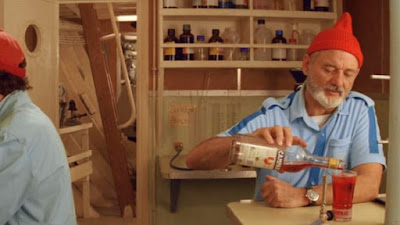
Anderson based Zissou on Jacques Costeau, the beloved French filmmaking oceanographer, right down to the famous red beanie. Of course, for all his conservation and groundbreaking exploration, he made a mess of things at home, fathering an entire second and secret family with his mistress, which has only caused bitter divides over his legacy in the years since his death. Anderson does not elide such emotional disorder in his Costeau-like character, brought home in Steve’s confession, rendered in immaculate Bill Murray deadpan, that “I haven’t been at my best the last decade.” That describes Steve’s filmmaking too. “The Life Aquatic” opens with his latest documentary flopping on opening night, the genuine tragedy of the mysterious Jaguar shark eating Steve’s longtime oceanographer partner Esteban (Seymour Cassel) treated like a storytelling stretch and Steve’s proclamation that he will exact revenge on the Jaguar shark in his next movie shrugged off. Afterwards, an old man approaches Steve to sign some posters of Zissou movies past, that famously exacting Wes Anderson production design utilized not as an end unto itself but a mammoth emblematic gesture, bringing Steve face to face with his former self. Weary with autographing so many, Steve tells the old man to forge the rest, essentially deeming his own legacy counterfeit.
That is not all complicating his legacy. There is also the appearance of Ned Plimpton (Owen Wilson), claiming to be Steve’s son from a long-ago love affair, and Jane Winslett-Richardson (Cate Blanchett), a reporter doing a story on Zissou. The latter sometimes feels like nothing more than a device for additional tension between the might-be father and son, though she also shines a harsh spotlight on Steve’s faded glory, confessing her magazine, Oceanographer Explorer, was apathetic toward the profile and that she’s covering her own expenses. “That’s what it used to be like,” sighs Klaus (Willem Dafoe), Steve’s second-in-command, as the crew watches one of their older works, an incendiary comic evocation of wallowing in nostalgia. Then again, even here, Murray’s slightly puffed-up countenance suggests the showboat Jane pegs him as later.
His emergent relationship to Ned proves similarly prickly, with stops and starts, a possible dad confessing he never wanted to be dad trying to be one anyway, yet often seeming to treat Ned with the same indifferent air he treats the bevy of hapless unnamed, unpaid interns. The relationship has undertones of both Royal (Gene Hackman) and Chas (Ben Stiller) Tenenbaum and Royal and Richie (Luke Wilson) Tenenbaum just as Steve Zissou himself echoes Royal. Hackman was never an actor concerned with likability, and Murray, I suppose wasn’t either, even though he excelled at making unlikable characters likable anyway. That’s what he sort of did in “Rushmore”, and in 2003’s “Lost in Translation” too, never mind the ultimate antihero Peter Venkman. In “The Life Aquatic”, on the other hand, Murray strains all the likability out, playing a pompous prick, rendering the homophobia and misogyny that comes out of his mouth as sudden as it is nonplussed, someone who has grown tired of himself and is all too willing to take it out on everyone around him, manifesting the same bitter taste as his favorite drink: Campari on the rocks.
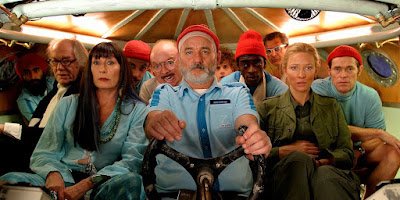
The ocean, then, would seem to be Steve’s remedy. But even if there are occasional glimpses, like Steve thinking fast by employing a champagne flute to save a pony fish, the very fact that he wants to kill the Jaguar shark denotes a creeping dislike of the water too, the one place that ostensibly would make him happy, just as the dolphins who swim with his ship mentally torment him more than his nominal nemesis Alistair Hennessey (Jeff Goldblum). (“Son of a bitch, I’m sick of these dolphins,” is the retroactive 2004 Line of the Year.) In the end, though, when Zissou and his entire team cram into a small submersible and come face to face with the Jaguar shark, something strange and mystical happens, emotions you didn’t even know were in there suddenly suddenly bubbling to the surface. I’ve never liked that Bill Paxton line toward the end of “Titanic”, about how he “never let it in,” maybe because he had to say it at all, and “The Life Aquatic” never makes Steve say it here. The moment merely embodies it, even as the Jaguar slips away, as potent a metaphor for the fleeting beauty of life as I have ever seen.


