Director John Hamburg’s “Why Him?” suggests a narratively inverted “Meet the Parents”, which Hamburg wrote, told from the perspective of the father-in-law, Ned Fleming (Bryan Cranston), though in this case the prospective son-in-law is not a hapless nurse but an eccentric dot com millionaire, Laird Mayhew, played by James Franco, which is nimble casting considering how so many have turned on the straining-to-be-eccentric Franco, and how most everyone long ago turned on dot com millionaires. And so Franco welcoming that hate, rather than trying to ward it off, with a persistent, occasionally irritating, gleam in his eye puts you in Ned’s shoes from the start. Laird is dating Ned’s daughter Stephanie (Zoey Deutch), a few semesters shy of graduating from Stanford, and not so much Daddy’s Little Girl as an Independent Woman Who Daddy Thinks Is Still His Little Girl. She doesn’t exactly have agency because she spends much of the film on the sideline as Ned and Laird tango over whether or not she should be proposed to, but she is allowed to reclaim her agency in the end, thank God, as if everything that came before was superfluous. Indeed, there is another scene where Stephanie and her mother Barb (Megan Mullally, given a fair amount to do if you nevertheless wish she got to do more) advise Ned they kept a secret from him for his own emotional safety. And in that instant you sense a whole movie where these two women observe the predictable hijinks from afar, shaking their heads, calling out the clockwork twists before they happen.
You might wonder, couldn’t we watch that movie instead of another in a long line of wacky, or pseudo-wacky, comedies about buttoned up fathers forced to confront their prospective anything-goes sons-in-law that must faithfully observe the time-honored Chekhov’s Moose Tank, stipulating that if a glass tank filled with moose urine is seen in the beginning then it must shatter before the end? I am receptive to that argument. Still, I confess to enjoying Cranston’s performance as not merely a tightly wound man but a tightly wound Midwesterner, a crucial distinction, introduced as owner of a printer company in Michigan barely getting by that is suddenly thrown out of balance when he arrives in a Left Coast environment existing entirely outside the box, where dinners are not so amply proportioned and comprised partially of edible paper and the people, to paraphrase an old Garrison Keillor line, are looking for a lot more eye contact than Ned is used to.
Sure, you have seen such fish out of water shenanigans before, but Cranston nevertheless invests them with comical urgency, particularly through facial contortions evoking the facial putty of George C. Scott in “Dr. Strangelove”, a comparison I do not employ lightly selling nearly every single bit with squints and sighs and double takes. His stiff body language, meanwhile, consistently mirrors the blazer, sweater, tie ensemble he sports to Laird’s big Christmas soiree, and underlines an attitudinal inflexibility that his surroundings are trying really hard to bend, never more so than an unfortunate voyage to the bathroom where, uh, simple manual sanitation has been phased out in the name of technological efficiency, which eventually yields to an invasion of Ned’s privacy in the most prominent place that no reserved Midwestern male, I assure you, wants his privacy compromised.
That is not the only thing compromised in “Why Him?” as Ned is also forced to grapple with his beloved business’s death rattle in age where the tangibility of printing paper has given way to abstruse smart home monitoring systems with a voice where there is no person. Ned cannot quite wrap his mind around these details, an aging man who suddenly finds himself discomfited by the modern world, hanging on by a thread that Cranston lends great comic desperation. You only wish the script surrounding him had done the same, relying more and more on rote hijinks the further the movie goes, like Ned awkwardly, unintentionally finding himself in the same room as his daughter and her boyfriend at a particularly delicate moment or the hopelessly stale subplot of Ned trying to hack Laird to get compromising information to bust up the relationship.
Laird and Stephanie’s relationship, really, is just the hoary convention Hamburg utilizes as a means to put a middle-aged man in present day America through the wringer of impending irrelevance, which is a tantalizingly idea, given the surrounding cultural landscape, to really extract Ned’s fear and resentment, both of which you catch in glimpses. Alas, this was a Christmas release and so all manner of plot pyrotechnics are summoned to ensure that forgiveness and goodwill ultimately trump fear and resentment. Still, in the machinated wrap-up there emerges the notion of Ned willingly relinquishing his self-appointed wise elder position to the youth movement. Maybe kids know best.
Showing posts with label James Franco. Show all posts
Tuesday, August 08, 2017
Why Him?
Labels:
Bryan Cranston,
James Franco,
No Comment,
Why Him
Tuesday, April 08, 2014
Homefront
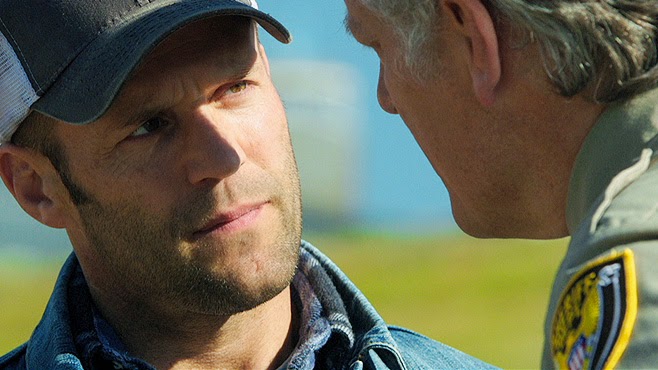
While “Homefront” may have been directed by Gary Fleder, it was written by Sylvester Stallone, and this shows in the way it feels leftover and freeze-dried from the 1980’s, born of such rough & tumble Me Decade rural action opuses like “Next of Kin” and “Road House.” Don’t presume it coincidence that the main character’s undercover code name is……Dalton. In fact, there was often talk of a Stallone/Schwarzenegger vehicle, which came never to fruition, but which is apropos because often “Homefront” feels like the belated sequel to Schwarzenegger’s “Commando” (1985). That’s a film that finds Arnie as John Matrix, retired Army colonel, living in isolation with his precocious daughter Jenny to protect himself from rabid enemies. Those rabid enemies kidnap his daughter and, thus, he travels to South America to get her back. “Homefront” acts in reverse, with Jason Statham as retired DEA agent Phil Broker, living in isolation in Louisiana with his precocious daughter Maddy to protect himself from rabid enemies. Those rabid enemies eventually ferret him out and attack and, thus, he stands up to defend his Homefront.
Fleder, however, more recently a middle-of-the-road professional (“The Express”, “Runaway Jury”) insistently attempts to dress up the film as Bayou Tony Scott, handheld camera and overeager cutting, overburdening its reflective moments with heaps of style, when an approach more reminiscent of its 1980’s forefathers would have gone a long way in strengthening its tone. Even so, Fleder, unintentional or not, pulls out two spectacular shots that underline the deviously tongue-in-cheek undercurrent of portions of the film. First, is a crate piled high with bags of precious meth offset by a Mountain Dew can in the forefront. Second, is the main character and chief heavy having a face-to-face, heart-to-heart in a local cafĂ© with a wild west, Monument Valley-esque mural in the background that momentarily re-casts them as the White Hat and the Black Hat. If the whole film had been this way, “Homefront” might have had a long life on TNT Saturday afternoons. Instead it will have to make do with being generally blasĂ© and sporadically joyous.
“Homefront’s” problem and blessing, in fact, is the heavies often seem more interesting – well, more loony, which makes them more interesting – than the off-the-rack father/daughter relationship meant as the focal point. Statham’s awkwardness is intended, raising his daughter all alone, but too often his performance strikes the wrong note of awkward. There are also occasional hints of a Big Daddy/Hit Girl relationship here, such as when Maddy makes like Daddy at school, employing a bit of Statham-Fu on a bully, but they never quite take flight beyond that bit of plot-instigation.
Much more fascinating is this backwoods family that becomes Broker’s adversaries. The classmate Maddy injures is the son of the sister, Cassie (Kate Bosworth), of the town’s meth king, Gator Bodine (James Franco), and so sister begs brother to teach out-of-towner a lesson. Franco, playing a meth cooker named Gator the same year he played a drug dealer named Alien, was but a stock-broker named Ryan away from playing the tri-headed monster of American Capitalism over the course of twelve months. File it under missed opportunities. Nevertheless, he brings a comic glint to his eye, as he often does, the whole performance feeling like a put-on because the character itself is a put-on, a small-timer who wants to be big. He desires statewide distribution for his operation, and that’s why he comes to view his sister’s pleas to confront Broker as more than just a nuisance. Through a little cinematic snooping (i.e. Happen Upon A Box Of Files In The Basement And Find The File Revealing A Character’s Entire Backstory), he learns Broker’s dirty little secret and intends to use it against him.
The scheme, which allows for Statham to do as Statham does, involves threats and intimidation – “Country payback” as the Token Black Guy (Omar Benson Miller) puts it – and an old Gator ally, Sheryl Mott. She is played by Winona Ryder. No one does the Panic Eyes like Winona and she imbues her eyes in nearly every scene with the twitchy panic of a methhead – in over her head but swept up in Gator’s laconic fury nonetheless. There is a righteous moment near the end when a character’s cellphone becomes a beacon which might seem a screenwriting convenience, except that Ryder has laid the groundwork throughout to make you fully believe she would forget to confiscate the cellphone. Her character is also referenced as having been busted for trying to smuggle drugs into Angola, which seems like fodder for a comic movie offshoot. To paraphrase Bridget Fonda talking to Robert DeNiro in “Jackie Brown”...“If you aren't the biggest fuck-up I've ever met in my entire life. How did you ever smuggle drugs into Angola?”
Statham’s character is an interloper in this back country and, really, he becomes an interloper in the movie. The obligatory action-packed climax almost – almost!!! – turns on a different character, the local sheriff (Clancy Brown), making amends, only to cop out at the last second because, of course, Clancy Brown doesn’t have top billing. So it goes. These meth addicts, stomping, squabbling, are more intriguing to watch than the hero, and, as such, the most intriguing character of them all sort of gets forgotten.
Kate Bosworth is not becoming in this movie. She is frightening to look at, a long-gone junkie, rail thin and consumed by the desperation of another fix. The family business has made her into this racing-mind monster and essentially abandons her when her problem gets too deep. Somewhere in there, amidst all the mechanized plotting and handheld camera work, however, Cassie cries out for help. No one listens. Why would they when there’s meth to make and skulls to crack and “Road House” is on TNT again?
Thursday, September 12, 2013
10 New Career Moves For James Franco
You may have heard that James Franco, new-fangled Renaissance Man, painted a mural awhile back in the hipster New York hive of Williamsburg. This, of course, is merely the tip of the vegan meatloaf when it comes to the all-around artisan that is James Franco. Actor. Acting Coach. Director. Author. Drag Queen. Artist.
This, as it must, got me to thinking: what other avenues could Hollywood's requisite cavalier pursue.
Note: This list does not include Becoming A Trappist Monk or Joining Greenpeace because, come on, those are just too obvious.
1. Films a documentary in which he waits in line at the post office. Titles it……”James Franco Waits In Line At The Post Office.”
2. Becomes the official "personal incense burner" for Dogstar.
3. Fashions an alter-ego named Ricky Lefevre, leader of a Lower East Side singing street gang called The Coral Catsharks.
4. Writes, directs and stars in a film along with Seth Rogen, Jay Baruchel, Danny McBride, Craig Robinson and Jonah Hill chronicling a cattle drive from Montana to Texas. In an inspired bit of Herzoginess he decides to lead an ACTUAL cattle drive with Seth Rogen, Jay Baruchel, Danny McBride, Craig Robinson and Jonah Hill from Montana to Texas and film it.
5. Opens an exhibit at the Metropolitan Museum of Art in which he drinks gas station coffee. Titles it……”James Franco Drinking Gas Station Coffee.”
6. Apprentices to Daft Punk.
7. Creates a line of "Franco Print" shirts, button-ups adorned with patterns of festive James Franco images. (He uses the proceeds of this venture along with a Kickstarter campaign to fund his remake of "Captain Ron.")
8. Becomes spokesman for Bartles & Jaymes and films ads with him in the role of Ed Jaymes & Seth Rogen in the role of Frank Bartles.
9. Legally changes his name to Bob Marley’s “Jamming.” The WHOLE song. “Yes, I had a reservation for Jamming, I want to jam it with you. We’re jamming, jamming, and I hope you like jamming too. Ain’t no rules, ain’t no vow, we can do it anyhow…” etc.
10. Calls a press conference and officially establishes himself as "America's Concierge."
This, as it must, got me to thinking: what other avenues could Hollywood's requisite cavalier pursue.
Note: This list does not include Becoming A Trappist Monk or Joining Greenpeace because, come on, those are just too obvious.
10 New Career Moves For James Franco
1. Films a documentary in which he waits in line at the post office. Titles it……”James Franco Waits In Line At The Post Office.”
2. Becomes the official "personal incense burner" for Dogstar.
3. Fashions an alter-ego named Ricky Lefevre, leader of a Lower East Side singing street gang called The Coral Catsharks.
4. Writes, directs and stars in a film along with Seth Rogen, Jay Baruchel, Danny McBride, Craig Robinson and Jonah Hill chronicling a cattle drive from Montana to Texas. In an inspired bit of Herzoginess he decides to lead an ACTUAL cattle drive with Seth Rogen, Jay Baruchel, Danny McBride, Craig Robinson and Jonah Hill from Montana to Texas and film it.
5. Opens an exhibit at the Metropolitan Museum of Art in which he drinks gas station coffee. Titles it……”James Franco Drinking Gas Station Coffee.”
6. Apprentices to Daft Punk.
7. Creates a line of "Franco Print" shirts, button-ups adorned with patterns of festive James Franco images. (He uses the proceeds of this venture along with a Kickstarter campaign to fund his remake of "Captain Ron.")
8. Becomes spokesman for Bartles & Jaymes and films ads with him in the role of Ed Jaymes & Seth Rogen in the role of Frank Bartles.
9. Legally changes his name to Bob Marley’s “Jamming.” The WHOLE song. “Yes, I had a reservation for Jamming, I want to jam it with you. We’re jamming, jamming, and I hope you like jamming too. Ain’t no rules, ain’t no vow, we can do it anyhow…” etc.
10. Calls a press conference and officially establishes himself as "America's Concierge."
Labels:
Gone To Colorado,
James Franco,
Lists
Monday, March 25, 2013
Oz: The Great and Powerful
It is important to note that the actual movie title “Oz: The Great and Powerful” is a misnomer. Oz, as in The Wizard of Oz, really is not all that great nor very powerful. On the contrary, he is a hustler, a poser. Yes, the Wizard of the original, much beloved Technicolor 1939 opus was played by the personable Frank Morgan but let’s not forget that he is the man behind the curtain, merely pretending to be “the great and powerful”, nothing more than plumes of smoke and fireballs, outing himself as – his words – “a humbug.” That’s an easy detail to overlook – the fact the Wizard has been duping The Emerald City for years. James Franco knows this and, in a performance that is less a callback to Morgan than entirely his own, plays straight to it. That is the movie’s strength......actually, that's not right. It could have been the movie's strength and instead it's more of a problem.
With a respectful nod to 1939, the film opens in handsome black and white on the Kansas plain where Oz, Oscar Diggs (James Franco), runs a magic show with a traveling circus. Right away he is revealed as a fraud, able to make a woman “levitate” but unable to cure a young girl of an inability to walk. He spouts some nonsense to his would-be-lover (Michelle Williams) about becoming a great man but – and this goes back to the way Franco plays the role – we sense his idea of “greatness” differs from a sense of moral goodness. Eventually a tornado descends and with it the not-so-good Oz is whisked away to magical land somewhere over the rainbow that appears to have literally been named for him.
At least this is how Theodora (Mila Kunis, painfully robotic) makes it sound when she happens upon him and tells of a prophecy which says a great and powerful Wizard will fall from the sky to save the Land of Oz. Diggs, outfitted with a Franco grin that is all sinewy insurance salesman, recognizes an opportunity to play a con and achieve the fame and fortune to which he feels so entitled.
Plot develops. The Emerald City – consciously portrayed more as empirical Rome than the let’s sing & dance version we all know so well – is under the rule of Evanora (Rachel Weisz) and Theodora – comrades on broomsticks – who are pit in a witchy war against the good Glinda (Williams again) with whom Oz will eventually unite. This is where the story breakdown begins to occur.
The real protagonist and antagonist of “Oz: The Great and Powerful” is not so much Oz as it is Glinda vs. Evanora (and Theodora). This trio, however, is written with no depth or illumination. Weisz, by far, manages the most mileage simply because she manages to convey some sense of inner turmoil beneath the glossy exterior, but Williams is just Mother Theresa and Kunis, trying desperately to quote Margaret Hamilton, emerges as shrill rather than wicked and her reasons for transformation are too hasty, and thus, unconvincing. Meanwhile Oz deliberately skirts the middle ground, unwillingly caught up in a revolution, William Wallace if William Wallace was an emotionally crippled huckster. Glinda may believe in him totally but others are suspicious, and even if his arc is pre-determined, well, I swear that Franco is fighting back against it with subtle cynicism every single step of the way.
That is the overriding issue. Everyone will want to compare this film to the 1939 version, there is no way around it, and so director Sam Raimi finds himself at an impasse. He works in special effects that do little more then hang around to try and be impressive (while also paling to the old-school matte paintings) and saddling Oz with his own version of a Dorothy Gale-esque quartet that is significantly under-imagined and stricken with terribly pat payoffs because, well, he has to, I suppose, even as a more twisted film lurks all the while, threatening to emerge but never quite doing so.
The high point is the third act Emerald City showdown which harkens back to 1939 while also working entirely on its own. This, of course, is meant to be Oscar Diggs truly becoming Oz, learning the difference between right and wrong, and I have no doubt this is what the screenplay intends.
But then here comes that Franco smirk again. Study it closely because I swear it’s conning us. His closing lines read as sincere but the spin Franco puts on them and the way he looks saying them betrays our trust. He might just go on to be someone who for, oh, say, twenty-five years manages to dupe The Emerald City into thinking he’s great and powerful.
Subscribe to:
Posts (Atom)