


 Posts


Showing posts with label Michael Shannon. Show all posts
Showing posts with label Michael Shannon. Show all posts
Friday, May 01, 2020


Monday, March 12, 2018
What Was Michael Shannon Drinking/Listening To on Oscar Night?
When “The Shape of Water” won the Best Picture Oscar a couple weeks ago, director Guillermo del Toro ascended the stage along with other principal members of his production, including stars Sally Hawkins and Richard Jenkins. Michael Shannon, who played the film’s chief heavy, was not present, unsurprisingly considering he, unlike Hawkins and Jenkins, was not nominated for an acting award. And so it was, or so it seemed, until post-Oscars a picture popped up on social media.

If my first reaction was to gasp, my second reaction was to wonder about Mr. Shannon’s reaction to this moment going viral. Not because the actor is not willing to engage with social media virality, because he has proven time and again that he is, but that a seeming private moment had become very much public. This isn’t Bill Murray deliberately inserting himself into a moment to further his anything goes brand; this is Michael Shannon’s personal chill time. But then I figured, Michael Shannon probably doesn’t care. Michael Shannon has probably already moved on. Michael Shannon probably forgot any of this even happened until one of his friends mentioned that he saw a friend of friend retweet the original tweet. And so having determined all that, we can then get down to the real nitty-gritty.
If Michael Shannon was drinking beer and listening to the juke while watching the movie in which he starred win Best Picture, what beer was he drinking and what song he was listening to? We have a few prospective combinations.
Spaten Optimator / Castles Made of Sand, Jimi Hendrix. Like one München Doppelbock can so easily become two, or three, or even four or five München Doppelbocks, quickly transforming a night of joy into a morning of bleary regret, so too does an Academy Award often work to merely remind us that these castles made of sand fall in the sea, eventually. Verdict: Unlikely
Anti-Hero / Art of Almost, Wilco. I have it on good authority that Michael Shannon once wore a ratty Wilco t-shirt, so hey, if, as Chris Jones says, the acting titan is already espousing Chicago values just by sitting there, why not take it step further with a pristine local brew and some Jeff Tweedy? And while I initially wondered if Shannon might be an old school Wilco guy, I ultimately decided that he would be an all-Wilco Wilco guy, reminding us that inherent values can still sometimes be modified. Verdict: Too Fanciful
High Life / Act Naturally, The Beatles. Michael Shannon has a sense of humor. So maybe he celebrated his picture’s win not with champagne but the Champagne of Beers and Ringo jestingly speculating about winning an Oscar. Verdict: Conceivable, But Still Dubious
Rolling Rock / Achin’ to Be, The Replacements. Michael Shannon hasn’t needed a new beer since the mid-90s, and there hasn’t been a good band since The Replacements. Verdict: Very Possible
Sam Adams / Shakin’, Eddie Money. Look, if you think Michael Shannon didn’t just roll in there, ask what the special was, get told it was $4 Sam Adams, order one and toss it back while some drunk imbecile played Eddie Money, you’re probably overthinking this whole thing. Verdict: Highly Probable
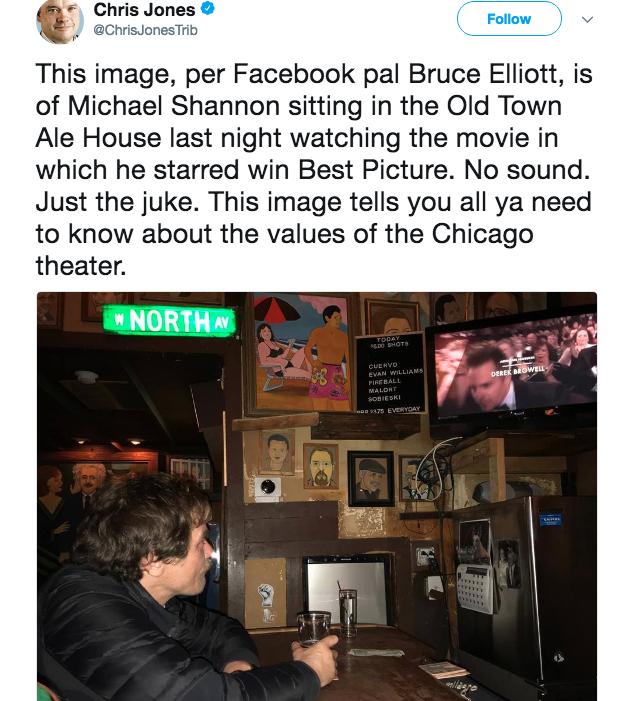
If my first reaction was to gasp, my second reaction was to wonder about Mr. Shannon’s reaction to this moment going viral. Not because the actor is not willing to engage with social media virality, because he has proven time and again that he is, but that a seeming private moment had become very much public. This isn’t Bill Murray deliberately inserting himself into a moment to further his anything goes brand; this is Michael Shannon’s personal chill time. But then I figured, Michael Shannon probably doesn’t care. Michael Shannon has probably already moved on. Michael Shannon probably forgot any of this even happened until one of his friends mentioned that he saw a friend of friend retweet the original tweet. And so having determined all that, we can then get down to the real nitty-gritty.
If Michael Shannon was drinking beer and listening to the juke while watching the movie in which he starred win Best Picture, what beer was he drinking and what song he was listening to? We have a few prospective combinations.
Spaten Optimator / Castles Made of Sand, Jimi Hendrix. Like one München Doppelbock can so easily become two, or three, or even four or five München Doppelbocks, quickly transforming a night of joy into a morning of bleary regret, so too does an Academy Award often work to merely remind us that these castles made of sand fall in the sea, eventually. Verdict: Unlikely
Anti-Hero / Art of Almost, Wilco. I have it on good authority that Michael Shannon once wore a ratty Wilco t-shirt, so hey, if, as Chris Jones says, the acting titan is already espousing Chicago values just by sitting there, why not take it step further with a pristine local brew and some Jeff Tweedy? And while I initially wondered if Shannon might be an old school Wilco guy, I ultimately decided that he would be an all-Wilco Wilco guy, reminding us that inherent values can still sometimes be modified. Verdict: Too Fanciful
High Life / Act Naturally, The Beatles. Michael Shannon has a sense of humor. So maybe he celebrated his picture’s win not with champagne but the Champagne of Beers and Ringo jestingly speculating about winning an Oscar. Verdict: Conceivable, But Still Dubious
Rolling Rock / Achin’ to Be, The Replacements. Michael Shannon hasn’t needed a new beer since the mid-90s, and there hasn’t been a good band since The Replacements. Verdict: Very Possible
Sam Adams / Shakin’, Eddie Money. Look, if you think Michael Shannon didn’t just roll in there, ask what the special was, get told it was $4 Sam Adams, order one and toss it back while some drunk imbecile played Eddie Money, you’re probably overthinking this whole thing. Verdict: Highly Probable
Thursday, June 15, 2017
The 25 Best Michael Shannon Films of the 21st Century So Far
Last week, as you may know, Manohla Dargis and A.O. Scott, esteemed film critics at The New York Times, published a list provocatively titled The 25 Best Films of the 21st Century So Far. It, as such lists will, sparked other critics to construct their 25 Best Films of the 21st Century So Far, and then other critics to construct their 25 Best Films of the 21st Century So Far, on until forever. And whereas lists like this should be good conversation starters or nice additions to an ongoing cultural discussion, mostly they are just triggers for outrage, which is a real shame, because, as Richard Brody, highbrow New Yorker critic who has thankfully never not owned his love of lists, notes in the introduction to his 25 Best Films of the 21st Century So Far list: "one reads different critics for different perspectives and different tastes."
Exactly. And you don't come to Cinema Romantico in the wake of The 25 Best Films of the 21st Century So Far lists to get our 25 Best Films of the 21st Century So Far list. That's not how we roll. So here's this list, assembled in absolutely no particular order whatsoever, instead.

Shotgun Stories. If Shannon has perfected the Dimensional Hothead then this might be the first performance where he nailed it, portraying a short-tempered southern man who wants to overcome Who He Is but will never cow Where He Comes From.
Premium Rush. If you are playing the stock villain in a bike messenger thriller you'd be forgiven for simply showing up and collecting your paycheck as you go through the motions. But Shannon, bless his heart, not only plays something, a weasel convinced the whole stinking world is out to get him, he wraps that something up with all kinds of comically terrifying emoting. This performance is proof positive that, if born in a different era, he would have been perhaps the greatest silent film villain of all time.
Nocturnal Animals. There is a moment where Shannon, his character's health revealed to be much less than tip-top and unable to stomach food because of it, is told to eat something. The way in which Shannon vehemently shovels a forkful of food into his mouth says more about the burden of enduring pain than any twelve hundred disease of the week movies combined.
Midnight Special. The Kid With Special Powers is the point here, which Shannon plays straight to, playing down because every move he makes is all about the kid.
Elvis & Nixon. His Elvis is majestic, by which I mean it is not majestic at all, a purposeful Vegas impersonation of Elvis at a time in Elvis's life when Elvis had, more or less, become an impersonation of himself.
They Came Together. I hated this movie. I mean, I really hated it. But when Michael Shannon came tearing in bearing his classic Shannon rage face for his, like, six second cameo, man, that was still the best.

Frank & Lola. I watched this on my laptop while my girlfriend was watching something else on TV, marking us as a truly modern American couple, and when I burst out laughing she turned to me and asked "What's so funny?" I replied, "Michael Shannon was just staring at this guy."
The Runaways. It's sorta like Paul Giamatti's Eugene Landy melded with R. Lee Ermey's Gunnery Sergeant Hartman if he was in a futuristic 80s rock opera.
Return. As the spouse of a soldier returned from Iraq, Shannon emits an aloofness hinting at his character's secret, but he also knows this is Linda Cardellini's movie through and through and simultaneously, quietly cedes the stage.
The Missing Person. One of the best comic bits that isn't really a comic bit at all of this century is Michael Shannon as an exhausted, irritated private detective trying to buy a cellphone that "takes pictures" while the cellphone store guy keeps trying to upsell him. My girlfriend knows this scene all too well even though she hasn't seen it because I quote it all the time in my terrible Michael Shannon impression. "I just [beat] want a phone [beat] that takes [beat] pictures."
Complete Unknown. For whatever issues this movie might have had, I still kind of loved it, and I loved Shannon in it, the way he burned not so much with anger at the betrayal of Rachel Weisz's character as envy for what she has gone and done.

Take Shelter. It's absurd to call any one Shannon performance the "best" since nearly every performance he gives is, in its own way, stone cold solid, but no Shannon performance, we can be sure, is better than "Take Shelter", where he's playing a father and a husband with something like a cosmic itch he can't scratch, loving yet terrified that his love alone won't be enough. I always think of Shannon in terms of the moment in this movie when he is standing beneath a lightning strewn sky that may or may not be real and rhetorically asks "Is anyone seeing this?" I feel like that so often when I'm watching Shannon. I want to turn to strangers in the theater and ask, bewildered, "Is anyone seeing this?"
Bug. Delusional and unhinged yet so righteously true to what might not be true that he just sort of swoops up and then carries along Ashley Judd's character in his wake, and, in turn, Shannon & Judd themselves become accomplices in pushing past The Great Barrier.
Mud. He's barely in this modernish Mark Twain adventure but makes his couple scenes as a single father count, playing totally erratic yet still, somehow, in the moment of truth, emotionally present for his son.
The Iceman. People are always seeing a movie they didn't like and saying something to the effect of "I just didn't care about the main character." In "The Iceman", as a vicious, vicious hitman, Michael Shannon, understand, does not care that you don't care about his character.
8 Mile. Playing Kim Basinger's abusive boyfriend, there's a lot of cliché inherent in his rage though he transcends it by communicating in the spaces in-between how if you just poked your thumb into his heaving chest, he would probably just topple over.
Freeheld. Shannon is sort of giving the Denzel Washington performance in a much, much worse "Philadelphia", though that's also selling him short because he's doing his own thing, allowing resentment and surprise not to erupt but just sort of burble and then evaporate in the name of of tolerance.
Revolutionary Road. Michael Shannon can see through your shit. That's what nearly every interview with Shannon reveals. And that's what made him so perfect to play John Givings, who's there specifically to see through April and Frank Wheeler's shit and call them on it. And, as everyone knows, when Michael Shannon calls you on your shit, the trumpets sound and the walls collapse.
Before the Devil Knows You're Dead. The thing Michael Shannon does when he says "'Sorry' ain't gonna pay the bills, Chico" is, on certain days, the funniest thing in the history of the world.

Bad Lieutenant: Port of Call New Orleans. If takes someone special to look at turned-up-to-eleven Crazy Eyes Nic Cage with calm suspicion and not get blown off the screen. Shannon does it.
World Trade Center. It takes a certain kind of commited zeal to play a real life guy - Dave Karnes - who just kind of felt himself spiritually summoned to Ground Zero and went with the flow. Shannon has that zeal, not playing it outwardly with great elan but inwardly, like it's something he cannot explain, doesn't particularly care to but must abide by nevertheless.
99 Homes. If Charles Darwin had vaped and been around during the 2008 Financial Crisis.
Batman v Superman: Dawn of Justice. We are only including this one, which I have not seen, because Shannon said he fell asleep while trying to watch it which is just so righteous.
Cecil B. Demented. As one part of a pack of movie anarchists, or thereabouts, this early career role has always made me ponder an alternate reality where Shannon took fewer and less bigger roles and remained more underground, like a more intense Michael J. Pollard.
Pearl Harbor. So here's a story and I swear it's true. When I saw this movie in the theater way back when, I came out of it, dazed and depressed, remembering only two things. I remembered Alec Baldwin saying "Leave your goddam hula shirts at home." And I remembered this guy, this guy I didn't know, this guy at the Pearl Harbor air force base who, when Josh Hartnett walks up and asks "Y'all pilots?" said "We're working on it. It's a lot of switches and stuff." Except he didn't, like, completely say it; he kind of, like, mumbled it, but mumbled it in this way that was sort of subtly calling Hartnett's character on his uppity shit although I don't think Hartnett's character (or Hartnett himself) even realized that's what was happening. God, did those mumbled lines resonate. A few years later I realized that Michael Shannon was the guy who mumbled.
Exactly. And you don't come to Cinema Romantico in the wake of The 25 Best Films of the 21st Century So Far lists to get our 25 Best Films of the 21st Century So Far list. That's not how we roll. So here's this list, assembled in absolutely no particular order whatsoever, instead.
The 25 Best Michael Shannon Films of the 21st Century So Far

Premium Rush. If you are playing the stock villain in a bike messenger thriller you'd be forgiven for simply showing up and collecting your paycheck as you go through the motions. But Shannon, bless his heart, not only plays something, a weasel convinced the whole stinking world is out to get him, he wraps that something up with all kinds of comically terrifying emoting. This performance is proof positive that, if born in a different era, he would have been perhaps the greatest silent film villain of all time.
Nocturnal Animals. There is a moment where Shannon, his character's health revealed to be much less than tip-top and unable to stomach food because of it, is told to eat something. The way in which Shannon vehemently shovels a forkful of food into his mouth says more about the burden of enduring pain than any twelve hundred disease of the week movies combined.
Midnight Special. The Kid With Special Powers is the point here, which Shannon plays straight to, playing down because every move he makes is all about the kid.
Elvis & Nixon. His Elvis is majestic, by which I mean it is not majestic at all, a purposeful Vegas impersonation of Elvis at a time in Elvis's life when Elvis had, more or less, become an impersonation of himself.
They Came Together. I hated this movie. I mean, I really hated it. But when Michael Shannon came tearing in bearing his classic Shannon rage face for his, like, six second cameo, man, that was still the best.

Frank & Lola. I watched this on my laptop while my girlfriend was watching something else on TV, marking us as a truly modern American couple, and when I burst out laughing she turned to me and asked "What's so funny?" I replied, "Michael Shannon was just staring at this guy."
The Runaways. It's sorta like Paul Giamatti's Eugene Landy melded with R. Lee Ermey's Gunnery Sergeant Hartman if he was in a futuristic 80s rock opera.
Return. As the spouse of a soldier returned from Iraq, Shannon emits an aloofness hinting at his character's secret, but he also knows this is Linda Cardellini's movie through and through and simultaneously, quietly cedes the stage.
The Missing Person. One of the best comic bits that isn't really a comic bit at all of this century is Michael Shannon as an exhausted, irritated private detective trying to buy a cellphone that "takes pictures" while the cellphone store guy keeps trying to upsell him. My girlfriend knows this scene all too well even though she hasn't seen it because I quote it all the time in my terrible Michael Shannon impression. "I just [beat] want a phone [beat] that takes [beat] pictures."
Complete Unknown. For whatever issues this movie might have had, I still kind of loved it, and I loved Shannon in it, the way he burned not so much with anger at the betrayal of Rachel Weisz's character as envy for what she has gone and done.

Take Shelter. It's absurd to call any one Shannon performance the "best" since nearly every performance he gives is, in its own way, stone cold solid, but no Shannon performance, we can be sure, is better than "Take Shelter", where he's playing a father and a husband with something like a cosmic itch he can't scratch, loving yet terrified that his love alone won't be enough. I always think of Shannon in terms of the moment in this movie when he is standing beneath a lightning strewn sky that may or may not be real and rhetorically asks "Is anyone seeing this?" I feel like that so often when I'm watching Shannon. I want to turn to strangers in the theater and ask, bewildered, "Is anyone seeing this?"
Mud. He's barely in this modernish Mark Twain adventure but makes his couple scenes as a single father count, playing totally erratic yet still, somehow, in the moment of truth, emotionally present for his son.
The Iceman. People are always seeing a movie they didn't like and saying something to the effect of "I just didn't care about the main character." In "The Iceman", as a vicious, vicious hitman, Michael Shannon, understand, does not care that you don't care about his character.
8 Mile. Playing Kim Basinger's abusive boyfriend, there's a lot of cliché inherent in his rage though he transcends it by communicating in the spaces in-between how if you just poked your thumb into his heaving chest, he would probably just topple over.
Freeheld. Shannon is sort of giving the Denzel Washington performance in a much, much worse "Philadelphia", though that's also selling him short because he's doing his own thing, allowing resentment and surprise not to erupt but just sort of burble and then evaporate in the name of of tolerance.
Revolutionary Road. Michael Shannon can see through your shit. That's what nearly every interview with Shannon reveals. And that's what made him so perfect to play John Givings, who's there specifically to see through April and Frank Wheeler's shit and call them on it. And, as everyone knows, when Michael Shannon calls you on your shit, the trumpets sound and the walls collapse.
Before the Devil Knows You're Dead. The thing Michael Shannon does when he says "'Sorry' ain't gonna pay the bills, Chico" is, on certain days, the funniest thing in the history of the world.

Bad Lieutenant: Port of Call New Orleans. If takes someone special to look at turned-up-to-eleven Crazy Eyes Nic Cage with calm suspicion and not get blown off the screen. Shannon does it.
99 Homes. If Charles Darwin had vaped and been around during the 2008 Financial Crisis.
Batman v Superman: Dawn of Justice. We are only including this one, which I have not seen, because Shannon said he fell asleep while trying to watch it which is just so righteous.
Cecil B. Demented. As one part of a pack of movie anarchists, or thereabouts, this early career role has always made me ponder an alternate reality where Shannon took fewer and less bigger roles and remained more underground, like a more intense Michael J. Pollard.
Pearl Harbor. So here's a story and I swear it's true. When I saw this movie in the theater way back when, I came out of it, dazed and depressed, remembering only two things. I remembered Alec Baldwin saying "Leave your goddam hula shirts at home." And I remembered this guy, this guy I didn't know, this guy at the Pearl Harbor air force base who, when Josh Hartnett walks up and asks "Y'all pilots?" said "We're working on it. It's a lot of switches and stuff." Except he didn't, like, completely say it; he kind of, like, mumbled it, but mumbled it in this way that was sort of subtly calling Hartnett's character on his uppity shit although I don't think Hartnett's character (or Hartnett himself) even realized that's what was happening. God, did those mumbled lines resonate. A few years later I realized that Michael Shannon was the guy who mumbled.
Tuesday, April 18, 2017
Frank & Lola
“Frank & Lola” opens by airdropping us directly into the midst of a sex scene between the titular characters. Well, make that a just-about-to-be sex scene, since Frank (Michael Shannon) stops them one thrust short, wondering if maybe he and Lola (Imogen Poots), who he barely knows, should wait. This has nothing to do with abstinence, mind you, because hey, the whole swath of Las Vegas is situated just outside the window of where they are laying and what is Las Vegas if not Sin City? No, it’s more that writer/director Matthew Ross’s film seeks to unmask the way in which such all-consuming passion inevitably yields jealousy and rage, an ancient tale, sure, but a story’s familiarity does not necessarily need to impede its execution because fresh execution can make the ancient feel brand new. Alas, Ross can only manage a few huffs and puffs of freshness before he’s all out of breath, leaving the back half of “Frank & Lola”, and a lot of what leads up to it, feeling mired in a plot that not only feels stale but sadly un-empowering for its principal female character.

There is something to these sorts of stories where romance blooms and then jealousy encroaches on said romance that typically requires a pulling back on the curtain of its characters, setting them up This Way so that they earn our empathy, or thereabouts, before they suddenly careen That Way, everything falling apart. That, however, admirably does not seem of particular interest to Ross, which is partly why he opens the movie when he does. The meet cute, the movie’s most tender moment, arrives in flashback, with Frank, a chef, concocting a culinary thrilling omelet for Lola, with Frank reciting the ingredients within, one of the most un-fraught line readings of Shannon’s career. This moment suggests a desire on Ross’s part to do for food what Luca Guadagnino did for edible delights in “I Am Love” but that sort of sensual parallel never quite emerges. If anything, what is eventually revealed as Frank’s my-way-or-the-highway attitude in the kitchen mimics his my-way-or-the-highway attitude in love.
It’s telling that this omelet-conjuring meet cute happens on Halloween as if it’s all just make believe. Or maybe it’s telling that on Halloween in his restaurant Frank is sporting a chef’s jacket covered in fake blood. As his and Lola’s relationship progresses, he exudes anger and suspicion at anyone he comes across, from Lola’s mother (Rosanna Arquette), whom he observes with a vicious side-eye, to the talkative, connected Keith (Justin Long) who gets Lola a fashion designer gig and who probably does, at least a little, have the hots for her. This, in fact, doubles as the movie’s best and funniest moment, in which Ross renders arguably History’s Greatest Staredown, with a semi-shot reverse shot in which Long’s character disappears from the frame when Shannon is staring at him, as if the stare has rendered him so weak he’s invisible, and then when it flips keeps Shannon in the frame so that he we still see him looming.


Shannon’s overwhelmingly magnetic menace was, I suppose, always bound to eventually go too far, though to be fair, once the jealously kicks in, his character doesn’t have much else going on regarding his relationship with Lola. He’s just…steamed. So Shannon plays him…steamed. And he’s never more steamed at anyone than he is at Alan (Michael Nyqvist), a French lothario who shares a potentially sordid past with Lola.
This leads Frank to finding him, ostensibly to beat his brains in, though it grows both more complicated and not complicated at all, at least for Lola, who is thrust into the background as these two men have long, faux-searching conversations about Lola and squabble and scrap over her, reducing her to an object of lust, which is something that Frank either doesn’t realize or that the movie doesn’t realize in order to make Frank wrestle with. It’s so frustrating that you don’t even want the asinine ambiguity of the final shot – you just want Lola to say “Later” and walk.
Monday, April 17, 2017
Wolves
Although “Wolves”, writer/director Bart Freundlich’s sixth feature film, is decidedly not great, it is nevertheless still compelling, or at the very least “watchable”, given its generally professional direction, most notably in some crackling scenes of domestic bliss and tension between a father and mother played by its two biggest names, Michael Shannon and Carla Gugino, succeeding in spite of the screenplay. Because that screenplay…oof, it’s an odd amalgam of “The Gambler” (1974), but one sapped of any insight, and “He Got Game”, though re-told as a white kid’s fantasy with a magical negro that would rightfully make Spike Lee go apoplectic. And while on a base level it grasps Conflict, tossing some in from every angle, it does not always grasp what engenders its Conflict or how to revealingly spur all this Conflict to convincing Resolution.

“Wolves” centers on high school basketball star Anthony Keller (Taylor John Smith), inevitably nicknamed St. Anthony for his sweet three point shot, one that has brought his team to the precipice of a state title and recruiters to Cornell from his doorstep, though the recruiters, like others who know Anthony well, sniff out the kid’s kryptonite, a distaste for brute physicality and a fear of the Big Moment. I might argue that Cornell, which went 8-21 last year, would be lucky to have St. Anthony Keller sniping from behind the arc, and hey, if they don’t want you then just take your talents over to Staten Island and Wagner since I’m sure they’d give you a full ride. But, I pick nits. The point is Anthony’s on court angst derives from his questionable at home environment, which, frankly, despite all the hardwood rigors, is where “Wolves” is best.
Anthony’s father Lee (Shannon) is a New York college literature professor doubling as a degenerate gambler, which makes him sound like a retread of James Caan’s Axel Freed in the aforementioned “The Gambler”, although, to be fair, Freed was Harvard educated and, as Lee says of where he instructs in the movie’s best line, “this isn’t even a good college.” (That’s an obvious metaphor for the movie itself and we will leave it alone.) “The Gambler”, however, tenaciously unpacked its character’s addiction while “Wolves” seems to think gambling and debt revolves almost entirely around ominous men in suits coming to collect debts.
Still, Shannon, ever committed, whose hair perpetually suggests he was just fiercely tousling it while watching whatever team he picked to win lose, invests his part with a convincing mania, never more so than opposite Gugino as Lee’s wife Jenny, a mostly thankless part that Gugino still fills out. Their marriage may be teetering because of her husband’s addiction, but Gugino does not simply push back against it. She plays at an attraction to Lee, just as Shannon plays at one to her, and one moment finds their characters downing cocktails in the immediate aftermath of Lee winning a bet, seeming to suggest that she too gets off on this action, and the way that these parents so brazenly flaunt their attraction and their problems right there in front of their kid suggests the road not taken that maybe should have been. These scenes are sharply played and sharply observed.
But that is of less interest to “Wolves” than the basketball, filled out, somewhat, by Lee’s past as a once promising baseball prospect, suggesting Lavar Ball-ish origins as a man trying to live out his failed dreams through his son. That cannot be easy for Anthony, sure, but it’s worth noting, given all the parallels to “He Got Game’s” own basketball recruiting saga, that the latter’s coveted player, Jesus Shuttlesworth (Ray Allen), was dealing with a dad in prison, on account of inadvertently killing Jesus’s mom, raising his sister and fending off hangers-on though his basketball skills never once suffered as as result. I imagine Jesus scoffing at little St. Anthony.

Then again, “Wolves” does kind of scoff at little St. Anthony in the form of (I’m not making this up) Socrates (John Douglas Thompson), the aforementioned magical negro, an ex-basketball legend haunting the playgrounds, who in a better movie might have suggested Lloyd Daniels, mentors St. Anthony, going so far as to show up at the Big Game to belt out inspiration like Charles S. Dutton in “Rudy.” Lord, it’s insulting and taken in conjunction with St. Anthony’s teammate, a stereotypical broadly comical Asian, someone needed to throw cold water on Freundlich’s face and ask him what the hell he thought he was doing?
These are just a couple other dramatic balls that Freundlich hurls into the air, along with an entire romantic subplot for St. Anthony that includes a teen pregnancy digression that lasts all of a montage, that, as if realizing is too much to wrap up in a regular run time, all get settled in a positively bonkers concluding scene at the Big Game ripped straight from the high school play strategy of get everyone on stage at the end. Prior to his requisite climactic free throw, Anthony looks to his dad in the stands and Lee’s reaction is bashful, almost embarrassed, which Shannon, perhaps unwittingly, plays more to the audience than Anthony, as if to say “Yeah, I can’t believe this either.” And when he gets squired away by those ominous men in suits coming to collect debts, it looks less like sadness than sweet relief.
Monday, November 28, 2016
Nocturnal Animals
The opening credits of “Nocturnal Animals”, featuring more than a few women who are, uh, generously proportioned and undressed, might well be exploitative, but being that it is quickly revealed as part of a Los Angeles art show ambiguous in nature immediately connects it to the ancient question that Tom Ford’s film asks – “What does art mean?” Ford, frankly, does not have an answer any more compelling or original than anything else that has come down the cinematic pike, though I do not mean to suggest the movie is abominable or inert. For all its fairly predictable plotting and paper thin observations about, you know, life, “Nocturnal Animals” still manages myriad moments of individual beauty, like a Texas lawman introduced smoking beneath a Budget Motel sign. It’s the kind of shot that sensorily stops you and then leaves you wondering why you got stopped, like you’re perusing an art gallery. And even if the film sometimes feels like an art gallery, with paintings hung from so many walls and sculptures standing at attention on so many floors, this is still a movie, and at the movies no image is more powerful than the human face. And Ford has found in Amy Adams an unlikely subject. I mean, who would have thought ten years ago that the bubbly Amy Adams of “Junebug” would one day approximate the ghostly spirit of Monica Vitti?

Adams is Susan Morrow (Amy Adams), curator of the opening art show, who wanders through a crowd of bohemians so ludicrous (Andrea Riseborough looks like she’s the star of a retro if swanky alt girl grunge video) you’ll be forgiven for thinking you’ve accidentally wandered into a showing of “Zoolander 2”, a movie Susan would no doubt give zero stars. In Susan’s disinterested behavior, another ancient idea emerges - that is, sumptuousness always equates with soullessness. But then, this is Tom Ford and oh my what sumptuousness! Indeed, Adams’s hairdo is the best at the movies this year, a sort of Veronica Lake à la mode, swept to one side with one eye cloaked behind those blood red bangs, like her visage is a Half Moon partly shrouded by hair. I do not mean to reduce Adams, mind you, to wardrobe. No, her fashion meticulousness is key to the character’s chilly air. She maintains a surface so still you sometimes suspect she might break in half. This does not betray a roiling sea below, however, but rather clues us into the nothingness at her core. She’s like a left coast version of the girl Woody Allen meets at the art gallery in “Play It Again, Sam.”
So, her soul will have to be stirred, and it is when a manuscript from her ex-husband, Edward Sheffield (Jake Gyllenhaal), a struggling, romantic writer, arrives in the mail. Their past relationship is glimpsed in flashbacks written in the kind of faux-soulful bilge that often plagues early-20s kind of work, where questions of paying fealty to The Man or staying true to your art reign supreme. Eventually Susan breaks Edward’s heart by leaving him for a handsome man named Hutton (Armie Hamer), though their marital bust up is tied just as much, as a vicious, slyly comic cameo by Laura Linney as Susan’s mom evinces, to an inherent weakness in Edward. It’s the old nice guy affliction, you might say, that he will simply never be able to run with the bulls.
As Susan dives into her ex’s manuscript, however, often reading in darkened rooms with nary a light, seeming to suggest she really does need those ginormous black frames she sometimes rocks, a story within a story emerges, as she envisions the novel unfolding in her head, casting Edward in the part of the book's protagonist’s, Tony Hastings, who is driving through the west Texas night with his wife (Isla Fisher) and daughter (Ellie Bamber). They run afoul of some southern roughnecks, captained by Ray (Aaron Taylor-Johnson), who run the family off the road, taunt and tease them and then abscond with Tony’s two loved ones, leaving him behind, and causing him to enlist the aid of a local lawman, Bobby Andes (Michael Shannon).

For all the tension Ford manages to create in little bursts here and there, and for effective as Gyllenhaal can be at coming across pitifully helpless, this story never quite flies, feeling like a grisly, washed out, cheaply budgeted midnight thriller all done up to play for more hoity toity crowds of movie awards seasons rather than the insomniacs looking for something to watch at 2 AM. Why else would the ringleader look less like the hitchhiker in “Texas Chainsaw Massacre” than a GQ model displaced from Hollywood to the rural prairie? What’s worse, because it quickly becomes clear that the story’s entire purpose is for Edward to communicate with Susan by page, transforming the guilt he felt for not being strong enough to be her man into some sort of grindhouse paperback, the characters within the story feel inconsequential, figments of Susan and Edward’s imagination.
All, that is, except for Bobby Andes, who, against all the odds, the ever-dexterous Shannon manages to outfit with real individuality, communicated in eyes that observe Tony with more judgment than suspicion, and a few grunts and grimaces that quietly evoke his character’s backstory before it even emerges. And when the backstory does come to light, Shannon plays it not with any kind of melancholy but a surly craving to see matters of earthly justice through before it’s too late. He’s ticked off, but dedicated. It’s really quite wonderful, this performance, this character, almost threatening to eat “Nocturnal Animals” not whole like an animal on a National Geographic special, but like someone stealing bites at a formal dinner.
Alas, Bobby Andes must disappear so that Tony’s story can come full circle, and so, in turn, can Edward’s. The manuscript ends on a note of ambiguity, and so, in a sense, does the movie itself. Not in terms of narrative, really, which builds to a point “you can see coming”, with vengeance consumed, but with the concluding emotions of Susan. The final sequence in which she sits at a swank restaurant, sipping at her lavishly lit cocktail, is like a work of art hung in a museum, one which pointedly leaves us to wonder her exact state of mind, which Adams pointedly refuses to betray, as if she will remain there for an eternity, content to let us wonder.
Thursday, September 22, 2016
5 Almost Famous Roles Michael Shannon Could Have Auditioned For
In a recent interview with Vanity Fair Michael Shannon explained that he was anti-acting coach on account of a less than stellar experience he underwent with an acting coach in advance of auditioning for Cameron Crowe's seminal rock 'n' roll opus "Almost Famous." What interests me there is not the anti-acting coach stance since nearly all evidence Mr. Shannon has so far submitted would heartily suggest he does not need one, but the fact that he auditioned for a role in "Almost Famous." This got me to thinking, because of my God of course it did, about what role could Michael Shannon have auditioned for in "Almost Famous." A few possibilities:

I'm pretty sure that Michael Shannon did not audition for Russell Hammond. 2000-era Michael Shannon did not have the spot in the public eye afforded to 2016-era Michael Shannon. Nevertheless, I find it fascinating to think about Shannon taking the role of self-professed "golden god" guitar hero Russell Hammond, and not, actually, because envisioning Michael Shannon give the "I am a golden god!" speech from a fan's Wichita rooftop sorta blows my mind. No, it's because I imagine Shannon going in a different direction altogether. It's been said that Russell Hammond was based on Glenn Frey, but I imagine Michael Shannon playing Russell Hammond more like Buckethead.

Marc Maron's one scene walk off as a concert promoter who gets into a heated argument with Stillwater's manager (Noah Taylor) is pretty memorable in its own right. But even when Maron is cursing and hollering at Taylor, his voice maintains its innate level of comicality, and so it is entertaining (hugely so) more than menacing. But think if Michael Shannon was the Angry Promoter. Suddenly this scene becomes something else. Suddenly the humor is replaced by tension. Suddenly Shannon, in the middle of the scene, ditches the golf cart his character is supposed to be riding and just runs, runs like a Frankenstein monster would, and probably catches the bus, and rips it to shreds with his bare hands.

I cannot really imagine Michael Shannon playing Dennis Hope, the band's professional, money-making manager who comes aboard halfway through, if only because it's sort of impossible to imagine Michael Shannon playing a Jimmy Fallon role. And I'm not sure that Dennis Hope would have been right for someone who was not a Jimmy Fallon type since Dennis Hope is a very specific type. And so I like imagining Michael Shannon, in forced accordance with this acting coach he apparently hated, trying to squeeze a Jimmy Fallon-ish energy out of himself in that audition and failing miserably.

Darryl is the boyfriend of William's sister, Anita, who is only glimpsed briefly near the beginning as he ferries her off to become a stewardess. But there is a famous deleted scene, one that Cameron Crowe says only failed to make the movie because he could not secure the rights to the song, and it involves William sitting his Mom, and a few of his teachers who want to encourage his Mom to let him go on the road with Stillwater, and Darryl, who is there for "moral support", to play "Stairway to Heaven" in its literal entirety to demonstrate "blazing intellectual pursuits." As they listen, Darryl struggles to restrain his inner musical spirit, lightly air drumming, and then really air drumming, and then air guitaring, induling his inner rock 'n' roller right there for all to see. And look, Jesse Caron is just fine here. But..... Imagine Michael Shannon playing a game of Guitar Hero. I imagine something close to Marty McFly going berserk at the end of his "Johnny B. Goode" cover, but more unnerving, and Cameron Crowe and Casting Director Gail Levin sitting there with their hands over their ears.

Larry Fellows, bassist of Stillwater, really does not have much to do, though he at least gets to occasionally speak, unlike the drummer, and so it retroactively would have been something else for Stillwater to have Billy Crudup, Jason Lee and Michael Shannon. But that non-existent trivia interests me less than imagining what Shannon could have done with the line "I'm just hungry, man. Let's just go out and find some barbecue or something."

Russell Hammond
I'm pretty sure that Michael Shannon did not audition for Russell Hammond. 2000-era Michael Shannon did not have the spot in the public eye afforded to 2016-era Michael Shannon. Nevertheless, I find it fascinating to think about Shannon taking the role of self-professed "golden god" guitar hero Russell Hammond, and not, actually, because envisioning Michael Shannon give the "I am a golden god!" speech from a fan's Wichita rooftop sorta blows my mind. No, it's because I imagine Shannon going in a different direction altogether. It's been said that Russell Hammond was based on Glenn Frey, but I imagine Michael Shannon playing Russell Hammond more like Buckethead.

Angry Promoter
Marc Maron's one scene walk off as a concert promoter who gets into a heated argument with Stillwater's manager (Noah Taylor) is pretty memorable in its own right. But even when Maron is cursing and hollering at Taylor, his voice maintains its innate level of comicality, and so it is entertaining (hugely so) more than menacing. But think if Michael Shannon was the Angry Promoter. Suddenly this scene becomes something else. Suddenly the humor is replaced by tension. Suddenly Shannon, in the middle of the scene, ditches the golf cart his character is supposed to be riding and just runs, runs like a Frankenstein monster would, and probably catches the bus, and rips it to shreds with his bare hands.

Dennis Hope
I cannot really imagine Michael Shannon playing Dennis Hope, the band's professional, money-making manager who comes aboard halfway through, if only because it's sort of impossible to imagine Michael Shannon playing a Jimmy Fallon role. And I'm not sure that Dennis Hope would have been right for someone who was not a Jimmy Fallon type since Dennis Hope is a very specific type. And so I like imagining Michael Shannon, in forced accordance with this acting coach he apparently hated, trying to squeeze a Jimmy Fallon-ish energy out of himself in that audition and failing miserably.

Darryl
Darryl is the boyfriend of William's sister, Anita, who is only glimpsed briefly near the beginning as he ferries her off to become a stewardess. But there is a famous deleted scene, one that Cameron Crowe says only failed to make the movie because he could not secure the rights to the song, and it involves William sitting his Mom, and a few of his teachers who want to encourage his Mom to let him go on the road with Stillwater, and Darryl, who is there for "moral support", to play "Stairway to Heaven" in its literal entirety to demonstrate "blazing intellectual pursuits." As they listen, Darryl struggles to restrain his inner musical spirit, lightly air drumming, and then really air drumming, and then air guitaring, induling his inner rock 'n' roller right there for all to see. And look, Jesse Caron is just fine here. But..... Imagine Michael Shannon playing a game of Guitar Hero. I imagine something close to Marty McFly going berserk at the end of his "Johnny B. Goode" cover, but more unnerving, and Cameron Crowe and Casting Director Gail Levin sitting there with their hands over their ears.

Larry Fellows
Larry Fellows, bassist of Stillwater, really does not have much to do, though he at least gets to occasionally speak, unlike the drummer, and so it retroactively would have been something else for Stillwater to have Billy Crudup, Jason Lee and Michael Shannon. But that non-existent trivia interests me less than imagining what Shannon could have done with the line "I'm just hungry, man. Let's just go out and find some barbecue or something."
Tuesday, September 20, 2016
Complete Unknown
“Complete Unknown” is something of a conundrum, a movie that seeks to know a woman (Rachel Weisz) we can’t really know because her life’s work as a serial identity changer has been all about being someone else. If that sounds like an opaque experience, well, exactly, because Weisz’s character is deliberately written as someone withholding her real self from everyone around her, even when she ends up in the presence of someone who knows her way from back when. She is not changing identities because she’s running from the law, or because some nefarious character is after her, or even because, like The Great Gatsby himself, it is the means to a particular end. No, she simply likes sliding into other lives. And if “Complete Unknown” never gets to the bottom of exactly who she is, that is because she will not allow it to. If you are the kind of viewer who fancies movies and their characters as puzzles to solve, suffice to say this one might leave you feeling frustrated. I rather fancied it.

After a crisply editing opening sequence, in which see this mystery woman cycle through various personas, from a trauma doctor to a magician’s assistant, we settle into the present, where, going by the name Alice, she has returned from Tasmania having done research on a new frog species, which she uses to essentially engineer a romantic meeting with Clyde (Michael Chernus), some sort of vaguely defined government official. And Weisz plays this sequence like she played her character in “Confidence” running a con on a portly banking vice president, smiling too widely, laughing too hard at Clyde’s bad jokes. Clyde is smitten, of course, inviting her along to the birthday party of his semi-tightly wound associate Tom (Michael Shannon), whose wife Ramina (Azita Ghanizada) has just announced that she has been accepted into a California school. If this feels conspicuously like a story turn meant to set up a Decision That Will Have To Be Made, well, Shannon still plays the moments with an effectively unfair resentment. His character has just had a breakthrough at work and so how can he be expected to adjust for her?
The ensuing birthday party is an electrifying sequence as Weisz allows Alice to wring immense pleasure in owning the room, wrapping everyone around her finger. Everyone, that is, except for Tom, of whom Alice steals telling little side-eyed glances, while he can barely mask a gruff awkwardness around her that suggests all is not as it seems. Eventually, in a moment alone, the truth emerges – they had an affair 15 years early, when she was “Jenny”. What transpires then, as Tom is suddenly forced to confront this person from his past who is masquerading as someone else, becomes an all night walk and talk, where she tries to impart the virtues of her strange existence.
This is evoked best in a sequence with an old married couple (Kathy Bates and Danny Glover) whom our central couple meets by chance. If the genesis of the scene feels forced, the interaction comes across natural and delightful, as Alice, or Jenny, or whoever, forces Tom into a role-playing exercise where he masquerades as a doctor. If Shannon purposely refuses to allow his character’s innate disposition to change in these moments, he still conveys in his matter-of-fact willingness to go along with the charade, that yes, maybe acting like someone else can be a kick, and dammit.

And as the evening progresses, the film’s focus moves just as much from “Alice” to Tom, a character whose introductory scenes about firing off emails regarding “fall grazing trends” do not factor into the plot in any substantial way other than to make our eyes and his eyes glaze over. After all, he admits his entire job basically boils down to sending emails, what fun, and while in that moment we are expressly made to understand his unhappiness with his place in life, Shannon has already allowed that sort of gloom to seep into his performance, where he looks at Weisz’s character with as much envy as incredulousness for what she has done. Could he do it too, you see him wondering in those twitchy eyes, and walk out of his current life?
It’s tempting. In one deft sequence Alice, or Jenny, or whoever, takes Tom to her research lab to hear the songs of the frogs she has been researching, signaling how Alice’s persona alterations are not merely about throwing away a previous life when she is worn out with it, but to explore new possibilities. In the flashes of being other people, Weisz is not so much crafting an entirely new character each time as conveying the palpable joy of her character sinking into a whole other existence. You see this best in her turn as a magician’s assistant, where she enters a box and drops through a trap door. She then waits, listening for the crowd’s applause post-trick, and when she hears it, a smile spreads across her face. God, it feels so good to disappear.
Monday, May 02, 2016
Elvis & Nixon
“Elvis & Nixon” is based on the famous photograph taken in the Oval Office on December 21, 1970 of Elvis Presley and President Richard Nixon post pow-wow where the latter improbably granted the former his wish of scoring a badge from the Federal Bureau of Narcotics and Dangerous Drugs. This meeting, however, was not recorded on Nixon’s infamous taping system, which would only be installed a few years later, and so “Elvis & Nixon”, directed by Liza Johnson and bearing three screenwriter credits, dreams up what happened inside the Oval Office walls, akin to Andrew Fleming’s “Dick” (1999) imagining what was said in those infamous 18 ½ minutes of missing tape.

Trouble is you can’t have a feature film that’s merely one meeting in an office, and so “Elvis & Nixon” is padded by a lifeless and obvious subplot involving Elvis’s aide-de-camp Jerry Schilling (Andrew Pettyfer, dull) having to decide what’s really important, a sequence in which Elvis visits a diner in a predominantly black neighborhood in some ill-conceived attempt to apologize for his appropriation of African-American music and myriad scenes of girls going gaga for the King. Still, for all the superfluousness, Michael Shannon’s lead performance as the King of Rock ‘n’ Roll is so incredible, insightful and against type despite being the most notorious Americana archetype of all-time that it single-handedly warrants that too-long run time anyway, transforming a potential nonentity into something substantial.
The film opens with Presley home alone at Graceland, flipping through his wall of TVs, unimpressed with each offering, and finally, un-holstering his golden handgun and popping a cap in each screen. Then, he gets up and lights out for the Memphis airport, all on his lonesome, to catch a commercial flight, determined to take a meeting with POTUS. At the ticket counter, he displays his badge as special deputy for the Shelby County Sheriff’s office as his sole means of identification, even though everyone knows who he is, explaining that this is the first time he’s ever actually flown by himself. It’s a funny line but it’s something more; it’s the line that informs Shannon’s entire performance, one in which Elvis’s self-appointed seclusion from society caused this King’s place on the throne to gradually rot.
Shannon, obviously, does not physically approximate Elvis, but he doesn’t have to; he lets the clothes do the talking, providing an autopilot swagger inside them, as if his ready-made persona does the heavy lifting. As for the voice, Shannon does not do an impersonation, not exactly – it’s like, half an impersonation, like Elvis himself has starting imitating his own larger-than-life voice. When Shannon is made to say “It’s good to hold onto your dreams” to an impressionable young female character, he puts a spin on the words that makes them sound like a checked-out Elvis impersonator. In fact, there is a scene when Shannon’s Elvis comes face to face with a pair of over-the-top Elvis impersonators. That the impersonators fail to recognize Elvis for Elvis does not come across like a cheap joke but a deft evocation of how by December 1970 America recognized Elvis more as a caricature and less as himself.

Spacey has less time on screen than Shannon and is more content to root around in the already famous wackadoo nooks and crannies of our 37th President, honing in on the insecurity and the paranoia. And it is the paranoia where, improbably, both he and the King find a common ground in their tête-à-tête, both beset by an emotional seclusion that brings them together despite their running in extremely different social circles. It’s a strange scene, one that you keep waiting to get truly unhinged, or really ram home some overarching statement about our national condition, which it never does. And once it ends, the movie does too, because the movie doesn’t seem to have any other idea about how to end, essentially just disappearing in a puff of smoke.
That might be right. Despite his peddling the notion that he wants to help his country, you never really leave “Elvis & Nixon” convinced of Presley’s professed reasons for so desperately wanting a badge. Shannon plays him as a guy who thinks that the accumulation of all these badges might offer an escape hatch from the cocoon of his own celebrity, an existence from which he has already become detached, wandering through this entire movie as if he has already become a kitschy apparition.
Thursday, December 12, 2013
Top 5 Actor vs. Actor Showdowns

I am a fervent adorer of "Ocean's Twelve", as we know, but rather than launch into yet another passionate argument for the film's unappreciated brilliance, I'd simply like to re-iterate that its single flaw is this: a scene was not included that featured George Clooney, Brad Pitt, Matt Damon and Julia Roberts sitting in a room together and LITERALLY reading from a phonebook, trying to one-up each other. A Hollywood Actor Royal Rumble.
Last week I was listening to a podcast with Grantland founder Bill Simmons and the site's resident film critic, Pulitzer Prize winner Wesley Morris. Morris mentioned how Meryl Streep has openly admitted to competing with actresses in films. This led to a later discussion on how the infamous scene between Al Pacino and Robert DeNiro in the diner in "Heat" was essentially like a pickup basketball game, one on one, Jordan vs. Bird, which led to pitching an idea of re-visiting noted movie moments to ask "Who Won The Scene?" And this, as it must, got me to thinking.
Not necessarily about scenes and wondering who won them, but actorly competition, a full night of Hollywood's best squaring off in the ring, a stellar undercard and the monumental main event, live from Madison Square Garden.
Top 5 Actor vs. Actor Showdowns


Al Pacino vs. Denzel Washington
You want to get the undercard to a heavyweight title fight off to a fluffy start, and what better way than these two Oscar-winning titans hollering at each other for five rounds? But maybe it wouldn't just be hollering? Maybe the heat of battle would allow Al to re-locate his long-gone nuance and Denzel to internalize and, in turn, show us his soul. Or maybe not and they'd just holler, and five rounds of Pacino & Denzel hollering would be pretty cool.


Amy Adams vs. Rachel Weisz
I dare say it wouldn't have the pre-match buzz of our other bouts, but, trust me, this would bring the heat. Two chameleons, one American and one Brit, staring each other down and throwing elegant haymakers, gracefully swerving from sassy to charming to sexy to spinster to hippie to indie to classical to bawdy and back again.


Christian Bale vs. Michael Shannon
The intensity. Sweet Jesus, man, the INTENSITY!!!!!! They wouldn't touch (figurative) gloves, they would squint and spit and chew scenery. It would be exhausting in the best way possible.


Cate Blanchett vs. Kate Winslet
You're toast, Blanchett.


Daniel Day-Lewis vs. Meryl Streep
The main event. 15 rounds. No referee because he/she would just distract. A fury of tics and accents and costume changes and bone marrow embodiments. I'd think Streep might be the favorite, if only because Day-Lewis seems to require so much prep work and getting-into-character time. Unless he spent the months leading up to the bout prepping and getting-into-character. Still, no one has really ever counterpunched Day-Lewis, and Streep could counterpunch. But then, Streep has never had anyone get back up off the ropes. And Day-Lewis would get back up off the ropes. Let's call it even 'til we see it.
Subscribe to:
Posts (Atom)