' ' Cinema Romantico: Shout-Out to the Extra
Showing posts with label Shout-Out to the Extra. Show all posts

Wednesday, April 05, 2023

Shout-Out to the Extra: John Wick: Chapter 4 Version

Shout-Out to the Extra is a sporadic series in which Cinema Romantico shouts out the extras, the background actors, the bit part players, the almost out of your sight line performers who expertly round out our movies with epic blink & you’ll miss it care.

Among the most famous entries of the late Roger Ebert’s so-called Movie Glossary was “Fruit Cart,” defined thusly: “An expletive used by film buffs during any chase scene involving a foreign or ethnic locale, reflecting their certainty that a fruit cart will be overturned during the chase, and an angry peddler will run into the middle of the street to shake his face at the departing Porsche.” These fruit cart peddlers are sentient extras, in other words, nameless, non-speaking roles that briefly emerge from the periphery to, in their way, comment on the action. One of the most spectacular sequences of the recently released (and reviewed) “John Wick: Chapter 4” contains a whole host of fruit cart peddlers reimagined as club-goers, though one stands above the rest in commenting on the action by, in fact, not commenting on the action at all. 

The specifics of this sequence both are and are not important. Suffice to say that in pursuing the sequence’s preeminent Bad Guy (Scott Adkins) through a Berlin club, our hero John Wick (Keanu Reeves) has to fight his way through an assortment of auxiliary bad guys to reach him, meaning he must wade through so many gyrating revelers, including one gyrating reveler so memorable I snapped a mental picture as she flew by.


It’s a little murky, I know, and I apologize, but it was the best I could do. That guy on the floor, his legs kicked out in the air, that’s John Wick, having just been hurled there by the preeminent Bad Guy towering over him. And you can see how some of the other extras react, like the guy over the preeminent Bad Guy’s left shoulder, freaking out at this savage fight, and even this guy over here to the left, next to our marked extra, who looks over his own left shoulder with some confusion and concern. And though it might appear that our marked extra is looking at them too, she is not, I assure you. Seriously, the still does not do her movement justice, sort of Sprockets as Gumby, the kind of extemporaneous choreography that goes hand-in-hand with 135 beats per minute. And though her thrusts and half-twists briefly turns her toward the hand-to-hand combat, she does not really even seem to register it, too far gone in her spastic groove.

The dancers, as I wrote in my review, are there to mirror the dance-like quality of John Wick’s countless one-on-one battles. But John Wick’s ferocious quest for serenity mirrors the dancers, too, suggesting how they are all there, to quote her eminence Kylie, to “lose it in the music.” And our heroic extra has decided in her brief moment of tangential screen time, that her character is not, even now, while death and mayhem is happening all around her, going to let herself be found, a commitment no less noble than John Wick’s. 

Pour one out for the extra. 


Thursday, August 11, 2022

Shout-Out to the Extra: Grease Version

Shout-Out to the Extra is a sporadic series in which Cinema Romantico shouts out the extras, the background actors, the bit part players, the almost out of your sight line performers who expertly round out our movies with epic blink & you’ll miss it care.

As I recollect, my parents had taped the 1978 movie version of the stage musical “Grease” to our Betamax at some point in the 80s, but I don’t ever remember watching it nor listening to the “Grease” soundtrack until high school, right around the point where my circle of friends and I were devouring music, I mean any and all music, anything we could get our ears around, far beyond the basics of the mid-90s Billboard charts. We’re talking Drifters and Three Dog Night deep cuts and jazz fusion and Uriah Heep and Yanni: Live at the Acropolis and yes, the “Grease” soundtrack entered the mix there, too, at some point. I remember my friend David telling me that he listened to the “Grease” soundtrack every night went he went to bed, but that he didn’t go to sleep until he got in all his favorites. One of those favorites, it probably goes without saying, was “Summer Nights,” the cross-cutting duet in which Olivia Newton-John’s Sandy and John Travolta’s Danny recount their summer romance, unaware that they are now both enrolled in the same high school.

At some point during the lockdown portion of the Pandemic My Beautiful, Perspicacious Wife and I happened upon “Grease” showing on some TV channel and watched part of it, including “Summer Nights” where we noticed something new. It’s an extra, one who pops up on Sandy’s side of the story in the school cafeteria. Right at the song’s turn, when it briefly downshifts and Sandy laments “It turned colder, that’s where it ends,” hugging herself as if she feels the chills from her memory and walks heavily left to right. As she does, the camera tracks with her and picks up an extra in the background, sitting on top of a lunch table, his feet on the bench, his chin in his hand, staring off into the distance.


Rather than merely going through the background motions, our heroic extra has channeled the spirit of the scene, of Sandy, of Olivia Newton-John (RIP), like if Rodin’s Thinker had been plunked down on the edge of a 35mm Metrocolor version of a Renaissance painting, compelled it would seem to remember his own teenage dream, to wonder what she’s doin’ now. Those summer nights, man.

Wednesday, October 20, 2021

Shout-Out to the Extra: Collateral Version

Shout-Out to the Extra is a sporadic series in which Cinema Romantico shouts out the extras, the background actors, the bit part players, the almost out of your sight line performers who expertly round out our movies with epic blink & you’ll miss it care.

Michael Mann’s “Collateral” begins with a hitman, Vincent (Tom Cruise), climbing into the back of a Los Angeles taxi driven by Max (Jamie Foxx) and proceeding to regale the cabbie with his thoughts on the disconnected urban sprawl of the City of Angels, laid out over the cool jazz on the soundtrack, making him sound like a disgruntled late night dee jay expounding for an audience of one. Of course, the movie to come, in which Max squires his gun-toting fare all over the city to carry out various assassinations related to a big court case, disproves the hitman’s theory, rendering L.A. as more interconnected than he ever would have dreamed, a violent evocation of that old semi-parable, it’s a small world after all. It’s a noisy one too; noisy, violent, and chaotic, which Max, as a cabbie, knows better than anyone. And one of Mann’s myriad sensational touches is how Max seals himself off from such noise, never more evocatively than his opening scene, when he enters his cab, closes the door, and, suddenly, all the cacophony of the garage cuts out on the soundtrack. For a second, Mann just lingers there, a second that feels like an eternity, giving Max space to indulge in this blissful moment of inner peace to steel himself against so many loudmouthed fares to come. It is not, however, merely Max who possesses this gift. 

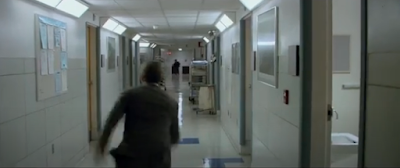
Let us now flash ahead to the middle of the movie, after various machinations have caused Vincent to accompany Max on his nightly vigil to his mother’s hospital room, Max, sensing an opportunity to blow everything up, seizes Vincent’s all-important briefcase and flees down the corridor.

Naturally, Vincent gives chase.


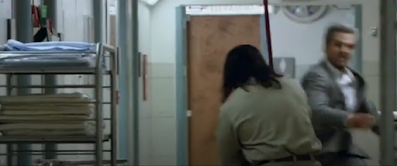
But as he does, his path down the same corridor is briefly interrupted, forcing him to cut like a football running back to his left in order to...


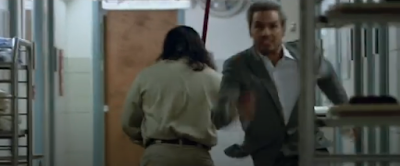
...evade this hospital janitor wheeling a giant mop bucket down the hall. The janitor, however, is not bothered nor confused. Rather he makes his own evasive maneuver, tilting to his own left to allow Vincent, this man in a clear fit of rage, the space to get around. 


Then the janitor continues down the hall without so much as looking back.


The extra could have played this moment as most extras would, reacting, overreacting, trying to make a moment to sell on that reel, at least ensuring his face gets seen. This extra, however, locks in with Mann’s groove, deciding that his character would not react but remain indifferent, if not bravely oblivious, to the world’s noise. 

Thursday, October 31, 2019

Shout-Out to the Extra: Report to the Commissioner Version

Shout-Out to the Extra is a sporadic series in which Cinema Romantico shouts out the extras, the background actors, the bit part players, the almost out of your sight line performers who expertly round out our movies with epic blink & you’ll miss it care.

1975’s “Report to the Commissioner”, as we shall see tomorrow, excels at 70s-era NYC location work, frequently seeming to just drop its actors into the midst of genuine street level hustle and bustle and covertly filming them interacting. Indeed, it excels so much at capturing this kind of unpremeditated authenticity that sometimes the extras, as you can see below, don’t even play along.


Pour one out for the extra.

Wednesday, March 27, 2019

Shout-Out to the Extra: School of Rock Version

Shout-Out to the Extra is a sporadic series in which Cinema Romantico shouts out the extras, the background actors, the bit part players, the almost out of your sight line performers who expertly round out our movies with epic blink & you’ll miss it care.

Last year My Beautiful, Perspicacious Wife and I and a couple friends attended a show by bluegrass supergroup I’m With Her at Thalia Hall. Midway through the show, after a rousing number, as the crowd applauded the all-female trio, some male knucklehead in the balcony nosebleeds thought it a fine time to holler god-knows-what in the direction of band member Sara Watkins. I couldn’t make out what he was saying; no one around me could make out what he was saying; Sara Watkins couldn’t make out what he was saying. When his noisy mush-mouthed blather concluded Sara Watkins waited the perfect comic pregnant pause and then said into the microphone with this strained sort of voice as honest as it was humorous: “What?” The crowd laughed so loudly in unison that we drowned out whatever this dufus bellowed as a response Sara Watkins didn’t want to hear anyway. And I thought, That Guy. Every concert has That Guy.

A few years earlier when My Beautiful, Perspicacious Wife and I saw the incomparable Nikki Lane at the Double Door (rip) some mostly bald, middle-aged moron in a black leather jacket kept hollering at Ms. Lane, like he was 22 and thought he was going to hook up with her after the show, when he wasn’t pointing at the guitarist after every one of his soloes like the two were axeman contemporaries. The guitarist deftly evaded eye-contact. At the turn of the century, at The Landing in St. Louis, when I was sitting in the grass listening to some band play a free show, I became so disgusted that they chose to play “Superman (It’s Not Easy)” (there is backstory I will not delve into) that I vocally announced my displeasure with their choice of cover. My friend Daryl then incredulously advised: “Uh, Nick, I think that’s their song.” Hells bells, it was. Five For Fighting, at the peak of his power, was playing a free stage, and I was mocking him for playing his own song. Some guy I didn’t know sitting nearby actually commiserated on my behalf that he didn’t know it was really Five For Fighting either. Still, if I’d been closer to the stage and Five For Fighting had decided to heckle me, I would have had no choice but to sit there like the idiot I was and take it. I, readers, was That Guy.

The climactic moment in Richard Linklater’s critically appreciated yet somehow still significantly under-valued “School of Rock” (2003) involves a band of musically gifted kids under the command of their metal axeman masquerading as teacher (Jack Black) playing The Battle of the Bands. They knock the gig out of the park. They are the clear winners, but, like Roy Jones Jr. inexplicably losing the Light Middleweight Gold Medal boxing match at the 1988 Olympics, lose out to the piffling No Vacancy. The crowd is chagrined. Well, not the whole crowd. As No Vacancy’s victory is announced, Linklater cuts to a wide shot of the audience, presumably to breathe in the pall that has just been cast. But one person, near the foot of the stage, over to the left of the frame, goes hog wild.


On the DVD commentary track, both Linklater and Black reference this dude. Black even calls the moment one of his favorite in the movie. Neither of them, however, indicate this was planned. Linklater, in fact, says that working with such a large crowd often results in unexpected moments of spontaneity. Many filmmakers, I reckon, might have edited this out, or before the next take told this extra to zip it. But Linklater, bless his heart, left the moment in. He knew what that extra was doing, and Black did too. That extra decided, in the moment, to make this concert feel truly authentic; he decided he would play That Guy.

Pour one out for the extra...


Thursday, February 14, 2019

Shout-Out to the Extra: Mamma Mia! Here We Go Again Version

Shout-Out to the Extra is a sporadic series in which Cinema Romantico shouts out the extras, the background actors, the bit part players, the almost out of your sight line performers who expertly round out our movies with epic blink & you’ll miss it care.

Spoiler: In “Mamma Mia! Here We Go Again”, Andy Garcia’s legendarily gravelly hotel manager Señor Cienfuegos has his name withheld nearly the entire movie because his name turns out to be Fernando, perhaps the most preeminent ABBA song not employed in the first “Mamma Mia.” We learn his name when he spies Ruby, mother to “Mamma Mia!” protagonist Donna, grandmother to “Mamma Mia! Here We Go Again” protagonist Sophie, and Señor Cienfuegos’s long lost love. And because this is a jukebox musical, when they spy each other, they sing “Fernando.”

As they sing, they cross a scenic terrace, meeting halfway, meaning they move through a convocation of extras. And yet, if these two stars make the scene, the nameless people on the periphery, as they so often do, enhance it.


Like this extra, who does not simply stand and watch but swoons.


Or these extras who, as Garcia passes them, turn to one another, raise their glasses and share a toast. These are extras not merely getting into the spirit of the scene but reveling in their good fortune to be part of it.


And then you have these extras, all of whom are like background snowflakes, each one special in her/his own way. You’ve got the guy sitting in the bottom right-hand corner who has decided to play this moment like he’s really hearing what Cher has to say, you know? You have the woman in the striped top just above the guy sitting down who looks as if she’s trying so hard to figure out what kind of face to make that her face has instead become frozen in impassiveness. But it’s the three women on the left hand side of the frame that really make it.

Moving from back to front, you’ve got the woman in the black skirt and colorful white top. She is not swooning, not like the woman up above, nor does she quite have the appropriate basking in the moment’s romance reaction like the extra in the striped head scarf. No, this extra seems to be bubbling up with glee that Cher is passing by. And the extra in the red top and white shorts, meanwhile, right next to her appears excited AF that Cher is passing by. And the woman in the black dress....oh my. She looks like the ghost of the Virgin Mary is passing by, which is totally right.

Cher is playing a character, of course, but really, she’s Cher, in countenance, in spirit. More than likely if you went to see “Mamma Mia! Here We Go Again” you knew Cher was in it and you were waiting for Cher’s moment and here it is, finally. And it is difficult – rightfully, respectfully – to take your eyes off her, or even off Garcia, who was, as many awards pundits have noted, snubbed for an Oscar nomination. As such, these extras transcend mere filler, becoming fill-ins for us, the audience.

Pour one out for the extras.....


Tuesday, September 25, 2018

Shout-Out to the Extra: Ronin Version

Shout-Out to the Extra is a sporadic series in which Cinema Romantico shouts out the extras, the background actors, the bit part players, the almost out of your sight line performers who expertly round out our movies with epic blink & you’ll miss it care.

The third and final car chase featured in John Frankenheimer’s “Ronin” is a ferocious affair in which the pursued and the pursuant zoom through the streets of Paris before eventually speeding against traffic. Frankenheimer toggles between close-ups of the characters’ reactions, point-of-view shots looking through the car windows at incoming traffic, and exterior shots of the cars’ evasive tactics and deft maneuvers. But Frankenheimer does not strictly limit this scene to the two cars in question. No, after the pursed and the pursuant have moved on, Frankenheimer frequently lingers over the damage left in their wake, cars crashing into each other, fireballs kicking up, even a car-carrying trailer getting slammed into and having one of its automobile hauls fly off the truck’s headrack and crash to the ground. There is, in other words, a world outside of “Ronin”, one not really explored, because it shouldn’t be, but glimpsed, felt.

It is also glimpsed in the beginning when most of the movie’s band of professional mercenaries first meet up in a Parisian bistro. Larry is already there, drinking and smoking, and Dierdre, the ringleader, arrives and then masquerades as a bartender, pouring an adult beverage for Vincent, who arrives not long after her. Sam arrives last, evoking his m.o. And so they all stand there, acting like they aren’t who they are, refraining from getting right down to the gritty-gritty because Frankenheimer has purposely placed a few patrons in the bistro that the Ronin are waiting on to clear out. A patron like this one…


If I had hundred and twenty-five thousand preeminent takeaways from my first trip to Paris last year, perhaps the pre-preeminent takeaway, aside from cheese, was café culture. Reader, I cherished café culture. Sitting at a café, sipping at my libation of choice, watching the world go by, letting time, worthless time, slip away, made my heart full. Nowhere, not even the movie theater, have I ever found a place that so impeccably matches my everyday air as every Parisian café I visited. The first time I sat at one, even though I did not necessarily know exactly where I was within the city’s geography, I felt right at home. Then again, I was on vacation. It is easy to bask when you are on holiday. I assume if I lived in Paris that I would not always bask in a café; sometimes, no doubt, I would lament. And that is why I love this extra so much. She could have just sat there, doing nothing more than clocking the hourly rate for a French extra. But she didn’t. She acted. She made a conscious choice to play this nameless patron a certain way. She lamented.

What’s more, in this particular frame, both she and Jean Reno’s Vincent seem to be lamenting, each of their gazes fixed downward in that way you do when some sort of existential question has left you  searching your soul for a doubtlessly non-existent answer. If extras are so often meant merely as, shall we say, bodily filler, existing simply to occupy space, forgotten even as they stand (sit) in plain sight, in this shot, the extra and the character rest, for one beautiful instant, on the same plain. In “Ronin”, may the movie gods bless it, everyone, line of dialogue or not, has something to lament.

Pour one out for the extra.


Thursday, July 26, 2018

Shout-Out to the Extra: M:I - Rouge Nation Version

Shout-Out to the Extra is a sporadic series in which Cinema Romantico shouts out the extras, the background actors, the bit part players, the almost out of your sight line performers who expertly round out our movies with epic blink & you’ll miss it care.

As the curtain on “Mission: Impossible — Rogue Nation” (2015) raises, IMF agent Ethan Hunt (Tom Cruise) is trying to board a cargo plane in Belarus about to take off to prevent a gaggle of nerve gas from winding up in the wrong hands. But to get onboard he needs Benji Dunn (Simon Pegg), who is on site, to hack into the plane’s operating system to get the door open. But to hack into the operating system Benji needs Luther Stickell (Ving Rhames), who is patched in remotely from Malaysia, to hack a Russian satellite, a governmental no-no. In the midst of all this, instructions, in a manner of speaking, are relayed from William Brandt (Jeremy Renner), Operations Director, at IMF headquarters on the other side of the globe. And despite this hopping back and forth between different time zones, the moment still feels intimate, the camera cutting between the four mentioned characters as if no one else is even involved. But other people are involved. As all this transpires, the plane begins to taxi, which Brandt realizes. “The package,” Brandt says with the air of a Domino’s manager who just realized his deliveryman left one of his deliveries in the store, “is still on that plane.” As he says it, we suddenly see an extra in the bottom left hand corner of the frame.


As first she is looking forward, in the same direction as Brandt, presumably at the IMF’s version of The Big Board. But when Brandt advises the package is still on the plane, she glances at him out of the corner of her eye.


This extra could have merely turned her neck, nothing more, but expressively she goes for it, and good for her. Her face betrays worry, but it is not the kind of worry that is necessarily worried about how they are going to get the package off the plane. If it was that kind of worry her brow, no doubt, would be more furrowed, connoting insta-brainstorming. No, this worry resembles a passenger in a car when the driver decides to floor it in the middle of rush hour traffic. The whole scene, frankly, is played as much at a comic pitch as an action-adventure one, and this extra’s A+ expression is evidence.

Stakes in movies like this are always high. If it’s not America, then it’s the world; if it’s not the world, then it’s the universe. The stakes are definitely high in “Mission: Impossible — Rogue Nation.” Still, even as the story trots the globe and encompasses geopolitics, this extra functions as a droll ode to the flunkey’s plight. As Brandt makes clear in the moment, his agency is under investigation, and hacking into a Russian satellite un-approved will no doubt cause additional consternation. Maybe hacking into it and preventing that nerve gas from getting where it should not go can be attributed to national security, sure, but in that extra’s expression you see how sometimes national security, and all that it entails, goes hand in hand with job security. “Am I,” she seems to be thinking, “about to get fired?”

Pour one out for the extra.


Wednesday, April 11, 2018

Shout-Out to the Extra(s): Geostorm Version

Shout-Out to the Extra is a sporadic series in which Cinema Romantico shouts out the extras, the background actors, the bit part players, the almost out of your sight line performers who expertly round out our movies with epic blink & you’ll miss it care. 

Disaster movies are inherently obligated to spend large swaths of time simply filling the screen with their chosen calamities, whether it’s monsters or meteorological events or some mixture of the two. No matter how impressively rendered these disasters might be, however, they are often not enough to in and of themselves communicate the full weight of terror. No, that requires a human counterpoint, and so for ages directors have employed standby reaction shots, cutting from the disaster to some nameless, slack-jawed extra staring up at a green screen, or capturing some nimble-footed extra fleeing the impending doom wrecker. If so many of these stock scenes are forgettable even as they are happening, some occasionally, whether through intentional or unintentional inspiration, can achieve glory, like the Margarita Guy from “Jurassic World.”

Dean Devlin’s “Geostorm” is packed with these stock scenes. The scenic beaches of Rio de Janeiro, for instance, are swallowed whole by an icy tidal wave, blotting out the sunshine and sending scantily clad beachgoers scrambling, including one young — expositorily deemed Bikini Girl in the closing credits — the camera locks onto as she runs, and runs, and runs, somehow staying not only one step ahead of the looming tidal wave but evading a jetliner that ices over in the sky and crashes directly behind her. The latter happens directly behind her as she comes up against a no-way-out wall in some alley, which seems like far too small a space to accomodate such a theoretically smashing sequence, never mind allowing her to escape unharmed, which she apparently does, despite doing nothing more than covering her head as the plane smashes apart, though who knows because we never see her again. Once the tidal wave sequence is complete, the movie’s use for her ceases, as is the case with so many valiant disaster movie extras.


If it’s not the funniest scene in the movie, that’s only because there are so many to choose from, like the Democratic National Convention getting incinerated by lightning. To explain why our extra in that scene rules, we have to set up the scene fully, which requires us to explain the whole movie, which is to say that a global satellite system designed to control the weather has been hacked in order to unleash the eponymous Geostorm on an unsuspecting Earth. Only the President of the United States (Andy Garcia) has access to the codes that can kill the Geostorm, and to get to the President, the film’s co-hero (Jim Sturgess) and his secret service agent lady friend (Abbie Cornish) stage an assassination attempt at the Democratic National Convention by firing a few shots into the air. This naturally causes everyone to panic and flee, though the Secret Service, if you watch closely, is really, really slow on the draw in getting to POTUS in the aftermath of those shots, and, long story short, the President winds up in a car with the film’s co-hero and his secret service agent lady friend as the Geostorm is about to devour the arena where hosting the DNC where they just were.

Okay. So. While simply showing the arena from the outside as it is incinerated does allow for some prime LOOK CONCERNED WHILE LOOKING AT THE GREEN SCREEN! reaction shots from Andy Garcia and Jim Sturgess, that is nothing compared to the brief scene back inside the arena just before it gets blown to smithereens, a scene involving a nameless extra we will simply deem Dr. Phil Lookalike. This extra.....


If most everyone else has fled on account of, you know, an assassination attempt and an impending Geostorm, Dr. Phil Lookalike is still sitting there on his folding chair with this miniature American flag waiting for...who knows what. Obviously he is just planted there by the film’s director to proffer the aforementioned human counterpoint to the arena being incinerated a couple seconds later, but the make-believe backstory that emerges in one’s mind over Dr. Phil Lookalike waiting the Geostorm out is nonetheless pretty comical. And, of course, that comicality is brought home in his expression, which is brilliantly juxtaposed against the more conventional Oh No expression of the extra in the lower left hand corner of the frame. Dr. Phil Lookalike’s expression is more crabbily fatalistic, seeming to suggest a man who chose to shelter in place and now realizes, a split-second before he merges with the infinite that, hells bells, he choose wrong. Godspeed, Dr. Phil Lookalike, we hardly knew ye.

Pour one out for the extra(s).....


Thursday, February 15, 2018

Shout-Out to the Extra: Under the Tuscan Sun Version

ASSISTANT DIRECTOR: “Extra?! Extra in back?! When I said act cool, I did not mean act too cool for school! Can you take it down a notch, please?”
EXTRA: “..........”  
ASSISTANT DIRECTOR: “Oh, ok. Never mind. Picture’s up!” 


Thursday, January 11, 2018

Shout-Out to the Extra: Moving Target Version

Shout-Out to the Extra is a sporadic series in which Cinema Romantico shouts out the extras, the background actors, the bit part players, the almost out of your sight line performers who expertly round out our movies with epic blink & you’ll miss it care.

Last July I spent a throwback weekend hanging out with my friends Daryl and Rory, and I say throwback because it was the first time in eons when we got together to simply sit down, watch a bad movie and crack wise over a couple cold ones. The DVD Daryl brought along just for the occasion was not of some landmark movie, or semi-landmark movie, or cult classic. No, that it was a DVD as opposed to a blu ray should tell you everything; it was 1995’s “Moving Target”, a title straight from the rejected pile of Steven Seagal movie titles, starring Michael Dudikoff as a bounty hunter who runs afoul of the Russian mob and gains the aid and trust of Detective Don Racine, played by Billy Dee Williams who is immortal but was nevertheless well into the melancholy point of his career where every character he played was affixed with a rank – Detective, Admiral, Captain, Commander, etc.

Per custom, the point wasn’t to watch so much as watch and comment, kind of a “Mystery Science Theater 3000” situation, which is not a program I have ever really ever enjoyed all that much, because riffing is funny when you’re part of it but not so much when you’re outside of it, kind of a Talking About My Fantasy Football League situation. And that is why I will refrain from submitting any of the inside jokes the three of us cultivated that afternoon. Still, from this viewing there emerged something beyond inside baseball, something that could provide enlightenment into the mind of the extra, where the job to act like you are in the world the movie is presenting and not in a movie and on camera is often more difficult than you might presume, and can be futzed up in post-production by an editor who is likely overworked and underpaid and in rush and not in tune to every little detail outside of the foreground.

There is a scene midway through “Moving Target”, or maybe the scene was early on, or perhaps it was quite late, I have no idea, in which Michael Dudikoff’s character is purchasing a hot dog from a street vendor. The camera is street level, appearing to peer through the crowd, almost as if it was captured on the fly, and perhaps it was, but also trying to lend this spotty little thriller some authenticity. Alas, that authenticity goes up in flames when the woman playing the hot dog vendor looks right into the camera.


What’s most funny is that you can sense this coming. All three of us, Daryl, Rory, me, were on the edges of our seats, so to speak, waiting for it to happen because the extra, as you can sort of see, is playing the moment with this small smile, which does not suggest overtaxed street vendor to me so much as person too excited to be in a crappy movie. In that smile you can sense the internal strife in not wanting to look, in knowing she shouldn’t look, but being overcome with the unstoppable desire to look anyway.

It’s hard being an extra. You’re on set all day, often with scads of humdrum downtime while the camera is set and the star is primped, stuck with meager rations from the craft table, and continually forced to act in the moment when you generally know that what shows up onscreen will, more or less, or completely, remove you from that moment. And so for these extras to stay in the moment, take after take after take after take after take after take, is not something that we should take lightly, though we often do, and we often never realize how lightly we take until a comical moment like “Moving Target”.

Pour one out for the extra...no, no, no, no, no. Pour one out for all the extras, all the ones who didn’t look. Respect.


Wednesday, December 06, 2017

Shout-Out to the Extra: Love Actually Version

Shout-Out to the Extra is a sporadic series in which Cinema Romantico shouts out the extras, the background actors, the bit part players, the almost out of your sight line performers who expertly round out our movies with epic blink & you’ll miss it care.

The prologue for Richard Curtis’s “Love Actually” (2003), a motion picture consisting of a mixture of strawberries, broken meringue, and whipped heavy cream, finds Hugh Grant as Britain’s Prime Minister explaining in voiceover a preference for kicking up his heels at Heathrow Airport’s arrivals gate to simply watch the affection exchanged between “fathers and sons, mothers and daughters, husbands and wives, boyfriends, girlfriends, old friends.” After that opening, however, there are a lot of observations about love, or the flickering myth version of love, if you prefer, but not a lot of characters standing back, like the Prime Minister essentially is in this opening, to observe love themselves. The closest we get to the Heathrow Airport arrivals gate – uh, aside from the Heathrow Airport arrivals gate right there at the end – is the climactic scene toward the end when neurotic Jamie (Colin Firth) dispels with his neurosis to make a grand gesture by catching a flight to track down his beloved Aurelia (Lucia Moniz) at the restaurant where she works to make marriage proposal in Portuguese. As he does, everyone in the restaurant comes to a standstill, including the waiter pictured below.


Every time I saw this frame, whether at the many annual tryptophan-hazed Thanksgiving viewings I had with friends over the years or anywhere in-between, I only really ever noticed the waiter. How could I not? His smile does not overwhelm, which is just right, a little more private, as if even in this moment he is adhering to the unwritten code that the customer comes first. Yet I had never noticed a couple others in the frame. The server to his right, for instance, who seems a little less pensive and a little more put out, as if she was just about to finish her shift and now this will further delay her fleeing. She, however, is nothing compared to the dude to the bottom of her, obscured by the subtitled “they”, who seems, like, legitimately angry, like who are these intruders, these glory hounds compromising his culinary experience. Indeed, his irritation and her more mild form of it contrast impeccably with the whimsy of the central waiter and make this frame so much fuller than I ever realized.

In recent years, of course, so many civil hands of movie lovers have been left unclean with civil blood in disputes over whether “Love Actually” is merely a rom com sugar plum fairy that makes even me, traditionally snide critic, want to say things like “You know, people just go to the movies to be entertained” [scrubs own mouth with soap) or something far more insidious, a sexist trash heap as Amy O’Dell deemed it so harshly for Cosmopolitan.

I am receptive to the arguments of O’Dell and the ten thousand others like hers, honestly, though I genuinely believe that “Love Actually” was crafted with far too much guilelessness to be considered so malicious. And I suppose that is why I identity with this frame. I understand the server who just wants this whole bad-Portuguese proposal to end, and I am empathetic with the incensed gentleman who doesn’t believe all this hooey for a second. Still, in this photo I am the waiter, and will be forever, standing back, observing love, believing in it, God help me, ’til the end.

Pour one out for the extra...


Wednesday, November 08, 2017

Shout-Out to the Extra: Men in Black Version

Shout-Out to the Extra is a sporadic series in which Cinema Romantico shouts out the extras, the background actors, the bit part players, the almost out of your sight line performers who expertly round out our movies with epic blink & you’ll miss it care.

“This makes total sense. How else do you explain New York?” This is what Darrell Edwards (Will Smith), newly christened as Agent J says upon learning from his mentor Agent K (Tommy Lee Jones) that Earth is overrun by aliens, all of whom have adopted some sort of human visage to blend in, and which leads their secret organization, the Men in Black, which gives Barry Sonnenfeld’s 1997 blockbuster its title, to move about undetected and maintain order. And Edwards’s line is a funny joke, see, because New York, see, is overrun by so many crazy crazies that the only possible explanation for such behavior is them all being aliens.

When I visited my best friend in Brooklyn for the first time many years ago, we had not been on the street more than a minute when some dude in a flannel shirt on the other side of the street began shouting for no particular reason. Shouting about what I am not entirely sure because it was difficult to decipher, but he was likely irate with some perceived slight, probably afforded by the universe, or an invisible man, I don’t know, and what truly stayed with me about the moment was how everyone else on his side of the street and our side of the street just coolly rolled with it, some of them even smiling, just another day. And in my subsequent visits to Brooklyn, and the rest of New York, I have seen this same sort of public dispassion on display many times more, and I am so impressed with it that I have sort of adopted this public dispassion, with a few modifications, for my own similar encounters on the streets of Chicago, or in Mariano’s grocery stores, where I was on Monday in the donwnstairs bar where some guy had a moved a chair under the escalator and was vociferating at the linoleum floor while changing his socks.

“Men in Black” brings this public dispassion home acutely when Edgar (Vincent D’Onofrio), a farmer whose body has been assumed by an alien bug, arrives in New York, stumbles out of his truck and then stumbles around in a hysterically off-kilter manner that appropriately embodies an E.T. inside a human. And as he passes by some archetypal New York bystander, he raises his hand, like he’s crossing the street and the bystander is a car and he’s telling the car not to go until he’s finished crossing. And the extra portraying the bystander makes it to Warp 10.


Lord, this guy plays the moment with precision. Your natural inclination to assume the role of a bystander encountering a dude on the street whose body is making motions that shouldn’t be possible is probably to overplay, to really recoil or widen your eyes or drop your jaw. Not this extra. No, this extra knows he’s a New Yorker. This extra not only does not give an inch, and not only does not really even change his facial expression, he just keeps right on walking, a passerby literally passing by an alien by, rolling with it, whatever, dude, whoever you are. Later that night he probably watched the Mets game at his preferred watering hole and never thought about this weird, stumbling dude ever again.

Pour one out for the extra...


Thursday, October 05, 2017

Shout-Out to the Extra: Bunny Lake Is Missing Version

Shout-Out to the Extra is a sporadic series in which Cinema Romantico shouts out the extras, the background actors, the bit part players, the almost out of your sight line performers who expertly round out our movies with epic blink & you’ll miss it care.

In a chat last year with Thrillist, the gastronome of robust repute, Anthony Bourdain, went off on the phenomenon of craft beer. Not on craft beer itself, per se, but on the culture surrounding it and that culture's kind of appropriation of, shall we say, bar culture. “A bar,” Bourdain said, “is to go to get a little bit buzzed, and pleasantly derange the senses, and have a good time, and interact with other people, or make bad decisions, or feel bad about your life.” This is to say, a bar is not about sitting there with a flight of five or six or seven or eight, etc., beers, all of varying flora and fauna and god knows what, comparing and considering, really tugging hard on your thinking cap. Because, as Bourdain implies, the bar is where you go to remove your thinking cap.

In recently watching Otto Preminger’s noir-y nightmare “Bunny Lake Is Missing”, in which Ann Lake (Carol Lynley) discovers her four year old daughter Bunny has gone missing from school, for the first time, I was struck my the scene where Newhouse (Laurence Olivier), the superintendent trying to get to the bottom of Bunny’s disappearance, takes Ann to a pub. “Ever been in a pub before?” he asks. “No,” she says. “Here it is,” he says, “the heart of merry old England. Complete with dirty glasses, watery beer, drafts under the doors, and a 23-inch television.” It’s a description, I think, of which Anthony Bourdain would approve, and the pub we see is not unlike the one Bourdain gives, where nobody glimpsed in the background through Ann and Newhouse’s conversation seems to be giving much thought to anything other than the beer in their glass, not even when The Zombies make a cameo appearance on a TV over the bar.

But this is best exemplified when Ann’s protective brother Steven (Keir Dullea) enters and tracks down Newhouse to give him a piece of his mind. Eventually Newhouse’s line of questioning peeves Steve and so he stands up in order to slug the superintendent, only to be held back by one of Newhouse's men. As all this unfolds, you will notice an extra in the background...


It is a little hard to see in the still I grabbed, but Steven is rearing back to punch the superintendent, and what you see is exactly how the extra plays the moment – that is, not playing the moment all. That’s an extra who has decided to play this scene with this thinking cap off. That’s an extra who has decided to play the moment as a man who has come to the bar to get a little bit buzzed and feel bad about his life, and if he feels bad about his life, what does he care about these others lives over here? Pffffft. And even as Steven is forceably ejected, the extra maintains that exact arid air, as if he is just watching a tumbleweed roll by.

Pour one out for the extra...


Wednesday, August 23, 2017

Shout-Out to the Extra: Top Gun Version

America First is the foremost policy slogan of the current President of the United States. And it is an interesting phrase. America First, as in “If you’re not first, you’re last,” which was the philosophy espoused by Reece Bobby (Gary Cole) to his son Ricky (Will Ferrell), NASCAR driver extraordinaire, in “Talladega Nights”, one of the finest film lines of the new century, so exact in its absurdness that NBA superstar Kevin Durant literally, un-ironically quoted in a written profile. And it seemed that much more prescient when Durant, not long after quoting it, ditched the Oklahoma City Thunder for superpower Golden State to get a ring because because, well, it’s all about winning, whether it’s the basketball court or, as we were reminded the other night, the battlefields of Afghanistan.

It’s a thin line between politics and sports. Why else would there have been an over/under on the Clinton/Trump debates or bars offering drink specials during the Comey Hearing? Partisan entrenchment is just like picking a team, throwing on a metaphorical t-shirt with a donkey or an elephant and following the party leader’s plea to MAKE SOME NOISE. “Scoreboard!” supersedes policy. Why else would President Trump refer more to the specifics of his electoral victory than the specifics of, say, his healthcare bill? This inherent insistence on filtering politics through a sports prism, however, often goes beyond party and to country. In the go-go 80s, for instance, when America was in the midst of a war served cold it was Us vs. Them, Red, White & Blue vs. Red.

This geopolitical competition was part and parcel to “Top Gun” (1986), the preeminent American movie of the 1980s. The infamous (or was it just famous?) volleyball scene was not superfluous; this was a sports movie in which everything boiled down to rivalries, on the volleyball sand, in the air as Navy fighter pilots competed for the Top Gun Trophy. “Remember boys,” says Slider (Rick Rossovich), “there’s no points for second place.” The actual Naval Fighter Weapons School on which the film was based did not have a trophy or a competition, both of which were added to the cinematic version as a means to add urgency, of course, but also to underscore America’s overarching competitive drive. And that comes home in the concluding sequence in which Americans duke it out with Russians over the Indian Ocean, Maverick and Iceman vanish the evil MIGs and our two adversarial aviators meet on the aircraft carrier afterwards and...wait.

What’s that I spy?


Whether the extra was told to do this or was caught up in the moment we will likely never know, but whatever the case may be, it was the right decision. After all, index fingers after sports victories had become all the rage, so much so that some scholars cite Georgetown’s Patrick Ewing holding aloft his index finger after losing in the NCAA Basketball Championship game to Villanova the previous year as the moment “We’re #1” jumped the shark. Not me. I pinpoint that moment as right here, when the deck of an aircraft carrier in the midst of the Cold War became like a gym floor at the end of the NCAA Basketball Championship game. Maverick returned to Miramar to become a Top Gun instructor, as everyone knows, but no doubt in-between he went to Disneyland and in a Rose Garden ceremony gave Reagan a Top Gun bomber jacket.

Thursday, July 06, 2017

Shout-Out to the Extra: Jurassic Park Version

Shout-Out to the Extra is a sporadic series in which Cinema Romantico shouts out the extras, the background actors, the bit part players, the almost out of your sight line performers who expertly round out our movies with epic blink & you’ll miss it care.

“Jurassic Park”, 1993’s blockbuster box office champ, was notable for its dinosaur special effects, obviously, as well as Jeff Goldblum’s scene-stealing, kooky supporting performance. Yet there was another performance just as memorable as Goldblum’s. No, not Sam Neill, though he was efficiently taciturn, and not Samuel L. Jackson, who chainsmoked with fine verve, but Laura Dern as Dr. Ellie Satler, an underwritten part compared to her male brethren that Dern nonetheless gave so many little bits of actorly flourish, both in scenes and moments where she is featured and on the edge of frames where if you watch close you see she is never not up to something.

I think of when we are introduced to both her and Neill’s Dr. Alan Grant on a paleontological dig in the Badlands of Wyoming, which allows space for us to simultaneously see Grant’s expertise and his dislike for kids when he lectures a particularly precocious young boy on the attack methods of velociraptors. As Neill’s character is about to launch into his soliloquy, Dern, standing at his side, busts out this incredulous grin and says, mostly to herself, “Uh oh, here we go.” Perhaps I’m wrong, but it strikes me as a moment Dern improvised given how its dialed back a little bit on the audio and sort of off to the side of the principal action. And yet it speaks volumes, evoking how this forthcoming lecture is typical for Dr. Grant, and something Dr. Sattler has learned to live with.

Though Dern is a principal cast member, this moment also speaks to the extra’s plight, forced to populate scenes where they are never ever the focal point and yet round them out anyway by always appearing to be engaged with what’s happening in front of them. Like, say, this extra…


She is simply there to provide an audience for Dr. Grant, of course, a homo sapien filling in the frame. And given that this scene was filmed at Red Rock Canyon in the Mojave Desert, which could have been the comfiest day of shooting, it would be easy to forgive an extra for just coasting. This extra does not coast. She is listening to Dr. Grant, by God, even if it might be the 29th take in a row for Neill, hanging on every word and then reacting to whatever those words, like these...


Here in the wake of Dr. Grant explaining just how easily a velociraptor can spill your intestines, the extra exudes less horror than “Golly gee willikers”, a choice I admire. Just like Dr. Grant and Dr. Sattler cannot undertake an excavation without a few trusted underlings, a director like Steven Spielberg cannot film a scene of an excavation without a few trusted extras to make it all seem real. When the actual velociraptors show up later they are predominantly at the mercy of animatronics, but this extra is at the mercy of no one’s decisions but her own. Respect.

Pour one out for the extra...


Thursday, December 22, 2016

Shout-Out to the Extra: Serendipity Version

Shout-Out to the Extra is a sporadic series in which Cinema Romantico shouts out the extras, the background actors, the bit part players, the almost out of your sight line performers who expertly round out our movies with epic blink & you’ll miss it care.

Being that I'm about to turn 40, and being that I grew up in central Iowa where the mall was the center of consumer experience, I remember the old days when holiday shopping meant you had to go out among the living. Going out among the living meant driving to the mall and circling the parking lot for 25 minutes until you saw a space open up that was 2.5 miles away. That long non-funeral funeral procession to the mall, though, no matter how cold it might be, was a breeze compared to being inside the mall. Oh my God, a mall at Christmas. In his book "The Christmas Blizzard" Garrison Keillor captured it just right, writing of "The anguished jollity of store clerks living in the hell of holiday shopping."

"Serendipity", my beloved "Serendipity", damn the grinches or those merely looking for a well-made motion picture, actually contains an image that implicitly, excellently encaptures this anguished jollity. It is not among the more famous images usually broached by film professors, like the recurring NYC snowfall that is transformed into a winter wonderland so rivetingly old-timey that it approximates a visual Shakespeare sonnet (reader grabs Nick's keyboard away from him)

No, this image happens in the earlygoing, during the opening shot follows a pair of gloves that have apparently been placed in the wrong section of a Bloomingdales as a sales clerk takes them from the wrong place to the right place, and as she does so, she is forced to navigate a crowd of holiday shoppers, given the film's Christmas setting. In the frame below, you see her there to the right, with her back to us, and so in this shot, she momentarily gets lost, giving way to the guy to her left, the guy moving toward us, which is the guy we want to talk about.


There's this thing you start to realize when your primary mode of getting around is public transportation - you start to realize, particularly at rush hour, that people don't let you off the train before they want to get on. The train stops, the doors open and as you go to get off, people are already piling on, advertently styming your progress to further theirs. I confess...I did this once. As the train pulled in to the station, I noticed more open space than usual at rush hour and so when the doors opened, absent-mindedly, idiotically, I made my move onto the train. I ran right into this guy who was simply trying to exit. He gave me a look that unmistakably said: "You dumbass." And you know what? I was a dumbass. I felt awful the whole train ride home. I wanted to track that guy down apologize. I wanted to tell him he was in the right and I was in the wrong. Now I will stand aside and let everyone off a train even if it means I get stuck with a crappy spot because other people are shoving their way past people trying to exit.

Anyway, long story much shorter, this guy in "Serendipity" is like the guy trying to get off the subway car at rush hour. In the audio he keeps saying "Excuse me...excuse me." It's not an angry "excuse me", though, it's a weary one; it's the ten-thousand and one "excuse me" of ten thousand others on an awful day of holiday shopping. Holiday shopping, in other words, is trying to get off a subway car, just in a department store setting, over and over and over again. And in the forthcoming narrative of transplendent, or thereabouts, romantic destiny, well, I nevertheless also love imagining this exhausted holiday shopper still out there somewhere in perpetual anguished jollity. If the cosmic needs a counterweight, it's him.

Pour one out for the extra...


Thursday, November 17, 2016

Shout-Out to the Extra: Hoosiers Version

Shout-Out to the Extra is a sporadic series in which Cinema Romantico shouts out the extras, the background actors, the bit part players, the almost out of your sight line performers who expertly round out our movies with epic blink & you’ll miss it care. 

 “Hoosiers” was released thirty years ago this week. A lot has been written about this movie – a lot has been written about this movie by me – and by now you have probably heard the story that for the climactic state basketball tournament clash between itty bitty Hickory and mighty South Bend Central, the filmmakers could not find enough extras to fill all of Butler Fieldhouse, forcing them to move the extras around from shot to shot so that it always appeared as if the gymnasium was full. Boy, that’ll earn the little money of your lower-rung production crew. But there is more to the story of extras in “Hoosiers” than this one.

There is an extra, in fact, one tasked with portraying a mighty South Bend Central player, that the esteemed Bill Simmons wrote about many years ago – “My favorite part of the ensuing chaos: As Jimmy is carried around the court, the cameras cut to the losing bench, where one of the big guys on South Bend is hugging a distraught cheerleader, finally glancing out to the court at Jimmy, pointing, and saying something that was undoubtedly the 1951 equivalent of ‘That’s one bad mother------.’” Truth. Watch the scene and you will see the moment described and you will nod and think “Yup.” That extra always caught my fancy too, but there is another extra that has always struck my fancy even more.

This extra is glimpsed a few times throughout, usually sporting a pair of overalls, and he’s always right down front in whatever auditorium the Hickory Huskers happen to be playing, like a more agriculturally competent version of L.A. Lakers fan #1 Jack Nicholson. A guy who always sits this close must clearly hold the team close to his heart, and while the extra is never allowed to speak, he still communicates that love in his few brief moments, the kind of love that I dare say is familiar to many fans.

This is never more apparent than at Regional Finals in Jasper. In the midst of a tense contest to determine whether itty bitty Hickory will reach the hallowed State Championship game, Hickory’s Everett Flatch is chagrined to find the injury he suffered in the previous game has flared back up. Normally this would send him to the bench. But these are delicate times. Two Hickory players have fouled out and so removing Everett from the game would mean hapless Ollie would have to go in. At first, Coach Norman Dale sends Everett back to the court. But upon doing so, he trudges toward bench, hand to brow, clearly still working this decision through. And as he does, you see our valiant extra down front, hands folded, leaning in, as if he, the fan, is about to hold a private council with the coach, and about to be pissed if the coach gets this decision wrong.


It’s a fan who wants to be privy to the coach’s decision making. Hell, it’s a fan who thinks he is privy to the coach’s decision making. It’s a fan filled with a possessive kind of love for his favorite team, a fan who considers himself part of the team, whether or not he suits up every game and practices every day between 3 and 5. It’s a fan who intrinsically embodies that one word so many self-righteous scribes tell fans never to use, only to be ignored, again and again, because it’s not a fan that says “Hickory.” Ha! Never. It’s a fan that says “We.”

Pour one out for the extra.


Wednesday, October 19, 2016

Shout-Out to the Extra: The Naked Gun Version

Shout-Out to the Extra is a sporadic series in which Cinema Romantico shouts out the extras, the background actors, the bit part players, the almost out of your sight line performers who expertly round out our movies with epic blink & you’ll miss it care.

Before we get to the extra we have to first discuss what happens in the lead-up to the extra's appearance. That is to say, the California Angels (1988, y'all) and Seattle Mariners are contesting a do-or-die one game playoff to see who gets into the playoffs. And that do-or-die one game playoff just so happens to be attended by the Queen of England. And it just so happens that chief villain Vincent Ludwig (Ricardo Montalban) plans to have one of the baseball players unwittingly* (*it's complicated) assassinate the Queen of England. And it just so happens that Detective Frank Drebin (Leslie Nielson) catches wind of this nefarious plot and goes undercover as head umpire at the game to try and deduce the assassin's identity. And it just so happens that this leads, as it must, to a massive brawl between both teams when Drebin gets a little too big for britches. But it just so happens that Drebin still manages to stop the assassin in the nick of time. And it just so happens that Ludwig then absconds with Drebin's girlfriend up the aisle, hoping to make a getaway. So. All of this has just happened. A brawl. An assassination attempt. The assassination attempt being thwarted. The Queen of freaking England saved. And now a guy with a gun is fleeing up the aisle with a hostage in tow. And as he does, he charges past a spectator, bumps into the spectator and sends the spectator's popcorn bag tumbling to the ground. It is the popcorn bag of this specator.....

"Hey! Where'd all my popcorn go?!"
It's a bit tough to see, I know, and I apologize for the low grade quality of the still, but still, there it is, our faithful extra with the popcorn bag his character, so to speak, has picked up after having it knocked from his hands, and intensely studying the bag's innards only to realize that, alas, it is now sans popcorn. You would be forgiven for suspecting that a man who has just seen an assassination attempt of the Queen of England thwarted a few seats over and has a madman with a gun and a hostage in tow rush right past him and bump into him might suddenly himself an unconcerned with his popcorn, but that's just not how this extra decided this guy would roll. This guy paid for his popcorn, dammit, probably paid a lot, and now this gun-wielding hostage-taker has gone and sent all his precious popped corn tumbling to the disgusting cement? That's a bummer, man, whatever the context. 

Pour one out for the extra.


Thursday, August 18, 2016

Shout-Out to the Extra: Without Limits Version


When The Beatles invaded, so to speak, America in 1964, it marked, as Greil Marcus put it, a “pop explosion”, and that pop explosion covered all manner of cultural ground. But when The Beatles invaded, so to speak, America in 1964, it also unleashed, as seen above, all manner of screaming girls, which was but one marker of that pop explosion engineered by the boys from Liverpool. Cultural forces like The Beatles can yield thoughtful, in-depth essays like those by Marcus and they can yield screaming girls who have never seen anyone so beautiful, never heard anything so remarkable, never wanted so desperately to be so close to someone. To see them is to have to scream.

I mention this because in the midst of his famed 5,000 meter race at 1972 Summer Olympics in Munich, late American middle distance runner Steve Prefontaine was termed by British commentator David Coleman “an athletic Beatle.” And this is not inaccurate. By that time, particularly in his native Oregon, where so many sported shirts with his name, where so many chanted the famed abbrevation of his full surname in the midst of his races, not only wanting to will him to victory but to let him know that they saw him and loved him, he had become the closest thing America probably still has ever seen to a rock star on the track.

In Robert Towne's Prefontaine biopic “Without Limits”, superior to the documentary-ish “Pre”, he has minimal time to establish this transition from mere Person Who Runs to Rock Star. He does this via a lone race at Hayward Field where Pre defies Coach’s orders and takes the race from the front by running away from everyone else. His shattering victory and the cocky ebullience he exudes connects with the crowd, and the crowd goes crazy, as if momentarily Hayward Field becomes JFK Airport in 1964.

To signal this, Towne cuts from a confrontation between Pre and Coach where Coach tells runner to take his victory lap. Pre goes to do just that. And as he does, Towne cuts to a shot of the first row of the stadium, but he leaves, initially, all the faces blurred out save for one, as if the screaming horde, which is always comprised of individuals, has been reduced to just a single individual and what Pre means to her and her alone.


And this, I suppose, is fandom, which while so often being a communal experience, is also intensely personal. We may outwardly express our fandom in a manner identical to all those around us by screaming even as we inwardly know from what particular place that scream first begins to gather steam. Pre had so many fans, but in this shot he just has one, and she momentarily represents all of us