' ' Cinema Romantico: Dissertations
Showing posts with label Dissertations. Show all posts

Thursday, June 11, 2026

Leisure Still Rules: Ferris Bueller’s Day Off at 40


When Gene Siskel and Roger Ebert reviewed “Ferris Bueller’s Day Off” for their TV show in 1986, the two inestimable Chicago film critics gave John Hughes’s pièce de résistance one thumb up (Ebert) and one thumb down (Siskel). For a movie that became both a cultural touchstone and lightning rod, their disagreements skewed basic; Roger thought it was fun and funny and Gene did not. There is, however, a revealing moment when they show a clip of the scene in which the eponymous high school senior (Matthew Broderick) laments having to take a test on European Socialism: “I’m not European, I don’t plan on being European, so who gives a crap if they’re socialists? They could be fascist anarchists, it still doesn’t change the fact that I don’t own a car.” Off camera and under his breath, Siskel mutters, “So much for the history of man.” He was 40 when the movie was released, just entering middle age, and though I chuckled at his line, it also struck me as blinkered. “Movies do not change,” his counterpart once noted, “their viewers do.” “Ferris Bueller’s Day Off” might have been fantastical, but his European Socialism line rang remarkably true from the point-of-view of so many teens and pre-teens like me who hated school. (I support public education and public schools. I contain multitudes.) Indeed, once Ferris has convinced his parents (Lyman Ward and Cindy Pickett) that he’s sick, he sits up in bed and confesses his lie by breaking the fourth wall. In 1986 this blew my eight-going-on-nine-year-old mind. He was making me his accomplice, taking me under his wing, and inviting me into his subsequent adventure as he moves heaven and earth to round up his girlfriend Sloane (Mia Sara) and best friend Cameron (Alan Ruck) to take a day off from school by leaving suburbia via Cameron’s dad’s 1961 red Ferrari GT for sunny downtown Chicago with Edward R. Rooney (Jeffrey Jones), Dean of Students, in hot if comically hapless pursuit.

The following year, “Adventures in Babysitting” would portray downtown Chicago as nothing less than an urban warzone, a far cry from the gleaming metropolis of “Ferris Bueller’s Day Off.” The truth of mid-to-late 80s Chicago likely lay somewhere in the middle, but then, “Ferris Bueller’s Day Off” was not an in-the-middle kind of movie. Its downtown Chicago was one where the most nefarious character encountered was a snooty maître-d (Jonathan Schmock) and where Ferris could join a parade midstream, sing karaoke, and the whole city would be none the wiser. The trio repeatedly comes close to being caught, though the movie never effuses a true sense of fear or risk, illustrating not only a lack of traditional stakes but how as a character, Ferris is virtually unchanged by the end. Like Ferris, “Ferris Bueller’s Day Off” is not playing by narrative rules, and while there is something to be said for a movie genuinely wrestling with the high school experience, there as much to be said for one that transcends it. High school is grueling, not just on account of homework and tests but from social anxieties and pressures, something to survive as much as enjoy. Ferris Bueller dared to imagine a world where none of that had to be true, for one day, at least. No wonder everyone considered him a righteous dude.

George Will certainly did. The same year The Wall Street Journal deemed the one-time Pulitzer Prize winner as the most powerful journalist in America, he called “Ferris Bueller’s Day Off” “the greatest movie of all time” in The Washington Post. “By ‘greatest movie,’” he explained, “I mean the moviest movie, the one most true to the general spirit of movies, the spirit of effortless escapism.” He makes this argument as only Will could, not merely lauding Hughes’s work but dissing French, Italian, and Scandinavian arthouse movies along the way, complaining that movies have grown too serious by literally writing that “in the 1950s movies became ‘films,’” and firing figurative shots at film critics like the name-checked Pauline Kael for deigning to treat movies seriously in the first place. I wonder what Will makes of his fellow conservative pundit Mark Hemingway’s take that “Ferris Bueller is a celebration of pure individualistic liberty.” Is that too serious or is that just common sense, an eternal verity rather than an ephemeral one, a la Joseph Epstein whom Will cites in opposition to what he predicts a mere two weeks after the movie’s release will be clichéd critiques “(o)f the self-absorption of youth corrupted by the complacency of the Reagan years.” He is not only essentially quoting David Denby’s negative assessment for New York Magazine but a thousand pithy leftist Letterboxd-style putdowns word-for-word, which is not necessarily to say those putdowns are wrong but that they are not in any way new as they no doubt assume themselves to be. Verily, all that was there in the beginning, kidz.


How can you argue with ‘“Life moves pretty fast; if you don’t stop and look around once in a while, you might miss it’” wondered Bonnie Stiernberg for Paste in 2016. Oh, you can argue, and plenty did and have, as Alan Siegel did in 2011 for The Atlantic, dismissing perhaps the movie’s most famous line as fortune cookie wisdom, the viewpoint of a character for whom the world is a cushy place, ensconced in wealthy suburbia, quite literally evoked in the movie’s first shot, an establishing exterior one of the Bueller home. Stiernberg, in fact, cops to Ferris’s cocoon of privilege even as she deems the story universal. Siegel, on the other hand, suggests it cannot be universal because of the privilege, the inherent classism, and the pointed whiteness of the main story. He links to a piece in The Paris Review by Caleb Crain which is some real Moby-Dick-is-the-Republic-of-Ireland stuff. Crain sees Ferris as “a child of wealth,” which is demonstrably true, everything else flowing from that, building to a concluding paragraph in which the Ferrari convertible becomes the ultimate emblem of capital, spending it rather than investing it, as he writes, destroying it for self-expressive pleasure. I laughed so hard reading this I practically had tears in my eyes.

The best “Ferris Bueller” revisionist argument is no essay; it’s Minhal Baig’s Chicago-set 2023 independent film “We Grown Now.” Told from the perspective of two pre-teen Black boys, Malik (Blake Cameron James) and Eric (Gian Knight Ramirez), living in the Cabrini-Green project of Chicago circa 1991, their lives are diametrically opposed to Ferris, besot with the threat of violence even if their mother works hard to make their home a serene, inviting place. Mid-movie, they skip school and light out for downtown Chicago via the CTA rather a 1961 Ferrari, visiting the Art Institute where in addition to seeing Georges Seurat’s A Sunday on La Grande Jatte like Cameron they also see Walter Ellison’s Train Station. In the former, Cameron might have desperately sought to see himself only to see nothing at all, but in the latter, described by the Art Institute as foreground(ing) the harsh realities of racial injustice under Jim Crow in the 1930s,” Malik and Eric are allowed to see themselves. And it suggests that a day off in downtown Chicago belongs just as much to two Black kids from Cabrini-Green as it does to three White kids from Shermer High. Why it even belongs to a pair of garage attendants (Richard Edson and Larry Flash Jenkins), as “Ferris Bueller’s Day Off” itself makes clear, when they take the Ferrari for a joyride in lieu of parking it. All these characters’ backgrounds and perspectives may be different, but the experience of the day off itself is universal.

At one point during the parking attendants’ Windy City hot-rodding, Hughes cues up the “Star Wars” theme, a humorous underscoring of this day off’s inherent sense of light-hearted rebellion. That rebellion takes a sober turn in the climax, however, when Cameron rejects his and his family’s wealth and his father’s own rejection of him by sending that pristine Ferrari plunging into the abyss, “like an outtake from ‘Rebel Without a Cause’ dropped into the middle of a Bugs Bunny cartoon,” Matt Zoller Seitz would write for Slant Magazine. “(B)y showing it, Hughes subtly acknowledged that the rest of what he’d shown us was pure escapism—and that by seeking out such entertainment, we were trying to avoid thinking about our own miseries, which might not be identical to Cameron’s in all the details, but were every bit as intense and alienating.” If Cameron momentarily punctures the bubble, it seems as if Ferris’s sister Jeanie (Jennifer Grey) and her parallel subplot is ready to puncture the bubble entirely, on the verge of giving up her brother right at the last minute…until she doesn’t. It’s not only that’s she spurred to self-reflection by a Boy in the Police Station (Charlie Sheen in a career-best performance), but in that final do-or-die moment, she chooses to believe in the fantasy, opting to follow her brother down the path of merrymaking righteousness. 


Escapism in movies is not a bad thing. Even Hollywood Special Emissary Emeritus Orson Welles knew the value of escapist cinema. “I think it’s very nice,” he said, “to make movies for the child which is in every grown person.” The truth is, as I get older, the harder it is to remember the movie-watching child within. I stopped caring about “Star Wars” a long time ago. I did not see the new “Masters of the Universe” movie because the first time I watched a He-Man cartoon in adulthood my immediate inclination was to call my dad and profusely apologize for ever having forced him to sit through such dreck. “Ferris Bueller’s Day Off” has not changed in the last 40 years, I have, and yet, for me, its spirit endures. Ferris often gets yoked to capitalism and individualism, but as I have aged and changed and formed and modified a set of beliefs and values, I see him through the lens of flânerie (he even dresses like a flâneur). The poster memorably decreed that Leisure Rules and in “Ferris Bueller’s Day Off,” he effectively transforms leisure into his own ism, demonstrating how it can enrich, fulfill, inspire, and nourish, that the very meaning of life is to stop and look around once in a while. If you think that message is banal or does not remain worthwhile then I’m willing to bet you’re still too scared to eat pancreas. 

Friday, February 28, 2025

State of Play / Random Awards 2024 (truncated ed.)


The more movies you watch, the more you realize the Academy Awards are merely a drop in the bucket of film. Even so, I have always loved the Oscars. Because films are movies too and movies need a little glitz, glamour, some searchlights, and giant self-regard. Yet, as the 97th Academy Awards approach, I struggle to remember in the 30-plus years that I have been watching them when they have felt so small, so unglamorous, so inessential. It is not just the wrenching fallout of the Los Angeles wildfires, nor the pall cast by America’s Useful-Idiot-in-chief casting our lot, apparently, with the new Axis of Evil in addition to all the other acts of virulent stupidity. No, it’s the movie themselves. It was a year so uninspiring that for the third time in the last four, I was not even compelled to compile a Top 10 list, underlined in the underwhelming collection of Oscar nominees that not only failed to enter the zeitgeist but seem to suggest, as Matthew Gasda did for his Substack, the Academy Awards have been gamed.

Now that is not entirely a new phenomenon. Before optimization became the trendy buzzword of the tech bros who would change your life (while stealing its pertinent details), studios were always seeking to game the awards system. Mark Harris’s book Pictures at a Revolution is partly about how “Dr. Doolittle” luncheoned its way to a Best Picture nod in 1967 while Miramax optimized its own kind of Oscar movie in the 90s and the aughts and then relentlessly, viciously promoted them. Many of those Miramax pictures were, in fact, just outgrowths of what critic Dwight McDonald once deemed Midcult. In his piece, Gasda quotes McDonald explaining Midcult: “the formula, the built-in reaction, the lack of any standard except popularity [covered] with a cultural fig leaf.” In other words, rather than focus on making a quality film that might ultimately appeal to the Academy, you reverse engineer it by working backwards from the Academy’s taste. The bigger problem, however, is that now this suboptimal approach to art is threatening to become the American movie industry’s prevailing method. 

In a comprehensive piece for N+1 Will Tavlin guides us through the streaming titan Netflix’s entire history from a mail rental company chewing up Blockbuster to a vertically integrated behemoth that is reshaping, if not ruining, the film industry by putting the cart before the horse, as they say, and working backwards to create movies by harnessing the data of viewers to then turn around and meet their expectations rather than seek to surprise of subvert them. Movies are no longer the end, as Tavlin writes, they are the means to the end, the end being subscribers. Netflix acquires and then keeps them by relentlessly churning out content, ensuring there is always something else on; you can log off, but you can never leave. They produce this content in-house, a la the old studio system but without a genuine commitment to craft, evoking a modern variation of “The Producers” in so much as a rushed, shoddy production can be more beneficial than a thoughtful, solidly made one. Their watered-down movies might as well be television, blurring the line once and for all between the two, an art form intended for the big screen reduced to what may as well be reruns of “Caroline in the City” on a Tuesday afternoon. 

In an interview on Defector’s flagship podcast The Distraction, Tavlin was asked by host Drew Magary if he saw any way out of this predicament. Tavlin cited federal intervention as potentially the best remedy, as it was in the 1940s when the Paramount decrees negated the big studios’ own vertical integration. He seemed fatalistic about this proposition, though, and it’s hard not to understand why, what with an American government currently being run by a plainly stupid philistine who seems determined in his way to recreate Hollywood in the image of the People’s Republic of North Korea. His maniac second-in-command, meanwhile, is upending government agencies in part by firing scores of people and deploying A.I. software instead and it’s easy to imagine a near future where Netflix does the same, cutting out the middleman between data collecting and artificial intelligence entirely. Distraction co-host David Roth took hope that the janky product this type of method is already eliciting might also elicit pushback, an outcry for a true human handprint. Me, I don’t know, my faith in people has wilted significantly the last few years. 

Still, I did not want to end on such a hopeless note. And so, even if I felt just as unmotivated to compile a traditional Random Awards list as I did a Top 10, I had, nevertheless, jotted down a few Random Awards throughout the year that are vintage in quality and did not deserve to sit in the drafts folder forever. There is quality out there, somewhere. Therefore, a truncated Random Awards. 

Random Awards 2024 (truncated ed.)

Her eminence Nicole Kidman appearing live via satellite from her couch to present the truncated edition of Cinema Romantico’s Random Awards.

Line Reading of the Year: “Hoo boy, Lousy Carter, what the fuck?” - Olivia Thirlby, Lousy Carter. In her immaculate drawing-a-blank deadpan and real emphasis of that concluding question mark, Thirlby hysterically encapsulates just what her character is doing in this moment, delivering the eulogy for an eponymous character who never quite believed in the worth of his own existence. 

Best Use of Wikipedia: Rebel Ridge. If using a search engine is typically a lazy storytelling device, in this Netflix (irony!) action-drama, a bunch of small-town southern cops only realizing a few moments too late what they are up against upon consulting everybody’s favorite free online encyclopedia not only turns a reveal into a hysterical punchline but a hysterical evocation of their own laziness for failing to look into things. 

Best Product Placement: Green and Red M&Ms®, Christmas Eve at Miller’s Point. A movie not so much about nostalgia as imbuing nostalgia through aesthetic, “Christmas Eve at Miller’s Point” creates a collage of emotions and feelings and sensory memories more than it unspools a narrative, like a slo-mo shot of so many holiday-themed chocolate confectionaries being poured into a bowl. As they were, I felt myself pulverized by flashes of holiday memory, of a gold-colored Anderson Erickson eggnog carton, of the blue Royal Dansk Danish butter cookie tin my grandmother would bring each December, of Holiday Greetings from Budweiser, in one breath laying bare how Christmas is inextricably intertwined with consumerism.

Best Laugh: Nicole Kidman, Babygirl. As I noted in my review, when another character humorously suggests she always assumed that Kidman’s character was raised by wolves or robots, Kidman’s laugh in response sounds robotic, a real live human being chortling in A.I. It’s a vocally fried chuckle on the level of Meredith Marks, which I understand might not mean anything to most of you but trust me, in the space of that laugh, Nicole touches the face of God.


The Ruffalo (most unsung performance in a movie this year): Hailey Gates, Challengers. As Helen, with whom lothario Patrick (Josh O’Connor) goes on a blind date solely in the hopes of getting a place to sleep for the night, Gates’s character is there to emphasize Patrick’s cruelty and provide a counterweight when the woman he really loves, Tashi (Zendaya), unexpectedly appears. But Gates makes all that count so much more by turning her character into a living, breathing human by effusing an insecurity that borders on tragic. It’s truly a supporting turn and the true supporting performance of the year. 

Best Metaphor: American Star, American Star. Granted, the 1940 ocean liner SS America that wrecked off the coast of Fuerteventura in the Canary Islands in 1994 and was just lying there to be gaped at for three decades before finally disintegrating and collapsing into the sea last year, might be an obvious metaphor for a hitman (Ian McShane) aging out of that life and life altogether, an anvil dropped on the head more than merely on the nose. And yet, in the conveyance of this metaphor, and the grave resignation with which McShane receives it, that gargantuan nature is itself an apt metaphor for how it made me feel when at movie’s close, the ocean liner just...disappears. Is that the world, I wondered, passing me by? (Don’t answer that.)

Friday, November 01, 2024

End of Days (Going Back to 1999)


In assessing the best movies of 1999 for Salon on December 17th of that year, Michael Sragow quoted James Agee assessing the best movies of 1945, deeming himself “neither more ‘hopeful’ nor ‘despondent’ than usual.” And maybe that’s the best way to approach a year-end movie audit, not decreeing it the best of times, or the worst of times, but just a moment in time, one that can be properly contextualized from a significant remove. That’s how Mark Caro saw it for the Chicago Tribune, writing “(1999) was an excellent year for very good movies and a breakthrough year for interesting movies, but only time will tell whether it also was a good year for great movies.” He had an inkling, though, noting, “Hollywood took risks in ways it hadn’t since the 1970s, and the result was films that were exciting, ambitious, innovative and imperfect.” In his year-end appraisal, Roger Ebert had an even bigger inkling: “The last four months of 1999 were a rich and exciting time for moviegoers–there were so many wonderful films that for the first time in a long time, it was hard to keep up.”

Jeff Gordinier dropped any pretense of qualifying. “You can stop waiting for the future of movies. It’s already here,” he wrote for Entertainment Weekly. “Someday, 1999 will be etched on a microchip as the first real year of 21st-century filmmaking. The year when all the old, boring rules about cinema started to crumble.” Mr. Gordinier appears to have segued into becoming a food and travel writer somewhere along the way, and so I was unable to locate his thoughts on Matt Zoller Seitz’s recent piece at the Roger Ebert site decrying the impoverished, anti-intellectual state of modern popular cinema and whether his heralding the new and improved future had been premature. Then again, the treacly “Cider House Rules” won a few Oscars at the ceremony honoring the best in film from 1999, and a Washington Post reader survey crowned “The Phantom Menace” as the best movie of 1999. Maybe populism is an inviolable fortress. “It was the best of movie times,” Manohla Dargis summarized for the L.A. Weekly on December 29, 1999, “sometimes.”


Even so, in due course of a quarter-century, 1999 has proven a seminal one for the movies, as the ongoing silver anniversary retrospective at the New York Times illustrates, if not the Best.Movie.Year.Ever, which was the title of Brian Raftery’s book, subtitled: “How 1999 Blew Up the Big Screen.” That book was published in 2019, going to show how even five years ago the consensus had already formed. Indeed, that same year The Ringer ran a 20-year retrospective much like The Times is running now, Vox’s Alissa Wilkinson lauded 1999’s cinematic risk-taking, and both the BBC and Kristopher Tapley at Uproxx declared no movie year had been better. Esquire proclaimed no movie year had been better ten years ago, five years before 2019.

Esquire also wondered if 1999 was the last great year for movies, which seems a little over-emphatically dubious. I always thought 2007 was an especially great year for movies. And as to whether 1999 was, in fact, the exemplar, there are myriad other noted contenders, like 1939 standing as the pinnacle of the Golden Age, 1960 pointing toward the future, the blooming of New Hollywood in 1967, the disparate tendencies of New Hollywood and the nascent blockbuster age in 1975. That’s why my instinct is to hedge, to say, if the working theory is that 1999 was the Best.Movie.Year.Ever then another movie year is likely just as good. I mean, I worked in a movie theater for most of 1999. I had a front row seat, in a manner of speaking, and I’d like to state for the record that I put together film reels for “My Favorite Martian, “The Deep End of the Ocean,” “Forces of Nature,” and “Pushing Tin,” among many forgotten others, a virtual what’s what of the mediocre DVD shelf from The Onion. They can’t all be winners, can they? And then: I examine the movies released in 1999 and wonder if everybody else had it right all along.

Among 1999’s considerable crop are my favorite Robert Altman movie (“Cookie’s Fortune”), and my favorite David Lynch movie (“The Straight Story”), and my favorite David Cronenberg movie (“eXistenZ”), and my favorite Steve Martin movie and favorite Eddie Murphy movie and favorite Hollywood movie in one (“Bowfinger”), and my favorite horror movie (“The Blair Witch Project”), and maybe, probably, my favorite Kirsten Dunst performance (“Dick”) and, I mean, heck, if you go by the U.S. release date then maybe, probably, my favorite Kate Winslet performance too (“Hideous Kinky”). Of course, these were not all beliefs I held in 1999; a couple of these movies I did not see until a few years later. If the passage of time takes so much, it also gives a lot in the form of perspective and understanding. And if back then I suspected that “Dick” was the essential Watergate movie, time strengthened my belief, and if back then I was lukewarm on Oliver Stone’s “Any Given Sunday,” time has allowed me to see it as the definitive American football movie, and if back then I really liked, even loved, Michael Mann’s “The Insider,” time has cemented it as a masterpiece, an aesthetic work of art, and of the innumerable movies I have so far seen over the years, quite possibly the best.


We didn’t have Vibes in 1999, but there were feelings and sensations and there were eerie, unsettling ones in the air, maybe owing to the impending Y2K Armageddon that ultimately fizzled, or perhaps just a natural uncertainty that goes hand-in-hand with the end of a century. If it was unmooring, so many filmmakers also found it inspiring, etching cinematic documents to capture their moods during that moment in time. Grandmaster Martin Scorsese deployed Nicolas Cage’s haunted eyes in “Bringing Out the Dead” to seemingly carry the entire weight of the previous hundred years. Paul Thomas Anderson sought to provide absolution in the form of frogs raining from the sky in “Magnolia” while “Fight Club,” on the other hand, ended with David Fincher calling for revolution. In “Office Space,” Mike Judge conveyed apocalyptic anxiety as indistinguishable from white collar tedium while “American Beauty,” getting one more account of suburban malaise that so often seemed to define the last half of the 20th century in just under the wire, sought to infuse our tedious reality with meaning. “The Matrix,” “Being John Malkovich,” “Run Lola Run,” and “Eyes Wide Shut” all questioned reality itself. Compared to this, “The Insider” felt more traditional, drawing from real events by telling the story of Jeffrey Wigand (Russell Crowe) blowing the whistle on Big Tobacco on 60 Minutes and Lowell Bergman (Al Pacino) and the news program’s herculean efforts to air the story. 

If it was classical storytelling, it also epitomized that 1999 sense of upheaval by upending those classical inclinations by handing the narrative from one character to another mid-stream and ended with a victory that felt so much more like defeat. Facts and reality are left distorted, journalism bends to corporations, truth becomes negotiable, doing the right thing only brings reprisals, rendering an upside-down world that comes across an awful lot like the one we are all enduring right now. It might have been pointing toward what laid ahead, but being based on recent events suggested that what ails us now was always in the American bloodstream, and is why, like Gordinier wrote, if in a different manner than he meant, “The Insider” was already living in the future.

Monday, May 20, 2024

Letting Go

Like many people born in the summer of “Star Wars” in 1977, and who grew up playing “Star Wars” with friends, and buying the action figures and the bubble bath, and staying up late to watch “The Empire Strikes Back” as the NBC Sunday Night Movie of the Week, as a fledgling adult in the summer of 1999 I was in a tizzy to see the long-awaited prequel “The Phantom Menace.” And because I was assistant managing a multiplex at the time, I first watched Episode I a couple days before its official May 19th, 1999, release, at midnight with just a few other managers. No regular employees were allowed; it was restricted access only. I literally had to step over people camped along the sidewalk for the first showing to get inside and was verboten from letting it slip why I was there. At some point during the movie, after what I think might have been the line about how you can’t stop change any more than you can stop the suns from setting, I exchanged a look with another manager, the same sort of look we might have exchanged during, like, “The Mod Squad” a couple weeks earlier. Digital effects aside, that’s basically what “The Phantom Menace” was, as good as “The Mod Squad.” After it ended, that same manager and I stepped back over the people in line and went to his car. He paused before opening his door, cast his eyes toward the devotees settling in for a night of sleeping on the cement, and said, with a genuine touch of melancholy, “Those poor bastards don’t even know.”


For its 25th anniversary I am not interested in making an aesthetic appraisal of “The Phantom Menace”; for the purposes of this post, consider my negative opinion of it strictly as a work of art written in stone. What always bothered me, though, both at the time of its release and in the years since as it has been reclaimed in some quarters as supposedly better than its reputation, were the assumptions that people who did not like it had an agenda, or held a grudge, or suffered from unfairly outsized expectations. Indeed, to observe the 25th anniversary of “The Phantom Menace,” the Roger Ebert site recently reposted its namesake’s original review and I was horrified to rediscover the first paragraph is an in-advance scolding of all the naysayers like me, that if we didn’t appreciate it for what it was then we couldn’t even appreciate the stars in the sky, or something. Reading that review, man, made me want to take up figurative arms like Gene Siskel on the other side of the aisle. “‘The Phantom Menace’ isn’t Orion, Roger, it’s the lights in the parking lot at Ruby Tuesday.”

There is considerable history and subsequent baggage that comes with being a “Star Wars” fan, true, and it’s easy to believe a great many fans of the franchise were and are not being honest with themselves, but Ebert’s positive notice was rife with equivocations and so maybe he wasn’t being entirely honest with himself. The ancient fallacy of assuming me incapable of setting aside my expectations and assessing the movie on its own terms ticked me off then and it ticks me off now. But letting that hate flow through me, to quote the late great Emperor Palpatine, is what tends to go hand-in-hand, anymore, with being a “Star Wars” fan: everything is taken personally, resulting in the kind of fan toxicity that has become a modern pop culture scourge, and which led me to detach from “Star Wars” as much as the mediocre prequels and subsequent sequels themselves.


I want to be real clear here and say that George Lucas did not destroy my childhood. Leaving aside the should-be self-evident observation that a movie having any real effect on my upbringing is ridiculous, those memories I have of playing “Star Wars” with friends, of buying the action figures and the bubble bath, of staying up late to watch “The Empire Strikes Back” as the NBC Sunday Night Movie of the Week all still happened despite whatever happened later. Besides, there is the movie itself, the first one, which has always meant the most to me, and which, in revisiting the first 30 minutes or so of recently, I was not surprised to find for the umpteenth time still slaps, to use the parlance of our times, imagery and editing and music linked in that way that continues to awe me independent of everything else. And as I get older, and my memory banks begin to deteriorate, “Star Wars” itself will exist as the last document of what it all meant. 

That half-hour of “Star Wars” I watched was the Project 4K77 version, the one in which a group of guerilla fans remastered the original 1977 cut, ridding it of Lucas’s myriad digital and narrative add-ons over the years, seeking to restore the real thing everyone like me grew up on and fell in love with to 4K visual fidelity. This post isn’t about the aesthetics of “The Phantom Menace” and it isn’t about the ethical or moral implications of this remastering, though it’s notable how Lucas seeking not just to alter the original cut but to actively suppress it would appear to go against his own words regarding film preservation, if you consider, as he would seem to, film preservation to be not just about protecting the film negatives of old movies but their original presentations, treating such a cut, as The New York Times’ Jody Rosen wrote of the masters lost in the 2008 Universal Music fire, as “the thing itself.” And if the thing itself is what endures as the last real memory for those of us who grew up with “Star Wars” only to see that memory essentially erased before our very eyes, I sympathize with the fans who don’t want to lose it even if I find something equally interesting and revealing in Lucas treating his masterpiece like a palimpsest.


Almost 50 years after it was filmed, the abandoned remnants of some original “Star Wars” sets remain scattered across Tunisia, standing in for Luke Skywalker’s home planet of Tatooine, like the little igloo in deep in the Sahara representing the character’s family home. Given the remote location and harsh climate, it’s hard to believe that it’s lasted this long, helped along by some “Star Wars” fans who specifically sought to preserve it, though you can bet that eventually the desert will reclaim it. It is reminiscent of the original trilogy itself, with Lucas as a kind of manmade Mother Nature, eroding his own creations, and reminds me of my own relationship with the seminal space opera, once alive and immediate but having gradually worn away over time. At one point in my life, movies and “Star Wars” were synonymous, but even by the summer of 1999, it had already ceased to matter to me as much as the movies themselves. And so, when “Star Wars” stopped being good, I didn’t really have a reason to need it anymore.

Friday, March 08, 2024

Book Review: Oscar Wars

At the end of the 89th Academy Awards ceremony on February 26, 2017, Warren Beatty and Faye Dunaway took the stage at the Dolby Theatre in Hollywood to announce the winner for Best Picture. Beatty opened the envelope, hemmed, and hawed, and held the card inside the envelope out to Dunaway as one might hold a menu at a roadside diner in the middle of the night upon realizing they do not, alas, serve breakfast all day. Seeming to think Beatty was being a card himself, Dunaway chuckled, glanced at the card in his hand, and announced the winner, or what she thought was the winner, “La La Land.” But the winner was not “La La Land.” They had the wrong envelope. The winner was “Moonlight.” The kind of mishap typically relegated to the realm of urban legend had happened, and even if people behind the scenes of the Oscar ceremony were scrambling in real time to set things right, it was essentially left to not victorious “La La Land” producer Jordan Horowitz to explain what had occurred, summoning the real victors from “Moonlight” to the stage.

Even now, it’s surreal to watch, the show’s host, a crestfallen, almost visibly ill Jimmy Kimmel, trying to intercede, and Beatty explaining himself as in the background various people hand the Oscar statues they did not win to the people who did. (Dunaway, at some point, disappears backstage before flitting out for the Governor’s Party, as if quietly suggesting the shindig’s overriding frivolity no matter who wins, or that maybe the ceremony is just a vessel for the afterparties.) This is where New Yorker staff writer Michael Schulman concludes his sensational 2023 book Oscar Wars: A History of Hollywood in Gold, Sweat, and Tears. After all, in recounting the nine decades of Academy Awards, the author finds an institution mired in perpetual crisis, where the line between winners and losers is often blurred, and the line between Black and White is not, and a ceremony that tends to be most rememberable when something goes wrong.


What are the Oscars, and who, exactly, are they for? This is the broad query regularly put forth by the inimitable collective “people” in advance of the Academy Awards, and then after them, especially if the TV ratings were bad. As Schulman’s intro suggests, however, the Oscars are essentially anything for everyone. They are for the pundits, some of whom have regrettably transformed Oscar prognosticating into a full-time job, an enervating year-round activity a la equally enervating never-ending NFL mock drafts. They are for fashionistas, the red carpet just one more runway. They are fodder for opinion columnists, and culture writers. They are the enemies of art, judging it rather than considering it, even if they are what force an industry to view their commercial products as art in the first place. They are as much a scapegoat for the industry’s flaws as they are a symbol. They are for you, and they are for me, and so, they are for all of us and none of us, which is why, as Schulman wryly notes in his first sentence, the Oscars are always getting it wrong. But more than anything, Schulman reckons, the Oscars are about power, “who has it, who’s straining to keep it...perpetually redrawing the bounds of the Hollywood establishment.”

Through this light, the colloquial and existential adage that Awards Don’t Matter has never rung hollower. They do matter, a lot, an industry talisman, and Schulman proves it again and again in eleven rollicking chapters spotlighting Oscar season altercations between management and labor, between Old and New Hollywood, between independents and studios, between rival producers, and rival actors. And they mattered, Schulman illustrates, almost immediately, long before they possessed a historical footprint, highlighting not just the ambitious nature of Hollywood but the innate magnetism of awards. Echoing Carey Mulligan, who recently told The Hollywood Reporter that any actor claiming not to care about winning an Oscar is lying, Schulman evokes the cravings of the silver screen’s biggest, from Frank Capra to Bette Davis to Joan Fontaine to Olivia de Havilland. When the latter lost to Hattie McDaniel for Best Supporting Actress in 1940, she told Entertainment Weekly years later that she “ceased to believe in (God).” For one night, at least. 


Yet, the scope of Oscar Wars simultaneously puts into perspective how so often these awards season scuffles are rendered immaterial by the ultimate agent of indifference, time. William Randolph Hearst and gossip columnist Hedda Hopper might have worked to kibosh Orson Welles winning Best Picture for “Citizen Kane,” or maybe, as Schulman also submits, that was the studio system putting the kibosh on an uppity auteur, but either way, “Citizen Kane” has essentially gone down in the record as the greatest movie of all time, rendering its lack of Oscar love as laughable. The yawning 62-year gap, meanwhile, between McDaniel becoming the first African American to win an Oscar in 1940 and Halle Berry becoming the first African American to win Best Actress for “Monster’s Ball” in 2002 demonstrates the overriding inadequacy of the victories. Like Sidney Poitier, who became the first Black man to win Best Actor in-between in 1964 but whose career ultimately became stuck between a rock and a hard place, the passage of time exposed McDaniel and Berry’s awards as Potemkin Oscars, mere emblematic offerings, a way for Hollywood to claim progress even as everything continued like normal (a new normal, you might say), and the winners were cruelly left twisting in the wind. The book’s most heartbreaking moment is Berry recalling how returning home in the aftermath of her historic victory, she was already sensing how nothing was going to change. The Oscar might lead your obit, as William Goldman said, but so often their real value proves fleeting. 

Given such recurring narrow-mindedness, it almost beggars belief that the Academy Awards could have lasted a century. It’s not just their homogeny, but their cowardice during the 1950s blacklist, and the anti-labor sentiment rooted in their very conception. Yet, while it might be a stretch to deem the Academy adaptable, more like grudgingly reactive, Oscar Wars also illustrates how it has proved itself to be a wily survivor. Unions threatened the existence of the Oscars almost before they got rolling, yet they wound up co-existing instead, and when the Academy became old and out of touch in the 1960s and was revealed as too old and white in the 2010s, voter purges and infusions of diversity from Academy presidents, respectively, Gregory Peck and Cheryl Boone Isaacs, managed to keep the ship on course. They even survived the infamous opening number of 1989 starring Rob Lowe and Snow White, though show producer Allan Carr did not. You begin the chapter thinking Carr made his own bed; you end it feeling as if Hollywood metaphorically slit his throat, an appeasement to the public so that next year, the show could go on.


Despite the Academy’s instinct for self-preservation, in his epilogue, Schulman nevertheless leaves us with the unmistakable impression that the Oscars are at a crossroads. True, they have benefitted from the most recent membership makeover engineered by Boone Isaacs, apparent in this year’s nominations, and there has always been a push and pull between the public’s taste and that of the Academy. But the divide has never seemed bigger, provoking questions not just about Oscar taste but relevance, reflected in dwindling ratings that has led to all sorts of desperate attempts to rope in a broader viewing audience, exasperating the motion picture lifers, a real lose-lose. And that’s to say nothing of the larger existential questions like streaming, and supply chain issues affected by the recent WGA and SAG-AFTRA strikes. In another time, Will Smith’s Best Actor win in 2022 might have been held up as a happy moment, but instead his slapping Chris Rock mid-ceremony became a symbol of something else, an Academy on the verge of coming undone. Schulman ends his book by describing the image of Smith dancing at the Oscar afterparties, a man Gettin’ Jiggy wit it as Hollywood burns.

Friday, December 08, 2023

In Memoriam: Wynnsong 16

Growing up in central Iowa, there was a house just outside my (then) small hometown of Waukee that we colloquially called the spaceship house. That was because that was how it looked, like a spaceship had landed amid corn and soybean fields, exhausted its supply of dilithium crystals, and stayed put. Its construction in 1993 coincided with me turning 16 and getting my license, and so my friends and I would occasionally drive out there, just to gawk. It was the lone residence in the mostly rural, undeveloped land between Waukee and West Des Moines, and perched atop a small hill, a lower level connected by elevator and spiral staircase to an upper level with a circular design echoing a flying saucer, it really did resemble some beacon from the future. My dad and stepmom recently moved into one of the many new subdivisions that have sprung up in the area around the spaceship house, and driving past it all these years later, it was jarring just how much that futuristic sensation had been dimmed by urban sprawl. 

née Wynnsong 16

The last AMC movie theatre in the Des Moines metro area closed Sunday November 26th with nothing more than a note taped to the door, as sure a sign as any that the people making the big decisions aren’t doing so with their hearts or their minds. Axios reported that the final showing at the AMC CLASSIC Johnston 16 was Taylor Swift’s “The Eras Tour,” doubly appropriate as both an emblem of movie theaters hoping America’s Pop Cultural Conqueror might bail them out and because that AMC CLASSIC’s shuttering really was the end of an era.

That AMC CLASSIC was not always one. It opened under the umbrella of Carmike Cinemas in May 1998 as the Wynnsong 16, a moniker said to be derived from the name of one-time Carmike President and CEO Michael Patrick’s son. If the name was peculiar, hey, it was trying, like a college football bowl game that does not simply borrow the title of its corporate sponsor. Sprawled on the southern edge of Johnston, Iowa, right near where I-35 exits on to 86th Street, something of a West Des Moines thoroughfare, there wasn’t much else out there when it opened, just one massive 16-auditorium monument to the movies. If you build it, yada yada, and people did, drawn to the first theater with stadium seating in the city. The Wynnsong boomed, and gradually the area filled in around it with hotels and restaurants and homes and schools, to such a degree that the few times I got back out there in the last 20 years, much like the outskirts of my own hometown and the spaceship house, I no longer recognized it.

via cinematreasures.org

When the Wynnsong 16 opened, I was still down the literal road at Cobblestone 9, which was rendered a relic of the cineplex scene practically overnight. It wasn’t just the lack of stadium seating but how our hallways came to feel like a dank maze and our lobby cramped compared to the expansive Wynnsong corridors and a lobby that was more like an atrium. Eventually, I wound my way to the new place, first as projectionist and then a manger. I learned a lot, about the divisions between labor and management, and about how to put film reels together. Once, when screening “The Mummy” after hours to ensure I had built the film reels properly, right around the time Rachel Weisz and Brendan Fraser arrive at Hamunaptra, they were suddenly backwards, necessitating emergency reel to reel surgery. I learned how to dance, in a manner of speaking, from my friend and fellow manager who one night busted out some gangly, too funny for words, really, choreography to whatever song was popular on the radio (“If You Had My Love” by Jennifer Lopez?) and then told me “It’s all in legs, Nick.” And I learned about the fragility of life when that same friend and fellow manager fell unconscious one Saturday afternoon in the lobby and died of sudden cardiac arrest. I went to the stairwell leading up to projector 16, shut the door, sat down, and cried. 

Though I left the Wynnsong just before the new millennium, I still went there regularly because they still regularly got all the best movies, both before and after I briefly lit out for Arizona. Before I left Des Moines for good, though, in 2005, the Jordan Creek 20 opened in a massive new shopping district to the west, effectively doing to the Wynnsong what the Wynnsong had done to the Cobblestone. After merging with Carmike in 2017, AMC not only rebranded the Wynnsong as the unimaginative Johnston 16 but as a so-called AMC CLASSIC, a little marketing 101 sleight of hand equating it with an archetype of the genre but really giving them license to eschew any necessary updates by freezing it in its ostensible “classic” form and essentially leaving it to rot, much like the one-time Arclight cum AMC in Chicago has been left to rot, the powers-that-be biding their time until they can stick another note on the door. That’s the state of the industry in 2023, which may well not be dying, but has undoubtedly shifted to a minor key. And if once the Wynnsong 16 seemed to emblemize what was to come, I can’t stop thinking about how it’s become just another rickety testament to what was. 

Friday, May 05, 2023

Some Drivel On...Jack and LeBron


The further I get from “Once Upon a Time… in Hollywood” (2019), the more I think it’s my favorite Quentin Tarantino movie, the one in which he most successfully transforms his preferred method of pastiche and self-awareness into something less gloating than moving. I’m 45, after all, halfway between 40 and 50, halfway home altogether, and OUTH is about the passage of time, told through the fading twilight of a friendship between an actor and a stuntman (Leonardo DiCaprio and Brad Pitt, respectively), of each man’s career, and of the 1960s. This is all brought home in a late movie montage in which Q.T. repurposes The Rolling Stones’ baroque slice of go-away-girl pop “Out of Time” as a goodbye to Hollywood, one that probably never even existed except in the minds of those of us who didn’t live through it, elevating that Hollywood into myth through the fantastical conclusion, suspended in “a beautiful lie,” to quote Carol (Christine Baranski) of another ode to La La Land, “Bowfinger.” If it was pure coincidence that Tarantino’s last joint was released the same summer as Bruce Springsteen’s nineteenth studio album, it proved cosmically befitting given just how exquisitely that fantastical conclusion lived out Springsteen’s title track: “the western stars are shining bright again.” For one night, at least.

--------------- 

After the most recent Academy Awards, there was a lot of talk about a conspicuous vacuum of star power that could not be filled, rendering Hollywood’s ostensible biggest night as less radiant than ever, a troubling metaphor for the whole industry. The Oscar telecasts I grew up on almost always seated Jack Nicholson right down front, and when the hosts ribbed him, it was acknowledging him as the real star of the show, to the Academy Awards as Mickey Mouse is to Disneyland. He watched the Oscars like he watched the Los Angeles Lakers, faithfully, from his courtside seat, “grin(ning) at the TV camera,” to quote Roger Ebert, “as if he expected the players to commit lascivious deeds right there on the floor.” Jack, however, relinquished his first pew at the Academy Awards a while ago, just as he mostly stopped attending Lakers games since the COVID-19 Pandemic. His courtside seat at the Staples Center Crypto.com Arena might have been generally occupied by someone else, but just like the Oscars, you could feel the void.


Nicholson has not made a movie since 2010 and there was some hullabaloo recently when some sleazy tabloid proffered images of the 85-year-old Nicholson, seemingly having just woken up and standing on a balcony. The reaction was disheartening. Disheveled and unrecognizable were a couple of the adjectives used to describe him and I mean, the dude can’t be unrecognizable, can he, if your dumbass headline says he’s Jack Nicholson and who among us, 85 or 15, doesn’t look disheveled in the damn morning. This went hand in hand with rumors about his mental state that seemed strictly that, rumors, and so which we will not dignify by repeating here.

It made me think about last September when I exited Wintrust Arena in downtown Chicago after my beloved Sky had lost a heartbreaker that would have sent them back to the WNBA Finals to try and repeat as champion. Candace Parker, their straw that stirred the drink, had not played well, not least because her coach failed to properly pace the 37-year-old’s minutes, leaving her palpably exhausted come crunch time. Walking home after the game, two teenage girls in front of me talked trash for must have been five minutes straight about Parker’s underwhelming performance.” Kids,” I wanted to pull them aside and lecture, “she’s a 37-year-old with bad knees who just played her third game in five days. Someday, believe me, you will understand.” You think you have all the time in the world, until suddenly, you don’t.

---------------


Though sports are innately a physical pursuit, professional sports often get bogged down in narrative, as LeBron James has, from future king to King to villain to prodigal son, etc., and I confess, from time to time, I could let those surrounding narratives dictate how I felt about him too, failing to grasp the fundamental truth of his athletic transcendence. My moment of clarity was the three-quarter-court bounce pass he unfurled to Kevin Durant in a preliminary game against France at the 2012 London Olympics, which fully embodied both the tangible and the abstract of LeBron, his incredible strength and acute vision and the awe invoked when he harnessed those skills. It’s the kind of raw athleticism that simply can’t last forever, and as his reign over the NBA has ineffably ended in the intervening 11 years, those overpowering moments of physical wonder waned. It’s what his made his Los Angeles Lakers first round Western Conference playoff series matchup with the Memphis Grizzlies so compelling, the latter led by Ja Morant, whose recklessly spectacular style of play demonstrates a blithe indifference to consequences encapsulating the kind of youth once possessed by a LeBron who has now re-engineered his game to fit his age, leaning heavily on smarts and savvy, on knowing his body, when to go hard, when to rest. The Lakers won, crushing the Grizzlies in Game 6 by a cool 40. Age before beauty, goat cheese, indeed.

---------------

It’s not mine to say why Jack Nicholson chose to show up at Staples Center Crypto.com Arena for Game 6, whether it was to put himself out there in public after the balcony photos or just for the chance to see his beloved Lakers close out the Grizz, but there he was. Jack is probably the one person in the world who could have walked right on the court and over to LeBron, but even LeBron knows who comes first in Hollywoodland and so he walked over to Jack, the two men half-embracing, chatting for a bit before the game commenced. LeBron entered the league in 2003, the same year Jack was last nominated for an Oscar, and now it was 20 years later, both men approaching the end in different ways, and I couldn’t help but notice that Nicholson wasn’t wearing his trademark shades. Maybe the future isn’t always so bright, but maybe that makes the present even more vivid.

Here’s to the cowboys, and the riders in the whirlwind / 
Tonight the western stars are shining bright again


Wednesday, April 12, 2023

(Not) In Too Deep: Jack Black


Merely reaffirming that I no longer fear death, “The Super Mario Bros. Movie” collected $204 million at the box office this weekend. To coincide with its enormous opening, a music video debuted of star Jack Black singing the movie’s breakout (and Oscar eligible) power ballad “Peaches.” I am less interested in the song itself, never mind the movie, god forbid, which I’m not seeing and which you don’t want me to see anyway, than I am in Black. I tend to be suspicious of the phrase Phoning It In because I generally think actors are professionals doing their level best and that what we frequently think of Phoning It In is, in fact, the director and producer(s) hanging the actors out to dry, but Black, bless his heart, could never be accused of such apathy. “Jack Black,” Spencer Hall said over the weekend in quote Tweeting the “Peaches” video uploaded by the official “The Super Mario Bros. Movie” account, “has never committed to anything at less than a rate of 150%.”

Indeed, the “Boogie Nights” recreation in last year’s “Weird: the Al Yankovic Story” in which the eponymous song parodist (Daniel Radcliffe) attends a lavish backyard pool party would have merely been that, a recreation, were it not for Jack Black elevating his Wolfman Jack impersonation into a true antagonist of young “Weird” Al. Black’s commitment to the bit is no less impressive than Radcliffe’s, the latter’s frenzied accordion playing becoming that much more hysterically triumphant because of Black’s astonished and aggrieved reaction. In Black’s brief cameo in “Anchorman: The Legend of Ron Burgundy” (2004) where his motorcyclist drop kicks the broadcasting buffoon’s (Will Ferrell) beloved border terrier Baxter off a bridge, he is not content to just show up and play Jack Black. No, he takes the nameless character’s love of his hog as true motivation, playing him as broken-hearted as Burgundy becomes over poor Baxter.


Though “Nacho Libre” (2006) was not altogether a success, Black’s performance was, demonstrating “his deft ability to balance ludicrous flailing and flopping with affecting emotional earnestness,” as Nick Schager observed. More than that, “Nacho Libre” is a useful metaphor for Black’s career, an actor demonstrating a no holds barred devotion to the role akin to a lucha libre, blurring the line between kayfabe and motion picture acting. Black’s very first feature film role was playing a fanatical fan of Tim Robbins’s titular folk singing conservative politician “Bob Roberts” (1992) where he was already foreshadowing a gift of going just far enough in playing characters who go too far.

In roles big and small, Black was all in, whether playing the smart-alecky windbag yang to Bruce Willis’s patented weary annoyance in “The Jackal” (1997) or in his explosive “High Fidelity” (2000) supporting turn, tellingly cited by Stephanie Zacharek as “almost too painfully accurate as the most annoying species of record store geek,” such a tempest of sound opinions that by the end John Cusack resembles a bent palm tree in the hurricane belt. His concluding cover of Marvin Gaye’s “Let’s Get It On” is partially such a revelation because Black has purposely made you expect the worst. Black evangelizes for rock ‘n’ roll to an even greater and more moving extent in Richard Linklater’s brilliant “School of Rock” (2003), turning his whole performance as a (faux) schoolteacher cum frontman into an evocation of Bruce Springsteen’s famous line “learned more from a three-minute record than we ever learned in school.” Black plays Dewey Finn as believing so fully in the ministry of rock ‘n’ roll that sometimes he can’t quite see which way is up.

I do not mean to suggest that in his eternal hurricane-force commitment that Black is eternally playing roles like a hurricane. Consider “Bernie” (2011), another Linklater joint, and possibly Black’s finest turn to date as real-life Bernie Tiede, a God-fearing funeral director in East Texas who murdered his wealthy, elderly companion and didn’t get away with it yet didn’t much peeve anyone in doing it, a nigh impossible piece of acting by Black that The New Yorker’s David Denby tellingly deemed “disciplined.” If Bernie seemed to bury himself in a part so deep that people around him couldn’t quite detect whether it was a put-on, so, too, does Black bury himself in the part “in which,” Denby writes, “self-seeking and the genuine desire to be useful exist side by side.” Local DA Danny Buck Davidson (Matthew McConaughey) might see the truth, but the rest of us are like Billy Bob Thornton’s “Bad Santa” looking incredulously at Thurman Merman. “Are you fucking with me?!” Who knows?


Jack Black even brought his notable dedication to Hollywood’s biggest night in 2015. Those were the 87th Academy Awards, hosted by Neil Patrick Harris with an opening song and dance number alongside Anna Kendrick about The Magic of the Movie™. I know, I know, The Magic of the Movies™? Barf. But that’s where Jack Black came in, playing a disgruntled audience member who heroically butts in and ascends to the stage to refute NPH’s flattery by critiquing the entire industry right in front of the industry’s biggest bigwigs, concluding astutely, if not presciently, how flickering myths were being relocated from the big screen to screens in our jeans, belting out, over and over, “Screens in our jeans! Screens in our jeans!” so emphatically that Black plays someone burying himself so far in the part that Harris has to verbally yank him back out. 

It’s such high-caliber role-burying that her eminence, Nicole Kidman, the ultimate role-burier, sitting down front, rewards Black with a whoop. Game recognizes game.

Thursday, March 09, 2023

1986 Oscar Best Original Song: Revisited


Lady Gaga was nominated along with BloodPop for Best Original Song at the upcoming Academy Awards for composing “Top Gun: Maverick’s” love theme leitmotif “Hold My Hand,” though I can only assume they are destined to lose to M. M. Keeravani and Chandrabose’s “Naatu Naatu” from the Telugu epic “RRR.” Objectively, that’s hard to argue against, even for me, devoted Little Monster, though the devoted Little Monster in me will be heartbroken when she loses. But hey, she’s got already got her singing Oscar, it’s the acting Oscar that comes next. (Cinema Romantico continues to have no comment regarding “Joker: Folie à Deux.”) I don’t really want to talk about this year’s Best Song category anyway. No, I want to talk about the Best Song category the last time we had a “Top Gun” movie, in 1986, when “Take My Breath Away” took home the Academy Award. Since we occasionally revisit the Best Original Song category, we thought this might be a good time to time travel back to 1986, when college basketball still didn’t have a three-point line and the Cold War was winding down, never to be fought again. What we found was an absolute stacked imaginary category.

1986 Best Original Song Oscar Nominees & Winner (in bold):

An American Tail An American Tail “Somewhere Out There” James Horner & Barry Mann (music);
Cynthia Weil (lyrics) 
The Karate Kid Part II “Glory of Love” Peter Cetera & David Foster (music); Cetera & Diane Nini (lyrics) 
Little Shop of Horrors “Mean Green Mother from Outer Space” Alan Menken (music); Howard Ashman (lyrics) 
That's Life! “Life in a Looking Glass” Henry Mancini (music); Leslie Bricusse (lyrics) 
Top Gun “Take My Breath Away” Giorgio Moroder (music); Tom Whitlock (lyrics)

Of course, we are required to remember right up front that Best Original Song is strictly limited to Original Songs, in whatever byzantine way the Academy defines originality, eliminating old pop hits used in movies which should be a category unto itself but, as always, do not get me started. That means Roy Orbison’s “In Dreams” from “Blue Velvet” and, best of all, Smokey Robinson’s “The Tracks of My Tears” from “Platoon” are verboten here. (Add The Feelies version of David Bowie’s “Fame” in “Something Wild,” dealer’s choice from the “Stand By Me” soundtrack, and The Righteous Brothers’ “You’ve Lost That Lovin’ Feelin’” in “Top Gun” and, once again, holy cow, what a category. Alas.)

Peter Cetera was almost the Oscar winner you’ve been dreaming of.

As far as the retroactive make-believe 1986 Best Original Song category, right off the bat, obviously, “Glory of Love” isn’t going anywhere. Nobody needed “The Karate Kid Part II,” but “The Karate Kid Part II” needed to exist for us to have “Glory of Love.” That’s a fair tradeoff.

“Mean Green Mother from Outer Space” doesn’t really deserve to get bounced either, I grant you, but in this revised category, I’m the sole judge and juror, understand. And this slot goes to, what else, “I Hate You,” the punk song from “Star Trek IV: The Voyage Home,” helping to establish the time-traveling film’s mid-80s mise-en-scène, written and recorded by associate producer Kirk Thatcher in a DIY-appropriate 24-hour period. “’Cause I hate you! / And I berate you!”

Ok. So. That leaves us with three more to consider. That “American Tail” garbage gets the heave-ho, and look, respect to Mancini and Bricusse who did some fine work over the years, but this was 1986, son, savvy, and that one needs to hit the highway. What takes their place? Well, if everyone likes to talk about Steven Spielberg’s 1993, hey, what about John Hughes’s 1986?

First, “If You Leave” by Orchestral Manoeuvres in the Dark from the soundtrack for “Pretty in Pink,” which Hughes wrote, is a no-brainer. It’s insulting, in fact, insulting to 9-year-old Nick who didn’t even watch the 59th Academy Awards because they aired opposite the 1987 NCAA Division I Men’s Basketball Championship Game between Indiana and Syracuse (the Oscars were still on Mondays back then) that “If You Leave” wasn’t nominated. No wonder I wasn’t watching!

But wait! What about the movie Hughes wrote and directed, released on June 11th, “Ferris Buller’s Day Off?” Because if everyone thinks about that soundtrack in terms of already released pop songs, like “Twist and Shout” and “Oh Yeah,” there was also the obscure Flowerpot Men’s “Beat City,” which my research seemed to suggest was recorded specifically for the movie, making it eligible. Because those guitar chords as Ferris, Sloane, and Cameron roar away from Shermer High toward downtown Chicago sonically encapsulate the brewing joy of a day off so impeccably, that even now, all these years later, when I leave my home on some morning in May here in Chicago when the sky is blue and it’s warm but, crucially, not hot, I swear I hear those chords as I walk to the train and think “How could I possibly be expected to handle school on a day like this?”

I can’t nominate both (for reasons we’ll get to presently) so which one do I choose?! “If You Leave” might be the one I’d most want to hear on the radio, but “Beat City” works best in the movie. The latter gets the nod.


That brings us right along to “Fire with Fire.” No, no, the 1986 romantic drama starring Virginia Madsen and Craig Sheffer was not nominated for anything, for real, make-believe, or otherwise, but does exist as something like the art world’s version of Sam Bowie being drafted one pick ahead of Michael Jordan. Because if “Fire with Fire” passed on a particular sonic creation by film composer Patrick Leonard, he took it to a different 1986 movie, “At Close Range,” and that eerie, unforgettable score fueling one of the great title sequences in movie history (see above) became the chassis for the greatest Madonna ballad, “Live to Tell,” which would surely win our retroactive faux Oscar if not for...

Ok. So. Back to “Take My Breath Away,” performed by Berlin and written by Giorgio Moroder and Tom Whitlock, which retains its nomination. Right? Wrong! Don’t misunderstand, I love “Take My Breath Away,” just as I have loved Moroder and Whitlock’s Danger Zone (performed by Kenny Loggins), but I have always loved the duo’s “Lead Me On” (performed by Teena Marie) just a little more. “Take My Breath Away” swoons, “Danger Zone” swaggers, and “Lead Me On” does both, winning our Not Real Retroactive 1986 Best Original Song. Teena Marie was an unknown legend in her time.

Friday, August 05, 2022

Petit tour des cabines téléphoniques au cinéma


Alfred Hitchcock knew the dramatic value of a good phone booth, trapping Tippi Hedren in one when “The Birds” attack, a more terrifying precursor to The Beatles deftly employing phone booths as a hiding spot one year later in “A Hard Day’s Night.” Indeed, it was around this time that producer Larry Cohen pitched the Master of Suspense the idea of a movie set entirely within a phone booth. Yet, if Hitchcock had managed to wrangle an entire movie of people in a “Lifeboat,” he and Cohen could not devise a whole film around an enclosed pay phone, and it was not until the late 90s, near the peak of public pay phones in the United States in 1995, that Cohen figured out his idea and began selling the script. And then Hollywood rigmarole, with directors and actors coming and going, meant that by the time “Phone Booth” at long last reached the big screen for a proper release in the spring of 2003, public pay phones were ironically on their way out. This looming extinction is baked into the script, with the phone booth where Colin Farrell’s character is trapped courtesy of a sniper’s rifle cited as being the last one in New York and scheduled for removal. It functioned as a spiritual goodbye, of sorts, as the very next year, 2004, Chris Evans starred in the appropriately titled thriller “Cellular,” where his unsuspecting character fields a mobile call from a woman (Kim Basinger) who desperately needs his help. 


In retrospect, these two movies signaled a demarcation in movie land between analog and digital that mirrored the evolving nature of real life where the omnipresence of cellular phones inexorably squeezed out pay phones, leading to one portion of the plot of “Phone Booth” finally coming true as New York’s last street payphone was removed in May. If the pervasiveness of cellular technology has yielded convenience, and all the standard bullet point benefits, it has caused us to lose something too. In appraising for The New York Times how pay phones and phone booths cordoned off “telecommunications…to discrete spaces, separate from the rest of your life,” Melissa Kirsch referenced Richard Dreyfuss’s call to Marsha Mason from a phone booth in a thunderstorm in “The Goodbye Girl.” Twenty-eight years later when Drew Baylor called Claire Colburn in “Elizabethtown,” they could drive to a physical meet up while still chatting via their 2005-appropriate block phones, evoking how that wall of separation had crumbled. As a character, Claire has taken all sorts of flack over the years, and fair enough, but when she dryly laments “we peaked on the phone,” woah nelly, was she was foreshadowing our present. 


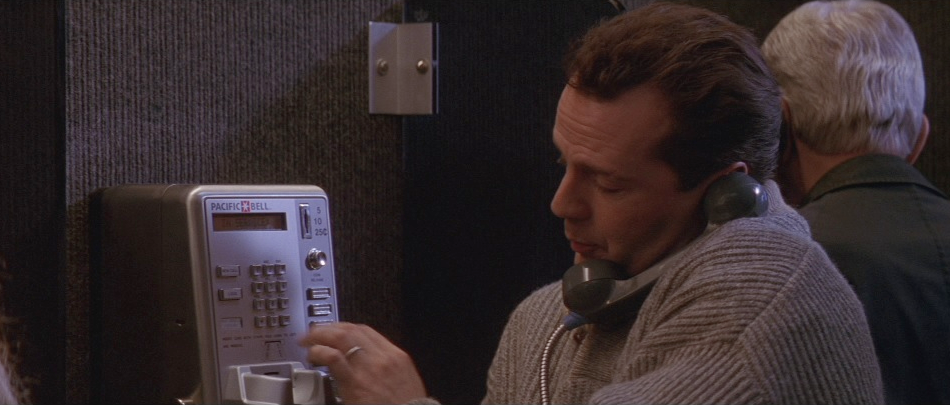
But if that means “Phone Booth” was in many ways a culmination of phone booths and pay phones at the cinema, it has never quite felt to me as their emblematic movie apex, too much of a gimmick to truly capture the essence of Alexander Graham’s Bell invention in a public space. That’s why Dirty Harry (Clint Eastwood) running around to answer calls from pay phones doesn’t move the needle for me just as John McClane (Bruce Willis) doing it however many years later in “Die Hard With a Vengeance” feels the same. No, the ultimate “Die Hard” pay phone moment for me will always be from the second “Die Hard,” “Die Harder,” when John McClane is waiting for his wife at Dulles and she calls his beeper (!) from her airphone (!!) and to call her back he has to wait for a pay phone (!!!) to open up in a crowded airport on Christmas Eve. It’s this mini-little moment of drama that Bruce Willis plays to the subtle hilt, diving for a pay phone that suddenly opens up like a running back hitting the hole, the camera catching sight of the disappointed patron who missed his shot to make his own call, as Willis indulges in this little moment of victorious pleasure while dialing, his body language reveling in having this pay phone all to himself, a tiny private space carved out of the mass of Dulles.


Essentially, of course, that’s what a phone booth could provide, contrary to what “Phone Booth” would have you believe, a sense of privacy, an intimate space, where Ritchie Valens serenaded the Donna in “La Bamba” and Clarence and Alabama, indifferent to the whoosh of semi-trucks flying by, get it on in “True Romance.” Of course, that intimacy can swing both ways, entrapping you, whether it’s Lloyd Dobler on the phone in the rain or Jimmy Conway in “Goodfellas.” “Anchorman” Ron Burgundy might have memorably bellowed that he was “trapped in glass case of emotion!” but no one was ever more trapped in an emotional glass case with greater intensity than Jimmy Conway in “Goodfellas.” You remember the moment, I’m sure, him learning via pay phone that Tommy has been whacked the very day he was set to become a made man and then Jimmy taking out all his frustration on the phone booth, battering it and kicking it with such ferocity that the street corner edifice tumbles. Once I saw Anne Heche on the Late Show with David Letterman to promote “Wag the Dog” and the clip they played was one on the plane when Heche is talking with a sleep mask-wearing DeNiro. Letterman jokingly said something to the effect of, That guy is such a good actor, he can act blindfolded. Well, DeNiro was such a good actor, he could turn a phone booth into a scene partner. 


True, phone booths became a symbol of blight, the word served up by The New York Times in going over the last pay phones in NYC, one frequently coded with racial prejudice. 1980s movie like “The Secret of My Success” pseudo-comically demonstrated the terrors of the Big City by trapping Michael J. Fox in a phone booth as a shootout erupted around him, while Penelope Ann Miller being trapped in a phone booth in a Chicago bus station in “Adventures in Babysitting” was less a haven than emblem of scary downtown Chicago to a cowering suburbanite. Even so, movies of the same era were just as likely to treat the phone booth with reverence. They are where Clark Kent changed clothes, after all, and one served as a time machine for “Bill and Ted’s Excellent Adventure.” As great as the last one was, though, no phone booth ever served as more of a portal than the red telephone box in “Local Hero” (1983). That’s where oil and gas exec Mac (Peter Riegert) gets dispatched to Scotland to see about acquiring a Highlands village for a refinery. The company’s owner, though, Felix Happer (Burt Lancaster), in a twist more fanciful than any ancient fairytale, is a CEO less interested in profit than stargazing. In one scene he listens on the other end of the phone from Houston as Mac stands in that phone box and describes the sky. The pay phone becomes a kind of portal, the sequence improbably rendering Reach Out and Touch Someone as something more than mere marketing verbiage, nearly peak payphone at the movies but not quite.


In a sense, Paul Thomas Anderson’s “Punch-Drunk Love” is a movie all about phones. It begins with novelty plunger salesman Barry Egan (Adam Sandler) taking the name and extension of the customer service rep on the other end of his phone line and that scene gives way to Barry trying to give his home phone number to one of his own clients on a different call. Both of these telephone-based conversations evoke Barry’s loneliness as much as the wide angles in which PTA frames him, and that loneliness becomes only more acute when at home he dials a phone sex hotline, the meekness in Sandler’s turning Reach Out and Touch Someone into something else altogether. Of course, this hotline reveals itself as a blackmail scheme, a personalized kind of robocall, betraying the phone as a familiar and ongoing tool of cruddy capitalism, while Barry’s profane over-the-phone face/off with the company’s owner (Philip Seymour Hoffman) demonstrates the phone as a weapon, a source of intimidation, as much as Christopher Plummer gazing up from that phone booth and into Elliot Gould’s apartment in “The Silent Partner.”

“Punch-Drunk Love’s” most critical scene doubles as the most important phone call Barry makes, after deciding on a whim to fly to Hawaii to see the woman he loves, Lena (Emily Watson), only calling her once he has arrived on Oahu. The scene, it’s pure romance, the pay phone noticeably lighting up when Lena answers. But once he’s told her he’s there and she tells him to come meet her, he starts asking her questions, the kind you might on first date, comically ignoring her pleas to hang up by just posing another getting-to-know-you query instead. In Kirsch’s piece for The New York Times, she notes that even if her beloved phone call in “The Goodbye Girl” is sentimental, it can be a useful metaphor for delineating boundaries between virtual and real life, and that is essentially what Anderson is evoking here even as he takes it one step further.

Barry just wants to stay on the phone, where things seem a little easier; Lena is telling him to hang up and come join her in the real world.