' ' Cinema Romantico: Amy Adams
Showing posts with label Amy Adams. Show all posts

Thursday, August 06, 2020

Ray of Light

Last week Deadline broke the news that Amy Adams will star in a movie with a title that I desperately wish I could hear my ex-movie theater manager (throw your hands up if you know who I’m talking about) announce to a crowded lobby is now seating: “Nightbitch.” Adams plays a woman convinced she is turning into a dog. The Amy-Adams-Will-Do-Anything-To-Win-An-Oscar tweets wrote themselves. The foremost question, it seems, whether she really is turning into a dog remains TBD because the movie is based on a book that has yet to be published. That, though, interests us here at Cinema Romantico less then another hypothetical: what if other Amy Adams movie characters thought they were turning into dogs? And more specifically and much more crucially, what kinds of dogs would her characters turn into?

A few thoughts:


Dr. Louise Banks, Arrival: German Shepherd


Ashley Johnsten, Junebug: Golden Retriever


Delysia Lafosse, Miss Pettigrew Lives for a Day: Pomeranian


Rose Lorkowski, Sunshine Cleaning: Australian Cattle Dog


Susan, Talladega Nights: Pit Bull


Lois Lane, Man of Steel: Alaskan Husky


Susan Morrow, Nocturnal Animals: Weimaraner


Sister James, Doubt: Greyhound


Charlene Fleming, The Fighter: Mutt


Lady Edith Greensly (Sydney Prosser), American Hustle: Elvira’s Poodle

 
Peggy Dodd, The Master: Frank the Pug, Men in Black

Wednesday, March 15, 2017

WHAT IS HAPPENING?


Is this.....

An impromptu meeting of two Class III Dignitaries of the Hollywood Glitterati?

An Auramoji wielded by social media users to express an aura of luxurious luminescence?

The moment right before Amy Adams slips away after having slipped a mickey into the glass of champagne in her right hand that Vin Diesel takes and tosses back?

Cover of the new Peter Mayle book in which a pair of mixologist grifters roam up and down the California coastline? 

A promo photo for a remake of “The King and I” called “The Queen and I”?

A promo photo for “American Hustle 2”? In which Amy Adams plays an actual English aristocrat rather than a make-believe one who, along with an unlikely salami-making safecracker (Diesel), hatches a plot to steal the Crown Jewels?

A promo photo for “XXXy”? A sequel to “xXx: Return of Xander Cage” in which Xander Cage becomes embroiled in some Himalayan what-have-ya, gets locked up in a remote, high-tech prison and has to be rescued by Yvonne Wyre, sort of the Ilsa Faust to Xander Cage’s Ethan Hunt?

A promo photo for a crossover between the “Fast and Furious” franchise and “Talladega Nights” in which Susan somehow, improbably, finds her way into the high-stakes world of street racing and both talks Dom Toretto out of retiring to open a California Pizza Kitchen and wins a street race in an Acura?

Promo for the new Diesel-Adams Talk Show, which is like a variation on the Hathaway/Franco Oscars in which Amy Adams is extremely accommodating and working really hard and Vin Diesel is all like “Do you even cliff dive, bro?” and if they say no he just turns his back.

The first ad in a re-launch of Proper Penguin Frozen Gourmet Dinners?

Amy Adams: “The Oscars ran long, surprise, surprise, and traffic getting home was awful. How am I supposed to put together an after-after party for 8 important friends in 20 minutes?” 
Vin Diesel: “What about Proper Penguin?” 
Amy Adams: “Oh my gosh. I totally forgot.” 
Vin Diesel: “An entire gourmet spread right in your freezer. Hamachi crudo. Maine scallops. Foie Gras with burgundy truffles. Artisinal cheeses. Even a mini-bottle of King Louis Cognac.”

Monday, December 12, 2016

Arrival

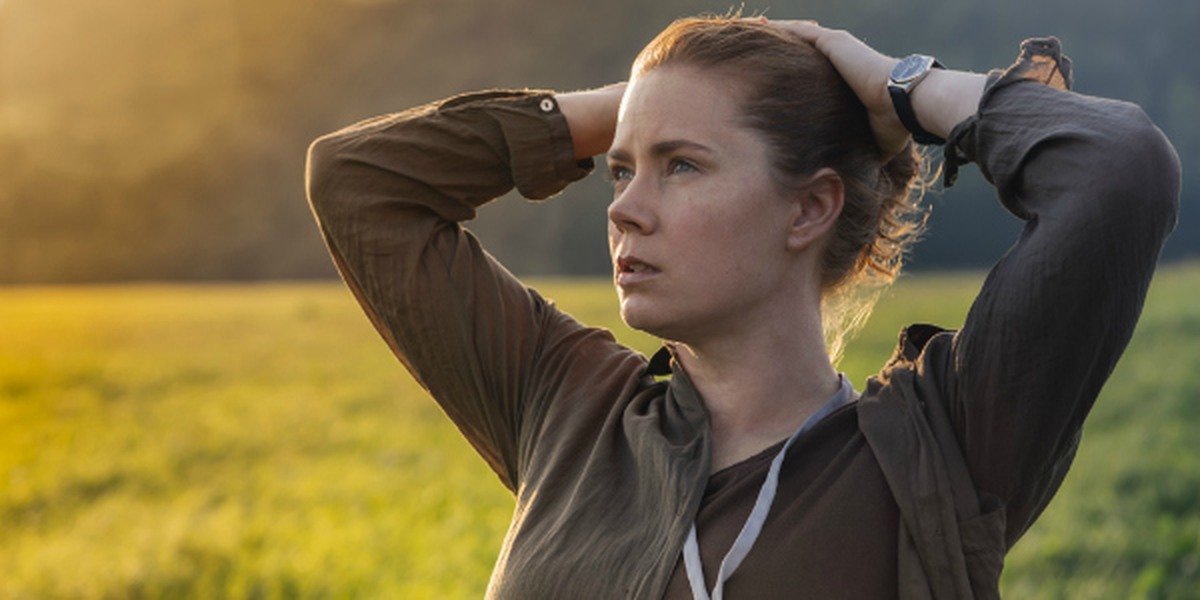
When the aliens touch down in Denis Villeneuve’s “Arrival”, they don’t quite touch down all the way, which is to say their semi-oblong slab-of-granite looking spaceships are hovering just off the ground at various places around Earth, captured most prominently in a breathtaking shot framing one of these spaceships in a picturesque Montana valley before circling around to reveal a significant military encampment, like you can’t have one without the other. Indeed, ten million alien invasion movies have conditioned us to expect the worse and when we finally see our visitors from another world up close, several feet high and tentacled, like octopi transplanted to land, heptapods as they are labeled, a moniker hueing a little too closely to the tripods of “War of the Worlds” fame, we might jump to that conclusion. Aside, however, from an itty bitty, undercooked subplot involving a few soldiers with a few bad thoughts bubbling and a few foreign powers who decide to fear the worst, “Arrival” is less concerned with initiating attack than stopping to listen.


This is where Louise Banks (Amy Adams) comes in. Rather than some sort of space jockey enlisted to combat these E.T.’s, she is a professor of linguistics summoned to try and make sense of exactly what these E.T.’s want. This is the second consecutive film where Villeneuve’s main character has been a female without much fuss or muss; she just is. Louise is simply the best person for the job, emblemized in her more or less calling the bluff of Colonel Weber (Forest Whitaker) when he shows up looking for her help while declaring an ultimatum. We’ve come a long way, even since “Contact” (1997), which bears resemblance to “Arrival” in terms of plot but featured its principal female (Jodie Foster) having to deal with the political machinations of a smug male (Tom Skerritt). The other male in “Arrival”, a theoretical physicist named Ian Donnelly (Jeremy Renner), quickly falls in line as a second in command. Of course, he’s a white male, which means America’s first contact with the aliens is chiefly handled by a couple Caucasians, which suggests there is still some work to do.

Still, Louise is a woman, our chief American ambassador, and one suffering through what seem to be flashbacks to a previous life with a young daughter lost. Yet despite such melancholy, and even in the face of having to enter an otherworldly craft while wearing an orange hazmat suit and try to make sense of aliens conversing via something like squid ink manifested as something like smoke signals, she is never fearful or overwhelmed. This is a testament to the performance of Adams, who exudes not just a winning pragmatism but a joyful humanitarianism (her line reading of “Joe Alien” is casually revealing). Her character is a professor and a peacemaker, and she takes the latter as seriously as the former, particularly as the stakes heighten when other nations begin acting scurrilous, issuing threats to the extra-terrestrials and engendering a countdown. Yet even as this happens, Villeneuve keeps his focus firmly on Louise and her quest to unravel the extra-terrestrial’s intentions, rendering a global event as an intimate one instead.

This intimacy is most strikingly conveyed in a few shots where Louise sits by herself, or in the company of Ian, a fair distance from the alien craft, gazing up at it. And Villeneuve frames these moments so that the spaceship is looming just over Louise’s shoulder, sometimes out of focus. Here, we are not seeing the ship through some militarized computer mainframe or through the screen of a television. Here, the din of innumerable news cable anchors, confused citizens, blowhard conspiracy theorists, and concerned military personnel that we hear throughout “Arrival” are long gone. Here, we are seeing a global event through the eyes of one woman, a woman open to the mysteries of the universe rather than closed to them. Here, all you feel is wonder, not terror. It feels pretty good.


So does most of the movie. Occasionally, Villeneuve gets off point, pausing to overly explicate information, like a montage in the middle accompanied by a Renner voiceover that gives us the nuts and bolts of everything that has happened, like a What Happened Last Week at the beginning of a two part television episode. It’s the one moment when the movie refuses to place trust in its audience and it tellingly blunts the impact.

The rest of “Arrival” is all about trust. Indeed, Villeneuve is essentially asking for our trust, asking for viewers not to play the guess ahead game and see if they can figure out the end while the narrative is still in progress, and simply engage with the present. And our engagement with the present, in a wonderful twist that will not be revealed, not exactly, is precisely what holds the key to the mystery for Louise establishing communication, and for Louise to settle the emergent mysteries in her own life. It’s a beautiful thing, the way that “Arrival’s” own answers amalgamate with our viewing experience. And if, like Louise, you are willing to simply listen, oh the things you’ll hear.

Monday, November 28, 2016

Nocturnal Animals

The opening credits of “Nocturnal Animals”, featuring more than a few women who are, uh, generously proportioned and undressed, might well be exploitative, but being that it is quickly revealed as part of a Los Angeles art show ambiguous in nature immediately connects it to the ancient question that Tom Ford’s film asks – “What does art mean?” Ford, frankly, does not have an answer any more compelling or original than anything else that has come down the cinematic pike, though I do not mean to suggest the movie is abominable or inert. For all its fairly predictable plotting and paper thin observations about, you know, life, “Nocturnal Animals” still manages myriad moments of individual beauty, like a Texas lawman introduced smoking beneath a Budget Motel sign. It’s the kind of shot that sensorily stops you and then leaves you wondering why you got stopped, like you’re perusing an art gallery. And even if the film sometimes feels like an art gallery, with paintings hung from so many walls and sculptures standing at attention on so many floors, this is still a movie, and at the movies no image is more powerful than the human face. And Ford has found in Amy Adams an unlikely subject. I mean, who would have thought ten years ago that the bubbly Amy Adams of “Junebug” would one day approximate the ghostly spirit of Monica Vitti?


Adams is Susan Morrow (Amy Adams), curator of the opening art show, who wanders through a crowd of bohemians so ludicrous (Andrea Riseborough looks like she’s the star of a retro if swanky alt girl grunge video) you’ll be forgiven for thinking you’ve accidentally wandered into a showing of “Zoolander 2”, a movie Susan would no doubt give zero stars. In Susan’s disinterested behavior, another ancient idea emerges - that is, sumptuousness always equates with soullessness. But then, this is Tom Ford and oh my what sumptuousness! Indeed, Adams’s hairdo is the best at the movies this year, a sort of Veronica Lake Ă  la mode, swept to one side with one eye cloaked behind those blood red bangs, like her visage is a Half Moon partly shrouded by hair. I do not mean to reduce Adams, mind you, to wardrobe. No, her fashion meticulousness is key to the character’s chilly air. She maintains a surface so still you sometimes suspect she might break in half. This does not betray a roiling sea below, however, but rather clues us into the nothingness at her core. She’s like a left coast version of the girl Woody Allen meets at the art gallery in “Play It Again, Sam.”

So, her soul will have to be stirred, and it is when a manuscript from her ex-husband, Edward Sheffield (Jake Gyllenhaal), a struggling, romantic writer, arrives in the mail. Their past relationship is glimpsed in flashbacks written in the kind of faux-soulful bilge that often plagues early-20s kind of work, where questions of paying fealty to The Man or staying true to your art reign supreme. Eventually Susan breaks Edward’s heart by leaving him for a handsome man named Hutton (Armie Hamer), though their marital bust up is tied just as much, as a vicious, slyly comic cameo by Laura Linney as Susan’s mom evinces, to an inherent weakness in Edward. It’s the old nice guy affliction, you might say, that he will simply never be able to run with the bulls.

As Susan dives into her ex’s manuscript, however, often reading in darkened rooms with nary a light, seeming to suggest she really does need those ginormous black frames she sometimes rocks, a story within a story emerges, as she envisions the novel unfolding in her head, casting Edward in the part of the book's protagonist’s, Tony Hastings, who is driving through the west Texas night with his wife (Isla Fisher) and daughter (Ellie Bamber). They run afoul of some southern roughnecks, captained by Ray (Aaron Taylor-Johnson), who run the family off the road, taunt and tease them and then abscond with Tony’s two loved ones, leaving him behind, and causing him to enlist the aid of a local lawman, Bobby Andes (Michael Shannon).


For all the tension Ford manages to create in little bursts here and there, and for effective as Gyllenhaal can be at coming across pitifully helpless, this story never quite flies, feeling like a grisly, washed out, cheaply budgeted midnight thriller all done up to play for more hoity toity crowds of movie awards seasons rather than the insomniacs looking for something to watch at 2 AM. Why else would the ringleader look less like the hitchhiker in “Texas Chainsaw Massacre” than a GQ model displaced from Hollywood to the rural prairie? What’s worse, because it quickly becomes clear that the story’s entire purpose is for Edward to communicate with Susan by page, transforming the guilt he felt for not being strong enough to be her man into some sort of grindhouse paperback, the characters within the story feel inconsequential, figments of Susan and Edward’s imagination.

All, that is, except for Bobby Andes, who, against all the odds, the ever-dexterous Shannon manages to outfit with real individuality, communicated in eyes that observe Tony with more judgment than suspicion, and a few grunts and grimaces that quietly evoke his character’s backstory before it even emerges. And when the backstory does come to light, Shannon plays it not with any kind of melancholy but a surly craving to see matters of earthly justice through before it’s too late. He’s ticked off, but dedicated. It’s really quite wonderful, this performance, this character, almost threatening to eat “Nocturnal Animals” not whole like an animal on a National Geographic special, but like someone stealing bites at a formal dinner.

Alas, Bobby Andes must disappear so that Tony’s story can come full circle, and so, in turn, can Edward’s. The manuscript ends on a note of ambiguity, and so, in a sense, does the movie itself. Not in terms of narrative, really, which builds to a point “you can see coming”, with vengeance consumed, but with the concluding emotions of Susan. The final sequence in which she sits at a swank restaurant, sipping at her lavishly lit cocktail, is like a work of art hung in a museum, one which pointedly leaves us to wonder her exact state of mind, which Adams pointedly refuses to betray, as if she will remain there for an eternity, content to let us wonder.

Saturday, September 03, 2016

Three Stills that Prove Nocturnal Animals Will Probably Be the Greatest Movie of All Time

It is dangerous, of course, to take film festival reviews as gospel, where often the reviewers are drunk on film festival beatitude, or maybe just drunk cuz #FilmFestivalNights. It is even more dangerous to judge a movie, an entire movie, a movie that consumes nearly two hours of screen time, on a few still frames. I mean, that’s insanity! The High Court of Film Critics would likely sentence me to some sort of egregious punishment for deigning to author a blog post in which I judged an entire movie on a few stills! But some risks, readers, must be taken, and so I will press forward, boldly and joyfully, for what choice did I have when “Nocturnal Animals” dropped at the Venice Film Festival and a few stills featuring future Oscar-winner Amy Adams illuminated the Interwebs. The following stills unequivocally and scientifically prove that “Nocturnal Animals” will in all likelihood be the greatest movie of all time.


“The predicament of Man forced to live in a barren, Godless eternity like a tiny flame flickering in an immense void with nothing but waste, horror and degradation, forming a useless bleak straitjacket in a black absurd cosmos.”


that feeling when you can’t find the perfect trip hop song on iTunes to mirror the blood red moon prophecy of your heart about to come true


The female cheetah with her prey.

Thursday, July 24, 2014

5 Actresses To Play Jesse Wallace's Ex-Wife

I recently re-took the distressing “Before Midnight” plunge after avoiding it for a year and a couple months after having my ardent (pitiful) Jesse & Celine Idealism shattered. And. Well. Yeah. It still hurt. I came around to seeing the ending in a bit more of a positive light – not positive as in “good” but positive as in “happy” – but not entirely. I don’t think I’ll ever get there. And in other ways, it was an even more brutal emotional experience than the first go-around. So brutal, in fact, that I unleashed yet another essay regarding my relationship with these films. And. Well. Yeah. I couldn’t bring myself to publish it. I almost trashed the whole thing. Not because I wasn’t pleased with it but because it kinda freaked me out. Perhaps I’ll put the post up on my birthday because an emotionally terrifying post coinciding with my birthday totally seems Cinema Romantico-esque.

Anyway, in lieu of that post, I still got to thinking. Because I’m always getting to thinking, if not about interesting things, per se, at least about things that I find “interesting” at which point I subject my few loyal readers who haven’t already flown this cinematic coop on account of my Katy Perry references to ponderings about them. ANYWAY, I got to thinking about the character in “Before Midnight” who is never seen but still a major player – that is, The Other Woman. The one to whom Jesse was previously married and gave birth to his son and whom he left Celine for because Jesse was meant to be with Celine because the world is perfect and wonderful (it isn’t). She is a major player because, as we learn, she moved Jesse’s son out of New York under the cover of darkness to limit her ex-spouse’s visitation rights. Cold. About as cold as the ways in which she’s referenced. In order, she is referred to as being “drunk and abusive psychologically”, possessing “the mother instinct of Medea” and – oh boy, here we go – “a hateful cunt” (Celine’s words! CELINE’S WORDS!!!).

So let’s say in nine years when “After Noon” (it’s a play on words) is released that Linklater, based upon our above criteria, wants to cast the ex-Ms. Wallace. To whom does he turn?

5 Actresses To Play Jesse Wallace's Ex-Wife

Marisa Tomei

Well, obviously. I mean, she should be in everything after all.

Winona Ryder

I concede both the predictability of this choice and its blatant self-referentialism, that casting the woman who acted opposite Hawke in the angstiest of angst fests, “Reality Bites”, would be an in-joke of epic proportions in a film series that should have nothing to do with in-jokes. And yet. Set all past history aside and simply envision Ms. Ryder in a metaphorical vaccum as a woman with “the mother instinct of Medea.” Yeah, you did.

Amy Adams

If you thought “The Fighter” was against type, this would totally go against the “Enchanted”, Probably The Nicest Person In The Whole World grain, and she could do it. Beware all ye who doubt the versatile skillz of AA. (I’m also assuming that in nine years she’ll have six Oscars and can just get cast in whatever she wants.)

Rosemarie DeWitt

God. God, what I would give to see Rosemarie DeWitt bust out the scoff face as Jesse does his Verbal Scat thing and then just cut him off and lay a titanic DeWitt-ish “You're so full of shit” on him. “I know what you’re doing, Jesse, okay? You’re answering all my questions with questions. I mean, I know you think you’re being really cagey, but you’ve used this same evasive methodology since I met you. It’s pretty obvious. And by the way, shoehorning a Dostoevsky reference into the middle of an argument? There’s no peanut gallery. There aren’t judges awarding you literary style points.” GOD, what I’d give.

Rachelle LaFevre

I am not a movie casting director because if I was a movie casting director I would do things like cast Billy Dee Williams as Batman and cast Kate Beckinsale as a version of Guinevere that told that charlatan Arthur and that lip server Lancelot what to go do with themselves and ruled the kingdom her damn self, but still… I like to imagine casting directors having epiphanies like the one Eddie Adams from Torrance had in the hot tub in “Boogie Nights.” And that was exactly the kind of epiphany I had when considering who should play Jesse Wallace’s ex-wife. When I close my eyes, I see this thing, a sign, I see this name in bright blue neon lights with a purple outline. And this name is so bright and so sharp that the sign, it just blows up because the name is so powerful. Rachelle LaFevre.

Tuesday, January 14, 2014

Her

It's a common scenario - thinking a person on the street is talking to you or talking to him or herself, only to realize he or she is actually chatting up someone on the other end of a bluetooth. In Spike Jonze's subtly super-stylized "Her", set in what Andrew Niccol's "Gattaca" might have termed The Not Too Distant Future, we are often made to see pedestrians chatting up technologically advanced earpieces as if they are more microscopic Google Glasses. This is to say that "Her" is clearly intended to resemble our world as much as create a new one and comment on our society as much as portray the one of its own invention.


Though Theodore Twombly (Joaquin Phoenix) is not quite an official hermit, he has significantly withdrawn socially since separating from his wife (Rooney Mara). Their courtship is primarily seen in flashback snippets, moments of joy paired with the rising anger that leads to their combustion. Theodore’s day job is at a wonderfully expository company called BeautifulLetters.com wherein he pens flowing college ruled tomes for men and women too insecure in their own thoughts to say what they mean and/or want. On one hand, it’s lovely to think that in The Not Too Distant Future handwritten letters delivered by post have once again become trendy, but it also neatly suggests a futuristic inability to communicate. Clearly Theodore can communicate on behalf of others, but struggles to communicate himself. This is paralleled by his apartment complex pals, Amy (Amy Adams) and Charles (Matt Letscher), who appear to be on disparate planets even when standing next to each other.

Quietly desperate to emerge from his high-rise cocoon, Theodore turns to society's new rage, O.S. (Operating Systems), which creates itself on his laptop and is then beamed into his earpiece in the form of a femininely agreeable voice that goes by the name Samantha (Scarlett Johansson, strictly voiceover). She giggles at his jokes, maintains his email and offers herself as a therapeutic sounding board. In doing so, her melifluous tones re-connect him with life, while in the meantime this abstract intonation comes alive within the confines of her own unseen world.

The delicacy with which Jonze, also working as screenwriter, builds this slightly heightened world, offering numerous shots of humans so close together but never further apart, matches the delicacy with which he sculpts this relationship into one of both heartbreaking and depressing believability. To be sure, Jonze is satirizing the modern world, our slow withdrawal into our smartphones, and parodying the idea that eventually even our boyfriends and girlfriends will be accessed via apps. That the insecure Theodore never seems insecure about revealing his girlfriend to be an operating system, however, and that most no one he to whom he reveals this seems startled, is telling. And that it never comes off as weird as it would seem in theory, is both kinda frightening as well as a testament to Phoenix’s sad-eyed turn.

Adams’ Amy would at first glance appear as Theodore’s requisite real world ballast, but even she finds herself caught up in an O.S. courtship when her marriage crashes against the rocks. No, Mara’s Catherine is ultimately the one most disturbed by her former spouse’s sonic love affair, and she calls him on the carpet for his unwillingness to deal with real emotion in a monologue that might seem on the nose except that for all the ill-communicaton in this film, her directness comes across refreshingly old school. I wonder if in “Her’s” landscape, Mara’s character might be viewed as a luddite, the sort unwilling to square with the technological turns the world has taken. This mostly remains unexplored, but even so “Her” proves itself to be of a more bygone era than its premise might suggest, Tom Hanks & Meg Ryan for Now.

The story of "Her", apart from its production flourishes and plot ornamentations, is rooted very much in the conventional. The high-waisted pants favored by the male characters, after all, can be seen throughout the decades in the history of American fashion, and, in a way, Theodore & Samantha are very much like those pants. She may be a voice, and she may be forced to call upon a body surrogate to re-invigorate their "sexual life", but then that problem - like all of Theodore & Samantha's problems - are the kind couples been having since before rotary phones.

The conclusion could maybe be viewed as a little simple for all the ideas "Her" yearns to propose, but then I'm not entirely certain the conclusion should be viewed so much as a cure as the most tried and true of stopgaps - every now and then all we need is a little human touch.

Friday, January 10, 2014

A 2013 Scene To Go Home With You

"This method acting? Well, I call it living." - Bright Eyes 

A common phrase employed in conjunction with that most bandied about of performing topics - Method Acting - is this: Living The Part. Living the Part was more or less born of Experiencing the Role, a critical ingredient of Constantin Stanislavski's system for acting, a system out of which parts of the Method would eventually flow. Stanislavski would discover that in truly experiencing a role, his mind and being would merge with the character's mind and being, allowing them to act jointly. He was, in other words, Living the Part. Now, that sounds mystical, and the New School of the Method certainly adds to that mystique. People think Daniel Day-Lewis and they automatically assume the man's personage literally fused with the soul of Honest Abe. Of course, it's never really that simple, and Method Acting combines psychological and physical preparation with affective memory. Stanislavski writes in his book "An Actor Prepares": "Always act in your own person, as an artist. You can never get away from yourself. The moment you lose yourself on the stage marks the departure from truly living your part."

In other words, there is no magical melding nor does an actor simply become someone else when living the part. He or she specifically brings him or herself to the part and his or her own feelings. "And any exception to the rule of using your own feelings," writes Stanislavski, "is the equivalent of killing the person you are portraying, because you deprive him of a palpitating, living, human soul."

"American Hustle" is based on the infamous Abscam FBI sting operation of the 70's and 80's, though "based" might be too strong a word. Perhaps we should say loosely based. Or, excessively loosely based. Or, director David O. Russell and writer Eric Warren Singer lift the Abscam riff to cultivate their very own unwieldy power ballad with disco underpinnings. This jumping off point is entirely appropriate given the film's primary motif - acting. Here, Abscam is merely dinner theater, and all the characters use it as an excuse to role play.

One scene in particular captures the essence of "American Hustle." The gang's role-playing grandmaster, Irving Rosenfeld (Christian Bale), is forced to spend an evening out in the company of Camden Mayor Carmine Polito (Jeremy Renner). Ah, but he is forced to spend it not in the company of his buxom role-playing cohort Sydney Prosser (Amy Adams), but in the company of his mouthy, headstrong wife (Jennifer Lawrence). He'd really rather be with Sydney. And Sydney would really rather be Irving. But, she isn't. She's alone. And in being alone she is forced to square with reality. And who in their right (wrong?) mind wants to square with reality?

So she calls up Richie DiMaso (Bradley Cooper), the FBI man running point on their sting who has gotten in too deep. Not in too deep in the manner of, say, Donnie Brasco, but in too deep in the manner of Kirk Lazarus. He's at home, so desperate to ignore the reality surrounding him - his fiancé he apparently doesn't like and his screeching mom - that he retreats to the bathroom with dinner. So, when Sydney phones, he's out the door in a flash.


The shot that initiates the scene is as side-splitting as it is sad - Richie is all done up like a permed OCD Tony Manero and Sydney dons a fur coat like a more assured Stephanie Mangano. They strut down the street, through the night, to the club. They are themselves, which is to say they are not themselves, because they are uncomfortable in their own skin, and assuming alternate personas and the lead roles in Sydney & Richie's Night Out! (in neon). It's a disco-era paradox, and in the disco-era where better to deny your true self then on the dance floor? What did Kylie Minogue say about the "Dance Floor"? Ah yes. "Gonna lose it in the music."

So they do. Donna Summer croons about how she "Feel(s) Love" on the soundtrack and Richie and Sydney shimmy and shake and sweat and move in close. They are not know who they are. They are whoever they want to be. But you know what they say about dancing - it's like sex. Thus, they hustle to bathroom stall to have some. Except they don't. They don't want to consummate until they've consummated the sting. They want to know that the sex is real, not something used to level the scheme-playing field. Except, of course (did I forget to mention this?), Richie doesn't even know she's Sydney. He think she's Edith, a totally proper British Lady. And so even though they have just decided in a bathroom stall to be entirely on the up-and-up, they are not at all on the up-and-up.

It’s a complicated moment. She is pledging honesty even as she maintains fakery by not divulging her true identity. Yet, in her own mind, crucially, she is not faking it. In the moment, she is Lady Edith, only Lady Edith, Sydney momentarily forgotten, and as Lady Edith she is being utterly forthright. This is to say, she has made an exception to the rule of using her own feelings. The scene concludes with Sydney releasing a blood-curdling shriek that you can literally (figuratively) see rise to the discoteque's rafters, symbolically working as the death cry of the person she is portraying, even if that death will stay on life support for several scenes.

As of this moment, she is no longer living the part.

Monday, December 16, 2013

American Hustle

“American Hustle” opens with the following disclaimer: “Some of this actually happened.” This is partly meant to instantly counteract the extravagant amount of liberty-taking with the film’s factual roots and partly meant to simply get a laugh, a broad twist on a typical device, but I suspect there is something more to it. I suspect this unshackles the film from having to be an exposĂ©, a commentary on having to Hustle for the American Dream, or some such, and instead frees it up to be a sprawling $50 million shaggy dog story.


Undoubtedly the film will invoke comparisons to Martin Scorsese with its frenetic camerawork, pop-heavy soundtrack and implementation of a rotary telephone for a character beatdown. It will also allow for citations of Paul Thomas Anderson, himself influenced by Grandmaster Marty, particularly 1997’s “Boogie Nights”, what when you consider “American Hustle” is set in the 70’s and makes liberal use of the era’s flamboyant costuming and disco tuneage. Some movies, however, do not aim to advance nor re-invent the form, merely to gather varying techniques of the form and wield them for the sake of sheer blinding entertainment. “American Hustle” is not The Story Of Abscam as much as it is David O. Russell’s Variety Hour – starring: Christian Bale, Amy Adams, Bradley Cooper, Jennifer Lawrence, and assorted others!

Bale is Irving Rosenfeld, yet another character that allows for its actor to undergo a physical transformation, adding serious paunch and a delightfully ridiculous comb over. Partly a dry cleaning entrepreneur, but mostly a con man, Irving falls for/teams up with Sydney Prosser (Adams), so desperate for any other kind of life that she sees Irving not for the fake hair on his head but for the desire to deceive in his heart. It's love at first lie. These two set the stage, past and present, with voiceovers that continually trade off, two grifters reciting a ripping yarn over cocktails. Bale finds real pathos amidst all the put-ons and Adams is remarkable, the film's foremost emblem, conveying that her desperation to be someone else is, in fact, who she is.

Sydney adopts an English accent, re-casts herself "Lady Edith" of the isles and the two indulge in a prosperous scheme until undercover FBI agent Richie DiMaso (Cooper) nabs them. If Sydney is determined to lead a different life then Richie is determined to move through the ranks at the speed of sound. So, he enlists them in a sting to go after Carmine Polito (Jeremy Renner), the mayor of Camden, New Jersey, and, in turn, crooked congressmen and, in turn, maybe, just maybe, the mob (represented in a particular walk-off cameo of inexpressible perfection).

Enter: The Wildcard, Rosalyn (Lawrence), wife of Irving and mother to the son he has adopted. Her initial appearance, after we have already seen Irving fall for and pledge devotion to Sydney, is a masterstroke, painting her as an afterthought, which is clearly how she views herself. He tries keeping her out of his crooked lifestyle, she worms her way in, repeatedly and hysterically. The role itself, from the screenplay by Russell and Eric Warren Singer, is killer, first and foremost, but Lawrence, who overcomes the comes-and-goes nature of her Jersey accent with manic energy, owns it. She threatens to blow up everything (the scam, the microwave) and threatens to steal the film entirely, if not for the fact her theatrical fervor is met head-on by the whole ensemble. (In keeping with the put-on-a-show nature of the whole film, I kind of wish Lawrence and Adams had swapped parts midstream. I so would have liked to see what each one could have done in the other role.)


As the untraditional crew lures Polito into its web, Richie reveals himself to be terrifically unstable and less intelligent than he thinks, falling for Sydney. She might be falling for him too, but she might be playing him, but then she might be doing both. Irving meanwhile forms a genuine affection for Polito and his family, and for Polito’s ideas to rebuild Atlantic City and, in the process, create new jobs and new wealth for New Jersey. This subplot, however, the political and social ramifications of the high-reaching undercover op, feels like an afterthought. It merely crops up around the edges, failing to provide the intended equilibrium to the Abscam shenanigans, and Russell repeatedly appears to purposely upstage tension and/or drama by playing for laughs. Thus, “American Hustle” ultimately fails to ring with any profound meaning, and yet I don't think it wants to.

There are so many little moments of absurd bliss and physical and verbal drollery inviting cuts from a theoretical editing standpoint that stay in because they are the point so much more than any “point”. As the stakes of the sting are raised, the more Richie yearns to elaborate on the ruse, to be a big shot, to rent out a whole suite at the Plaza, to be someone else.

One heightened moment goes so far as to find him dressing up like Tony Manero in "Saturday Night Fever" and squiring Sydney to the discoteque. He’s play-acting, and from the get-go we can tell that what Irving and Sydney (or is it Edith?) get off on more than the cash is the burlesque. The conclusion suggests our “heroes” have settled into their own skin, but it's telling that is the least convincing part of the picture. Everyone here just wants to lose themselves in the part, to put on a show, and what a hell of a show “American Hustle” is.

Thursday, December 12, 2013

Top 5 Actor vs. Actor Showdowns


I am a fervent adorer of "Ocean's Twelve", as we know, but rather than launch into yet another passionate argument for the film's unappreciated brilliance, I'd simply like to re-iterate that its single flaw is this: a scene was not included that featured George Clooney, Brad Pitt, Matt Damon and Julia Roberts sitting in a room together and LITERALLY reading from a phonebook, trying to one-up each other. A Hollywood Actor Royal Rumble.

Last week I was listening to a podcast with Grantland founder Bill Simmons and the site's resident film critic, Pulitzer Prize winner Wesley Morris. Morris mentioned how Meryl Streep has openly admitted to competing with actresses in films. This led to a later discussion on how the infamous scene between Al Pacino and Robert DeNiro in the diner in "Heat" was essentially like a pickup basketball game, one on one, Jordan vs. Bird, which led to pitching an idea of re-visiting noted movie moments to ask "Who Won The Scene?" And this, as it must, got me to thinking.

Not necessarily about scenes and wondering who won them, but actorly competition, a full night of Hollywood's best squaring off in the ring, a stellar undercard and the monumental main event, live from Madison Square Garden.

Top 5 Actor vs. Actor Showdowns


Al Pacino vs. Denzel Washington

You want to get the undercard to a heavyweight title fight off to a fluffy start, and what better way than these two Oscar-winning titans hollering at each other for five rounds? But maybe it wouldn't just be hollering? Maybe the heat of battle would allow Al to re-locate his long-gone nuance and Denzel to internalize and, in turn, show us his soul. Or maybe not and they'd just holler, and five rounds of Pacino & Denzel hollering would be pretty cool. 


Amy Adams vs. Rachel Weisz 

I dare say it wouldn't have the pre-match buzz of our other bouts, but, trust me, this would bring the heat. Two chameleons, one American and one Brit, staring each other down and throwing elegant haymakers, gracefully swerving from sassy to charming to sexy to spinster to hippie to indie to classical to bawdy and back again. 


Christian Bale vs. Michael Shannon 

The intensity. Sweet Jesus, man, the INTENSITY!!!!!! They wouldn't touch (figurative) gloves, they would squint and spit and chew scenery. It would be exhausting in the best way possible. 


Cate Blanchett vs. Kate Winslet

You're toast, Blanchett. 


Daniel Day-Lewis vs. Meryl Streep

The main event. 15 rounds. No referee because he/she would just distract. A fury of tics and accents and costume changes and bone marrow embodiments. I'd think Streep might be the favorite, if only because Day-Lewis seems to require so much prep work and getting-into-character time. Unless he spent the months leading up to the bout prepping and getting-into-character. Still, no one has really ever counterpunched Day-Lewis, and Streep could counterpunch. But then, Streep has never had anyone get back up off the ropes. And Day-Lewis would get back up off the ropes. Let's call it even 'til we see it.