' ' Cinema Romantico: Before Sunrise
Showing posts with label Before Sunrise. Show all posts

Wednesday, March 08, 2017

33 Observations on Before Sunrise

A few Saturdays ago my girlfriend was out of town and bad news in the world of American politics was prominent for, like, the 537th consecutive day and I started watching "Dog Eat Dog" (don't ask) and I got through the prologue and was just like.....nuh uh. Nope. Not tonight. I switched it off. I put on, for reasons only the movie gods could divine, "Before Sunrise" for the first time in, maybe, four years. I felt like I was sucking down oxygen. I observed some things. I guess they are things I have observed many times having watched this movie many times and so I decided to record them for blogging posterity. 

----------

It opens, right, with that couple on the Eurorail arguing and then the camera cuts to Celine (Julie Delpy) sitting across from them and I love how in having Celine try and blot their argument out, Delpy really has her re-focus on her book,


Then she gets up and moves, you know, and takes the seat right across from Jesse (Ethan Hawke) and they steal those little looks of each other. And I really love how Linklater cuts from medium shots of them stealing looks to close-ups in the wake of these little quick zooms when they actually start conversing.


He does that again way later, when they are in Vienna and they have been walking and talking all night and have now, at this little cafe on a yacht, broached the topic of Will We See Each Other Again? At first, when they are seriously considering it, they are in medium shots.


But when they decide to say, Nah, screw that, this is our one night, our only night, let's make it count, it goes to close-ups.


When they first sit down in the dining car on the Eurorail and engage in nervous conversation, Delpy has Celine bite her nails...


...which Delpy reprises later when they first come close to broaching the subject of whether or not they will see each other again.


In Vienna, they hop on the tram and sit down.


Hawke has Jesse not so subtly go for the arm-sort-of-around Celine move.


But as he does, Delpy has Celine respond by sitting up, perceptibly moving away from the arm-sort-of-around her schtick.


Then she spends the rest of the conversation pitched ever so slightly forward and away from the arm.


Eventually, though, that gives way, as you see here later on another tram where, as they exit, she grabs hold of his arm.


And then finally, much later, she actively takes his arm and puts it around her.


I like how so often when they talk, Hawke has Jesse listen with this wide-eyed gleam...


...while Delpy has Celine listen.


There are a couple times when the Future Jesse & Celine can be glimpsed. For instance, the scene with the fortune teller, who walks away and then turns back, intoning about how we are all "stardust" and some such.


But LOOK at these reactions as they turn away from the fortune teller, who you can still see their in the background. Celine's smile is pure, honest joy; Jesse's smile is what the hell was that all about?


Later, when they happen upon the street dancer and move in closer to watch, Hawke has Jesse goofily dance too, which you can sort of see in the below frame.


But then he notices that Celine isn't even paying attention to his goofy dancing.


So he settles down and watches too. I mean, if you didn't know there was a "Before Sunset" and "Before Midnight" you could watch this scene and see a lifetime of Jesse trying to make something about someone else be about him instead and Celine willfully ignoring him.


Ah yes. The bartender, my dawg, played by Haymon Maria Buttinger, who has all kinds of IMDb credits and gives a woefully underrated one scene performance here. He is on the receiving end of Jesse's pitch for a bottle of wine to celebrate this one night he has with Celine.


And when Jesse explains he has no money to actually pay for the wine, Buttinger reacts with his incredulous laugh.


And then when Jesse says he'll promise to mail the bartender the money for the wine, Buttinger parries with his INCREDIBLE "don't fool me, son" look.


But. But. The bartender, cautiously going along, asks for Jesse for his "hand" as a promise to honor his pledge to send the money. Hawke is all jangly nerves but Buttinger here is straight up gallant.


Then he gives him the wine. "For the greatest night of your life," he says, and Buttinger gives the line this ring of semi-amusement, like he's still on the fence about how much he believes this whole plea.


But the look Buttinger has the bartender give Jesse and Celine as they depart? Nah, man. Dude believes in true love, maybe even in spite of himself. Haymon Maria Buttinger should have been nominated for an Oscar.


I just love this shot. That's all.


They look so young...


Wednesday, September 03, 2014

Mind Playing Tricks On Me

The legendarily perturbable Richard Brody of The New Yorker is one of the few film critics not simply un-smitten with Richard Linklater's Jesse & Celine Trilogy - "Before Sunrise" (1995), "Before Sunset" (2004) and "Before Midnight" (2013) - but outright hostile toward them. In a typically breathless whoosh of writing he smacks the films around ceaselessly. "I knew that 'Before Sunset' was a cheat from the mishmash of Paris geography that the action is based on." That is not a misplaced criticism, however, in the vein of the annoying moviegoer who feels he or she deserves a merit badge for picking out continuity errors but a more choice observation of how that “mishmash of Paris geography” speaks to the film’s overall intentions. "The lack of respect for Paris geography in the interest of the picturesque," he writes, "goes along with the actors’ chatty smiliness and the script’s foregrounded intentions." In other words, a film so determined to present "naturalism" (Brody's word) is cheating that naturalism by quite obviously over-staging everything. He's right, I suppose, though I suspect there is more improv going on moment-to-moment then he probably wishes to give credit for, but I also don't find fault with Linklater's approach. Isn't that, like, you know, filmmaking? Formally creating something to feel spontaneous? Still, despite my disagreement with Brody's stance, I found myself returning to it in the wake of my long-awaited long-feared re-watching of "Before Midnight" as I thought about how we see what we see - or, perhaps I should say, what we think we see.


One detail of the film I had forgotten involves Jesse and Celine, on vacation in Greece, taking a detour to the shrine of St. Odilia, the Patron Saint of Eyesight. People pray to her to restore eyesight but I couldn't help thinking of it in the more metaphorical context of Mr. Brody's musings. Not for nothing is this the place where the screenplay deems it time to inform the audience that despite having twin daughters, Jesse and Celine are not married. "The girls asked me again," Celine says, "what our wedding was like." And so she told them a story. She continues: "It's just all those fairy tales they like so much, you know? Remember when they were little, at the end of every cartoon they watched, they'd be all 'Oh they're getting married!' Even if it's Pinocchio and his dad, or Donald Duck and his nephews." Fairy tales. Not unlike, say, "Before Sunrise", the first film in the (so far) trilogy of Jesse and Celine, where they meet for one night in Vienna and fall in love, never to see each other again (until the next film nine years later).

Kismet, as it so often does, came calling the day after my long-awaited long-feared re-watching of "Before Midnight" when I listened to the previous evening's airing of "A Prairie Home Companion" which was a re-broadcast of an episode from nearly thirty years ago, November 23rd, 1985 in Claremont, California. In it, Garrison Keillor, in a moment that becomes supremely meta (albeit in a very Midwestern way), wonders if all these people he discusses back in Lake Wobegon might not be real. That leads him to wondering if other momentous memories he retains might not be real. As if they are so momentous in his imagination, so consequential to the person he thinks he is or has become or once was, that the only possible explanation is he made it up, projected it into his imagination to work as some sort of cosmic explanation. This leads to him wondering if a particular girl from his past and the moment that he chased after her and took her hand might very well merely be a story he made up. "I hope not," he says in a placid voice that is nonetheless haunting.
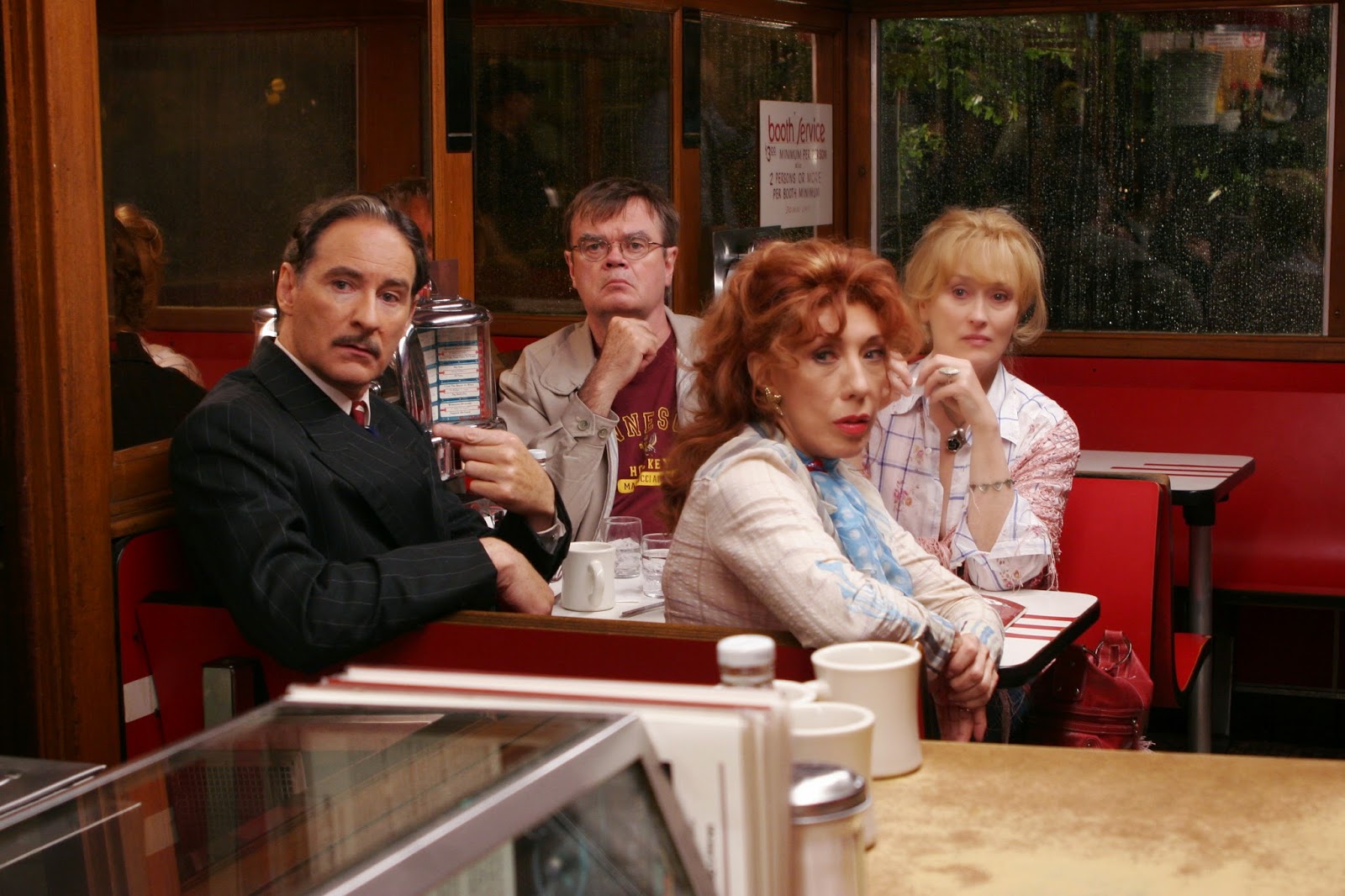

A movie exists and so that movie is what it is, and "Before Sunrise" exists and so it is the story of how and Jesse and Celine met and yet......what if it's just their imagination? What if it's just a fairy tale? What if it's just a story they made up to tell their daughters, to tell their friends, to tell themselves? What if “Before Midnight” is “The Bob Newhart Show” and “Before Sunrise” is “Newhart”? I hope not.

Several years ago I watched a film called “Free Enterprise” in which a couple Trekkies meet their idol, William Shatner, who immediately pitches them a Shatner-ish idea. Long after the fact, I recounted to my friend Daryl, a Trekkie, how this scene involved Shatner yearning to perform a one-man version of Shakespeare’s “Hamlet” in which he’d, as the term one-man version implies, play all the parts. “Even Ophelia?” I said just as the Trekkies said to Shatner. “Yes,” I replied in my best (worst) Shatner impression. At some point in the wake of telling him this, we both happened to catch “Free Enterprise” showing on TV, and when the aforementioned sequence arrived, I was stunned to discover that Shatner was not pitching “Hamlet” but “Julius Ceasar.” The Trekkies point out that to play all the parts in “Julius Ceasar” means Shatner would have to stab himself in the back. “I’ve done it before,” says Shatner.

I was flummoxed. How was my remembrance of the sequence so spectacularly incorrect? I mean, I even imagined dialogue that hadn’t happened! I submit this story because this is a movie blog and I’m attempting to keep it relevant but also to demonstrate how so many stories of our past, even the most inane, can in the melodramatic recesses of our mind be re-shaped. Maybe I changed it to “Hamlet” because I know “Hamlet” so much better than “Julius Ceasar.” Maybe I said Ophelia because sub-consciously any time I think of “Hamlet” I think of Kate Winslet playing Ophelia. The “Why?” of the reconstruction of this specific memory is in the context of this piece irrelevant compared to the broader question of “How Many Other Memories Have I Reconstructed?”


“People have these romantic projections they put on everything that’s not based on any kind of reality.” This is what Jesse says to Celine in “Before Sunrise” and in a way “Before Midnight” (as well as “Before Sunset”) works as a realistic deconstruction of the romantic projection of the first film. At the same time, “Before Sunrise” itself is a romantic projection that’s not based on any kind of reality, and that’s what I did do and why it still speaks so strongly to me and why “Before Midnight’s” subtle questioning of that romantic projection tears my soul in two.

Twenty years ago this summer one of the most momentous events of my life took place, and I’m not entirely being hyperbolic. It was back in high school during my churchgoing days and my Lutheran youth group was striking out for the ELCA Youth Gathering in Atlanta, and being an epic introvert, I declined to go because, my apologies, Jesus, but Jesus, all the people. My parents and friends ultimately convinced me otherwise and I went. But because I chose to sign up after my own collective already had, I was forced to enroll with another collective from a different church in a different town. This meant upon arrival in Atlanta, I had to separate from my friends at our hotel to go check in with the other group at their hotel halfway across town. In other words, as someone who was wholly uncomfortable with people I didn’t know, I was suddenly with a whole group of people I didn’t know in a city I’d never been to.

I still have nightmares about being at parties where I don’t know anyone, yet as I’ve grown, I’ve learned better how to quell my anxieties. At the age of 16, however, I was helpless, and inwardly I was having a panic attack. And there was one girl (who shall remain nameless to protect her from the ravings of some moron with a blog who hasn’t seen her in, like, 18 years) who recognized, without explicitly ever saying so, that I was having a panic attack and, for lack of a better phrase, took care of me. It was so sweet and so wonderful. She was so sweet and so wonderful. This was in advance of my junior year and so nearly 12 months later, when I went to my first prom, even though she went to another school, she went as my date.

Later that same day, as we gallivanted in the deep south, it started to rain, prompting us to veer for cover in a nearby shopping mall, and as we did, I sped up too fast and got ahead of this girl, with whom I had been walking and talking, and so she grasped the back of my shirt and pulled me back toward her. It’s a split-second that’s never left me and that I can still feel when I really think about it, and I realize that taken in conjunction with that entire day and the events it led to correlates directly to my propensity for putting romantic projections on everything. Every one of the twelve million references I've made to “Serendipity” can be traced directly to that pull on my shirt, a moment that still seems to me like the most emblematic in a gargantuan Georgian fairytale.

There seems to be consensus - at least among the populace that treats every life circumstance like an ongoing Slate “You're Doing It Wrong” article - that once you leave your twenties it's time to retire romanticism and idealism and nostalgia. I think instead of Bruce Springsteen hoarsely exhorting that “Someday these childish dreams must end / to become a man and grow up to dream again.” Every time I’ve heard him sing those lines live is one of the moments I sing along the loudest because it understands that as you get older, yes, you must set aside a certain set of romantic ideals, but that doesn't mean you have to set aside all your romantic ideals. And I haven't. And I won't. And yet.


The older and wearier I get, the deeper my problems and the world's problems become, the more society kvetches about every little thing, the more I feel my soul grumbling in the mornings and getting sleepy earlier than ever in the evenings, the more I begin to question that line and those romantic projections, the less I can feel that pull on my shirt, and the more terrified I am. And I start to worry. Did she really pull on my shirt? Was that real? Was that just a story I made up? I hope not.

Wednesday, June 19, 2013

Before Midnight's Bitter Aftertaste

The first time I watched “Before Sunrise”, rented from Hollywood video on VHS (“Memory…all alone in the moonlight”), was a genuinely revelatory moment. This was early 1998, a tumultuous (relatively speaking) period in my life, and there was a sense of displacement the characters had – two people who did not know one another, wandering around all night in a city where they did not live, kind of untethered from their actual selves – that mirrored the way I felt. And the fact that the film was defiant to that displacement not with anger or depression or violence but with romance……well, you only need to read the name of this blog to know it hit me flush.

It comforted me, it still comforts me, and it’s a film to which I often turn when in most dire need of recalibration. It is simplistic to reduce something such as 9/11 to "The first movie I watched in its wake was..." but, nonetheless, the first movie I watched in its wake was, by very definite choice, "Before Sunrise."


I had never encountered a film quite like “Before Sunrise.” This was in the midst of the period where I was just becoming a cinemaphile, watching everything I could get my hands on – old, new, mainstream, out of left field, whatever, whichever – and so I still had “My Dinner With Andre” and a few Eric Rohmer films (whose ouvre I’m still too far behind on), courtesy of the late, great Roger Ebert’s recommendation, to come, which meant I soon realized other films preceding “Before Sunrise” struck the same sort of conversational tone. But……I’m Gen X. I’m from the slacker generation. I cut my teeth on the era of 90’s Indie. I “knew” Winona Ryder before she ever stole a thing. I had a pathetic goatee and pierced both my ears. I was soulful and idealistic, which is to say I was idiotic and clueless. I was Ethan Hawke’s character in “Before Sunrise."

Well, that’s not right. Let’s say, I liked to imagine I was Ethan Hawke's character in "Before Sunrise." Maybe even more than that I liked to imagine I was meeting a French girl on the train and falling in love. Was there wish fulfillment happening here? Sure there was, and I suppose owning up to it rules me out of order in objectively discussing the film. But then, as the film critic Dana Stevens has noted, "one of the oldest and most compelling reasons there is to go to the movies" is seeing something which we can admit "we'd like to be doing...too...and this is as close as we're ever gonna get."

That, and "Before Sunrise" is not necessarily a film I have ever claimed to examine objectively. While I have written too many words over the years on both it and its eventual 2004 sequel "Before Sunset", I have never written a proper review of either one. This is to say, I have never critiqued them, never appraised them analytically, at least not out loud and in print (or: on the internet). As someone who strives to be (or: likes to fancy himself) a film critic this, I admit, is essentially against the rules. And yet, Jesse and Celine are from a time when I was still just an innocent movie fan, when I didn’t scrutinize text for subtext and attempt to provide a “reading” of each film I viewed. Please don’t misunderstand, I think those things are vital in cinema discussion and I wholly understand and fully embrace the need of objective film criticism, but in penning my reviews I am always attempting to do so in my voice. The voice I hope to project (and I’m not certain I’m always successful) is one that strikes a balance between the emotional and critical, the sonnet and the evaluation.


So, basically, “Before Midnight” was the first Jesse & Celine film I watched mindful of both emotion and analysis. It was…..weird. I wrote a real review. I critiqued it to the best of my abilities. It left my friend Daryl wondering: “So, did you like it? I couldn’t tell.” I’m not sure I could tell either. Which is not to say the film isn’t good – nay, very good. It is. But it’s a sad movie – at first wistfully so and then, in its own way, darkly. The end, the very end, absolutely crushed me. It’s difficult to gauge its exact intention but I swear it wants to be upbeat. Except that I think it plays exactly the opposite. It’s akin to “Sex and the City” (don’t ask how I know this) when Carrie and Berger’s relationship is kinda, sorta on the rocks and they resort to a “bit” – a “Hollywood kiss” when they are “being pissy with each other.” Carrie tells Miranda this to which Miranda, incredulously, replies: “You guys need a bit?” That’s how the end of “Before Midnight” played to me. Jesse and Celine need a……bit? Jesse and Celine???

Which, of course, is what makes it so wondrously bold. I get it! I do! My friend Ryan at The Matinee captures this notion in a beautiful review, writing: "It’s a special moment when any film can make its audience think about these sorts of ideas surrounding love. That writer-director Richard Linklater made these characters confront it feels extra special.” That, though, is simultaneously the overriding dilemma I face. I may have watched “Before Midnight” critically, but I was still feeling it emotionally. But I was feeling it even more emotionally than I do most movies specifically because it’s these characters.

This is a no-man’s-land to which, I think, I have never ventured, stricken by a kind of cinematic cognitive dissonance. The film is a grand achievement, yet my relationship to the characters at the core of the film is too close and too personal. So while I understand that what the film is doing might very well make it great, the greatness with which it goes about doing it simply makes it all too much for me to bear.

Wednesday, April 17, 2013

The Ferris Wheel Of Movies

For reasons I will not delve into a few years ago I caught a re-run of “Sex and the City” in which our gal Carrie (Sarah Jessica Parker) found herself in a sex buddy relationship with a guy played by Dean Winters. Dean Winters had a name in this episode – I think – but that name is unimportant, and it is unimportant because, of course, we all know Dean Winters best as Dennis Duffy, the beeper selling beau of "30 Rock" protagonist Liz Lemon. As plot dictates, Carrie eventually wants to expand her relationship with Dean Winters into more than just sex buddy status but as soon as she does she discovers that Dean Winters is loud, uncouth, clueless – kind of a irredeemable moron, basically. In other words, he is an awful lot like……Dennis Duffy.

Well, this blew my mind. What if he WAS Dennis Duffy? “30 Rock” was set in Manhattan. “Sex and the City” was set in Manhattan. Wasn’t it conceivable that Dennis Duffy could have found himself as sex buddy to Carrie Bradshaw before moving on several years later to being Liz Lemon’s paramour-in-arms? I know what you’re thinking. You’re thinking, “But on ‘Sex and the City’ he was dressed in a suit, like a wolf of Wall St. That’s so un-Dennis Duffy.” To which I reply, if you think for one second that Dennis Duffy – owner of the coffee machine at 38th and 6th in the basement of the K-Mart – wouldn’t get himself into a suit solely to be someone’s sex buddy, you’re outta your mind.


I thought about this again when I recently re-watched Carol Reed’s “The Third Man” for the umpteenth time and once again inhaled the savory aroma of the sequence between dime novelist drunkard Holly Martins (Joseph Cotton) and notorious racketeer Harry Lime (Orson Welles) aboard the Wiener Riesenrad – that is, the famed ferris wheel in Vienna’s Prater Amusement Park. It’s an ominous conversation despite Lime’s pretense of goodwill, and it’s partially ominous because these are old boyhood pals whose relationship has been suddenly, tragically altered. Just as Vienna was so different “before the war”, so were these two men, and now their hearts have been made dark – Holly no longer has his friend, Harry merely acts as if that’s what he still is. It is the human psyche plunging into the pit of despair.


It rises back up 46 years later when Jesse (Ethan Hawke) and Celine (Julie Delpy), college-age kids from America and France, respectively, who meet on a train and get off together at Vienna to experience a single night of bliss, living life as it should be lived, and eventually riding that very same ferris wheel where they share a first kiss. It is, in a way, a quiet if forceful rebuttal of the insignificance of human existence Harry Lime argued for all those years ago in the exact same place. That would suggest the makers of “Before Sunrise” were acting on the knowledge of “The Third Man”……but where they? I suppose it depends on how we view the movies.

The ancient phrase goes, Does a tree that falls in the forest make a sound if no one is there to hear it? But I ask a different variation on the question. I ask, do Rick Blaine & Ilsa Lund watch Bridget von Hammersmark movies? This is to say, did the Rick & Ilsa of “Casablanca” exist in the same universe as the German movie star of “Inglorious Basterds”? Are the movies a whole universe unto themselves where everything that happens just as it does here in our own world? Or are they make-believe, each one influenced by all the others?

Well, if you know me you know damn well what I believe, and I believe that Rick & Ilsa watched Bridget von Hammersmark movies and that when Jesse & Celine boarded that ferris wheel they had no idea that 46 years earlier a dime store novelist and a racketeer rode it too because what history text teaches about a dime store novelist and a racketeer? No, they were just like any Chicago tourist that takes in a game at Wrigley field without knowing who may have inhabited that rickety seat before them, or Chris Parker leading her charges through downtown without knowing some guy named Ferris did the same thing a year earlier.

Of course, Jesse and Celine probably knew about the mysterious death of that one guy in the park about eight years earlier. That was probably in all the papers.

Wednesday, February 27, 2013

Before Sunrise, True Love Lasts A Lifetime: 1,500th Post

---This is actually Post 1507. But the official 1500th post happened in the middle of Oscar week and I didn't want to interfere with my traditional countdown posts because, well, I'm weird that way. And because I specifically wanted THIS post to celebrate #1500. So we will celebrate it today. And hey, everyone, thanks for reading. Truly.---

Jerry: “And when she laughed, she’d reach out and touch my arm.”
George: “Love it when they touch the arm. Why is that?”
Jerry: “You know what? Let’s not even analyze it.”

I think it happened during the scene in the cafĂ© in which Jesse (Ethan Hawke) and Celine (Julie Delpy) are having make believe conversations on make believe phones with friends to explain why they are both in Vienna spending an entire night with someone they just met on the train. I thought, this scene, if you were to just draw it up on a cocktail napkin like a basketball play (“couple has make believe phone conversations, employing thumb and pinkie phone as telephone”), would emanate a certain saccharine ridiculousness. On screen, it does not. On screen, it is one part magical and one part poignant, effortlessly allowing Jesse and Celine to truly express the affectations of this encounter and to quietly set up the inevitable conversation we know has to come (“Are you gonna see him again?”).


I thought, why does this scene work so well? Oh, I suppose I could take my spelunking hat and burrow deep into the movie’s inner workings to understand why it and every other scene around it gracefully evokes a lifelike fairytale, but I hesitate.

My Mount Rushmore of Movies, as I have often stated, looks like this: “Last of the Mohicans”, “Million Dollar Baby”, “The Myth of Fingerprints”, “Before Sunrise.” Well, the first three I blather about all the time, much to my readers’ respective chagrins. The last one I blather about, too, but usually in the context of the second one or the forthcoming third one. I don’t particularly care to analyze the first one so much. I prefer simply to watch and let it draw me back in as it always does. Perhaps making such a confession discredits the critic. Is it not a film critic’s responsibility to critically evaluate the film he/she has seen? Indeed, it is, but in order to evaluate “Before Sunrise” we must evaluate the storyline that drives “Before Sunrise.”

To say it conventionally, “Before Sunrise” is about a Meet Cute on the eurorail and two people falling in love. But that does not do the film justice. No, it is about, to quote Celine from the film itself, about “the attempt of understanding someone, sharing something.” Even more specifically, it is about “just this little space in between.”

I dare say we have all experienced that little space in between, but only very rarely and probably in a way that is entirely ineffable. And you are in touch enough to realize it as it is happening – as Jesse and Celine are – it is probably something best left un-analyzed lest it be compromised or ruined. It seems as if a consensus has formed around “Before Sunrise” and its eventual 2004 follow-up “Before Sunset” and the consensus is that while both films were very good, the second was better.


“’Before Sunset’ is better,” wrote the esteemed Roger Ebert, “perhaps because the characters are older and wiser, perhaps because they have more to lose (or win).” David Denby of The New Yorker shared this sentiment, writing that “it goes deeper—it’s more emotional and direct, with intimations of sharp disappointment and unhappiness.” To their points, they are both correct, lives merely become more complicated with age and those complications lend the sequel a dramatic subtext its predecessor could not possess.

But, I propose that perhaps it is even more difficult to create a film where the stakes, as they call them, are not as high and less relevant, where the only complication is an airplane flight. Maybe “Before Sunset” is a better movie, but maybe “Before Sunrise” is still a greater achievement, and maybe “Before Sunrise” still means more to me because it captures something that no one’s words (except those of Jesse and Celine as they live it) can adequately express.

It is a film about “just this little space in between” and as anyone who has searched for that space (and found it, however fleetingly) knows, it is impervious to analysis.