Less a traditional sports movie than a thriller set in the sporting arena, "Fair Play" revolves around Anna (Judit Bardos), an 18 year old elite-level Czech sprinter who openly opines that she prefers "racing to running", and small wonder why. After all, it is 1984, the Cold War is still raging, and communist countries like Czechoslovakia are in an athletics arm race with those nansy-pansy democracies, determined to display their ideological might by essentially stating OUR people can run faster than YOUR people. Nah nah nah nah nah nah. And so Anna, enrolled into a "special" program that accounts for its "specialness" by having its athletes take seconds and thirds and fourths at the buffet table of anabolic steroids, has her body essentially co-opted by her country in the craven desire of implementing it as sprinting propaganda.
Interestingly, despite its backdrop, the most important relationship in the film proves not to be athlete & coach but daughter & mother. Irena (Anna Geislerova) was once a promising a tennis star only to have her career negated by ties to government dissidents, and now, forced to work as a cleaning lady for the teensiest of wages, she fears her daughter failing to take advantage of her choice position in a society where choice positions are few.
The re-surfacing of Irene's ties in the form of an old lover, Marek (Roman Zach), who asks her to carry out vaguely defined yet clearly criminal tasks is one of the film's weaker points, never feeling properly lived in, too transparent as a plot necessity. Still, the motherly decision to engage in such activity at the possible expense of her daughter's career is evocative of a certain selfishness - a selfishness that pulsates through the entire picture.
It was Martin Luther King Jr. who observed "Communism forgets that life is individual", a sentiment which "Fair Play" both embraces and rejects. Even if Irena is acting out of what she perceives as her daughter's best interests, her actions are not simply spectacularly negligent (and not to be revealed in this review), but carried out in spite of Anna's wishes. This is underscored by the country's track program as a whole, one that builds her into a sleek sprinting machine for the glory of itself, the sports doctors admiring what a precise specimen they have created, snidely and not inaccurately taking credit for her accomplishments.
It is telling that for much of the film, Anna, more or less, takes a backseat to a story that nonetheless remains primarily about her. She is manipulated by her government in the name of common ownership and she becomes an unwitting puppet of her mother to strike back at communism's core values. And Anna purposely becomes lost in the middle, a victim even in victory of two sides of a political spectrum using and abusing her.
Showing posts with label Chicago Film Festival. Show all posts
Wednesday, November 12, 2014
Wednesday, October 22, 2014
CIFF Review: 1001 Grams
"1001 Grams" centers around the Norwegian national kilo which is kept under scrupulous security at the nation's institute for weights and measures, a premise that blatantly belies its thematic intention to explore the balance a person tries to maintain in his or her life. Of course, as "Michael Clayton's" Karen Crowder once so ominously noted, that balance is "a shifting balance", one that is not so much a struggle to maintain as to find.
A film treating a kilogram with the reverency of "original, not rereleased - underlined - Frank Zappa albums" is clearly intended as an affair of the quirky, and director Bent Hamer gleefully obliges. He layers his films with smart cars and bird songs and cutesy shots like a gaggle of scientists walking single-file in the rain with matching umbrellas. Counteracting this quiet if insistent vibe of cutsiness, however, is matter-of-fact Marie (Ane Dahl Torp). An early shot finds her in a queen-sized bed but all wrapped up in a comforter and blanket straddling only one side, leaving the other empty. This is because, as we learn, her husband has left her. Yet more than that this bit of evidential characterization reveals her as someone so rigidly precise that if a portion of her mattress is rendered unoccupied, she will take painstaking care to ensure it remains spotless.
Her Nordic blonde hair often pulled back in tight ponytails, her demeanor rarely betraying emotion, Marie easily could have devolved into a brittle ice queen. But Dahl's performance matches the character's precision, her general air in tune with a home of sleek living room furniture that she ignores to sit on a bench along the wall, as if the arrangement is so faultless she cannot dare disturb its symmetry. Of course, her life balance, as it must be, is shifted when her father passes away. And seeing as how he was the institute's representative to squire Norway's kilo to the annual conference in Paris where it is inspected to ensure it has retained its official condition, the job is passed from father to daughter.
Naturally transporation of the kilo goes awry, further symbolizing an already symbolic descent into weightlessness of the soul, and it will all be rectified by The Frenchman In The Jaunty Hat, the male counterpart toThe Manic Pixie Dream Girl (er, strike that!). She takes down her hair, literally, in his presence, as his birdsong-listening and tree-planting ways cause her to embrace the vitality of life. And all of this, to be honest, might be a tad unbearable if Torp didn't sell it by not really selling it at all - by which I mean she convincingly crafts a closed-off individual, one who isn't lurching so much as listing. If the quirky pieces of plot threaten to throw the scale out of whack, it is Torp who keeps it properly weighted.
A film treating a kilogram with the reverency of "original, not rereleased - underlined - Frank Zappa albums" is clearly intended as an affair of the quirky, and director Bent Hamer gleefully obliges. He layers his films with smart cars and bird songs and cutesy shots like a gaggle of scientists walking single-file in the rain with matching umbrellas. Counteracting this quiet if insistent vibe of cutsiness, however, is matter-of-fact Marie (Ane Dahl Torp). An early shot finds her in a queen-sized bed but all wrapped up in a comforter and blanket straddling only one side, leaving the other empty. This is because, as we learn, her husband has left her. Yet more than that this bit of evidential characterization reveals her as someone so rigidly precise that if a portion of her mattress is rendered unoccupied, she will take painstaking care to ensure it remains spotless.
Her Nordic blonde hair often pulled back in tight ponytails, her demeanor rarely betraying emotion, Marie easily could have devolved into a brittle ice queen. But Dahl's performance matches the character's precision, her general air in tune with a home of sleek living room furniture that she ignores to sit on a bench along the wall, as if the arrangement is so faultless she cannot dare disturb its symmetry. Of course, her life balance, as it must be, is shifted when her father passes away. And seeing as how he was the institute's representative to squire Norway's kilo to the annual conference in Paris where it is inspected to ensure it has retained its official condition, the job is passed from father to daughter.
Naturally transporation of the kilo goes awry, further symbolizing an already symbolic descent into weightlessness of the soul, and it will all be rectified by The Frenchman In The Jaunty Hat, the male counterpart to
Labels:
1001 Grams,
Chicago Film Festival
Tuesday, October 21, 2014
CIFF Review: August Winds
Prior to my showing of "August Winds" at the Chicago Film Festival, its lead actress, Dandara de Morais, was introduced and made mention of it being not only her first film but the first non-documentary film of its director, Gabriel Mascaro. Even if she had not offered this informative tidbit, it would have been easy to surmise as the film is clearly less concerned with narrative than National Geographic-ism. Set in the Alagoas of Brazil, Mascaro effortlessly captures the sensation of a specific place on camera, of thunderstorms gathering on the precipice of the Pacific, occasionally allowing for cascades of rain to blot out the camera, as if we're watching in a poncho under a useless awning, and reveling repeatedly in towering palm fronds that its characters sometimes scale.
But then, it's not merely a travel brochure on celluloid. Those palm fronds are routinely the backdrop for hard labor, busting up coconuts and then hauling them on a tractor trailor, and with those rains come the tide and the wind, and with the wind comes a kindly mystery man (Mascaro) recording the wind for reasons that don't much exist beyond "Need More Story Here". He conveniently swoops in simply to wash up onshore not along after, dead. This is where the story, as it were, finds its (miniature trickle of coconut) juice in Jeison (Geova Manoel dos Santos) and Shirley (de Morais) attempting to care for the deceased when no one else appears much interested.
Many of Marasco's compositions evoke the haunting and beatific passages that open another Malick movie, "A Thin Red Line." But whereas that establishing passage documented Jim Caviezel's Pvt. Witt seeming to find a sort of mystical Eden, the prevalent air currents of "August Winds" would seem to find something more foreboding. At one point Jeison talks of how the rocks in the ocean have "lungs", suggesting they are ineffably alive, and which distinctly alludes to the overriding notion of nature reclaiming this rock.
Yet the film, in spite of its many shots showing the tide inching closer and closer, bit by bit, resists this notion. Its repeatedly decadent wide open frames of nature never come across terrifying, even when they are supposed to, only as reminders of its resplendence. And even if the wind recorder's dead body is shown without compromise, it is treated with a noticeable absence of pity, several local kids approaching it with whirling noisemakers as Jeison cleans it, their way of celebrating the life he must have led. We barely know him but we assume he must have gone out like Bodhi, dying doing what he loved, consumed by his meteorological environment.
But then, it's not merely a travel brochure on celluloid. Those palm fronds are routinely the backdrop for hard labor, busting up coconuts and then hauling them on a tractor trailor, and with those rains come the tide and the wind, and with the wind comes a kindly mystery man (Mascaro) recording the wind for reasons that don't much exist beyond "Need More Story Here". He conveniently swoops in simply to wash up onshore not along after, dead. This is where the story, as it were, finds its (miniature trickle of coconut) juice in Jeison (Geova Manoel dos Santos) and Shirley (de Morais) attempting to care for the deceased when no one else appears much interested.
Many of Marasco's compositions evoke the haunting and beatific passages that open another Malick movie, "A Thin Red Line." But whereas that establishing passage documented Jim Caviezel's Pvt. Witt seeming to find a sort of mystical Eden, the prevalent air currents of "August Winds" would seem to find something more foreboding. At one point Jeison talks of how the rocks in the ocean have "lungs", suggesting they are ineffably alive, and which distinctly alludes to the overriding notion of nature reclaiming this rock.
Yet the film, in spite of its many shots showing the tide inching closer and closer, bit by bit, resists this notion. Its repeatedly decadent wide open frames of nature never come across terrifying, even when they are supposed to, only as reminders of its resplendence. And even if the wind recorder's dead body is shown without compromise, it is treated with a noticeable absence of pity, several local kids approaching it with whirling noisemakers as Jeison cleans it, their way of celebrating the life he must have led. We barely know him but we assume he must have gone out like Bodhi, dying doing what he loved, consumed by his meteorological environment.
Labels:
August Winds,
Chicago Film Festival
Monday, October 20, 2014
CIFF Review: The Fool
In the frigid darkness of a Russian Night, Dima (Artem Bystrov), sort of a Eurasian version of Joe the Plumber, strikes out down the sidewalk while a pop anthem on the soundtrack rises, its rhythm matching the urgency of his every stride. He is not a man functioning on account of high-falutin' ideals but from a place of mere human decency, simply wanting to save the 800 souls unwittingly resting inside a decrepit tenement building tottering on the verge of collapse. It is a hero's moment but Dima, the film argues and betrays with its title, is not a hero. As the camera pans alongside him it eventually comes to a standstill with a red traffic light in the foreground of the frame. It's telling Dima to stop, of course. But he doesn't stop. He won't stop. He's a fool.
The chief of a maintenance crew in a bleak, unnamed Russian town, he is called to a housing complex on account of a burst bathroom pipe only to find the entire edifice fissuring from the ground to the top floor. Upon doing some quick calculations he reasons it has roughly 24 hours before it splits apart and crumbles - perhaps a narrative stretch but sometimes fierce allegories require a stretch - and so like the RMS Titanic functioning as a 46,000 ton metaphor for Victorian Society about to crack apart and go under, this building of mis-managed apathy and greed at the center of director Yuri Bykov's "The Fool" comes to resemble and, in turn, repudiate a society seemingly content to let anyone not on the top rung founder.
Dima's wife (Darya Moroz), and his mother and father who live with them, urge him to turn his back on the problem, arguing that to stir up shit will only effect a target on his back. He stirs up shit anyway - literally, in fact, by barging into the birthday celebration of the town's mayor and money-grubbing power-broker, Nina (Nataliya Surkova).
As Nina takes the stage to make a speech, Dima is glimpsed periodically in the background, appearing woefully out of place in his sweater and stocking cap, like he's time-traveling extra at an "Anna Karenina"-esque soiree. The contrast between these pompous, wine-swilling, back-patting chieftains and the poverty-stricken and hardscrabble addicts for whom Dima brazenly goes to bat would be crudely broad if it didn't ring with so much head-shaking truth.
Finally, upon being explained the situation, they adjourn to a conference room and debate what to do, only to realize their rampant mis-direction of funds that could have aided the dwelling's repair has left them with virtually no options. How do they evacuate 800 people when there is no place to put them? What happens when they are forced to explain themselves to higher-ups in the midst of the evacuation? This sequence, and ensuing ones like it, are filled with none-too-subtle, perhaps too much so, explaining and politicking to the point that one characer literally admonishes out loud their "beauracratic" bellyaching. It also betrays how the backstory and motivations of the rich get more face time than the those of the poor, but maybe that's intended. Who in Putin's Russia gets more face time than the rich and powerful? The poor's motivation is meaningless and hardly existent. The old man playing cards actively roots for a collapse.
In this elongated middle act, Dima also appropriately kind of becomes lost amidst the movers and shakers, as his attitude bears no significance to the choices being made by those who really run the show. He is at their mercy, as everyone is, and yet when he makes his inevitable choice in the impassioned conclusion to take a stand, Bykov takes care to illustrate his protagonist's ethics as being both righteous and irresponsible, clinging to humanity even as he surrenders his soul.
The chief of a maintenance crew in a bleak, unnamed Russian town, he is called to a housing complex on account of a burst bathroom pipe only to find the entire edifice fissuring from the ground to the top floor. Upon doing some quick calculations he reasons it has roughly 24 hours before it splits apart and crumbles - perhaps a narrative stretch but sometimes fierce allegories require a stretch - and so like the RMS Titanic functioning as a 46,000 ton metaphor for Victorian Society about to crack apart and go under, this building of mis-managed apathy and greed at the center of director Yuri Bykov's "The Fool" comes to resemble and, in turn, repudiate a society seemingly content to let anyone not on the top rung founder.
Dima's wife (Darya Moroz), and his mother and father who live with them, urge him to turn his back on the problem, arguing that to stir up shit will only effect a target on his back. He stirs up shit anyway - literally, in fact, by barging into the birthday celebration of the town's mayor and money-grubbing power-broker, Nina (Nataliya Surkova).
As Nina takes the stage to make a speech, Dima is glimpsed periodically in the background, appearing woefully out of place in his sweater and stocking cap, like he's time-traveling extra at an "Anna Karenina"-esque soiree. The contrast between these pompous, wine-swilling, back-patting chieftains and the poverty-stricken and hardscrabble addicts for whom Dima brazenly goes to bat would be crudely broad if it didn't ring with so much head-shaking truth.
Finally, upon being explained the situation, they adjourn to a conference room and debate what to do, only to realize their rampant mis-direction of funds that could have aided the dwelling's repair has left them with virtually no options. How do they evacuate 800 people when there is no place to put them? What happens when they are forced to explain themselves to higher-ups in the midst of the evacuation? This sequence, and ensuing ones like it, are filled with none-too-subtle, perhaps too much so, explaining and politicking to the point that one characer literally admonishes out loud their "beauracratic" bellyaching. It also betrays how the backstory and motivations of the rich get more face time than the those of the poor, but maybe that's intended. Who in Putin's Russia gets more face time than the rich and powerful? The poor's motivation is meaningless and hardly existent. The old man playing cards actively roots for a collapse.
In this elongated middle act, Dima also appropriately kind of becomes lost amidst the movers and shakers, as his attitude bears no significance to the choices being made by those who really run the show. He is at their mercy, as everyone is, and yet when he makes his inevitable choice in the impassioned conclusion to take a stand, Bykov takes care to illustrate his protagonist's ethics as being both righteous and irresponsible, clinging to humanity even as he surrenders his soul.
Labels:
Chicago Film Festival,
The Fool
Thursday, October 24, 2013
CIFF Review: Will You Still Love Me Tomorrow?
Writer/Director Arvin Chen’s new film takes for its title The Shirelles’ 1960 pop standard, a song performed in an obligatory karaoke scene blending reality and fantasy, joy and sadness. It is a demonstration of what made many of those songs from the 50’s and 60’s so great – sonically they were all sunshine and rainbows, lyrically they were often honest and aching. Thus, Chen takes that idea and communicates it cinematically. The film has a fanciful air and a bright visual sheen, but lurking is an undercurrent of melancholy. Formally, “Will You Still Love Me Tomorrow?” is very much a rom com, what with its meet cutes and misunderstandings, and yet it’s still willing to drop a tab of Alka Seltzer into the sugary milkshake. Here, whimsy actually has consequences.
Its focus is two couples, connected as family, but each one finding its romantic ideals tested. Mandy (Kimi Hsia), suggesting a reformed party girl, breaks off her engagement to San San (Stone), whose name alone evokes a Sad Sack if his general demeanor did not, more from fear than any logical reason. She stays indoors and watches soaps as the soap’s leading man continually materializes beside her, dispensing advice that only appears to enable her already questionable attitude.
Meanwhile, Mandy’s older brother, Weichung (Richie Jen), a demure optometrist, finds his long repressed homosexuality re-bubbling to the surface when a handsome flight attendant (Wong Ka-Lok) enters his shop and makes eyes at him through his brand new frames. This is problematic because Weichung has a young son with his wife of nine years, Feng (Mavis Fan), whose own turmoil involves potential downsizing at her office job.
Help for both confused men arrives in the form of gay greek chorus, fronted by wedding photographer Stephen (Lawrence Ko), who is in a marriage to a lesbian – a tart character that could have used a little more screen time – that purposely has no boundaries to afford maximum happiness. He coaches hapless San San in an effort to first re-woo Mandy and then become his own man. He urges Weichung to be honest with himself, and so Weichung tentatively begins to explore feelings he put aside for responsibility upon saying “I do.”
Feng, as it happens, is the weight that keeps “Will You Still Love Me Tomorrow?” from floating into the billowy clouds, not unlike an umbrella-sporting character near the start who finds himself whisked into the sky at a moment of profound happiness. Most films would have been content to focus on Weichung’s coming out, to show him as the victor simply for acknowledging the truth, but Chen’s film also acknowledges the price to pay for that truth is Feng’s own well-being.
Hope and hurt collide, and a happy ending is proven more difficult to achieve than merely taking a magical umbrella ride.
Its focus is two couples, connected as family, but each one finding its romantic ideals tested. Mandy (Kimi Hsia), suggesting a reformed party girl, breaks off her engagement to San San (Stone), whose name alone evokes a Sad Sack if his general demeanor did not, more from fear than any logical reason. She stays indoors and watches soaps as the soap’s leading man continually materializes beside her, dispensing advice that only appears to enable her already questionable attitude.
Meanwhile, Mandy’s older brother, Weichung (Richie Jen), a demure optometrist, finds his long repressed homosexuality re-bubbling to the surface when a handsome flight attendant (Wong Ka-Lok) enters his shop and makes eyes at him through his brand new frames. This is problematic because Weichung has a young son with his wife of nine years, Feng (Mavis Fan), whose own turmoil involves potential downsizing at her office job.
Help for both confused men arrives in the form of gay greek chorus, fronted by wedding photographer Stephen (Lawrence Ko), who is in a marriage to a lesbian – a tart character that could have used a little more screen time – that purposely has no boundaries to afford maximum happiness. He coaches hapless San San in an effort to first re-woo Mandy and then become his own man. He urges Weichung to be honest with himself, and so Weichung tentatively begins to explore feelings he put aside for responsibility upon saying “I do.”
Feng, as it happens, is the weight that keeps “Will You Still Love Me Tomorrow?” from floating into the billowy clouds, not unlike an umbrella-sporting character near the start who finds himself whisked into the sky at a moment of profound happiness. Most films would have been content to focus on Weichung’s coming out, to show him as the victor simply for acknowledging the truth, but Chen’s film also acknowledges the price to pay for that truth is Feng’s own well-being.
Hope and hurt collide, and a happy ending is proven more difficult to achieve than merely taking a magical umbrella ride.
Wednesday, October 23, 2013
CIFF Review: La Jaula De Oro
It goes without saying that the border between Mexico and the U.S. can be, whether politically or narratively, divisive. To one the border might appear as a demarcation of hope, a new beginning, a second chance. To another the border might appear as a false hope, a line of trouble, where dreaming only leads to despair. Perhaps the most interesting aspect of director Diego Quemada-Diez’s marvelous film, “La Jaula De Oro”, a prize-winner at Cannes, is how gracefully it straddles both sides of this argument, refusing to pick sides or offer solutions. Rather Quemada-Diez, to quote the late great Roger Ebert, puts human beings on the screen, and asks his audience to walk a little awhile in their shoes.
Our introductory image is Juan (Brandon Lopez) tromping through his shanty Guatemalan neighborhood. It is telling because it visually encapsulates the film’s whole forthcoming journey – straight-ahead and determined, whatever may come. He and his pal Samuel (Carlos Chajon) and his girlfriend Sara (Karen Martinez), who cuts her hair, tapes her breasts, and masquerades as a boy, hop a train, intent on making the perilous 1,200 mile journey north to Mexico and ultimately the El Dorado that is Los Angeles. These repeated wide hanging shots of trains in the Central American countryside, aspiring immigrants packed body-to-body on the roofs, are stirring, evoking modern-day refugees aboard boats bound for Ellis Harbor.
Of course, it’s not so easy. The trio encounters a younger Indian whose language is hard for them to decipher (impossible for us as it purposely goes without subtitles), Chauk (Rodolfo Dominguez). Juan, hotheaded, a thief of necessity, wants him to stay away. Sara and Samuel are more gracious. But Chauk seems to come as both a blessing and a curse, and his presence results in them being deported back to Guatemala. Nevertheless, they hop another train and re-strike out for points north.
A multitude of harrowing setbacks and snafus await, including a brief allusion to an event chronicled in a This American Life episode. Often these characters are willing or left without an alternative other than to place their trust in the hands of those they meet on the road. Juan may be brash, but his naivety can be jaw-dropping, and this leads them straight into trouble. Yet, what choice do they have? After all, the mythical border crossing they yearn to make would rely on them submitting themselves as drug mules. By any means necessary, right? The idea of faith in your fellow man is shattered, yet simultaneously reinforced in the way that Juan and Chauk come to find a mutual respect. Not a friendship, per se, just the recognition that shared hardships can bring.
That is one of “La Jaula De Oro’s” neatest concepts, its offering of standard setups – including one involving Sara that shall not be revealed – and then its admirable defiance to commonplace payoffs, if it even provides payoffs at all. No one is safe, and that lends the film a fierce urgency.
In spite of so much risk and tension, the characters never lose sight of their intent, clinging to the ideal of the fabled borderland. Once there, however, reality intrudes. The dream drives them forward, the dream is unmasked as an illusion, and both ideas blend together in a haunting finale showing a quiet snowfall not as the purity of a brand new start but as the burying of all facile assumptions.
Our introductory image is Juan (Brandon Lopez) tromping through his shanty Guatemalan neighborhood. It is telling because it visually encapsulates the film’s whole forthcoming journey – straight-ahead and determined, whatever may come. He and his pal Samuel (Carlos Chajon) and his girlfriend Sara (Karen Martinez), who cuts her hair, tapes her breasts, and masquerades as a boy, hop a train, intent on making the perilous 1,200 mile journey north to Mexico and ultimately the El Dorado that is Los Angeles. These repeated wide hanging shots of trains in the Central American countryside, aspiring immigrants packed body-to-body on the roofs, are stirring, evoking modern-day refugees aboard boats bound for Ellis Harbor.
Of course, it’s not so easy. The trio encounters a younger Indian whose language is hard for them to decipher (impossible for us as it purposely goes without subtitles), Chauk (Rodolfo Dominguez). Juan, hotheaded, a thief of necessity, wants him to stay away. Sara and Samuel are more gracious. But Chauk seems to come as both a blessing and a curse, and his presence results in them being deported back to Guatemala. Nevertheless, they hop another train and re-strike out for points north.
A multitude of harrowing setbacks and snafus await, including a brief allusion to an event chronicled in a This American Life episode. Often these characters are willing or left without an alternative other than to place their trust in the hands of those they meet on the road. Juan may be brash, but his naivety can be jaw-dropping, and this leads them straight into trouble. Yet, what choice do they have? After all, the mythical border crossing they yearn to make would rely on them submitting themselves as drug mules. By any means necessary, right? The idea of faith in your fellow man is shattered, yet simultaneously reinforced in the way that Juan and Chauk come to find a mutual respect. Not a friendship, per se, just the recognition that shared hardships can bring.
That is one of “La Jaula De Oro’s” neatest concepts, its offering of standard setups – including one involving Sara that shall not be revealed – and then its admirable defiance to commonplace payoffs, if it even provides payoffs at all. No one is safe, and that lends the film a fierce urgency.
In spite of so much risk and tension, the characters never lose sight of their intent, clinging to the ideal of the fabled borderland. Once there, however, reality intrudes. The dream drives them forward, the dream is unmasked as an illusion, and both ideas blend together in a haunting finale showing a quiet snowfall not as the purity of a brand new start but as the burying of all facile assumptions.
Labels:
Chicago Film Festival,
La Jaula De Oro
Tuesday, October 22, 2013
CIFF Review: Miele
I apologize straight away for opening a review this way but as the oft-repeated Robert Warshaw phrase goes: “A man goes to the movies. The critic must be honest enough to admit he is that man.” And if this is true, and I contend whole-heartedly that it is, then it also must be said that a man goes to the movies on a certain date and time. The critic must be honest enough to admit he is that man on that certain date and time. This is to say, I saw “Miele” the very same day two girls were arrested in connection with the bullying of Rebecca Sedwick that led her to commit suicide. The terms suicide and euthanasia both come attached with a great deal of weight in society, but is there a difference between the two? And should they carry such negative connotations? This is the question “Miele”, the directorial debut of Valeria Golino (of whom you may have heard), poses.
Our protagonist is Irene (Jasmine Trinca), bringing to mind a less possessed Milla Jovovich, whose working name is Miele (i.e. Honey) and who earns scratch as a for-hire Angel of Death, rambling about Italy to assist people in need of suicide and/or euthanasia by washing down barbiturates used to put dogs to sleep that she scores from Mexico with vodka. She also sets the mood with by-appointment musical selections. It’s an all-encompassing service. We never learn how she fell into this job, nor should we. For-hire Angels of Death, I imagine, just sort of emerge from the mists rather than answer ads in the classifieds.
The film displays admirable patience in allowing the audience to figure out on its own who she is and what she does (or should the latter come first?). It is strongly suggested, but not spelled out. Eventually we learn she maintains her own standard of ethics – namely, she only aids the already terminally ill. Thus, as she must, she is assigned to an older man, Grimaldi (Carlo Cecchi), who seeks to be euthanized not on account of his health, which is fine, but simply because he has grown tired of life.
Irene becomes indignant, actively trying to stop him, but gradually gives ground. A teensy subplot involves Irene’s father, with whom she socializes but doesn’t really interact. This clearly colors Grimaldi as a kind of father figure, and honestly “Miele” might have been better sans that bit of business. It works better as a re-prioritizing of Irene’s ideals. She draws closer to Grimaldi and finds her worldview, for better and for worse, altered. Rather than plowing toward some dramatic faceoff, it quiets down into a graceful understanding, an admission of the world’s reality. No reason is ever established for Grimaldi’s desire to check out. He even mocks that notion, saying something to the effect of “Now’s the time when I tell a sad story?” Whatever brought him here is deep-seeded, a long time coming.
Ultimately the film concludes that no one really wants to die. We all want to live, but a point may arrive where life seems unlivable. Is it truly unlivable? Regardless of what some may argue, I contend only the individual knows. That is not to suggest the absence of a breakdown – whether emotional, whether societal – but that it is entirely possible for an otherwise healthy human being to reach such a place of despair.
Rebecca Sedwick reaching that point wrecks my heart, and I desperately wish she could have seen that there was a way out. But I also believe she must have reached a point where she genuinely felt she could not go on, and I hope beyond hope that her soul found peace. And paradoxically, I wish everyone in life could be as kind and generous as Irene is helping distribute death to those who seek it.
Our protagonist is Irene (Jasmine Trinca), bringing to mind a less possessed Milla Jovovich, whose working name is Miele (i.e. Honey) and who earns scratch as a for-hire Angel of Death, rambling about Italy to assist people in need of suicide and/or euthanasia by washing down barbiturates used to put dogs to sleep that she scores from Mexico with vodka. She also sets the mood with by-appointment musical selections. It’s an all-encompassing service. We never learn how she fell into this job, nor should we. For-hire Angels of Death, I imagine, just sort of emerge from the mists rather than answer ads in the classifieds.
The film displays admirable patience in allowing the audience to figure out on its own who she is and what she does (or should the latter come first?). It is strongly suggested, but not spelled out. Eventually we learn she maintains her own standard of ethics – namely, she only aids the already terminally ill. Thus, as she must, she is assigned to an older man, Grimaldi (Carlo Cecchi), who seeks to be euthanized not on account of his health, which is fine, but simply because he has grown tired of life.
Irene becomes indignant, actively trying to stop him, but gradually gives ground. A teensy subplot involves Irene’s father, with whom she socializes but doesn’t really interact. This clearly colors Grimaldi as a kind of father figure, and honestly “Miele” might have been better sans that bit of business. It works better as a re-prioritizing of Irene’s ideals. She draws closer to Grimaldi and finds her worldview, for better and for worse, altered. Rather than plowing toward some dramatic faceoff, it quiets down into a graceful understanding, an admission of the world’s reality. No reason is ever established for Grimaldi’s desire to check out. He even mocks that notion, saying something to the effect of “Now’s the time when I tell a sad story?” Whatever brought him here is deep-seeded, a long time coming.
Ultimately the film concludes that no one really wants to die. We all want to live, but a point may arrive where life seems unlivable. Is it truly unlivable? Regardless of what some may argue, I contend only the individual knows. That is not to suggest the absence of a breakdown – whether emotional, whether societal – but that it is entirely possible for an otherwise healthy human being to reach such a place of despair.
Rebecca Sedwick reaching that point wrecks my heart, and I desperately wish she could have seen that there was a way out. But I also believe she must have reached a point where she genuinely felt she could not go on, and I hope beyond hope that her soul found peace. And paradoxically, I wish everyone in life could be as kind and generous as Irene is helping distribute death to those who seek it.
Labels:
Chicago Film Festival,
Miele
Thursday, October 17, 2013
CIFF Review: Bluebird
If you have survived a harsh winter, and as both a native and current Midwesterner I can attest to having survived a great many of them, you understand their oppressiveness. Snow seems permanently embedded to the ground, the frozen chill refuses to subside, the sky just won't stop being grey, and any reasonable human being feels the urge to withdraw from the world in general and hibernate until spring (which likely won't arrive until April). Director Lance Edmands captures that wintry relentlessness with an astute eye and an indescribable ability to imbue mentally that you too are trapped in this Maine tundra (the guy sitting next to me put on his jacket midway through).
Thus, "Bluebird" purposely and a little problematically wears you down. It will not give an inch on its weary atmosphere. Even the character names come slathered in somber metaphor. The primary family's last name is Dyer. The requisite slime-infested lawyer's last name is Lyman. Even the symbolic respite that provides the film its title doubles as a harbinger of doom. That is, Lesley (Amy Morton), a school bus driver in the small town where the film is set, is distracted by a bluebird during her routine check after dropping her many young charges off, and fails to see little Owen sleeping in one of the seats. She finds him in the next morning. He has gone into a coma on account of hypothermia and is rushed to the hospital.
Owen's mother Marla (Louisa Krause), her mind clouded by her usual diet of drinks and drugs, was supposed to pick him up but forgot. Not that she would have even been taking Owen to her own home since her son stays with his grandmother (Margo Martindale), who patiently remains at Owen's side, forced to watch Marla go back out for more drinks and drugs. The requisite slime-infested lawyer shows up and suggests monetary compensation.
A lawsuit and her own error might be enough to make Lesley loony, but there's more. Her husband Richard (John Slattery) is on the verge of being laid off from the local lumber mill where he has worked for 25 years, though he keeps this to himself. He keeps mostly to himself. The subject of his past infidelity is raised, never addressed. Slattery's (the film's) funniest line is as follows: "This house is falling apart." It's so uninterested, as if the house has been falling apart for quite some time, as if life in general has been falling apart for quite some time.
Paula (Emily Meade), the lone daughter of Lesley and Richard, seems the sliver of light, but the gauntlet of a New England winter combined with familial distress gets to her too. The boy she's sorta seeing promptly brushes her off after they have sex and her life at school is unavoidably affected by her mother's horrible mistake. Still, she has the guts to stand up to her father, and mostly no one else appears capable of such intestinal fortitude. Morever, she is the only one with an occasional smile not merely meant to mask the sadness.
The film's finest moment finds Paula, who works part-time at some sort of value store, stocking the shelves with assembly line snow globe music boxes. As she does, she winds up each one so that the music plays and the itsy-bitsy fake snow falls. The next scene shows Marla slumped in her parked car, popping pills and smoking a cigarette. It's winter. It's not going to end. You choose how to cope.
Thus, "Bluebird" purposely and a little problematically wears you down. It will not give an inch on its weary atmosphere. Even the character names come slathered in somber metaphor. The primary family's last name is Dyer. The requisite slime-infested lawyer's last name is Lyman. Even the symbolic respite that provides the film its title doubles as a harbinger of doom. That is, Lesley (Amy Morton), a school bus driver in the small town where the film is set, is distracted by a bluebird during her routine check after dropping her many young charges off, and fails to see little Owen sleeping in one of the seats. She finds him in the next morning. He has gone into a coma on account of hypothermia and is rushed to the hospital.
Owen's mother Marla (Louisa Krause), her mind clouded by her usual diet of drinks and drugs, was supposed to pick him up but forgot. Not that she would have even been taking Owen to her own home since her son stays with his grandmother (Margo Martindale), who patiently remains at Owen's side, forced to watch Marla go back out for more drinks and drugs. The requisite slime-infested lawyer shows up and suggests monetary compensation.
A lawsuit and her own error might be enough to make Lesley loony, but there's more. Her husband Richard (John Slattery) is on the verge of being laid off from the local lumber mill where he has worked for 25 years, though he keeps this to himself. He keeps mostly to himself. The subject of his past infidelity is raised, never addressed. Slattery's (the film's) funniest line is as follows: "This house is falling apart." It's so uninterested, as if the house has been falling apart for quite some time, as if life in general has been falling apart for quite some time.
Paula (Emily Meade), the lone daughter of Lesley and Richard, seems the sliver of light, but the gauntlet of a New England winter combined with familial distress gets to her too. The boy she's sorta seeing promptly brushes her off after they have sex and her life at school is unavoidably affected by her mother's horrible mistake. Still, she has the guts to stand up to her father, and mostly no one else appears capable of such intestinal fortitude. Morever, she is the only one with an occasional smile not merely meant to mask the sadness.
The film's finest moment finds Paula, who works part-time at some sort of value store, stocking the shelves with assembly line snow globe music boxes. As she does, she winds up each one so that the music plays and the itsy-bitsy fake snow falls. The next scene shows Marla slumped in her parked car, popping pills and smoking a cigarette. It's winter. It's not going to end. You choose how to cope.
Labels:
Bluebird,
Chicago Film Festival
Wednesday, October 16, 2013
CIFF Review: Domestic
So much of the so-called Romanian New Wave has been built around exceedingly long takes filmed with stationary cameras, setting up a precise, sometimes picturesque, frame and then blocking actors within that space. It is meant to invoke a sense of realism, and often it does, but, at the same time, in this cinematic world of quick cuts galore, it can come across surreal. Indeed, Director Adrian Sitaru’s “Domestic”, amidst those long takes and real-looking people, presents a distinct tone of the surrealist.
Set almost entirely inside an apartment building in Bucharest, “Domestic” chronicles, in its unique way, a pair of families and a partially noble dognapper with a recurring dream he struggles to make sense of. Him being a dognapper is not merely meant as comedic fodder as animals factor into the story as prominently as humans.
Mr. Lazar (Adrian Titieni), the building administrator, is shocked to see his wife (Clara Voda) return home with a live hen intended for dinner. But this means someone has to snuff out the hen. So the Lazars argue as their daughter, Mara (Ariadna Titieni), weighs ethics against monetary compensation for doing the dirty deed. The sequence – which has to be ten minutes at least – is a single take demonstration of how the film’s laughs arrive directly from a natural escalation of their built-in absurdity.
A few doors down a cabbie (Gheorghe Ifrim) brings a rabbit home to his son for a makeshift pet. Ultimately the rabbit winds up in a stew and that leaves the son despondent which leads to the son bringing home a pigeon intent on it being a makeshift pet. In other words, pets are not merely the props, they are very much the point.
Please indulge your humble “reviewer” in a personal anecdote, but it bears relevance. When my sister went away to college her roommates had a cat for whom none of them were interested in caring. So my sister took it upon herself to care for the cat, and inevitably she became attached. But when my sister finished college and begin criss-crossing the U.S. on a multitude of adventures, it fell upon our father to care for the cat, and inevitably he became attached. This is the theme “Domestic” gently unspools, building to an antepenultimate scene that effortlessly shows how two characters have become attached to a cat for whom neither of them ever much cared.
Well, build might be a strong word. “Domestic” is far more aligned to vignettes than standard arc, and so ginormous developments – such as a certain character’s death – are dropped in during otherwise casual conversation, and other conversations only exist for the sake of themselves. Not that I’m complaining. A Christmas dinner monologue revolving around God, for instance, evoked Garrison Keillor, if Garrison Keillor left Lake Wobegon and re-settled near the Carpathian Mountains. Many individual moments are enjoyable, intriguing ideas are raised, but the film feels incomplete.
But perhaps that is a virtue. We are conditioned to expect that the oft-debated dream will be returned to at the conclusion, and its meaning will be readily apparent, and all will fall into place. And sure enough, like clockwork, the dream re-appears at the conclusion but......not so fast! It really doesn't answer any of our questions. Thus, a sequence over the closing credits shows our characters CONTINUING to debate the dream.
Even when the movie ends, its characters’ trundle on.
Set almost entirely inside an apartment building in Bucharest, “Domestic” chronicles, in its unique way, a pair of families and a partially noble dognapper with a recurring dream he struggles to make sense of. Him being a dognapper is not merely meant as comedic fodder as animals factor into the story as prominently as humans.
Mr. Lazar (Adrian Titieni), the building administrator, is shocked to see his wife (Clara Voda) return home with a live hen intended for dinner. But this means someone has to snuff out the hen. So the Lazars argue as their daughter, Mara (Ariadna Titieni), weighs ethics against monetary compensation for doing the dirty deed. The sequence – which has to be ten minutes at least – is a single take demonstration of how the film’s laughs arrive directly from a natural escalation of their built-in absurdity.
A few doors down a cabbie (Gheorghe Ifrim) brings a rabbit home to his son for a makeshift pet. Ultimately the rabbit winds up in a stew and that leaves the son despondent which leads to the son bringing home a pigeon intent on it being a makeshift pet. In other words, pets are not merely the props, they are very much the point.
Please indulge your humble “reviewer” in a personal anecdote, but it bears relevance. When my sister went away to college her roommates had a cat for whom none of them were interested in caring. So my sister took it upon herself to care for the cat, and inevitably she became attached. But when my sister finished college and begin criss-crossing the U.S. on a multitude of adventures, it fell upon our father to care for the cat, and inevitably he became attached. This is the theme “Domestic” gently unspools, building to an antepenultimate scene that effortlessly shows how two characters have become attached to a cat for whom neither of them ever much cared.
Well, build might be a strong word. “Domestic” is far more aligned to vignettes than standard arc, and so ginormous developments – such as a certain character’s death – are dropped in during otherwise casual conversation, and other conversations only exist for the sake of themselves. Not that I’m complaining. A Christmas dinner monologue revolving around God, for instance, evoked Garrison Keillor, if Garrison Keillor left Lake Wobegon and re-settled near the Carpathian Mountains. Many individual moments are enjoyable, intriguing ideas are raised, but the film feels incomplete.
But perhaps that is a virtue. We are conditioned to expect that the oft-debated dream will be returned to at the conclusion, and its meaning will be readily apparent, and all will fall into place. And sure enough, like clockwork, the dream re-appears at the conclusion but......not so fast! It really doesn't answer any of our questions. Thus, a sequence over the closing credits shows our characters CONTINUING to debate the dream.
Even when the movie ends, its characters’ trundle on.
Labels:
Chicago Film Festival,
Domestic
Tuesday, October 15, 2013
CIFF Review: Suzanne
Maria (Adèle Haenel) and Julien (Paul Hamy) are discussing Maria's sister and Julien's lover, Suzanne (Sara Forestier), and how she left her job with her young son in tow to be with Julien. Maria suspects Julien of pressuring her but Julien says "I didn't ask her to." He continues: "You know how she is." He smiles. Maria smiles. They know how she is.
How she is is impulsive, an erratic carefree spirit. Within the film's first ten minutes Suzanne has become pregnant, though tellingly we never see nor hear about nor so much as get the first name of the father. Why does she want to keep the baby? "Because I feel like it," she replies with a shrug. In most films that might constitute the screenplay's lack of understanding its own protagonist, but here it communicates to us in toto who Suzanne is and how she sees the world.
Director Katell Quillévéré, who penned the screenplay along with Mariette Désert, has in many ways crafted a French answer to Derek Cianfrance's "The Place Beyond The Pines", in so much as it as an era-spanning document of a family and its ongoing crises. "Suzanne", however, is more compact, refraining from separate acts, content to unspool in a free-flowing form evoking the refreshing sensation that it is being written on the screen.
On a couple occasions Suzanne even briefly drops out of the story, as it focuses more on the exploits of Maria and her and Suzanne's father Nicolas (Francois Damiens) and their efforts to raise Suzanne's son as she abandons him for a wayward life of crime on the arm of Julien. In fact, I suspect Quillévéré could easily have made a "Suzanne" B-side called "Maria." It can be tough to stay on the side of a character that willingly walks away from her child, and that we stay at least partially rooted to her selfish struggle is because Maria stays at least partially rooted to her sister. Sisterly Love is binding, and "Suzanne" conveys this gracefully, not least because of the knowing performances of Forestier and Haenel. They are two girls facing mature decisions with only lives primarily of immaturity to guide them.
It must be said, however, the film's final act is spurred by an extreme coincidence, which is always bothersome, and a particular character's reckoning felt cheap. Although maybe it wasn't cheap at all. Maybe its all-of-a-suddennes was very in tune to her herky-jerky arc of life. And maybe my emotional connection to that particular character - and too often, I feel, critics are unwilling to confront lurking emotional connections to evens on the screen - influenced my line of thinking.
Nevertheless, I have substantial admiration for a film that allows its primary character to take possession of her (or him) self rather than letting the plot square things. Is Suzanne's conclusive choice a case of too little, too late? It could be argued, but I enjoyed myself so much I was willing to believe she'd finally turned the corner.
How she is is impulsive, an erratic carefree spirit. Within the film's first ten minutes Suzanne has become pregnant, though tellingly we never see nor hear about nor so much as get the first name of the father. Why does she want to keep the baby? "Because I feel like it," she replies with a shrug. In most films that might constitute the screenplay's lack of understanding its own protagonist, but here it communicates to us in toto who Suzanne is and how she sees the world.
Director Katell Quillévéré, who penned the screenplay along with Mariette Désert, has in many ways crafted a French answer to Derek Cianfrance's "The Place Beyond The Pines", in so much as it as an era-spanning document of a family and its ongoing crises. "Suzanne", however, is more compact, refraining from separate acts, content to unspool in a free-flowing form evoking the refreshing sensation that it is being written on the screen.
On a couple occasions Suzanne even briefly drops out of the story, as it focuses more on the exploits of Maria and her and Suzanne's father Nicolas (Francois Damiens) and their efforts to raise Suzanne's son as she abandons him for a wayward life of crime on the arm of Julien. In fact, I suspect Quillévéré could easily have made a "Suzanne" B-side called "Maria." It can be tough to stay on the side of a character that willingly walks away from her child, and that we stay at least partially rooted to her selfish struggle is because Maria stays at least partially rooted to her sister. Sisterly Love is binding, and "Suzanne" conveys this gracefully, not least because of the knowing performances of Forestier and Haenel. They are two girls facing mature decisions with only lives primarily of immaturity to guide them.
It must be said, however, the film's final act is spurred by an extreme coincidence, which is always bothersome, and a particular character's reckoning felt cheap. Although maybe it wasn't cheap at all. Maybe its all-of-a-suddennes was very in tune to her herky-jerky arc of life. And maybe my emotional connection to that particular character - and too often, I feel, critics are unwilling to confront lurking emotional connections to evens on the screen - influenced my line of thinking.
Nevertheless, I have substantial admiration for a film that allows its primary character to take possession of her (or him) self rather than letting the plot square things. Is Suzanne's conclusive choice a case of too little, too late? It could be argued, but I enjoyed myself so much I was willing to believe she'd finally turned the corner.
Labels:
Chicago Film Festival,
Suzanne
Friday, October 26, 2012
CIFF Review: Tchoupitoulas
Often when I fall asleep and slip into a dream I realize later on that I can’t recall the dream’s beginning. More so, I can’t quite recall the thread of the dream. I can only recall fragments, bits and pieces, sporadic but nevertheless indelible images. It’s those images of our most potent dreams that remain long after waking up.
“Tchoupitoulas” is ostensibly a documentary but provokes a sensation much more akin to a dramatic film. That said, it’s not truly dramatic. There is not much in the way of a storyline. There are no grand heights for our characters to scale. It’s almost entirely imagery and atmosphere. It may not hook you instantly. By my count four people walked out early of the screening I attended. Heck, I confess it did not hook ME instantly. But that’s because “Tchoupitoulas” is a dream state. It’s all about fragments, bits and pieces, sporadic but nevertheless indelible images.
Three brothers – and their dog – in New Orleans take a ferry across the water to the heart of the Crescent City, Bourbon Street and the French Quarter. There is music, dancing, fire-eating, and more music. The kids stand back and just take it all in. Occasionally the camera even breaks from the kids and wanders off on its own. Occasionally the film cuts to a Malick-y voiceover from the youngest of the boys. This is essentially the whole deal. Yes, the boys fail to make the ferry going back and, thus, are left on their own in the big city all night, but there is never a palpable sense of danger or suspense – at least, not traditionally.
The film’s most marvelous sequence involves them sneaking aboard a decrepit riverboat and prowling through its corridors. Even here, though, the sensation is less “What’s around that corner?” and more that upon crossing the gangplank they have mystically entered old world New Orleans. When they stand below an illuminated chandelier standing out amidst the grave darkness, it’s as convincing a portrait of time travel as “Looper.”
To grapple for its meaning is to grasp at straws. At the end the youngest boy, in the morning light, after being awake all night, makes mention of finally getting to go to sleep. No doubt when he awakes it will all feel like a dream.
“Tchoupitoulas” is ostensibly a documentary but provokes a sensation much more akin to a dramatic film. That said, it’s not truly dramatic. There is not much in the way of a storyline. There are no grand heights for our characters to scale. It’s almost entirely imagery and atmosphere. It may not hook you instantly. By my count four people walked out early of the screening I attended. Heck, I confess it did not hook ME instantly. But that’s because “Tchoupitoulas” is a dream state. It’s all about fragments, bits and pieces, sporadic but nevertheless indelible images.
Three brothers – and their dog – in New Orleans take a ferry across the water to the heart of the Crescent City, Bourbon Street and the French Quarter. There is music, dancing, fire-eating, and more music. The kids stand back and just take it all in. Occasionally the camera even breaks from the kids and wanders off on its own. Occasionally the film cuts to a Malick-y voiceover from the youngest of the boys. This is essentially the whole deal. Yes, the boys fail to make the ferry going back and, thus, are left on their own in the big city all night, but there is never a palpable sense of danger or suspense – at least, not traditionally.
The film’s most marvelous sequence involves them sneaking aboard a decrepit riverboat and prowling through its corridors. Even here, though, the sensation is less “What’s around that corner?” and more that upon crossing the gangplank they have mystically entered old world New Orleans. When they stand below an illuminated chandelier standing out amidst the grave darkness, it’s as convincing a portrait of time travel as “Looper.”
To grapple for its meaning is to grasp at straws. At the end the youngest boy, in the morning light, after being awake all night, makes mention of finally getting to go to sleep. No doubt when he awakes it will all feel like a dream.
Labels:
Chicago Film Festival
Thursday, October 25, 2012
CIFF Review: King Curling
Curling, the infamous game of brooms and stones, is a game of patience and precision, two qualities that could either bring about a man’s inner peace or a drive man to insanity. Truls Paulsen (Atle Antonsen, suggesting a less manic Nordic Jack Black), curler extraordinaire, is the so-called Master of the Millimeter, so consumed with the delicate precision of his beloved sport that he suffers an on-ice breakdown and is carted away to the loony bin.
10 years pass. Truls is released into the care of his wife Sigrid (Linn Skaber), a controlling woman with a penchant for a reality TV. It is her mission to keep Truls on his meds and away from the broom. But Truls’ old curling pal Arne (Harald Eia) turns up to explain their mentor is in the hospital and in dire need of a lung transplant. The Curling Nationals are in but a week’s time and a Norwegian lottery winner has just pledged his earnings to the victorious team in an effort to showcase curling as more than a (groan) niche sport. A conflicted Truls will eventually, as he must, forgo his meds to pick up the rock because, as they say, all curlers are born with rocks in their hands (they don’t really say that) in order to win that cash to get that lung.
The film does not take the time to revel in the finer points of the sport and does not spend all that much time at the ice rink aside from the climactic third act. No, “King Curling” is a comedy, a broad comedy, but also a knowing one, providing every character his or her own trait and packing the film with pratfalls and berserk imagery and sexual innuendo that quite honestly would not have been out of place in “Bad Santa” and an artsy gal pal (Ane Dahl Torp) of Truls who gets too little screen time and, of course, a dog. It hits, it misses, different for every viewer, much like any movie of this sort, and so it goes.
What it is also is, though, is a sly send-up of sports movies, much more so than, say, “Dodgeball”, which bears a resemblance to “King Curling” but relied less on content and more on celebrity cameos. It never really explicitly says so but it’s fairly apparent that Truls is willing to risk his sanity for the glory of curling. It’s an obsession, not unlike, say, “Any Given Sunday’s” Shark willingly walking right back into harm’s way.
Perhaps the film’s finest sequence involves Arne tracking down and speaking with his estranged father, a Rod Stewart impersonator (don’t ask). His father tells him a story to explain his side of the story. He concludes: “Follow your dream.” Arne laughs, long and loud. He exclaims: "Follow your dream?! What a crock of shit!"
10 years pass. Truls is released into the care of his wife Sigrid (Linn Skaber), a controlling woman with a penchant for a reality TV. It is her mission to keep Truls on his meds and away from the broom. But Truls’ old curling pal Arne (Harald Eia) turns up to explain their mentor is in the hospital and in dire need of a lung transplant. The Curling Nationals are in but a week’s time and a Norwegian lottery winner has just pledged his earnings to the victorious team in an effort to showcase curling as more than a (groan) niche sport. A conflicted Truls will eventually, as he must, forgo his meds to pick up the rock because, as they say, all curlers are born with rocks in their hands (they don’t really say that) in order to win that cash to get that lung.
The film does not take the time to revel in the finer points of the sport and does not spend all that much time at the ice rink aside from the climactic third act. No, “King Curling” is a comedy, a broad comedy, but also a knowing one, providing every character his or her own trait and packing the film with pratfalls and berserk imagery and sexual innuendo that quite honestly would not have been out of place in “Bad Santa” and an artsy gal pal (Ane Dahl Torp) of Truls who gets too little screen time and, of course, a dog. It hits, it misses, different for every viewer, much like any movie of this sort, and so it goes.
What it is also is, though, is a sly send-up of sports movies, much more so than, say, “Dodgeball”, which bears a resemblance to “King Curling” but relied less on content and more on celebrity cameos. It never really explicitly says so but it’s fairly apparent that Truls is willing to risk his sanity for the glory of curling. It’s an obsession, not unlike, say, “Any Given Sunday’s” Shark willingly walking right back into harm’s way.
Perhaps the film’s finest sequence involves Arne tracking down and speaking with his estranged father, a Rod Stewart impersonator (don’t ask). His father tells him a story to explain his side of the story. He concludes: “Follow your dream.” Arne laughs, long and loud. He exclaims: "Follow your dream?! What a crock of shit!"
Labels:
Chicago Film Festival
Wednesday, October 24, 2012
CIFF Review: Sister
The opening moments of “Sister” are comprised almost entirely of close-ups of our 12 year old protagonist, Simon (Kacey Mottet Klein), in plain disguise in snow pants and a ski mask, as he goes about fleecing the guests at a luxurious ski resort in the Swiss alps. He gathers up skis out in the open and lumbers off with them. He nabs gloves, swipes goggles, pinches coats, digs through backpacks to abscond with food and change. He’s Gaspar LeMarc by way of Ralphie’s brother in “A Christmas Story.” Later we see why director Ursula Meier has chosen to frame the first few images this way – in wide shots Simon becomes lost amidst the setting, the snow and the skiers, as if he’s always below radar cover. No wonder it’s so easy for him to repeatedly pull this ruse.
Simon lives in the shadow of the mountain, in a grimy apartment in a grimy tower in a grimy town with his sister, Louise (Lea Seydoux), a few years older yet decidedly more irresponsible than her kid brother, taking and occasionally demanding the money he earns as a chalet thief to fund a fairly unglamorous life of going off with random guys for days at a time. At one point she returns home with a black eye. No mention is made of it. Perhaps this happens regularly.
We learn from Simon’s brief alliance with a sympathetic cook (Martin Compston) at a resort kitchen that his and Louise’s parents are out of the picture, possibly long since dead. He steals not to afford extravagances but to afford food and rent and toilet paper. People cheer for Robin Hood because he stole from the rich to give to the poor and, essentially, that is what Simon is doing. He is poor. Thus, he is stealing from the rich to give to himself. And to his sister. Does this excuse his actions? It does not, and the film does not attempt to excuse them. But for sure matters of class loom above all in “Sister” and repeated visuals of Simon taking a cable car up to the resort and back down to the valley evoke a mountainside “Upstairs, Downstairs.”
“Sister” significantly relies on a twist. The presentation of the twist is as jarring as the twist itself. No bells and whistles, it’s just suddenly……there. Can you “see it coming”? Perhaps. I didn’t “see it coming”. But I never see any twists coming. I live movies frame to frame. It doesn’t matter much either way because the twist is not as much about Shock Value as it is about a re-valuing of the movie’s priorities.
Sometimes the most un-humane decisions can be wrong morally but right financially. Sometimes the most humane decisions can be right morally but wrong financially. It's an exacting portrait of an eternal dilemma.
Simon lives in the shadow of the mountain, in a grimy apartment in a grimy tower in a grimy town with his sister, Louise (Lea Seydoux), a few years older yet decidedly more irresponsible than her kid brother, taking and occasionally demanding the money he earns as a chalet thief to fund a fairly unglamorous life of going off with random guys for days at a time. At one point she returns home with a black eye. No mention is made of it. Perhaps this happens regularly.
We learn from Simon’s brief alliance with a sympathetic cook (Martin Compston) at a resort kitchen that his and Louise’s parents are out of the picture, possibly long since dead. He steals not to afford extravagances but to afford food and rent and toilet paper. People cheer for Robin Hood because he stole from the rich to give to the poor and, essentially, that is what Simon is doing. He is poor. Thus, he is stealing from the rich to give to himself. And to his sister. Does this excuse his actions? It does not, and the film does not attempt to excuse them. But for sure matters of class loom above all in “Sister” and repeated visuals of Simon taking a cable car up to the resort and back down to the valley evoke a mountainside “Upstairs, Downstairs.”
“Sister” significantly relies on a twist. The presentation of the twist is as jarring as the twist itself. No bells and whistles, it’s just suddenly……there. Can you “see it coming”? Perhaps. I didn’t “see it coming”. But I never see any twists coming. I live movies frame to frame. It doesn’t matter much either way because the twist is not as much about Shock Value as it is about a re-valuing of the movie’s priorities.
Sometimes the most un-humane decisions can be wrong morally but right financially. Sometimes the most humane decisions can be right morally but wrong financially. It's an exacting portrait of an eternal dilemma.
Labels:
Chicago Film Festival
Tuesday, October 23, 2012
CIFF Review: Off White Lies
As a thirteen year old of divorce, leaving your mother to permanently live with your father is a choice, I imagine, of great agony. But imagine if you were not simply moving across town. Imagine if you were moving from California all the way back to your birth land of Israel. That would mean even greater agony, right? But that’s not all. Imagine if upon arrival in Israel your dad packs you up in the car and says you’re taking a trip north. And that this car isn’t really his car – he’s just borrowing the car – because he can’t afford a car. And that you’re taking a trip up north because he’s “between homes” because he can’t really afford a home. That’s, like, a double decker of agony. But that’s still not all. Imagine if on this trip you’re taking up north the Hezbollah decide to launch an attack and so you spend your first night in your new “home” in a bomb shelter.
The thirteen year old is Libi (Elya Inbar). She is withdrawn, partially because of this life upheaval but partially, it seems, because this is her personality. Her father Shaul (Ger Bentwich), however, is demonstrative almost to a fault, fancying himself an “inventor.” His latest invention involves a device that sucks up cigarette smoke thereby allowing you to get your fix indoors. We can’t assume it will make a splash since all his other “inventions” have left him with just enough money to be “between homes.” So he decides to invent something else.
Seeing a news report detailing Israeli homes opening up to refugees from the north where the attacks are concentrated, Shaul convinces his daughter that the two of them will pose as refugees. Reluctantly, she agrees to this scheme. How long Shaul expects this ruse to last is never made clear specifically because he appears incapable of thinking that far ahead. The home in which they make their pretend refugee residence belongs to Gideon (Tzahi Grad) and Helit (Salit Achi-Miriam) who we learn have chosen an open marriage quite likely on account of that marriage’s staleness. They have a teenage son, a few years older than Libi, and this tiny subplot will factor into the story in an unfortunately expected way.
The story developments of this family feel trucked in from a more plot-heavy movie and get in the way of the more touching and behavior-driven main story of Libi and Shaul. That said, one of the most significant predicaments in these sorts of Masquerading As Someone Else stories is the inevitable outing of the masquerade, and in lesser (most) movies the outing occurs via some sort of ridiculous happenstance. “Off White Lies”, however, only APPEARS to be taking us down that road (literally) before reversing itself at the last second and nobly refusing to take the decision out of the character’s (read: Libi’s) hands.
And really, when it’s all said and done, it is Libi’s film. How can you come into your own when you’re living a lie? She acts out in her own quiet way not to demand attention but to demand that someone, anyone, just once, for the love of God, tell her the truth.
The thirteen year old is Libi (Elya Inbar). She is withdrawn, partially because of this life upheaval but partially, it seems, because this is her personality. Her father Shaul (Ger Bentwich), however, is demonstrative almost to a fault, fancying himself an “inventor.” His latest invention involves a device that sucks up cigarette smoke thereby allowing you to get your fix indoors. We can’t assume it will make a splash since all his other “inventions” have left him with just enough money to be “between homes.” So he decides to invent something else.
Seeing a news report detailing Israeli homes opening up to refugees from the north where the attacks are concentrated, Shaul convinces his daughter that the two of them will pose as refugees. Reluctantly, she agrees to this scheme. How long Shaul expects this ruse to last is never made clear specifically because he appears incapable of thinking that far ahead. The home in which they make their pretend refugee residence belongs to Gideon (Tzahi Grad) and Helit (Salit Achi-Miriam) who we learn have chosen an open marriage quite likely on account of that marriage’s staleness. They have a teenage son, a few years older than Libi, and this tiny subplot will factor into the story in an unfortunately expected way.
The story developments of this family feel trucked in from a more plot-heavy movie and get in the way of the more touching and behavior-driven main story of Libi and Shaul. That said, one of the most significant predicaments in these sorts of Masquerading As Someone Else stories is the inevitable outing of the masquerade, and in lesser (most) movies the outing occurs via some sort of ridiculous happenstance. “Off White Lies”, however, only APPEARS to be taking us down that road (literally) before reversing itself at the last second and nobly refusing to take the decision out of the character’s (read: Libi’s) hands.
And really, when it’s all said and done, it is Libi’s film. How can you come into your own when you’re living a lie? She acts out in her own quiet way not to demand attention but to demand that someone, anyone, just once, for the love of God, tell her the truth.
Labels:
Chicago Film Festival
Monday, October 22, 2012
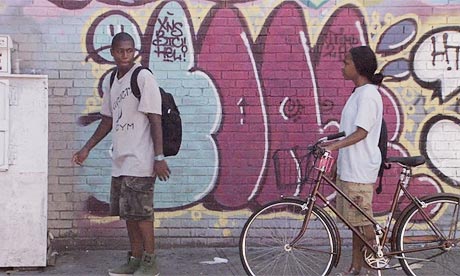
CIFF Review: Gimme the Loot
Footage of a painfully 80’s cable access show advises the holy hope of all New York City graffiti artists is to “bomb the apple” – this being the apple that rises in the outfield of Shea Stadium (since re-built and re-christened as, ugh, Citifield) after a homerun. Nobody has actually managed this feat. In present day NYC, however, two teens, Malcolm (Ty Hickson) and Sofie (Tashiana Washington), wake one morning to find their loving piece of graffiti ruined by a few rivals who have sprayed over it an image of the Shea Apple. Thus, Malcolm and Sofie determine to gain revenge by tagging the Shea Apple itself.
Malcolm knows a guy who can get them to the Apple in the dead of the night……for $500. They don’t have $500. So writer/director Adam Leon’s film follows them from street level through the course of 48 hours, neighborhood to neighborhood, as Malcolm and Sofie scheme and hustle, talking trash and dreaming big, encountering disparate characters that range from an overly-tattooed thief, Champion (Meeko), who robs retirement homes to feed his family to an over-privileged layabout stoner, Ginnie (Zoe Lescaze).
Swiftly paced and packed with scenes that outwardly seem like simple vignettes only to quietly hang together, “Gimme the Loot” is foul-mouthed and – in that spirit – funny as fuck but also sweet and, believe it or not, old-fashioned. Leon chooses to fill the soundtrack with bygone jazz and soul numbers, delightfully evoking a setting that in spite of its smartphones and other modern trappings feels timeless. It possesses rapid-fire omnipresent dialogue, true, except the film is so carefully observed and subtly visual – and not overbearing with its hand-held images which are more of necessity, I suspect, than auteur-ism – that it could have been done as a silent film and still convinced. One of the better single sequences in any movie this year involves a two-on-one faceoff on a rooftop where nary a word is spoken.
The acting of the two leads gets by mostly on attitude and it is only in a few of the more restrained moments which truly requires them to hit specific lines that their presumable lack of experience shows, but this is just fine, a non-fatal issue. And as the hours pass and their failures, comedically, pile up, leaving her without her bike and him without his shoes amongst other inepitudes, the more we recognize the less the film is about “bombing the apple” than Malcolm and Sofie recognizing just why they are so willing to go to such crazy lengths for one another.
Did “Gimme the Loot” remind this unabashed romantic of another movie featuring a guy and girl rushing about scenic New York? Of course, it did. What was it John Cusack said to Jeremy Piven in “Serendipity”? Ah yes. “Maybe all this is just a maze designed to lead me directly back to where I started.”
Malcolm knows a guy who can get them to the Apple in the dead of the night……for $500. They don’t have $500. So writer/director Adam Leon’s film follows them from street level through the course of 48 hours, neighborhood to neighborhood, as Malcolm and Sofie scheme and hustle, talking trash and dreaming big, encountering disparate characters that range from an overly-tattooed thief, Champion (Meeko), who robs retirement homes to feed his family to an over-privileged layabout stoner, Ginnie (Zoe Lescaze).
Swiftly paced and packed with scenes that outwardly seem like simple vignettes only to quietly hang together, “Gimme the Loot” is foul-mouthed and – in that spirit – funny as fuck but also sweet and, believe it or not, old-fashioned. Leon chooses to fill the soundtrack with bygone jazz and soul numbers, delightfully evoking a setting that in spite of its smartphones and other modern trappings feels timeless. It possesses rapid-fire omnipresent dialogue, true, except the film is so carefully observed and subtly visual – and not overbearing with its hand-held images which are more of necessity, I suspect, than auteur-ism – that it could have been done as a silent film and still convinced. One of the better single sequences in any movie this year involves a two-on-one faceoff on a rooftop where nary a word is spoken.
The acting of the two leads gets by mostly on attitude and it is only in a few of the more restrained moments which truly requires them to hit specific lines that their presumable lack of experience shows, but this is just fine, a non-fatal issue. And as the hours pass and their failures, comedically, pile up, leaving her without her bike and him without his shoes amongst other inepitudes, the more we recognize the less the film is about “bombing the apple” than Malcolm and Sofie recognizing just why they are so willing to go to such crazy lengths for one another.
Did “Gimme the Loot” remind this unabashed romantic of another movie featuring a guy and girl rushing about scenic New York? Of course, it did. What was it John Cusack said to Jeremy Piven in “Serendipity”? Ah yes. “Maybe all this is just a maze designed to lead me directly back to where I started.”
Labels:
Chicago Film Festival,
Great Reviews
Tuesday, October 16, 2012
CIFF Review: Flowerbuds
A signal operator at a train station in a wintry Czech industrial town, Jarda (Vladimir Javorsky), tends to his ship in a glass bottle. But then a van, driven by Jarda’s Vietnamese neighbor, becomes stuck in the rail-line at the same moment a train, as it must, bears down on him. In a moment without even a whiff of melodrama, Jarda swoops in for the rescue. He pushes the van out with nary a second to spare. As he does, the camera returns to the ship in the glass bottle as it rolls off the table and breaks apart on the floor. Real life intrudes and, as it does, our dreams are shattered.
This dramatic debut from writer/director Zdenek Jirasky brought to mind a more eastern European flavored Alejandro Gonzalez Inarritu whose films are famous for their multiple characters and intertwining storylines. But while Inarritu’s films always seem to suggest lives intertwining is part of a grander meaning, “Flower Buds” seems to suggest that if you live in a tiny town people’s lives are bound to bump up against others.
Ground Zero is Jarda’s household. His wife Kamila (Malgorzata Pikus) scrubs toilets and mops floors by day and is a Flower Bud – a slightly less whimsical version of a Calendar Girl – by night. His teenage daughter Agata (Marika Soposka) is pregnant, though she doesn’t seem to know who the father is (there are two possibilities) and she doesn’t seem to know if she wants to keep it. His teenage son Honza (Miroslav Panek) falls in love with a stripper who performs for the hardscrabble locals. Meanwhile Jarda himself constructs his ships in his bottles, harboring a dream of taking his family and leaving this mundane existence behind. Ah, but dreams aren’t funded on emotion, and so Jarda wiles away dreary nights at the dreary pub by taking out loans he can’t afford to play the slots. Gambling never looked so unromantic.
Director Jirasky spoke very briefly through an interpreter before the screening and said he had made a movie that was “a little depressing” but that was also injected with humor. And Jirasky, not surprisingly, knows his own film pretty well. It is a little depressing but it is injected with humor. The humor, however, is not necessarily used by the characters as an attempt to shield them from their misery. Rather the humor shines through the misery.
Oh, the characters try to shake free from their misery in their own ways, though whether they will get there is not truly determined. There are no real resolutions to the various story lines. Instead they just kind of trail off into the snowy Czech air and leave us with the sensation that if we don't get with the program and choose the course of our own lives, life chooses for us.
This dramatic debut from writer/director Zdenek Jirasky brought to mind a more eastern European flavored Alejandro Gonzalez Inarritu whose films are famous for their multiple characters and intertwining storylines. But while Inarritu’s films always seem to suggest lives intertwining is part of a grander meaning, “Flower Buds” seems to suggest that if you live in a tiny town people’s lives are bound to bump up against others.
Ground Zero is Jarda’s household. His wife Kamila (Malgorzata Pikus) scrubs toilets and mops floors by day and is a Flower Bud – a slightly less whimsical version of a Calendar Girl – by night. His teenage daughter Agata (Marika Soposka) is pregnant, though she doesn’t seem to know who the father is (there are two possibilities) and she doesn’t seem to know if she wants to keep it. His teenage son Honza (Miroslav Panek) falls in love with a stripper who performs for the hardscrabble locals. Meanwhile Jarda himself constructs his ships in his bottles, harboring a dream of taking his family and leaving this mundane existence behind. Ah, but dreams aren’t funded on emotion, and so Jarda wiles away dreary nights at the dreary pub by taking out loans he can’t afford to play the slots. Gambling never looked so unromantic.
Director Jirasky spoke very briefly through an interpreter before the screening and said he had made a movie that was “a little depressing” but that was also injected with humor. And Jirasky, not surprisingly, knows his own film pretty well. It is a little depressing but it is injected with humor. The humor, however, is not necessarily used by the characters as an attempt to shield them from their misery. Rather the humor shines through the misery.
Oh, the characters try to shake free from their misery in their own ways, though whether they will get there is not truly determined. There are no real resolutions to the various story lines. Instead they just kind of trail off into the snowy Czech air and leave us with the sensation that if we don't get with the program and choose the course of our own lives, life chooses for us.
Labels:
Chicago Film Festival
Monday, October 15, 2012
CIFF Review: Black Pond
A therapist, broadly played by Simon Amstell, explains to his emotionally fractured patient that if you were to take all the colors of the universe and blend them you would merely be left with a kind of arid grey. "Black Pond", co-directed by Tom Kingsley and Will Sharpe, is a film of evocative colors haphazardly blended together that wishes to reach a genuinely poignant moment in spite of the ceaseless quirkiness and occasional filmmaking tricks. It doesn't quite get there. In the end, "Black Pond" is just sort of an arid grey.
Tom (Chris Langham), the not entirely respected head of the Thompson household, has lost the three-legged family dog, blandly named Boy, on a walk when he meets Blake (Colin Hurley), the sort whose bushy beard seems to exist solely to distract you from his crazy eyes. They chat and despite Blake's apparent mental unbalance, Tom invites him back home for tea. Blake accepts. Tea turns into dinner with Tom's wife Sophie (Amanda Hadingue) and dinner turns into Blake spending the night.
And when misfortune involving Boy strikes, more misfortune will occur and The Thompson family finds itself being branded murderers of their unique houseguest. This is not a spoiler. This is revealed immediately, primarily because "Black Pond" is filmed in a mockumentary format with talking head confessionals sprinkled throughout. The very nature of this device suggests we are seeing the story through the lens of each respective character, which could potentially account for its wildly shifting tones, except the family seems unified on just what happened.
Rather "Black Pond" comes across like the work of new filmmakers with specific scenes and bits and moments and music in mind but not necessarily the roadmap to reach a cathartic and satisfying conclusion.
The best thing in the film is the performance of Chris Langham, an actor with whom I am not familiar but who I learned afterwards has been out of work for several years on account of, shall we say, personal trauma. We will excise that from this movie-only discussion, however, and instead say that Langham cultivates a character who has drifted into a listless life and seems to believe that doing one good deed, however untraditional and odd to the general public, could offer at least a momentary sense of redemption.
It's a great germ of an idea that is just isn't satisfactorily translated for a full 90 minutes.
Tom (Chris Langham), the not entirely respected head of the Thompson household, has lost the three-legged family dog, blandly named Boy, on a walk when he meets Blake (Colin Hurley), the sort whose bushy beard seems to exist solely to distract you from his crazy eyes. They chat and despite Blake's apparent mental unbalance, Tom invites him back home for tea. Blake accepts. Tea turns into dinner with Tom's wife Sophie (Amanda Hadingue) and dinner turns into Blake spending the night.
And when misfortune involving Boy strikes, more misfortune will occur and The Thompson family finds itself being branded murderers of their unique houseguest. This is not a spoiler. This is revealed immediately, primarily because "Black Pond" is filmed in a mockumentary format with talking head confessionals sprinkled throughout. The very nature of this device suggests we are seeing the story through the lens of each respective character, which could potentially account for its wildly shifting tones, except the family seems unified on just what happened.
Rather "Black Pond" comes across like the work of new filmmakers with specific scenes and bits and moments and music in mind but not necessarily the roadmap to reach a cathartic and satisfying conclusion.
The best thing in the film is the performance of Chris Langham, an actor with whom I am not familiar but who I learned afterwards has been out of work for several years on account of, shall we say, personal trauma. We will excise that from this movie-only discussion, however, and instead say that Langham cultivates a character who has drifted into a listless life and seems to believe that doing one good deed, however untraditional and odd to the general public, could offer at least a momentary sense of redemption.
It's a great germ of an idea that is just isn't satisfactorily translated for a full 90 minutes.
Labels:
Chicago Film Festival
Subscribe to:
Posts (Atom)