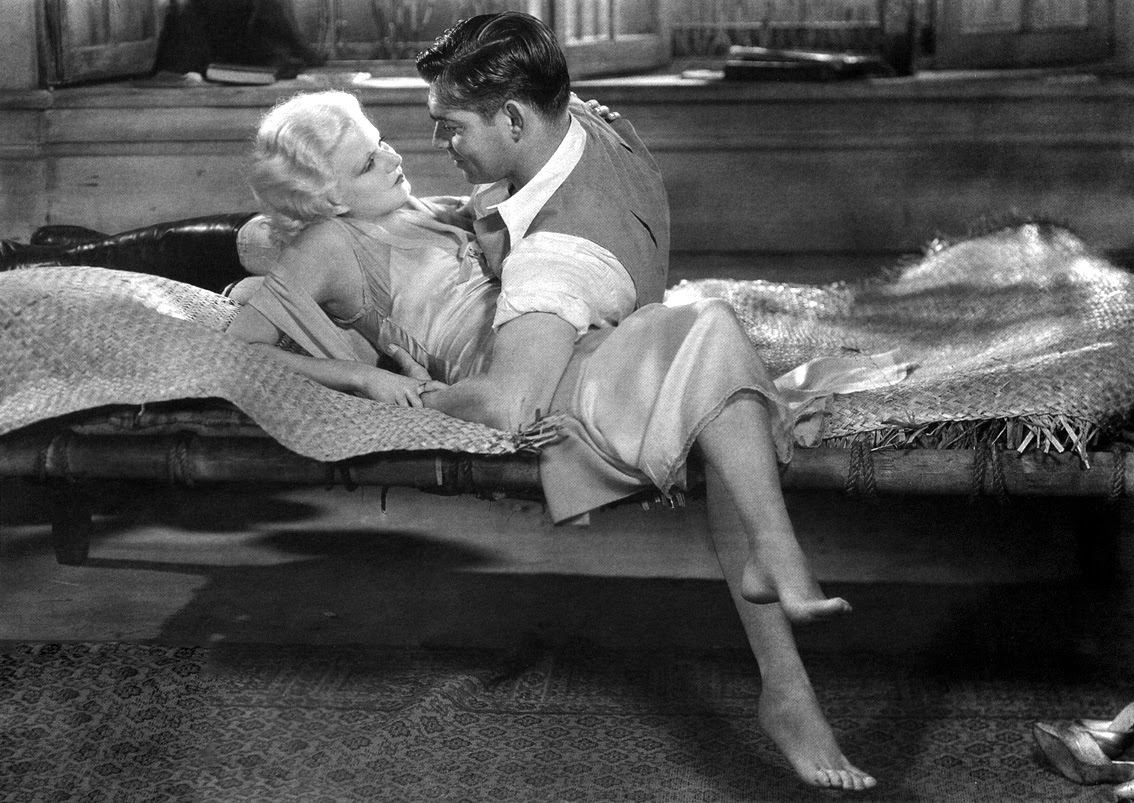
I wish “Saratoga” had never been made. I know that’s harsh declaration right up front. And I don’t mean to suggest that director Jack Conway’s 1937 film has no redeeming values. It stars Jean Harlow, for God’s sake, and Clark Gable exchanging wily looks and bon mots with her, not to mention a pre-“Wizard of Oz” scene between the Wizard (Frank Morgan) and The Wicked Witch of the West (Margaret Hamilton) when the latter was not even officially billed in the cast credits, which I know is just an unintentional Easter egg but, hey, we classic movie fans deserve a little protein now and then too. But “Saratoga” doubled as the last film in which Harlow would appear, collapsing on set near the end of filming and dying, sadly, terribly, aged but 26, from kidney failure. Ugh. This, though, doesn’t just mean “Saratoga” suffers in a cosmic sense. No, as it turns out, the film’s conclusion, simply on a narrative and aesthetic level, was so utterly compromised by her passing, that as I watched it, honestly, the whole time I just wanted to look away.
“Saratoga”, as the title may or not imply, refers to the horse racing track in upstate New York, where much of the action takes place. This was back in the glory days of the sport, when it was arguably the country’s most popular, and reminds us of a time when a movie could transport you to a place you only ever read about or heard on the radio, reveling in images of real-life horses making the turn, cutting to rear projection footage to see the jockeys conversing mid-race up close. This befits “Saratoga’s” everything-and-the-kitchen-sink air, like a lengthy sequence aboard a train with several comic encounters and even a song, making a movie in order to put on a show, the plot dynamics just along for the ride as much as driving the action.
That plot, as it were, involves the Clayton horse farm, situated in Saratoga, that has fallen on hard times, with various ruses and schemes to keep it afloat, involving a love triangle that forms between Carol Clayton (Harlow), engaged to a wealthy businessman (Walter Pidgeon) whose portfolio might save the place if bookie Duke Bradley (Clark Gable) doesn’t fleece him with some bad bets first in order to get the money to save the place himself and get the girl instead. This allows for plenty of long two-shots of Harlow and Gable verbally having it out, which is why we’re here in the first place. Granted, if Harlow’s health was flagging during the production, you can sometimes tell, only certain scenes possessing the kind of crackle she was famous for delivering in tandem with her male co-stars, like a screwball scene where he hides under the couch.
Harlow also was playing more to the idea of spoiled sophisticate than brassy blonde, as she often was, and her character’s trajectory gets set up as someone out to prove that she doesn’t need Duke’s help to get what’s hers. Alas, after Harlow vanishes, that trajectory doesn’t get seen through, not like it should, how could it, as Conway is forced to rely on obvious body doubles with their backs to the camera or binoculars held up to their eyes to obscure the face, using someone else’s voice (whose name we will refrain from mentioning because, c’mon, what was she supposed to do?), so abnormal sounding in the face of the real thing that it sounded to my ears like a “Peanuts” squawk, making me cringe. The action moves, meanwhile, in so as much as it does, by having other characters speak about Harlow’s character when she’s not there, which just comes across like attending a funeral reception. And as “Saratoga” concludes, it cuts back to what’s clearly footage of that earlier scene aboard the train, between Harlow and Gable, a fitting tribute, in more ways than one, merely reinforcing what was missing all that time she was gone.
Showing posts with label Jean Harlow. Show all posts
Friday, March 06, 2020
Friday's Old Fashioned: Saratoga (1937)
Labels:
Friday's Old Fashioned,
Jean Harlow,
Saratoga
Friday, March 08, 2019
Friday's Old Fashioned: The Beast of the City (1932)
“The Beast of the City” is a pre-code precursor to 1987’s “The Untouchables” in so much as it chronicles a passionate cop’s attempts to stamp out rampant corruption in the Prohibition era. The latter muddied the moral waters by having mentor-ish beat cop Malone (Sean Connery) repeatedly demand of the virtuous Eliot Ness (Kevin Costner) what he was prepared to do to bring down Al Capone. “Beast of the City” seeks to muddy the moral waters too yet gives the game away from the outset with a title scroll bearing words penned by President Herbert Hoover expressing undying devotion to the police and telling the viewer in no uncertain terms to do the same. It is not that President Hoover is wrong, per se, but that the conceit of the ensuing film as a vehicle for thought is almost immediately negated; before the movie even starts you are being told what to think about it. Still, if “The Beast of the City” is propaganda, it advocates with great flourish, an early crowd scene that truly feels in the street and not on the lot of cop cars zooming through on the way to a murder scene contrasting nicely with a later crowd scene from above of chattering prisoners in a holding cell. The former demonstrates who is being protected; the latter demonstrates who they are being protected from.
The protector is Captain Jim Fitzpatrick (Walter Huston) – Fightin’ Fitz. If the character is tasked with confronting hard-bitten criminals to clean up the mean streets, his family life is idyllic, a counterpoint that director Charles Brabin draws with too much broadly comic clarity, like an entirely forgettable scene of Fitz’s twin daughters hapless attempt to make him pancakes for breakfast. This scene, however, also carves out space for Fitz’s brother, Ed (Wallace Ford), a detective on the force. Though he cheerily pretends to eat the inedible pancakes, Ed is also unmarried, a moral strike against him, free of Fightin’ Fitz’s grounding by way of a rock-solid marriage. That leaves Ed susceptible to the untoward advances of Mildred Belmonte (Jean Harlow), the gal of notorious gangster Sam Belmonte (Jean Hersholt), the super bad dude Fightin’ Fitz is trying to bring down.
As Turner Classic Movies recalls, this was Harlow’s first movie under contract for MGM and her yearning for better roles after being merely propped up as so much side-of-the-arm eye candy did not initially appear different to her eyes. Brabin, however, worked with Harlow to try and sculpt a legitimate performance as opposed to simply relying on her Blonde Bombshell aura. That might be true, though it’s sometimes difficult to separate the two, such as when she poses as another women to seduce Ed, prompting him to abet the very people his brother is trying to bring down. Then again, the scene works like gangbusters, demonstrating how in the age of Movie Stars aura and acting could go hand-in-hand. There are other moments, however, when Harlow gets at something more natural, like her introductory scene where her character disinterestedly lazes on the side, barely paying attention as her bemused crook of a husband is confronted by Fightin’ Fitz and his flatfoots, as if she’s been through all this before. It’s a nasty world, “The Beast of the City” says, and in these moments Harlow evinces impressive indifference to such nastiness. It works, in fact, to shade her aforementioned wicked role play as a chance to have fun.
That indifference is what Fightin Fitz' is up against, bringing Belmonte to justice only to see him get off the hook anyway, the sort of corruption that causes him to employ more brutish methods, damn the cost. True, an intrepid newspaperman is there to occasionally question the value of such vigilante tactics, but in the cinematic language of the “Beast of the City” he comes across less like a crusader than a nuisance, and his points are completely done away with by the film’s terrifying if admittedly effective conclusion. Realizing the rule of law is no match for Belmonte, Fightin’ Fitz goes after him like it’s the old west, which is evoked in a gunfight that works because of its simplicity, both sides walking right at each other with guns blazing, bodies falling left and right. I’ll give you one guess who is left standing. It’s as if the reality-bending scene in “The Untouchables” where Ness throws Nitti off the roof has become the chief of police’s new strategy. President Hoover said it’s ok, after all.
Friday, March 30, 2018
Friday's Old Fashioned: Hold Your Man (1933)
“Hold Your Man” was the third film featuring Jean Harlow and Clark Gable, the follow-up to 1932’s “Red Dust”, an inconsistent yet nevertheless entirely memorable spate of pre-Hays Code ardor in which the Platinum Blonde spent most of the film aggressively flirting with her male co-star. That they wound up in each other’s arms at the end might have been a nod toward morals, but the overall movie is most remembered for its un-subtle salaciousness. And, for a little while, “Hold Your Man” suggests it might be going down the same road, what with the true enforcement of the Hays Code still a year or so away. Why director Sam Wood goes so far as to sort of re-create “Red Dust’s” most famous shot of Harlow in a tub by placing Gable in a tub instead, though it’s played more for comedy than for, ah, passion. That’s emblematic, however, of the confusion at the heart of “Hold Your Man.” Wood’s film is by far best in its early moments, when small-time thief Eddie Hall (Gable) infiltrates the apartment of Ruby Adams (Harlow) to evade the cops, which might technically be breaking and entering though it’s difficult to quibble on any real-world level in the face of the stars’ emergent magnetism, which appears onscreen like the click of a butane lighter, once Harlow and Gable get a look at one another, with her playing hard to get and him smiling back like he’s willing to play along for the rest of his life. Sigh. If only.
This apartment opening comes on the heels of a set-up with an air of authenticity. A wallet falls on the ground where Eddie and another fella pick it up and fight over the cash contained inside. The whole thing is a con, evoking “The Sting”, but that desire for cash, any cash, taken in conjunction with the conspicuously grim set design where For Rent signs dot the background buildings, is not turning a blind eye to the Depression, which even gets name-checked later. And both Eddie and Ruby, as we see her later working the angles with a guy that she doesn’t really love in an attempt to keep her financially afloat, are characters that have fallen through the cracks in the wake of economic disaster and are fighting to hang on. It might have been an interesting angle to see the whole way through, particularly because the movie does desire to get serious, just that it gets serious in a different way.
“Hold Your Man’s” real turn toward morals comes when Eddie and his partner in crime Slim (Garry Owen) decide to full a fast one on a married drunk with eyes for Ruby, blackmailing him into a payoff, though at the last minute Eddie decides to pull the plug because he can’t bear the thought of it. That leads to him proposing marriage to Ruby in one of those line readings that Gable strips of any romance for pure gruffness instead, which turns it deliriously, delightfully comical, and which Harlow has Ruby meet with that patented stuttering sentimental bamboozlement. But rather than explore these two lovebirds getting hitched, the script takes a turn for dark melodrama, forcing Ruby to take the fall when their would-be mark winds up dead. She is sent away to a woman’s reformatory, and when she is, the movie mostly moves Eddie out of the picture, leaving her on her own.
It might have been a really good idea, and you can see specks of it, where these many women in Ruby’s company seem to have suffered at the hands of men, men who have subsequently abandoned them and left them to rot, and where these no good men, intentionally or not, pit these women against one another as evinced by a past gal of Eddie’s who naturally winds up in the same reformatory as Ruby. This allows Harlow to employ her distinguished aptitude for self-pity, particularly when one of her pre-Eddie beaus turns up pledging to cut a deal to get her released if only she’ll marry him. Harlow lets her body virtually tremble as she listens to this pitch. It’s a moment when you think Ruby might well be about to take possession of herself. But, of course, this is a movie where the heroine can only achieve said status by conforming to the patriarchy, meaning she still has to marry anyway, just to Eddie, who, in essence, busts into prison while on the lam in order to say “I do” to the woman he loves. And even if my modern eyes might have liked to see this movie forge some excitingly unforeseen ending rather than a climactic marriage, well, sometimes the rote is still, on account of the players involved, resplendent.
Friday, March 03, 2017
Friday's Old Fashioned: The Girl from Missouri (1934)
The mantra espoused by Eadie Chapman (Jean Harlow), “The Girl from Missouri” herself, is familiar and it goes like this: “I want be somebody.” Emphasis, of course, on the “be” – I want to be somebody! –
which Harlow, bless her eternal soul, sells with all the verbal va-va-voom she had at her mighty, mighty disposal. In this case, however, being somebody has nothing to do with becoming an actress or a singer or a doctor or a lawyer or an aviator. No, being somebody means finding a rich dude and marrying him.
Not, mind you, that Eadie is a mere gold digger. After all, the movie opens with Eadie and her best friend Kitty (Patsy Kelly) escaping the Show Me State and one of those outfits that in kinder, gentler Hollywood is a brothel but isn’t, labeled a “beer hall”, or something, instead, like the New Congress Club of “From Here to Eternity” where Donna Reed was merely a (cough, cough) hostess. Eadie has spent a lifetime of being taken advantage of by men and so Harlow plays straight to this idea, emitting the air of a woman who’s going after what she’s cosmically owed.
What she’s owed becomes entangled in something like a misshapen love triangle that unfolds as the action moves from Missouri to New York to Palm Beach where Eadie makes eyes at a self-made millionaire T.R. Paige (Lionel Barrymore) even as Paige’s son Tom (Franchot Tone) makes eyes at Eadie. She initially doesn’t want anything to do with Tom except that T.R. doesn’t want anything to do with her, and so when Tom persists in his courtship, she feels herself starting to fall for him, one of the strands of story that feels less than convincing. If anything, Tom’s pursuit of her is over the edge. Indeed, if Eadie seems to believe she’s cosmically owed, Tom has the same idea for himself, insistent that she reciprocate his feelings even as she herself insists he offer a wedding proposal rather than a mere roll in the hay.
This was the dawn of post-code Hollywood and so it’s easy to wonder what a pre-code “Girl from Missouri” would have liked, whether or not Eadie would have withheld you-know-what from Tom or whether that really was the intent of the movie all along. Still, it is notable in the way she stands up her for herself, which all of Harlow’s patented platinum blonde feistiness was made to evince. Not that Harlow does not also communicate something real. Look no further than the bordering-on-disturbing scene in which Tom, determined at his father’s suggestions to pull the mask back on Eadie’s gold digging intentions, essentially tries to force himself on her.
All of Eadie’s talk about being somebody informs this moment in a brilliant way as her fears of not really being anybody, of simply being a woman for whom she is no good except how men can exploit her and her body, pours forth as she tries to call him off. Harlow had a way of turning from a barrel of tornadic fury to trembling vulnerability in an instant and she manages that feat here as well as she ever did, emotionally crumbling right before our eyes and before Tom’s eyes too. She has fallen for him, and in the wake of this scene, he falls for her too, a mutual affection that cannot help but feel narratively hurried in light of what has just preceded it.
The concluding act, in which T.R., dead set against this union, finagles ways to fight back by slandering Eadie, which leads Eadie to fight back by further slandering herself as a means to try and slander T.R., comes across rushed too in the face of these emotionally fraught hijinks, an obvious determination to engender a happy ending when the entire tone seems to suggest tragedy waits. It’s nice, I suppose, that she gets her happy ending, but it’s still difficult not to note that for all this movie manages to say about a woman's place in the world that the only happy ending that’ll suffice is to say “I do.”
Thursday, March 03, 2016
Thursday's Friday's Old Fashioned: China Seas (1935)
Her eminence Jean Harlow was born this day 105 years ago in Kansas City, Missouri. In her illustrious honor, we serve this week’s Old Fashioned a day early. Cheers.
As Tay Garnett’s “China Seas” opens, hard-charging Capt. Alan Gaskell (Clark Gable) tends to various matters of escalating importance as his steamship gets set to depart port for a jaunt to Shanghai. Passengers must be sucked up to; crew members must be issued orders; cargo must be accounted for; pirates trying to sneak aboard in disguise must be revealed; and, of course, Gaskell must sober up after an on-land bender. It all comes fast and furious, but none of it is as fast or as furious as when he enters his quarters and is confronted by the girl he got close to while in port.
That's China Doll (Jean Harlow). She emerges in his quarters to advise in no uncertain terms that she will be making the voyage to Shanghai with him. Oh no you won’t, he basically says. Oh yes I will, she basically retorts. Back and forth they go in of those Golden Age verbal sparring sessions that automatically justifies any narrative contrivance to make it happen. And in the midst of this sonically-glorious disagreement, which has been filmed primarily in two shots of our principal stars, Garnett cuts to a close-up of Ms. Harlow, one of those ravishing soft-lit frames so sumptuously composed you half-suspect he set it up over the course of several hours with just her, not Gable, on set in order to ensure its precision. Forget the typhoon special effects that come later; the most persuasive shot in cinema is a Movie Star in close-up, and Jean Harlow was more Movie Star than most.
Of course, you can’t just have her tag along and that’s that. No, you need some drama, you need some intrigue, and so as they set sail, English aristocrat Sybil Barclay (Rosalind Russell) strides up the gangplank, which causes Gaskell to do a double take and China Doll’s shoulders to slump. It seems Gaskell was once in love with Sybil, and she with him, only she wound up married to someone else, and that someone else has now passed away and here she is. The old flame flickers in Gaskell’s and Sybil’s eyes while China Doll’s eyes burn with jealousy. She acts out by cozying up to Jamesy McArdle (Wallace Beery), a passenger and cohort of Gaskell’s, who, it turns out, is in league with pirates. Round and round they’ll go, where it stops...well, you know, but gettin' there is still just the tops.
Harlow has some improbably delicious insults in this one (“When I want you to sound off, Golden Bells, I’ll pull your rope”) and her flirtations with Beery’s character suggest another movie altogether, one where China Doll skulks about the streets of Shanghai with the riff-raff, making like a heaven-sent outlaw. But it’s Gaskell she loves, naturally, and in spite of the pugnacious attitude she cops in the face of having her one true love possibly taken away, she occasionally lets moments of genuine hurt and insecurity seep out.
Harlow could do that, you know. She was rarely a subtle actress, though she had it in her, and was still learning the craft before she tragically, terribly perished and may have pushed it into other places. But she had an evocative way of unleashing a torrent of indignant insults and then stopping on a dime, assuming a put upon look, dropping her voice to a near whisper, and letting an insecure admittance peep out. Even better is when she goes to great lengths to get the best of Russell’s Sybil, only to have it turned right back against her, and then practically sinks into herself, ashamed, for sure, but also knowing that she can’t quite help it.
There is a moment when China Doll uncovers Jamesy’s ruse with the pirates and goes to warn Gaskell. She could simply declare the dangerous situation the second she enters the room, but doesn’t. Instead she keeps trying to tell him, only to have him thwart her, and finally she keeps it to herself, content, apparently, to put them all in harm’s way. In another movie, or with another actress, that would have been a classic Idiot Plot moment. In the hands of Jean Harlow, however, it becomes something else; she’s not an Idiot, she’s an Insecure Renegade. “I’ll show you,” she’s communicating, and she does, damn the consequences.
And while the first time I watched “China Seas” left me indifferent to the pirate takeover of the ship and the typhoon at sea, a re-watch crystallized their purpose, which goes beyond simply rounding out a romance with derring-do. Because the derring-do is what Gaskell digs so much, and it is in China Doll, not Sybil, that he sees that same sort of bravado, even when she’s putting them all at risk. She lies to convey that she loves him, and it’s the truth.
Labels:
China Seas,
Friday's Old Fashioned,
Jean Harlow
Friday, October 23, 2015
Friday's Old Fashioned: Red-Headed Woman (1932)
- This week Karina Longworth, proprietor of the fabulous You Must Remember This podcast, a wonderful social media gateway to old world Hollywood, released the Jean Harlow episode for which I'd been pining since its inception. I had a new (old) movie originally planned for today's post but have decided to audible in favor of a particular Harlow favorite instead, re-posting a review from two years ago in the Platinum Blonde's honor.
Lil (Jean Harlow) is in the midst of of attempting to entice married Bill Legendre Jr. (Chester Morris, who, like so many male actors of the early eras, is outfitted with too much makeup). He ain't having it. He smacks her. Woah. But...she smiles. She asks him to do it again. She tries to get him to do it again. Wowza. Meanwhile Lil's friend and confidante Sally (Una Merkel) listens to the action with her ear pressed up against a door in another room. At first, she seems aghast. But then...she smiles. She speaks, I suspect, for the entire audience for the duration of the brief but kicky run time of "Red-Headed Woman" - the experience is more than a little unsettling but we remain enraptured anyway.
"Red-Headed Woman" was released in 1932, two years after the dastardly Will Hays put into effect his nicey-nice Production Code but two years before it really began being enforced with an America & Apple Pie-scented fist. This is why you can hear the word "Sex" said at least twice in "Red-Headed Woman"! No! Really! "S.e.x." Ai-yeeeeeeee! Heck, there's a sequence where we see Harlow undress......well, sorta. In a single take the camera focuses on her bare feet and then her face as it is made insistently clear she is briefly going pantsless and then topless to slip into evening wear. That sounds passé but back in the day there were probably upstanding women who saw this in the theater and fainted.
The film opens with Lil as but a poor stenographer with designs on glitz and glamour and high fashion and society. This is why she targets Bill Legendre with such insistence. She will not be denied. And she isn't, not even when it appears Bill's wife Irene (Leila Hyams) adores him so much and seems so convinced that his one-time foul-up is anomaly. No, instead Bill ends up divorced from Irene and married to Lil who indulges in her newfound upper crust status for all its worth until she realizes the rest of the upper crust will forever shun her for her adulterous dalliance.
Ha! says Lil. With the rich and famous Charles Gaerste (Henry Stephenson) in town to meet with the Legendre family, Lil merely re-sets her plan. A seduction of Gaerste, higher up the social ladder and with even more prominent moneybags than her current husband, would engender the societal reciprocation that Lil cannot get on the arm of Legendre.
Eventually she finds herself separating from her husband to move in with Gaerste while having an affair with Gaerste's French chauffeur (Charles Boyer) on the side.
Per TMC, a certain dude named F. Scott Fitzgerald wrote a draft that legendary producer Irving Thalberg deemed too serious and which was completely re-written by Anita Loos to be more whimsical. Remnants of this screenwriting war are littered throughout the film, particularly in the way Lil's incessant blackmailing and cold, cold heart are so often presented in the manner of simple rom com propellents. Truly, you are often left to wonder if director Jack Conway has any idea just how dark the underlying nature of his film is, and this is made more apparent by a "happy ending" that looks and sounds happy but isn't really happy at all if you give it a half-second of thought.
Perhaps the trickiest element of the whole film is Harlow's performance. This is not to suggest she overwhelms the screen with complexity but that she kind of plays the part of this home wrecking status seeker as if to appease Thalberg's desire for a more breezy escapade. Yet, by playing the part this way her character is made even more sinister.
Her Lil shares much in common with later era "Fatal Attraction" Glenn Close and "Body of Evidence" Madonna but in a non-Will Hays world those actresses very much played up the psychotic. Harlow, however, by maintaining such a bubbly air even as she screws (literally and figuratively) every guy around her to get what she wants just seems.......crazy. Like, super crazy. It's a less realistic performance which is precisely what makes it seem so much more realistic than the unhinged red-headed woman of the modern day.
In a movie today if Lil pulled a gun when she pulls a gun you think, "Oh. Plot mechanics." But in 1932 when Lil pulls the gun when she pulls the gun you think, "Yup. That red-headed woman's done lost her mind."
Sunday, June 07, 2015
Jean Harlow, Always
Gable: "Anything you want?"
Harlow: "Anything I... ? Toots, I got everything."
Jean Harlow. March 3, 1911 - June 7, 1937.
Labels:
Jean Harlow
Friday, April 10, 2015
Friday's Old Fashioned: Suzy (1936)
Released within five months of each other in 1936, both “Wife vs. Secretary” and “Suzy” placed its primary star, her eminence, Jean Harlow, in that old plot warhorse, a love triangle. Yet in the former film it wasn’t really a love triangle at all. It was something of a commentary on the love triangle, and on the idea that women must pit themselves against men, and that what we see when we see a man and a woman isn’t always what we think we see. It’s really a wonderful film. The latter, however, is a far more traditional variant of the Love Triangle. It harkens back to Harlow’s big splash, “Hell’s Angels”, where her character came between two dueling pilots and it presages Michael Bay’s “Pearl Harbor”, where Kate Beckinsale’s character comes between dueling pilots, by sixty-five years. Because in “Suzy”, yes, sure enough, Jean Harlow comes between dueling pilots, and it generates about as many sparks as either one of those other love triangles, which is to say it generates none. It’s a multi-purpose stadium movie, one that haphazardly combines romance and espionage-ish intrigue and action. The late-game aerial dogfight is so misplaced it goes to show that even Hollywood’s Golden Age had its fair share of giant spiders.
In fairness, the screenplay, based on a novel, though haphazardly if reviews of the time are to be believed, does its leading lady no favors, forgoing imagination and snap, crackle, pop dialogue for rote formula and basic repartee. Harlow’s Suzy, an American showgirl in 1914 London, marries an Irish inventor, Terry (Franchet Tone), only to run afoul of a sinister German plot that leaves her new spouse dead, or so she thinks. We knew he’s not dead, even as she flees in fear of being framed for his murder, all the way to Paris where she quickly jumps into the arms of another man, French aviator Andre Charville (Cary Grant), and gets re-married. Neither of these relationships, however, are outfit with any kind of discernible passion, particularly because Suzy is written as having no plan aside from getting a man and getting married.
Andre is a playboy. He has affairs, and she knows, and his father, Baron Edward Charville (Lewis Stone), knows, and no one does anything about it. Her character is beholden to some sort of fear of being alone but none of this comes through in the writing, which just wants to spur the film toward a melodramatic conclusion. Nor is it conveyed in the acting, which often struggles to get on the same page. Harlow seems to be taking all of this rather seriously, another attempt at dramatic acting that she was only just beginning to pursue at this point in her career, while Grant seems to view the entire ordeal as much more of a lark. When his character is caught red-handed he barely bats an eye. Neither he nor she even appear to have real feelings for one another, an idea worth exploring but one which the film ignores to instead bring her first husband back into the mix to re-ignite the triangle of love.
It’s a shame that Harlow and Grant never got the opportunity to play off one another again. Their careers, of course, were at very different junctures in 1936, even if neither of them knew it. She would be dead, horribly, a year later. He would release “The Awful Truth” a year later and begin his ascent to the top. In “Suzy”, however, Harlow was still trying to get a handle on genuine dramatic acting and Grant’s flawless embodiment of debonair had yet to kick in. Here he comes across more like a douche frat boy. It’s easy to wonder how peak Grant might have matched up with a more honed Harlow. Alas, it was not to be.
There is, however, one moment when “Suzy” lights up, and, tellingly, it’s when she gets away from the measurements of the triangle. It’s her and the Baron, a grumpy old man who, improbably, has come around on his daughter-in-law, viewing her with affection and fearing for her well-being when he realizes his son is cheating on her. Harlow often needed a larger-than-life performer to play off because, well, she was larger-than-life. But here she finds a different gear, a lower gear, a tender gear, a melancholic gear. She accepts his concern and downplays, even if Harlow lets us pull the curtain ever so slightly aside to let us that downplaying it is merely her defense mechanism. And in that moment, Lewis Stone hurts for her. It’s a paternal love, and the only love “Suzy” ever makes convincing. It’s enough to wish on a hundred-million shooting stars that Jean Harlow could have lived to see all her talent through.
Labels:
Cary Grant,
Friday's Old Fashioned,
Jean Harlow,
Suzy
Friday, January 23, 2015
Friday's Old Fashioned: Wife vs. Secretary (1936)
The stars, the concept, even the poster, all of it would seem readymade to mark Clarence Brown’s “Wife vs. Secretary” as a hijinks-laden love triangle or even an of-the-era advisory of a lasivicious working woman demonstrating that her place is really the hearth and home. And yet.....that "Vs." of the title is so terribly misleading. It's like the film's marketers wanted audiences to assume it was "Bride Wars" 73 years before "Bride Wars" was released. They wanted it to sound like a rom-com styled OK Corral Shootout. "Only ONE woman can wind up in Gable's arms. Who's it gonna be?!" They wanted to emit the air that it was another in an eternal supply of Hollywood confections that employ their brightest and best females as a means to be reductive to women, to put forth the antiquated idea that where there are two women there is bound to be claws and catfights.
Ah, but "Wife vs. Secretary", bless its forward-thinking soul, knows all this and subverts it, skillfully and successfully. Why it even goes one further and how asks how we look at others and what we see when we look at them and how quick we are to not only judge but to be influenced by scattershot opinions of the masses.
As the film opens, all seems tranquil with the principal trio. Van (Clark Gable) and Linda (Myrna Loy) are happily married and Van's magazine publishing company is running smoothly due in large part to the eternal efforts of his secretary, the unfortunately named Whitey (Jean Harlow). Really, truly, utterly, it's all hunky dory. But then "Wife vs. Secretary" conforms to the wicked stepmother stereotype as Van's mom (May Robson) points out to Linda, as if she hadn't noticed before, the natural effervescent attractiveness of her spouse's secretary. And later at a company party, so many wives of so many employees of Van tell Linda the same damn thing. They basically make Whitey out to be a strumpet because she's blonde and voluptuous and looks like Jean Harlow.
For the remainder of the film, Linda's viewpoint of Whitey is tainted by these baseless accusations. What she sees suggests nothing is amiss, but what she sees seems less than paramount to what she's been told, and so what she's been told becomes what she sees, not that a human being would ever fall prey to such an epistemological crisis. Ha! Take Whitey's boyfriend, this knucklehead named Dave (Jimmy Stewart). He doesn't think it's "natural" for a woman to be working. Natural! "Not made or caused by humankind." Like, on the ninth day God said, "The womenfolk don't work." And when Dave proposes to Whitey, partially out of love but partially out of "Because once you're wearing my ring I'll decree that you don't work no more", she rejects him.
Everything comes to a front at a conference in Havana that Van and Whitey attend as boss & secretary. Linda calls her husband's room only to have, sure enough, Whitey answer. Nothing was happening, but the instant Linda hears that nasally tart voice on the other end of the line every one of her misplaced suspicions comes true. And it's in the moments that follow when "Wife vs. Secretary" soars, putting Van and Whitey into the position where fulfilling carnal desire would be the obvious thing.
In my ongoing effort to watch every Harlow film, I dare say never has Harlean Carpenter been better. She sits on the end of Gable's bed, where his character sits drunkenly, with an impassive expression that still conveys a rolodex of emotion. It's as if every opinion everyone has ever formed of her, whether true or untrue, has been made to bear, dropped on her at once, and the toll the age-old weapon of innuendo can take is palpable. Yet in spite of the slander, she maintains her virtue, and perhaps "Wife vs. Secretary" would have done best to end right there even if various entanglements would have gone unresolved. Instead a little phony baloney is tossed on top, including Whitey getting back together with that tweedle-dum Dave and her awesome integrity is idiotically compromised. The film was smart enough to subvert sexual politics of the day, yet stupid enough to still fall prey to them.
Monday, November 10, 2014
Tuesday, March 04, 2014
Post-Oscar Recalibration
"Don't you 'atta girl' me! You're worse than all the rest of 'em! 'Stone-Age Stuff!' 'Mad with Desire!' 'Lovers' Brawl!' Is that the way you prove that you just more than care for me? Treating me like a strip act in a burlesque show! A glamorous bombshell, eh? A glorified chump, that's what I've been! Well, I'm sick of it, you understand? With the business and everybody! You can get another 'It Girl,' a 'But Girl' or a 'How, When and Where Girl.' I'm clearing out, and you can all stay here in this half-paid-for car barn and get somebody else to pull the apple cart! I'm going where ladies and gentlemen hang their hats and get some peace and quiet."
- Jean Harlow, "Bombshell"
Labels:
Bombshell,
Jean Harlow
Friday, January 24, 2014
Friday's Old Fashioned: Reckless (1935)
"Don't forget that weakness of yours. Wanting to make people happy. It's a mean one."
This is what Mona Leslie (Jean Harlow) says to her suitor, Bob Harrison Jr. (Franchet Tone), even though she's really talking to herself, and in those words she neatly, sadly summarizes her own primary flaw, suggesting a fatal self-awareness. Harlow's character is a famed Broadway showgirl, drawing a clear-cut parallel with her own life, and, in fact, Harlow initially did not want to take on the role for fear that it hued too close to actuality. Still, she succumbed, and earned a role with singing and dancing - that is noticeably dubbed (even though, it seems, others testify that most of it was not dubbed) - but also rich with drama and pain.
Evoking the title rather insistently, "Reckless" opens with light-heartedly ominous tones when Mona is jailed for, ahem, reckless driving. Not to worry, as her longtime friend, Ned Riley (William Powell), a sports promoter, is on the scene to bail her out, albeit with a little back and forth. She has to make it to the stage in time for a charity event put on by the S.A.M.L. As it happens, the S.A.M.L. stands for Society for the Admiration of Mona Leslie and is run by and consists of a single man - Bob Harrison Jr., the sole audience member. He is the wealthy son of a wealthy father, and this is how the rich woo the women they love.
They also woo them tirelessly, and perhaps this should have been the warning to Mona that for all his affectations not everything is quite as it seems. But then, as established, her weakness is wanting to make other people happy, and it is that desperate need that drives her forward. It is also the need that threatens to leave Ned out in the cold. William Powell is known so well for his quick wit and one-liners, and those are on display in "Reckless", but so too is a cigarette smoke cloud of melancholy. He also pines for Mona, but can't quite bring himself to admit his feelings, perhaps from fear, perhaps from timidity.
A majestic sequence finds he and Mona kicking back with ice cream cones under the night sky, Powell gradually hinting at the genuine feelings underneath, and then imagining a marriage proposal to a theoretical girl free of all the timeworn pomp and bluster. "I'd simply say: how 'bout it, kid?" Of course, he's really saying it to her. Alas, she has gently dozed off. The Accidental Doze is usually for laughs, but here it's for all the pain Powell can muster. And so is another moment, when Mona jaunts off the rehearsal stage to sit side-by-side and crack wise with Ned, both trying to cover their belief that true love is but a poetic myth. Above all, notice the shot of Mona gently grabbing his arm, the tangible illusion of the physical touch they both crave.
Eventually, having eloped, Mona returns home with Bob to meet his parents, including his requisitely disapproving father, dismissing Mona as a mere "Broadway Bride". But she also learns Bob had been set to marry his childhood sweetheart, Jo (Rosalind Russell), only to jilt her for Mona instead. On the surface, Jo appears to have squared with it, and is nothing but nice to Mona, only to quickly turn around and marry the first guy that asks. This drives Bob to depression and Mona to confusion and will eventually drive Ned to desperation in order to protect his friend.
David O. Selznick produced and concocted the story, and he based the story on the real-life tragedy of Libby Holman, whose husband Zachary Smith Reynolds, heir to a fortune, committed suicide - supposedly - after an argument with Holman upon learning she was pregnant. Harlow's own husband, however, Paul Bern had also committed suicide roughly three years before the release of "Reckless", which is precisely what made Harlow reluctant to do it. Indeed, when Bob commits suicide in the film, the public turns against Mona
Unfortunately this third act dissolve into scandal, combined with the film's song and dance numbers and its relentless reliance on Exposition Via Newspaper Headline, result in tonal inconsistency that prevents "Reckless" from officially achieving greatness. Even so, it's hard not to obfuscate its faults in your mind and merely focus on the good stuff.
The insatiable need of the artist to please everyone, and the eternal inability to do so (at least, in his/her mind), weaves throughout the whole narrative. It is the need that would appear to leave them so emotionally unlucky, Mona observing with a wryness only a stage performer could manage, "The joy of real love is not for us." Oh, how my heart weeps to hear it. And it weeps at the final shot, Powell making one more plea and Harlow reaching out to take his hand.
Labels:
Friday's Old Fashioned,
Jean Harlow,
Reckless,
William Powell
Friday, January 17, 2014
Friday's Old Fashioned: Red Dust (1932)
Per TCM, "Red Dust" was banned from showing in Berlin, "deemed too hot for Nazified Germany." Well, you can certainly see what must have left Hitler in such a dither. This was 1932, two years into the Hays Code, but two years before the Hays Code was genuinely enforced, and the sexuality of "Red Dust" is so overt that had the MPAA been around (imagine the MPAA and Will Hays uniting! Egads!) this whole glorious cinematic kerfuffle would have been hit with an NC-17 broadside.
Set in a rubber plantation on Indochina, the film offers an early shot of a tiger, lurking in the jungle, striding right into the camera, told to be preying on the plantation's workers, but mostly just hanging out on the periphery of the film to function as a growling symbol of the animalistic nature of sex and love (or is it just sex and not the other?). But that tiger, in spite of being an actual tiger, feels less palpable than the "Life of Pi"-esque CGI carnivore manifestation. This is specifically because the real tiger in "Red Dust" is Jean Harlow, ribald and grinning and having the time of her life.
The famous scene - re-created in her pre-eminent "Bombshell" - features Harlow in a rain barrel. According to legend, Harlow was naked for realsies and demonstrated this fact by briefly flaunting her unadorned chest region for the pleasure of the hard-working crew. Director Victor Fleming quickly evaced this no doubt striking footage for understandable reasons, yet more or less serves the same shot earlier when Harlow bends down and allows her cleavage to roll around in full view for whole the viewing audience. My apologies to all if that sounds crass, but the shot is the shot. Fact.
The first time we meet Harlow as the woman of the night Vantine, she more or less emerges from the indoor equivalent of the mist - her voice heard off screen, her figure shrouded in darkness, and a light going on to reveal her perched in bed in a kind of nightgown that seems more appropriate for a suite at the Plaza then at a plantation in Indochina. Which is where she is. Why she's there escapes me. It was mentioned, I merely fail to recall. Of course, the "why" is not as crucial to the story as the why, which is that she needs to provide counterbalance and temptation to the plantation owner.
He is Dennis Carson, a character whom I really feel like could have used a more baroque name, played by Clark Gable without the mustache and, in one scene, without an undershirt, which was the 1932 equivalent of Kevin Bacon momentarily going sans towel in "Wild Things." He is immediately at odds with Vantine, perhaps because her take-no-shit attitude is too reminiscent of his own. He wants her gone, but the boat meant to carry her downriver to Singapore is in need of repairs. (And you can't tell me Vantine didn't employ her feminine wiles to ensure the boat needed repairs.)
The plot thickens when Dennis's new surveyor, Gary Willis (Gene Raymond) arrives with his bride Barbara (Mary Astor), not cut out for the monsoon lifestyle. Quite quickly the differences between the effete and societal Barbara and the uncouth and sassy Vantine become apparent, and an obligatory sexual push/pull emerges. Barbara finds herself swept up into the arms of Dennis when a storm materializes out of nowhere, and with it goes any sense of her decorum. He unlocks something within her. Thus, she throws herself at him, and he sends her husband off to do work deep in the jungle to provide a clear runway to a classic case of plantation adultery. And Vantine watches from the sideline.
It might be fashionable to say that Vantine is the devil on Dennis’s right shoulder and Barbara is the angel on Dennis’s left shoulder, but that is not quite right. Rather Vantine is the devil on Dennis’s shoulder and Dennis is the devil on Barbara’s shoulder and Barbara is the angel wracked with insecurity. In real life, Harlow was wracked by insecurity, and from the numerous films of hers I watched this past year, that insecurity is often on display. And while in “Red Dust” her character looks at Barbara with both envious and jealous eyes, Barbara is truly the one suffering from a crisis of identity, repressed until now.
Why else would she fall into an affair at a clap of thunder? Raymond does not present much competition to Gable – Barbara actually calls him “helpless” – but then this is not so much about a love triangle about competition as it is about self-recognition (or the opposite). Barbara is made to realize that she truly has no sense of her self, and while her spouse sort of mans up at the end, it's really more of a faux-manning up, perpetrated by Dennis and Vantine as much as himself. No, it's difficult not to see Barbara slinking off to an everlasting marriage of misery. But hey, at least now she won't be denying it.
Dennis, meanwhile, is made to recognize he is where he belongs, a grimy plantation owner keeping time with the lowest common demoninator. Vantine is the only one who seems able to recognize her life's position from the get-go, even if she thinks of herself as no good. You get what you think you deserve.
Labels:
Clark Gable,
Friday's Old Fashioned,
Jean Harlow,
Red Dust
Friday, December 06, 2013
Friday's Old Fashioned: China Seas (1935)
Alan Gaskell (Clark Gable) is set to pilot his steamship from Hong Kong to Singapore, though the China Seas, a dastardly mass of water if there ever was one, what with the looming threat of piracy and potential typhoons. It’s enough to drive a captain to drink during his stopover onshore, which is precisely what Gaskell has been doing, which is why he appears worse for wear as he navigates the swarming docks to where his ship awaits. But soon enough we see what’s really weighing on Gaskell. Hey, pirates are ornery and storms are volatile, but neither can compare to the combative winds of Jean Harlow.
Harlow was beautiful, of course, but what truly made her a star’s star was the attitude. She was a blonde fireball as much as a bombshell, able to go toe-to-toe with any gruff male, as she does repeatedly with Gable in “China Seas.” Yet, at the same time, we sense a second layer beneath all that feistiness, as she convincingly demonstrates a vulnerability covered up with sassy retorts. Per TCM, Irving Thalberg, producing boy wonder, supposedly said of the film: “To hell with art this time.” He merely wanted a box office bonanza, an action-adventure on the high seas, rollicking stunt work on a display in a studio-made monsoon, and that’s all there to fine effect, sure, but there is also emotional oomph for a garnish.
As the unfortunately named China Doll, Harlow is the main squeeze of Gable’s Captain. Or so she thinks. Because when the Captain enters his quarters who comes traipsing outta the powder room but China Doll. He was set to set sail without her, see, and then tries to escort her back to dry land, but, nuh uh, she’s staying put. Alas, when an old lost love of Gaskell, the elegant and refined (she’s English!!!) Sybil (Rosalind Russell), comes aboard and makes eyes at Gaskell and he makes eyes at her, poor China Doll’s whole life plan is on the verge of going overboard.
Here, we might expect a screwball scheme to emerge as China Doll attempts to re-woo Gaskell and slander Sybil. Not quite. Rather during dinner at the Captain’s table, China Doll cozies up to the Jamesy McArdle (Wallace Beery), a hard-drinking lout, cut of the same uncultured cloth. In the process, China Doll quite obviously makes a fool of herself, talking loud and saying a lot of nasty stuff, apparently assuming that misplaced bravado will fool people into thinking this is her brave face. Sybil sees right through it and calls her out. And though you feel bad for Sybil and everyone else at the table, Harlow lets you feel her hurt too.
She loves Gaskell, she does, and fears it’s her down by the boondocks countenance that has caused him to seek solace in the arms of high society. Thus, when she discovers that McArdle, posing as Gaskell’s ally, has hatched a scheme to allow pirates onboard, arm them and steal all the gold squired away in the safe so that he can get a cut, she is torn. Torn by love, torn by anger, torn by jealousy. That sounds dark, but it is handled more in the manner of the yarn the title suggests.
Action scenes abound, including the obligatory typhoon that swoops in and sends waves crashing across the deck which, in turn, allow for bouts of both heroism and cowardice. Pirates attack and shots are fired and they seek the gold in the safe as Jamesy subtly plays both sides. And these effects, I must admit, remind me how much I prefer manmade wind and rain to computer made wind and rain. The computer stuff looks real. The manmade stuff feels real. Not that it matters so much since the effects are merely filler between the Harlow and Gable and Beery banter. Harlow and Gable and Beery banter, as we know, trump any tempest.
And Harlow, as we know, must trump Russell. Which Russell found, per TCM, “patently absurd.” She may have got along winningly with Harlow the person, but the character Harlow was playing? “How can you spend time with her?” Russell theoretically wondered of Gable. “She’s rather vulgar, isn’t she?” Maybe. But maybe one woman’s vulgar is another man’s lively.
On the surface, “China Seas” might appear undone by a classic Idiot Plot development, in so much as China Doll goes to Gaskell’s cabin to warn him of McArdle’s behind-the-scenes nefariousness. Gaskell keeps stopping her warning short, telling her off, sending her away, wanting nothing to do with her. It could be argued as an Idiot Plot because if China Doll simply were to shout “McArdle and a bunch of pirates are going to steal the gold!”, the remainder of the film would cease to exist. That she chooses to refrain from shouting it out is not on account of her being idiot, far from it. Rather she is demonstrating who rules the roost.
If her behavior puts all the other passengers in peril, well, so be it. Harlow is the queen, the ship is her castle, and all the rest are merely her subjects.
Labels:
China Seas,
Clark Gable,
Friday's Old Fashioned,
Jean Harlow
Friday, June 14, 2013
Friday's Old Fashioned: Libeled Lady (1936)
As I watched "Libeled Lady" I could not stop thinking of Will Smith and how he claimed to have turned down the title role of Quentin Tarantino's "Django Unchained" specifically because the role was not, to use his words, the lead. A theory that gets posited an awful lot is that the movie star - and all that glorious term contains - is "dead." That really is not true, however, partially because Hollywood is still so insistent on attempting to manufacture movie stars and, in turn, shove them down our throat.
Consider romantic comedies of today. They generally require a couple stars that get top billing and then a bunch of hangers-on for support who cannot, under any circumstances, be allowed equal footing of those stars. The art of the ensemble, in other words, often seems to be lacking. Even in a movie like "Ocean's Eleven" with a great many talents there is still a clear hierarchy - Clooney and then Pitt and then everyone else.
"Libeled Lady", director Jack Conway's delightfully rabble rousing screwball rom com from 1936, on the other hand, opens even before the opening credits with its quartet of high voltage stars - William Powell, Myrna Loy, Jean Harlow, Spencer Tracy - dressed up and strolling arm-in-arm. That is telling.
I dare say that if a cinematic sabermetrician (God help us) was assigned to the case, he/she would deduce that William Powell was the principal of "Libeled Lady." Ah, but then look at the poster. Whose name comes first? Why, it's Harlow's, not Powell's. Granted, Powell and Harlow were married at the time and perhaps Powell, nobly, conceded top billing to his better half. But there have been legendary conflicts in Hollywood over top billing and, thus, I don't think this is should pass by unnoticed. Even so, Harlow, despite being Powell's real life better half, did not play his better half on the screen in order to capitalize on the "Thin Man" chemistry of Powell and Loy. Harlow is instead Tracy's better half even though she ends up feigning as Powell's better half while Powell is attempting to feign as Loy's better half.
Tracy is Warren Haggerty, editor of The New York Evening Star, who, unbeknownst to him, has just splashed a scandalous headline involving socialite Connie Allenbury (Loy) on its front page. Thus, he is forced into the office to deal with accusations of libel made by Allenbury's father (Walter Connolly). This is made more problematic because to do so he neglects his marital ceremony scheduled for that day to Gladys Benton (Harlow) who, in a stone cold classic moment, storms into his office still in her bridal gown and, in that hard-charging but mellifluous Harlow voice, lets him have it.
Oh, but it's gonna get worse, dear Gladys, because Warren calls upon an ex-reporter, the wily Bill Chandler (Powell), to help him out of this jam. The scheme: Bill will sail home from England aboard the same vessel as Connie and her father, pretend to be married to Gladys, woo Connie with this William Powell-ness and then, at a delicate moment, have Gladys walk in on them. Voila! Libel begets Libel!
You can see where this is going. But can you? Well, sort of. Connie will fall for Bill, of course, but Loy, thankfully, was never one to play second fiddle to Powell - they played co-first fiddles - and so her title as "socialite" betrays her true nature as a thinking, feeling human being. She can see what Bill is up to and is only eventually drawn in for real at the same time that he is being drawn in for real. Gladys, meanwhile, is forced to deal with her dolt of a fiancé forcing her into a sham marriage to protect his own reputation. Harlow plays the part reluctantly but not as a pushover and, in time, falls for her pretend husband on account of his William Powell-ness.
The film is a dizzying array of ruses and double crosses and best laid plans, as good a time as the actors on the screen seem to be having simultaneously. It concludes with a lengthy, kicky scene in a hotel room between our quartet as the upper hand continually switches from person to person/couple to couple in the face of revelation upon revelation. In his review of "Before Midnight" the don't-call-me-a-contrarian Armond White wrote: "No doubt this talkathon appeals to indie geeks who haven’t realized that cinema is a visual medium." Oh, Armond, you perturbed bastard, I guess Jean & Will & Myrna & Spence were just a bunch of indie geeks then several decades before the term "indie" even came into being since this scene is nothing much more than a spectacular talkathon with a camera that just happens to be rolling.
It is such a perfect coda because it subtly refuses to shine the spotlight on any one person and lets it rest on all of them instead. Warren seems set to get the best of Bill & Connie until they seem set to get the best of Warren until Gladys seems set to get the best of all three of them until......on and on it goes. It ends with all four of them talking over each other at once.
The whole ensemble wins.
Consider romantic comedies of today. They generally require a couple stars that get top billing and then a bunch of hangers-on for support who cannot, under any circumstances, be allowed equal footing of those stars. The art of the ensemble, in other words, often seems to be lacking. Even in a movie like "Ocean's Eleven" with a great many talents there is still a clear hierarchy - Clooney and then Pitt and then everyone else.
"Libeled Lady", director Jack Conway's delightfully rabble rousing screwball rom com from 1936, on the other hand, opens even before the opening credits with its quartet of high voltage stars - William Powell, Myrna Loy, Jean Harlow, Spencer Tracy - dressed up and strolling arm-in-arm. That is telling.
I dare say that if a cinematic sabermetrician (God help us) was assigned to the case, he/she would deduce that William Powell was the principal of "Libeled Lady." Ah, but then look at the poster. Whose name comes first? Why, it's Harlow's, not Powell's. Granted, Powell and Harlow were married at the time and perhaps Powell, nobly, conceded top billing to his better half. But there have been legendary conflicts in Hollywood over top billing and, thus, I don't think this is should pass by unnoticed. Even so, Harlow, despite being Powell's real life better half, did not play his better half on the screen in order to capitalize on the "Thin Man" chemistry of Powell and Loy. Harlow is instead Tracy's better half even though she ends up feigning as Powell's better half while Powell is attempting to feign as Loy's better half.
Oh, but it's gonna get worse, dear Gladys, because Warren calls upon an ex-reporter, the wily Bill Chandler (Powell), to help him out of this jam. The scheme: Bill will sail home from England aboard the same vessel as Connie and her father, pretend to be married to Gladys, woo Connie with this William Powell-ness and then, at a delicate moment, have Gladys walk in on them. Voila! Libel begets Libel!
You can see where this is going. But can you? Well, sort of. Connie will fall for Bill, of course, but Loy, thankfully, was never one to play second fiddle to Powell - they played co-first fiddles - and so her title as "socialite" betrays her true nature as a thinking, feeling human being. She can see what Bill is up to and is only eventually drawn in for real at the same time that he is being drawn in for real. Gladys, meanwhile, is forced to deal with her dolt of a fiancé forcing her into a sham marriage to protect his own reputation. Harlow plays the part reluctantly but not as a pushover and, in time, falls for her pretend husband on account of his William Powell-ness.
The film is a dizzying array of ruses and double crosses and best laid plans, as good a time as the actors on the screen seem to be having simultaneously. It concludes with a lengthy, kicky scene in a hotel room between our quartet as the upper hand continually switches from person to person/couple to couple in the face of revelation upon revelation. In his review of "Before Midnight" the don't-call-me-a-contrarian Armond White wrote: "No doubt this talkathon appeals to indie geeks who haven’t realized that cinema is a visual medium." Oh, Armond, you perturbed bastard, I guess Jean & Will & Myrna & Spence were just a bunch of indie geeks then several decades before the term "indie" even came into being since this scene is nothing much more than a spectacular talkathon with a camera that just happens to be rolling.
It is such a perfect coda because it subtly refuses to shine the spotlight on any one person and lets it rest on all of them instead. Warren seems set to get the best of Bill & Connie until they seem set to get the best of Warren until Gladys seems set to get the best of all three of them until......on and on it goes. It ends with all four of them talking over each other at once.
The whole ensemble wins.
Friday, April 12, 2013
Friday's Old Fashioned: Red-Headed Woman (1932)
Lil (Jean Harlow) is in the midst of of attempting to entice married Bill Legendre Jr. (Chester Morris, who, like so many male actors of the early eras, is outfitted with too much makeup). He ain't having it. He smacks her. Woah. But...she smiles. She asks him to do it again. She tries to get him to do it again. Wowza. Meanwhile Lil's friend and confidante Sally (Una Merkel) listens to the action with her ear pressed up against a door in another room. At first, she seems aghast. But then...she smiles. She speaks, I suspect, for the entire audience for the duration of the brief but kicky run time of "Red-Headed Woman" - the experience is more than a little unsettling but we remain enraptured anyway.
"Red-Headed Woman" was released in 1932, two years after the dastardly Will Hays put into effect his nicey-nice Production Code but two years before it really began being enforced with an America & Apple Pie-scented fist. This is why you can hear the word "Sex" said at least twice in "Red-Headed Woman"! No! Really! "S.e.x." Ai-yeeeeeeee! Heck, there's a sequence where we see Harlow undress......well, sorta. In a single take the camera focuses on her bare feet and then her face as it is made insistently clear she is briefly going pantsless and then topless to slip into evening wear. That sounds passé but back in the day there were probably upstanding women who saw this in the theater and fainted.
The film opens with Lil as but a poor stenographer with designs on glitz and glamour and high fashion and society. This is why she targets Bill Legendre with such insistence. She will not be denied. And she isn't, not even when it appears Bill's wife Irene (Leila Hyams) adores him so much and seems so convinced that his one-time foul-up is anomaly. No, instead Bill ends up divorced from Irene and married to Lil who indulges in her newfound upper crust status for all its worth until she realizes the rest of the upper crust will forever shun her for her adulterous dalliance.
Ha! says Lil. With the rich and famous Charles Gaerste (Henry Stephenson) in town to meet with the Legendre family, Lil merely re-sets her plan. A seduction of Gaerste, higher up the social ladder and with even more prominent moneybags than her current husband, would engender the societal reciprocation that Lil cannot get on the arm of Legendre.
Eventually she finds herself separating from her husband to move in with Gaerste while having an affair with Gaerste's French chauffeur (Charles Boyer) on the side.
Per TMC, a certain dude named F. Scott Fitzgerald wrote a draft that legendary producer Irving Thalberg deemed too serious and which was completely re-written by Anita Loos to be more whimsical. Remnants of this screenwriting war are littered throughout the film, particularly in the way Lil's incessant blackmailing and cold, cold heart are so often presented in the manner of simple rom com propellents. Truly, you are often left to wonder if director Jack Conway has any idea just how dark the underlying nature of his film is, and this is made more apparent by a "happy ending" that looks and sounds happy but isn't really happy at all if you give it a half-second of thought.
Perhaps the trickiest element of the whole film is Harlow's performance. This is not to suggest she overwhelms the screen with complexity but that she kind of plays the part of this home wrecking status seeker as if to appease Thalberg's desire for a more breezy escapade. Yet, by playing the part this way her character (unwittingly?) is made even more sinister.
Her Lil shares much in common with later era "Fatal Attraction" Glenn Close and "Body of Evidence" Madonna but in a non-Will Hays world those actresses very much played up the psychotic. Harlow, however, by maintaining such a bubbly air even as she screws (literally and figuratively) every guy around her to get what she wants just seems.......crazy. Like, super crazy. It's a less realistic performance which is precisely what makes it seem so much more realistic than the unhinged red-headed woman of the modern day.
In a movie today if Lil pulled a gun when she pulls a gun you think, "Oh. Plot mechanics." But in 1932 when Lil pulls the gun when she pulls the gun you think, "Yup. That red-headed woman's done lost her mind."
Subscribe to:
Posts (Atom)