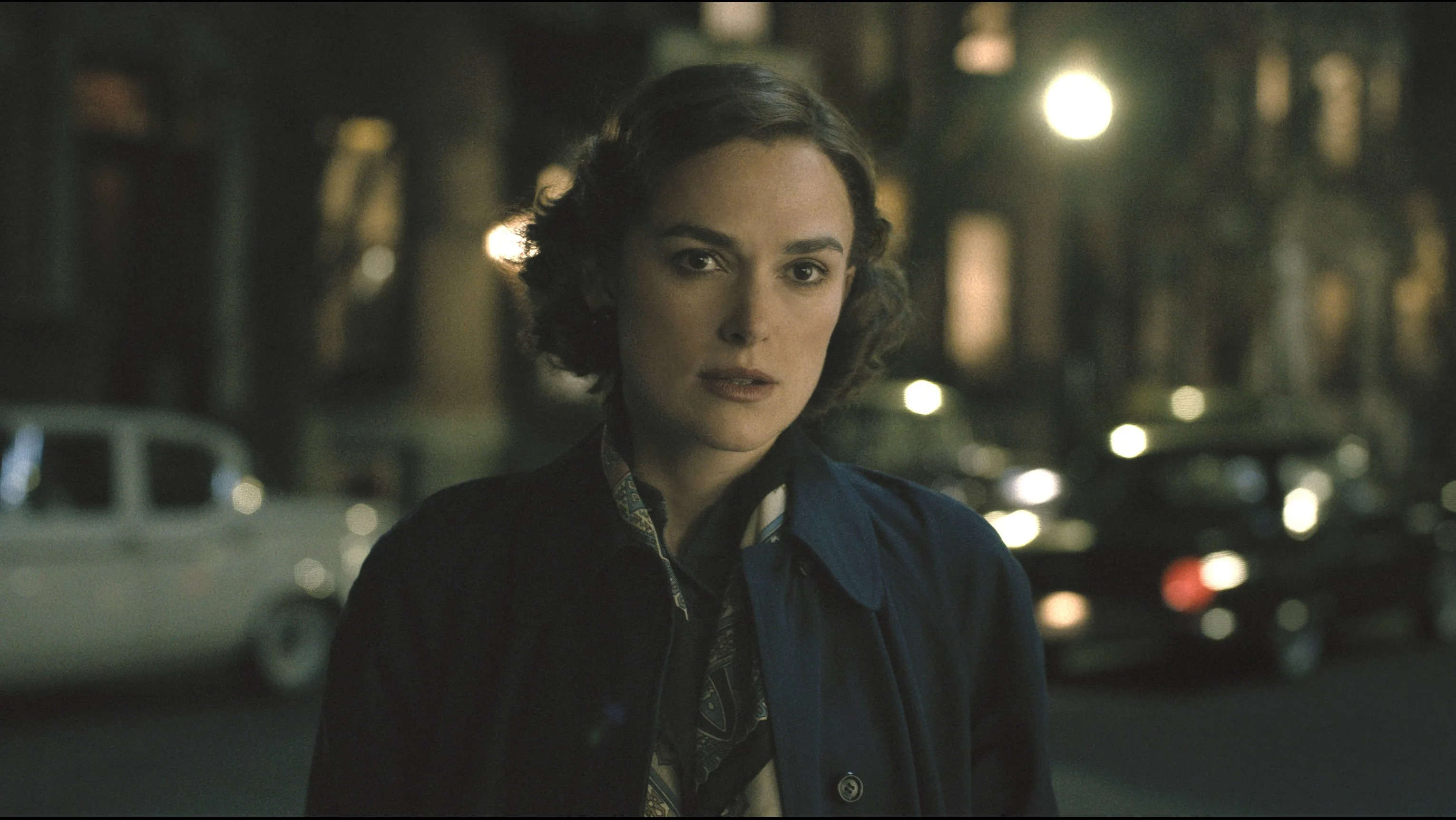
But that mystery never truly materializes. It’s not just that the secret is given away earlier than you might expect, but that “The Woman in Cabin 10” never makes any real attempt to cover the fact that Bullmer is up to no good, underscored in Pearce’s supercilious performance, slurping up orange juice at the breakfast buffet like Shooter McGavin eats pieces of shit for breakfast. Stone, who co-wrote the script with two others, see this less as a mystery than a nightmare, kind of “Gaslight” on a superyacht in which a middle-class journalist slips into psychosis as the rich and famous continually tell her not to believe her lying eyes. Stone, though, doesn’t just see “The Woman in Cabin 10” as a nightmare but, crucially, as trash; it’s set almost entirely on a boat, but like Lt. Frank Drebin, the movie itself is swimming in raw sewage. Stone embodies the unrepentant shamelessness of the rich by throwing all sense of shame to the wind, evoking the haughty belittling of Lo in the over-the-top comical tones, essentially rendering the superyacht as nothing less than an opulent apparatus for covering up a crime, and amplifying Lo’s nigh hallucinatory state through all manner of wide-angle lenses. Indeed, even if many frames remained marred by that artificial Netflix sheen, especially the interiors, Stone’s shot-making is better than you might suspect. One image right after Lo’s concerns have been blithely written off shows her standing at the edge of the yacht, the wide angle disappearing the boat altogether, making it seem for all the world that she has been set adrift with the truth.
Showing posts with label Keira Knightley. Show all posts
Wednesday, November 19, 2025
The Woman in Cabin 10
Looking for an easy assignment after a traumatic one, Guardian journalist Laura Blacklock (Keira Knightley), “Lo” for short, jumps at the chance to hitch a ride aboard billionaire Richard Bullmer’s (Guy Pearce) superyacht to interview his terminally ill wife Anne (Lisa Loven Kongsli) about what she intends as a posthumous foundation. It doesn’t take long for things to go wrong, however, and not just because Lo’s ex-boyfriend Ben (David Ajala) is also aboard. No, on her first night she witnesses a person thrown overboard, believing it to be the young woman she briefly met earlier, the one in Cabin 10. After alerting the crew, however, they conduct a search and explain that not only are all passengers and crew accounted for, but Cabin 10 had no occupant in the first place. Given not just the situation but the setting, “The Woman in Cabin 10” seems set up for a stylish murder mystery in which Lo turns sleuth to interview a gallery of intriguing suspects from a rock star (Paul Kaye) to a gallerist (a gloriously icy Hannah Waddingham) to Buller himself. Knightley is certainly game for such a mystery, anyway. When Lo is told everything checks out, time to keep going, chop-chop, director Simon Stone opts for a comic long shot as Knightley’s face quizzically droops, conveying, “Like, wait, what?”
But that mystery never truly materializes. It’s not just that the secret is given away earlier than you might expect, but that “The Woman in Cabin 10” never makes any real attempt to cover the fact that Bullmer is up to no good, underscored in Pearce’s supercilious performance, slurping up orange juice at the breakfast buffet like Shooter McGavin eats pieces of shit for breakfast. Stone, who co-wrote the script with two others, see this less as a mystery than a nightmare, kind of “Gaslight” on a superyacht in which a middle-class journalist slips into psychosis as the rich and famous continually tell her not to believe her lying eyes. Stone, though, doesn’t just see “The Woman in Cabin 10” as a nightmare but, crucially, as trash; it’s set almost entirely on a boat, but like Lt. Frank Drebin, the movie itself is swimming in raw sewage. Stone embodies the unrepentant shamelessness of the rich by throwing all sense of shame to the wind, evoking the haughty belittling of Lo in the over-the-top comical tones, essentially rendering the superyacht as nothing less than an opulent apparatus for covering up a crime, and amplifying Lo’s nigh hallucinatory state through all manner of wide-angle lenses. Indeed, even if many frames remained marred by that artificial Netflix sheen, especially the interiors, Stone’s shot-making is better than you might suspect. One image right after Lo’s concerns have been blithely written off shows her standing at the edge of the yacht, the wide angle disappearing the boat altogether, making it seem for all the world that she has been set adrift with the truth.
Monday, April 10, 2023
Boston Strangler
“Boston Strangler” begins with a cryptic recreation of one of the eponymous mystery figure’s crimes, though the movie ultimately proves much less about him, whoever it might be, than the person, nay, woman attempting to suss out his identity – namely, Loretta McLaughlin. The real-life Boston Record American reporter is played by English actress Keira Knightley with an American accent that doesn’t sound much like a Boston accent, not that I’m really qualified to judge, but that in its skeptical scratchiness nevertheless works quite well for the role. Much to her chagrin, Loretta is assigned the Lifestyle beat, and there is a great shot in which Loretta is framed between her colleagues, looking the wrong way, her head in the clouds, or more accurately, on the mind of three women recently strangled in the Boston area. If her editor (Chris Cooper) does not initially deem this story worthy, Loretta does, at first working at it on her own time and then for the paper with a world-wearier reporter who knows the angles, Jean Cole (Carrie Coon).
The first thing you notice about “Boston Strangler” is its color palette. Exclusively muddy browns and greens, everything here, from Loretta’s home to a police interrogation room to various crime scenes, looks the same. If it evinces an appropriately grim sensation given the circumstances, the unyielding sameness of it all also unfortunately counteracts much of the tension, making it feel heavy rather than foreboding, the city never coming across under terrifying siege the way Loretta and Jean’s stories say it is. That lack of tension is furthered in Ruskin’s approach of solemnity over suspense. A scene in which Loretta enters a suspect’s apartment comes across rote, cribbed straight from David Fincher’s “Zodiac” (2007) and with little perspective of its own. The brief moment just before, a shot of Loretta from across the street generates the kind of omniscient fear the rest of “Boston Strangler” lacks.
In reporting the story, Loretta and Jean run up against all sorts of impediments to their progress, both within the police department and their own newsroom, though the intriguing idea of these institutions of power conforming to the same sort of misogyny that motivated the killer merely simmers below the surface rather than emerging as an overriding and forceful point. Ruskin, who wrote the screenplay in addition to directing, comes across more concerned with the nuts and bolts of the investigation, though the emergent ambiguity (the movie literally ends by reminding us the case is unsolved) is weirdly negated near the end through a theory proposed by Loretta that both the movie and Knightley’s air suggest as kind of Case Closed. Loretta’s scenes at home, meanwhile, in which Loretta ignores her husband (Morgan Spector) and kids to keep hunting the story are, weirdly in their own way, both boilerplate and the best part?
At some point Loretta says her kids are spooked, but we hardly see her kids, they are immaterial, it’s more about James, who mostly just says the things and acts the way Neglected Movie Spouses always act in these situations. That’s not so interesting, obviously, but what’s more interesting is how Knightley plays these scenes, like Loretta can’t quite bring herself to care that he’s peeved. Coon’s character gets no real backstory, save for one tossed off line about how her home life is a wreck, though Coon seizes on that line and essentially makes the whole performance out of it, like that mess hardly bothers her, like here, at work, this is what’s important. Ruskin never quite dares to truly weave the idea that a horrific story such as this one gave them purpose, or made their careers, but in the last scene when Loretta and Jean toast their drinks at a bar, he does suggest that in their careers they found their home.
Labels:
Boston Strangler,
Keira Knightley,
Middling Reviews
Saturday, November 07, 2020
keira knightley is so fucking relieved
Labels:
Election,
Keira Knightley
Friday, November 06, 2020
keira knightley lights another cigarette
Labels:
Election,
Keira Knightley
Thursday, November 05, 2020
keira knightley self-medicates
Labels:
Election,
Keira Knightley
Wednesday, November 04, 2020
keira knightley cries in the tub
Labels:
Election Day,
Keira Knightley
Tuesday, November 03, 2020
keira knightley sits in the tub
Labels:
Election Day,
Keira Knightley
Tuesday, October 13, 2020
Misbehaviour
Near the conclusion of “Misbehaviour”, Philippa Lowthorpe’s UK film about beauty pageants and those who would protest them, Jennifer Hosten (Gugu Mbatha-Raw), Miss Grenada, who has just been named Miss World 1970, and Sally Alexander (Keira Knightley), the woman’s liberationist who has just interrupted Hosten’s crowning by throwing stink bombs, meet backstage. If the moment is a convenient narrative ritual, the way it is portrayed and played transcends the device’s treacly nature. Jennifer and Sally are not forging common ground or even brokering a peace so much as finding themselves at an impasse; they’re both right. It’s a refreshing multi-dimensionality, an acknowledgment and brief exploration of the world’s prominent grey areas that, alas, is in short supply in the movie preceding it. “Misbehaviour” forgoes an interesting character study to soften edges and simplify situations for the sake of something examining All Sides in so much as it is crafting an entertainment meant to appease Everyone. Paradoxically, it too frequently feels in line with the generic taste of Eric Morley (Rhys Ifans), the two-footed ham who runs Miss World.
As “Misbehaviour” opens, Lowthorpe cuts between footage of a beauty pageant and Sally applying to study at University College London. The review board facing Sally is all male and as she sits down, two of the gentleman rate her looks, equating the latter with the former, not just a demonstration of the inherent social sexism she faces but the movie’s oft-obvious presentation of it. Though she is buttressed back home by a partner (John Heffernan), the gender roles are reversed, not simply in his wearing an apron, much to the disgust of Sally’s mother (Phyllis Logan), but how the character is written as nothing less than the Supportive Spouse archetype. If it’s a failure in a vacuum, in the broader scope, it’s also the cows, quoting Lt. Frank Drebin, coming home to roost, a man reduced to the one-note role so many women have been relegated to in movies over the years. To his credit, Heffernan knows it and fades into the background from the jump. When they have arguments, the camera lingers on Knightley’s making sense of things facial expressions, underlining the moments as hers, not his.
Eventually Sally joins the women’s liberation movement, forging an unlikely friendship with Jo Robinson (Jessie Buckley), who lives in a women’s commune and would rather spray political graffiti then hand out leaflets. If Knightley does a solid job fitting in without shedding her character’s inherent civil air, Buckley’s character constrains her performance. Though Jo is supposed to be a radical, “Misbehaviour’s” aesthetic is so moderate it unintentionally douses any sense of righteous fury, as if afraid of offending the wrong person, inadvertently taking the piss outta the whole revolution.
If Sally and Jo epitomize liberation, Jennifer as well as Pearl Jansen (Loreece Harrison), Miss Africa South, epitomize representation, even if their underwritten subplot unintentionally denotes representation’s limits. Miss Africa South takes that name from being the country’s black Miss World representative, while a white contestant – Miss South Africa – is sent along too. And though we hear Pearl explain she was ordered in no uncertain terms by her country not to speak out about apartheid lest she be sent home, little context is provided to reinforce this significant political pressure she faces. Likewise no context is provided to show what Miss Granada being the first black winner means; it’s as if simply putting her on screen is enough. To Mbatha-Raw’s credit, however, she gives as good a performance as she can, best in moments when she is not forced to recite clumsy dialogue, like a close-up where she watches other contestants having a good time on a night off, the smile on her face quietly eroding, the professionally mandating joy giving way to personal melancholy and the cross she bears.
As a villain, the patriarchy, simply in and of itself, the idea, the concept, is far too abstract for a movie like “Misbehaviour”, forcing it to give the patriarchy a face. Not Eric Morley, mostly just mincing comic relief, but Bob Hope (Greg Kinnear), enlisted as Miss World 1970’s special guest. Armed with a golf club like a royal scepter, Kinner, alas, leans a little too heavily on facial mimicry, playing the heel to a fault, never quite getting across how Hope could mask his sneering sexism in comedy, lessening the portrayal and unfortunately rendering the patriarchy as something akin to just this one bad apple. Then again, just as there is something refreshing in seeing Sally’s partner reduced to The Supportive Spouse, there is something refreshing in Lesley Manville as Dolores Hope, Bob’s spouse, in the performance of the film, transcend The Suffering Spouse archetype in her final scene, right after Miss World concludes, leaving Bob at a loss for what the world has become.
Manville is not simply reprising her performance in “Phantom Thread”, mind you, but she affords the moment similar astute, wicked psychology, evoking everything women throughout the ages have been forced to put up with, assuaging her idiot husband’s ego so deftly he can’t quite see she’s just asked him, if not in so many words, why don’t you take your ball and go home?
Labels:
Keira Knightley,
Middling Reviews,
Misbehaviour
Thursday, September 03, 2020
Tuesday, August 11, 2020
keira knightley needs a time-out
Labels:
Coronavirus Diaries,
Keira Knightley
Friday, May 08, 2020
Saturday, March 21, 2020
Wednesday, February 05, 2020
Wednesday, January 08, 2020
Wednesday, September 25, 2019
keira knightley battens down the hatches
Labels:
Don't Ask,
Keira Knightley
Monday, September 16, 2019
Official Secrets
This summary is not available. Please
click here to view the post.
Labels:
Good Reviews,
Keira Knightley,
Official Secrets
Wednesday, August 21, 2019
The Aftermath
Set in post-WWII Hamburg, Germany, much of “The Aftermath”, based on a novel by Rhidian Brook, takes place inside a mansion requisitioned by the British, specifically for Colonel Lewis Morgan (Jason Clarke), overseeing efforts to rebuild the city and deal with insurgent attacks, and his wife Rachael (Keira Knightley) who has just arrived from London. If the ornate, pristine interior stands in stark contrast to so much rubble of bombed out buildings outside, it is no haven, marked by a discernible chill, evoked in Rachael’s arrival where, standing on the balcony, admiring the view, she asks to go back inside since it is freezing, as if taking the cold with her. Some of the best shots in the movie are when Knightley just stands rock still inside the mansion as its expansive surroundings seem to swallow her up. Initially Rachael sits on the furniture, Knightley doesn’t even quite sit all the way down, just sort of perching on the edge; this is not home.
It not being Rachael’s home is merely underlined how its previous owners – Stefan Lubert (Alexander Skarsgård) and his daughter Freda (Flora Thiemann) – are still living there, upstairs in a different annex. This is only because Lewis feels humanist rumblings after witnessing the brutal death of a German in the street, despite this German’s Third Reich sympathy, and extends an olive branch to Stefan. Complications ensue, though they never feel too complicated, if only because Skarsgård is so genteel in his anguish and Freda’s dalliance with a Werwolf is nothing more than mere red herring. No, the real complication is in the relationship between Rachael and Lewis, already strained by the death of their son during The Blitz. With the emergent knowledge that a discoloration on the wall was where a portrait of you-know-who once hung, evoking an apparition of a war that has only nominally concluded, Rachael struggles to believe that everything is now just automatically peachy keen even if Lewis says so, prompting a transonic “you’re shitting me” look at him from her at dinner.
It might seem odd, then, that Rachael and Stefan get it on. But the all-of-a-sudden presentation, where he just plants one on her out of the blue and then, a little later, she just fiercely and without warning kisses him right back, leading to an affair right under Lewis’s nose, does not come across in this context as dubious character motivation but something like physical necessity. She needs someone. He needs someone too, suggested in how his own wife perished during the war. And so when Lewis is called away on a duty for a few weeks, a “Bridges of Madison County” situation germinates, though here, as Stefan takes Rachael as something akin to a marital replacement and Rachael starts doting on his daughter as something akin to her own, it feels less romantic than distressing, coloring scenes like the Stefan and Rachael throwing snowballs at each other in the light of two people having gone round the bend.
Yet rather than follow these characters down the intriguing rabbit hole of role-playing, it opts for forced sentimentality, bringing Lewis back early from his military responsibilities, interrupting this faux family unit and instigating a love triangle. At this point, the tenor of Knightley and Skarsgård’s performances don’t change but the context does, which makes “The Aftermath” come to feel like one of those movies where a climactic twist winds up in a brief montage of revisiting early scenes to cast them in a whole new light, but which we do in our minds instead. And so the scene of Stefan and Rachael throwing snowballs at one another transmutes from a creepy variation on “Rebecca” into Hallmark Channel fluff, the twist, then, in this case being that the whole movie collapses right before your very eyes.
Labels:
Keira Knightley,
Middling Reviews,
The Aftermath
Tuesday, August 20, 2019
All You Had To Say Was 'Keira Knightley Stares Forlornly Out a Window'
An old Onion piece appropriately titled: “All You Had To Say Was ‘Owen Wilson Befriends A Dolphin And I Was Sold’” imagines a Hollywood pitch meeting from the perspective of an agent who cuts off the pitch less than a sentence in not because the pitch is so bad but because the pitch is so good. “Listen—stop talking,” implores this imaginary agent. “I don’t need to hear the rest. The first half of the sentence was genius! ‘Owen Wilson befriends a dolphin and…’ And? What ‘and’? No ‘and’ necessary! Are you kidding me? I’m sold. Sold!” The agent then proceeds to concoct the rest of the movie right then. “Now, all we need to do is figure out the movie. What? You have a whole concept worked out already? Beautiful—but completely unnecessary. I’ll come up with the rest of it, off the top of my head, right now, while I’m on the 405.” This inevitably leads to the movie’s poster: “I see Wilson, the dolphin, front seat of a convertible, wearing shades. Yes, both of them.”
This piece is legendary amongst my movie-loving friends. Why just a few weeks ago, on the news site Facebook, my friend Daryl, in response to my posted “Gloria Bell” review, wrote “What do you mean ‘Julianne Moore goes dancing to disco music and?’ Your pitch meeting was over right there!” And I thought of that piece again as I sunk into the sofa and cued up the latest Keira Knightley joint, “The Aftermath.” And though the review will come, and the review will be honest and unmerciful, before the review, we have to discuss the beginning independent of the rest because, well, let me explain.
“The Aftermath’s” opening shot is an old steam train rounding the bed on some snowy mountain. A snowy mountain is right in my wheelhouse.
It wasn’t supposed to be funny, I know, but context is everything, and I have never seen a movie opening so specifically crafted to my peculiar, obsessive tastes. I don’t think I’ve laughed that hard at a movie since Rose Byrne told the story about the Bulgarian clown in “Spy.”
And that’s when I realized I could never be a Hollywood producer. That’s my kryptonite. That’s how you get me to greenlight anything. “All You Had To Say Was ‘Keira Knightley Stares Forlornly Out A Window’ And I Was Sold.’ I don’t need to hear the rest. The first half of the sentence was genius! What ‘and’? No ‘and’ necessary! Are you kidding me? I’m sold. Sold!” I don’t need to know what she’s staring at. Don’t tell me. And don’t tell me where the train is going. Does it matter? Of course it doesn’t matter. Keira Knightley is staring forlornly out a window! I’m hooked! Teeth, line and sinker! Wherever she’s going, I’ll go too, straight into the heart of melancholia, baby!
This piece is legendary amongst my movie-loving friends. Why just a few weeks ago, on the news site Facebook, my friend Daryl, in response to my posted “Gloria Bell” review, wrote “What do you mean ‘Julianne Moore goes dancing to disco music and?’ Your pitch meeting was over right there!” And I thought of that piece again as I sunk into the sofa and cued up the latest Keira Knightley joint, “The Aftermath.” And though the review will come, and the review will be honest and unmerciful, before the review, we have to discuss the beginning independent of the rest because, well, let me explain.
“The Aftermath’s” opening shot is an old steam train rounding the bed on some snowy mountain. A snowy mountain is right in my wheelhouse.
But then – then! – the very next shot – the second shot in the whole movie! – is pushing in on one of the train car windows where we see who else but Keira herself forlornly staring out of it.
It wasn’t supposed to be funny, I know, but context is everything, and I have never seen a movie opening so specifically crafted to my peculiar, obsessive tastes. I don’t think I’ve laughed that hard at a movie since Rose Byrne told the story about the Bulgarian clown in “Spy.”
And that’s when I realized I could never be a Hollywood producer. That’s my kryptonite. That’s how you get me to greenlight anything. “All You Had To Say Was ‘Keira Knightley Stares Forlornly Out A Window’ And I Was Sold.’ I don’t need to hear the rest. The first half of the sentence was genius! What ‘and’? No ‘and’ necessary! Are you kidding me? I’m sold. Sold!” I don’t need to know what she’s staring at. Don’t tell me. And don’t tell me where the train is going. Does it matter? Of course it doesn’t matter. Keira Knightley is staring forlornly out a window! I’m hooked! Teeth, line and sinker! Wherever she’s going, I’ll go too, straight into the heart of melancholia, baby!
Labels:
Don't Ask,
Keira Knightley
Monday, August 05, 2019
keira knightley can't even
Labels:
Don't Ask,
Keira Knightley
Thursday, July 18, 2019
Memes Unlimited
If a meme was, as Richard Dawkins first defined it in his 1976 book The Selfish Gene, and as James Gleick put it for The Smithsonian Magazine, connecting the evolution of genes to the evolution of ideas, it was only inevitable that those ideas would mutate into something else over time since that mutation was Dawkins’s whole point in the first place, even if that mutation took a different form than he might like. Indeed, in the 1990s Mike Godwin established a law that has taken his name, one stipulating that the longer an online discussion goes, the greater the probability that a N*zi or H*tler comparison will emerge, which, one might argue, crystallizes our current American peril. Memes, though, have taken other, less outright evil forms in the Internet age, a little less like the evolution of ideas and more like the evolution of inanity. If Tweets and texts have replaced letters and fully formed thoughts then memes by way of GIFS have replaced Tweets and texts. Why actually reply to someone with words online when you can still, now, in 2019, go to the dry well of that cat furiously clicking the keyboard GIF in moments of extreme online stress or offer congratulations via that GIF of Leonardo DiCaprio in “The Great Gatsby” raising his glass. Never mind that one blogging idiot who conveys his current state of mind not with words but screen shots of Keira Knightley doing things. (Seriously, give it up, dude.)
The Leo meme is instructive. If Jay Gatsby’s lavish parties belie the American Dream’s emptiness, as any grade school book report should be able to attest, the memeification of Gatsby making a toast to accompany one of those hollow soirees is at odds with the actual image’s intent. It is further evidence of the Internet Killed Irony argument, just like the oft-used Nod of Approval Meme is culled from Robert Redford’s “Jeremiah Johnson” (1973), a movie in which a war veteran walks into the wilderness and remains there, its 1973 release predating the online echo chamber but nevertheless foreshadowing a future where people of a certain variety yearn for the last place on earth without human noise, only marking this mountain man meme as all the more rich. This dumb bit of Internet comedy, however, took an unexpected twist when it was recently uncovered that a good chunk of the online community replicating it had no idea the person in the image was Redford, let alone that the movie was “Jeremiah Johnson.” What they thought it was – “Cry Wilderness” from “Mystery Science Theater 3000”? – seems less important than what it seems to say about our current cinematic state.
At my showing of “Toy Story 4”, across the aisle and one row up, a mom stood up and snapped a photo with her phone of her children watching “Toy Story 4.” She did not do this before the movie. She did not do this during the coming attractions. She did this DURING THE MOVIE. Forget for a moment the egregious example of moviegoing etiquette she is setting for her own children and consider how, in this example of egregious movie-going etiquette, she is reducing the film on the screen to a mere prop undoubtedly in service of a Facebook for Instagram post. “Toy Story 4” becomes nothing but a hashtag to help expedite the likes. That flashed me back to the screening of “The Trip to Italy” My Beautiful, Perspicacious Wife and I attended in 2014. At the end, as an indelible Mediterranean sunset filled the screen, a patron down front and to our left, held up her phone and snapped a photo. My Beautiful, Perspicacious Wife and I debated about the point of this photo. Was it just a keepsake? Was she going to share it online to show she’d been at the movie? Was she going to pass the photo off as her own?
In the end, it doesn’t matter. This picture, like the “Toy Story 4” family photo, diminishes the whole big screen experience to a personal instant Polaroid. I’m surprised the woman at “The Trip to Italy” didn’t slide in front of the screen to have her friend take a picture, like the big screen was one of those giant cutout boards at an amusement park where you and yours put your faces into some pre-made board and become a prairie family on the Oregon Trail, or something, which is probably our next level of god-awful future. And that’s essentially what memes are doing too. They are not Youtube clips which are, at least, in their own way, appreciations of the films from which they are taken. And they are not rap samples, which are borrowed, yes, but frequently form the sonic backbone of a song (like Tribe Called Quest sampling Art Blakely on “Excursions”). No, memes are disassembling existing images in service of something like a cinematic chop shop, not just ridding them of their original meaning but stripping them of all context, selling them as something else. And though it’s possible I am merely a Grumpy Gus trying to ruin everyone’s online fun, I nevertheless fear a future where what you call movies I call screensaver slideshows.
![]() |
| keira knightley finds out about this idiot’s meme of her |
At my showing of “Toy Story 4”, across the aisle and one row up, a mom stood up and snapped a photo with her phone of her children watching “Toy Story 4.” She did not do this before the movie. She did not do this during the coming attractions. She did this DURING THE MOVIE. Forget for a moment the egregious example of moviegoing etiquette she is setting for her own children and consider how, in this example of egregious movie-going etiquette, she is reducing the film on the screen to a mere prop undoubtedly in service of a Facebook for Instagram post. “Toy Story 4” becomes nothing but a hashtag to help expedite the likes. That flashed me back to the screening of “The Trip to Italy” My Beautiful, Perspicacious Wife and I attended in 2014. At the end, as an indelible Mediterranean sunset filled the screen, a patron down front and to our left, held up her phone and snapped a photo. My Beautiful, Perspicacious Wife and I debated about the point of this photo. Was it just a keepsake? Was she going to share it online to show she’d been at the movie? Was she going to pass the photo off as her own?
In the end, it doesn’t matter. This picture, like the “Toy Story 4” family photo, diminishes the whole big screen experience to a personal instant Polaroid. I’m surprised the woman at “The Trip to Italy” didn’t slide in front of the screen to have her friend take a picture, like the big screen was one of those giant cutout boards at an amusement park where you and yours put your faces into some pre-made board and become a prairie family on the Oregon Trail, or something, which is probably our next level of god-awful future. And that’s essentially what memes are doing too. They are not Youtube clips which are, at least, in their own way, appreciations of the films from which they are taken. And they are not rap samples, which are borrowed, yes, but frequently form the sonic backbone of a song (like Tribe Called Quest sampling Art Blakely on “Excursions”). No, memes are disassembling existing images in service of something like a cinematic chop shop, not just ridding them of their original meaning but stripping them of all context, selling them as something else. And though it’s possible I am merely a Grumpy Gus trying to ruin everyone’s online fun, I nevertheless fear a future where what you call movies I call screensaver slideshows.
Labels:
Don't Ask,
Keira Knightley
Subscribe to:
Posts (Atom)