' ' Cinema Romantico: May 2023

Wednesday, May 31, 2023

One Day as a Lion


Putting your movie on a clock tends to raise suspense, as it did famously in “High Noon,” where the ticking clock was literal, or in the much more recent “John Wick: Chapter 4,” where an ornate three-hour movie never felt overly ornate or that long because of the countdown. But sometimes, as we all know, whether scientifically or innately, the more time speeds up, the more it seems to slow down, as it does in John Swab’s mid-shelf middling thriller “One Day as a Lion.” Though hapless would-be hitman Jackie Powers (Scott Caan) gets put on a clock after the hit he tries to carry out at the behest of the mob to earn the money he needs to pay a lawyer to spring his kid from juvie wind ups with the wrong guy dead and he and a diner waitress named Lola (Marianne Rendón), the lone witness to his inadvertent birdbrained crime, on the lam, Swab and Caan, doubling as co-screenwriters, immediately decelerate. Instead, “One Day as a Lion” becomes a high-octane thriller rendered in the key of a hangout movie, drifting along as its characters futz about, the various criminal lowlifes philosophizing about and arguing over underworld red tape. When Jackie and Lola pose as engaged to try and finagle a wad of cash from the latter’s mother, Valerie (Virginia Madsen), to fund her acting school dreams and pay for his lawyer, mom asks Jackie to get go some grab crab legs for her to eat while she mulls over the request. He acquiesces. This is a movie that has time for crab legs.

“One Day as a Lion” gets by in no small part on the combined energy of its leads. Swab emotionally links them in the opening sequence through profile shots of each character, him in his car, her at a table in the empty diner, positioning them both as someone who would rather be anywhere else. That’s true even when they’re together, not so much falling in love as just sort of emotionally skipping ahead to the point in their ersatz shotgun marriage where they already can’t stand each other. Caan might resemble a vein-bulging kind of bro, but his strength has always been a weary, annoyed deadpan and he wisely writes/plays to his strength here, emblemized his Hawaiian shirt with cowboys on horses rendering him as a pale, if amusing, imitation of the real thing, where the movie sort of writes off the person he accidentally kills in lieu of his intended target as Hey, He Didn’t Mean It. Rendón, meanwhile, reimagines Cameron Diaz’s spoiled rich kid in “A Life Less Ordinary” as a true slacker, while also evincing amusing pity for a kidnapper she is always two steps ahead of.

And while it’s true that Swab’s approach counteracts much of the scenario’s inherent tension and doesn’t really build to anything substantial, there’s something agreeable about this trivial air nonetheless, the ultimate pointlessness of the ostensibly big final shootout giving the entire movie the feel of a shaggy dog story. Granted, that’s why “One Day as a Lion” doesn’t really end, it just shrugs and fades out, but it also spiritually culminates several scenes earlier ends with a courtroom scene in which Jackie masquerades as his son’s lawyer and Lola masquerades as Jackie’s son’s mom. If up until this point, Lola’s acting bug has felt tangential, a trait assigned by the screenwriter more than anything real, in one fell swoop, Rendón makes up for that flaw by bringing her character improvising a monologue on the spot to ridiculous, glorious life, burying her character so deep in the role that I was reminded of another 1997 movie character, Dustin Hoffman’s “Wag the Dog” movie producer, so passionately animating a case of political fraud that it becomes honest.

Tuesday, May 30, 2023

Hope Springs Eternal

The casts of Wes Anderson movies are typically so stacked that you’d be forgiven for thinking everyone has already been in one. And yet, Hope Davis, ironically given that this blog once argued she should literally be in everything, has never been in a Wes Anderson movie. And though I’m someone who might well have argued Wes’s “The French Dispatch” was the best movie of 2021, meaning I was aware of the existence of Anderson’s forthcoming “Asteroid City,” it had somehow escaped me that Hope Davis was in “Asteroid City” until I saw the trailer. I confess, I missed most of the trailer because every time she appeared, it took my breath away.

Davis is fifty-nine, after all, meaning she is considered a spinster in Tinseltown terms, well past The Hollywood Age Cutoff Line for women, mostly relegated to television, essentially allowed to appear in movies if she is playing someone’s mother, like “Captain America: Civil War.” Indeed, a 2014 study indicated that the careers of women in Hollywood peak at age 34. Sure enough, the Hope Davis-starring Cinema Romantico canon rom com “Next Stop Wonderland” was released in 1998 when Davis, born in 1964, was 34. I’ll be God damned.

Now Davis might seem outside the Wes Anderson wheelhouse given that his movies tend to call for fussiness – exactness – in his performers and Davis’s preeminent asset has often been a naturalistic quality, the frazzled eye of the station-wagon storm in the 1996 indie epic “The Daytrippers,” the genuine loving exasperation she evinces beneath that wig in “American Splendor,” or functioning as the true heart and soul of “About Schmidt,” her moving life exhaustion the kitchen-sink counter to all the stylized acting going on around her. But I mean, c’mon, man, she made her name in the 90s indie scene and you couldn’t hack it in the 90s indie scene if you couldn’t be credibly, nay, charismatically witheringly dry. And in the “Asteroid City” trailer, Davis’s gift for deadpan is on full display, innately illustrating my argument that she should be in everything because even though she’s never been in a Wes Anderson coffeehouse and is surrounded by Wes Anderson regulars she fits right in like she’s been there the whole time.   

The man who reviews a trailer is the man who’s lost his mind but, hey, what do I sound like if not a man who’s lost his mind? And when I saw Hope Davis in the “Asteroid City” trailer, I saw her second onscreen credit, 33 years ago, the nameless French Ticket Agent in “Home Alone” filtered through the French New Wave, just with an American accent, glorious, resplendent ennui. 


Friday, May 26, 2023

Friday's Old Fashioned: The Flying Saucer (1950)


“The Flying Saucer” billed itself as being the first movie to tackle its eponymous subject, both capitalizing and commenting on the phenomenon that took root in America in 1947 after pilot Kenneth Arnold’s UFO sighting near Mount Rainier and the incident in Roswell, New Mexico. Indeed, director Mikel Conrad’s opens with a montage of newspaper headlines mimicking the so-called flying disc craze of 1947 in which famous American playboy Mike Trent (Mikel Conrad) is recruited by American Intelligence to return to his native Alaska under cover of having had a nervous breakdown with government agent Vee (Pat Garrison) posing as his nurse to covertly investigate reports of Soviet spies poking around The Last Frontier in the wake of flying saucer reports. If it sounds like a flimsy intelligence operation, well, such flimsiness embodies “The Flying Saucer” itself, which spends less time on UFOs than it does on both an unconvincing, altogether heatless love story between Mike and Vee and the Alaskan scenery. The climax seems to exist less in the name of culminating suspense than showing off an on-location glacier and one scene in which Mike pilots a small plane spends a couple minutes at least just watching him as he looks at the scenery below, like a moving advert for future statehood.

The UFO itself is barely glimpsed, Conrad as director apparently knowing his special effects were not up to snuff, and is most interesting for the sound it makes, not the eerie whirring to which we are so accustomed but something more akin to a fighter jet. That betrays its human origins, invented by an American scientist (Roy Engel) and craved by the Soviets, who will stop at nothing to acquire this saucer for themselves. “The Flying Saucer” generates an almost stunning lack of tension from this set-up, but the twists and turns at least interesting through a historical lens, a movie employing the saucer craze as Cold War propaganda, never really seriously entertaining otherworldly thoughts. Watching this drowsy attempt at Sci-Fi, it’s easy to understand why ensuing cinematic cracks at this topic decided to opt for little green men instead.

Thursday, May 25, 2023

Adventures in Movie Promotional Photos, part 112

In discovering yesterday’s image from the (not) “Twister” premiere, I naturally was led to images from the (L.A. Edition) “Twister” premiere (how many premieres did this movie have?), all helpfully catalogued at Go Fug Yourself. I never got past image 13. Cuz, damn. The 90s are back, even if they are not back for people my age, people who lived through the 90s, but while this image is from the 90s, this look is timeless, which is to say immortal, which is to say infinite. In this image, Wesley Snipes is, like space, beyond the observable universe, and so beyond observable fashion, something you, me, we cannot begin to comprehend. And so, I got to thinking.


You might have heard the recent news that Glen Powell is in talks to star in the (semi) long-awaited “Twister” sequel. And I get it. In a mostly movie star-less landscape, Powell is one of the Hollywood young guns who seems like he might have the juice. This blog loves Glen Powell and has said so! But seeing that image of Wesley Snipes at the (L.A. Edition) “Twister” premiere put me in mind of turning the “Twister” sequel into the long-awaited Wesley Snipes comeback. And though the “Twister” sequel is apparently going to be called...can you guess?...can you?...“Twisters,” like, hey man, despite its title, the first “Twister” had multiple twisters, both across the whole movie itself and in one sequence where the sky sprung two tornadoes at once. So, while I understand sequels are all about higher concepts, how exactly is “Twisters” a higher concept? We can do better, so much better, and I’ll tell you how. 

Mike Merriweather (Snipes) is a legendary storm chaser who has seen more tornadoes than anyone. “He’s done everything,” says one grizzled meteorologist, “short of ropin’ a twister.” But when Mike chases a conspicuously erratic tornado one May afternoon in northwest Oklahoma, he suspects it of being...alive? “It’s like that tornado knew me,” growls Mike. Naturally, this gets him laughed out of the storm chasing community, left to watch The Weather Channel in disgrace in fleabag highway motels. Until, that is, a madman scientist (Michael Shannon) is discovered to have implanted the Oklahoma sky with Artificial Intelligence. When an outbreak of robotic tornadoes threatens the entire state, the National Weather Service calls upon Mike once again for the biggest storm chase of his life, one that ends with him, yes, ropin’ a twister. 

Was that so hard?

Wednesday, May 24, 2023

Adventures in Movie Promotional Photos, part 111

A little while back, Chicago was besieged by inclement weather, severe thunderstorm warnings and tornado watches. So, as the local news breathlessly broke down the Doppler, I did what I often do in such situations and Googled “Twister.” Maybe it was streaming, I thought, and maybe I could watch a little before the tornado siren sounded and I fled to the cellar. But I never got that far. No, what I saw instead was an image captured lo those 27 years ago. This image:


At first, I assumed it must have been snapped at the “Twister” premiere. But the premiere took place in Oklahoma, where the movie is set, and astute readers will notice the baseball cap sported by Woody Harrelson (who is not in the movie) as belonging to the city of Atlanta’s baseball team. Indeed, just behind Helen Hunt and Bill Paxton (who are in the movie), with a hand on each of their shoulders, is Jane Fonda (who is not in the movie) who in 1996 would have been married to Ted Turner, owner of Atlanta’s Major League Baseball organization. Indeed, this, as it turned out, was the “Twister” premiere...with a twist. That is to say, it was the “Twister” premiere benefitting Jane Fonda’s G-CAPP (The Georgia Campaign for Adolescent Power & Potential), held at Atlanta’s Fox Theater one day after the “Twister” premiere in Oklahoma City. 

But what I am even talking about here? This is all setting the scene and, honestly, you don’t need the scene to be set. The scene sets itself. This photo exists independently of where it took place. It does because of Hunt, of course. And though you can find photos from this same scene snapped just before or after the above photo that show Hunt smiling and seemingly jovial and happy to be there, in the vacuum of this single image, that matters as little as the surrounding context. Because there, here, all on its own, in Hunt’s frown amid this sea of smiles is where the truth emerges.

It might be tempting to ask, who are they looking at? Because clearly, they are looking at someone. (Ted Turner? Speculation!) But whoever is outside of the frame does not affect what is inside the frame, which is perfect all on its own, one moment in time that feels eternal, a split-second in which Helen Hunt, consciously or not, embodies the overcrowded agony of the movie premiere, where rather than standing on a red carpet, you wish to god you were sprawled at home on your couch. 

Tuesday, May 23, 2023

In Memoriam: Reed Rothchild

Over the weekend, The Video Archives podcast announced that Rick Dalton, who starred in the 1960s television series “Bounty Law” and was egregiously robbed of an Emmy for his guest appearance on “Lancer” prior to reinventing himself as a star of spaghetti westerns overseas in Italy, died at the age of 90. He passed away peacefully in his Hawaii home, per Video Archives, and was survived by his wife, Francesca. It was a sad day. Less reported, however, was the comprehensive story in Popular Science Magazine detailing the disappearance of Reed Rothchild, co-star of the cult movie “Angels Live in My Town” and semi-prominent San Fernando Valley professional magician, a little over five years ago when he concluded a show in the northern California city of Mount Shasta with his patented Vanishing Man trick and then never re-appeared. An unusual search and rescue team of FBI agents, physicists, and paranormal investigators were ultimately left flummoxed. 

The state of California officially closed Rothchild’s missing person case over the weekend. He is presumed dead, though the fortune teller who accompanied state officials at a small, hastily arranged press conference made certain to note that death in this specific case also included the possibility of Rothchild being in another dimension, or possibly The Andromeda Galaxy.


Monday, May 22, 2023

Plane

“Plane” is a title ripe for mockery. I mocked it myself! And yet, in finally watching Jean-François Richet’s January action/thriller, which would have been an equally appropriate as a May or June release, frankly, it becomes apparent the monosyllabically terse moniker is an apt embodiment of the movie’s own refreshingly streamlined nature, damn the torpedoes, full speed ahead, if not also the straight-forward gruffness that leading man Gerard Butler has turned into, for want of another blunt term, his thing. And if it can sometimes feel as if “Plane” is an ironic name too, given just how much of the movie takes place outside its MD-80, screenwriters Charles Cumming and J.P. Davis deliciously devise something like an elaborate narrative obstacle course to take us away from the plane and then back to it, culminating in a resolution that made me laugh out loud for the second time and quoting Peter Venkman to no one since no one was with me, “I love this plan! I’m excited to be a part of it!”


The first time I laughed out loud during “Plane” was right at the start as we meet former RAF pilot and Commercial Air Captain Brodie Torrance (Butler) as he hustles into the Singapore airport, late for his flight (of course he is!) to Honolulu by way of Tokyo and FaceTiming his daughter who he is slated to see in Hawaii, durable narrative economy that let me know right away that I was in good hands. Richet, Cumming, and Davis create the best kind of plot-forward movie, deploying a textbook “Now What?” strategy of reversals that relentlessly change and reup the stakes – “Now what?” Brodie is late for his flight, and then is told a small passenger list will include a prisoner in handcuffs, Louis Gaspare (Michael Colter), being extradited to Canada, and then is told he will have to fly directly into a storm to conserve expensive fuel, and then has a lightning strike fry the plane and communication system, and then must emergency land on Jolo Island in the Sulu Sea of the Southwest Philippines, and then must find a way to radio for help, and then discovers the island is controlled, in a manner of speaking, by rebels who eventually take the passengers hostage, forcing Brodie to play Schwarzenegger, all while a crisis team back in the U.S. overseen by Scarsdale (Tony Goldwyn) enlists private military contractors in rescue attempt. Whew. All that and a bag of money too.

By tying a brick firmly to his accelerator, Richet ensures “Plane” raucously elides all its necessarily baked-in inanity while simultaneously saving its best and biggest joke, in a manner of speaking, for last, a movie that understands how to crescendo by transforming its biggest set piece into a kind of action-oriented punchline. Jolo, meanwhile, is best not viewed through any real cultural lens and instead as a kind of make-believe island teeming with stock movie villains. That is not, however, to mean that “Plane” is tongue-in-cheek. Though he allows himself room to have fun, Richet still mines a certain amount of Hollywood verisimilitude from his filmmaking, both in the initial crash-landing sequence and one on the island in which Brodie is surprised by a bad guy in a warehouse while radioing for help and is forced to kill him. The intensity of the struggle is rendered palpable in the close-ups and eschewing of a musical score, and while one might quibble with Brodie’s abilities with regard to such a task, the agony in the character is made real, not least because of Butler.


The airplane passengers are admittedly afterthoughts, mostly just existing to be in harm’s way, though Colter’s inherent gentle giant air plays right for the role of a Prisoner Who Turns Out to Not Really Be a Bad Guy, and he and Butler have solid chemistry in their scenes together. (As the crisis manager, Goldwyn brings a dry severity that might have made for a good kind of Sgt. Al Powell-ish pairing, though because of the lack of communication, this can never take flight.) But ultimately, “Plane” belongs to its Pilot. There’s not a ton to this character, this Brodie Torrance, a scar from his past that has left him helming NYE flights, the daughter he doesn’t see anymore, and a dead wife. The latter is just sort of summarized in a one close-up in the cockpit after Brodie tells his co-captain, where Butler lets a polite smile give way to an undertow of pain, a nifty demonstration of conveying a whole backstory in one look. Not long after, he stands in the galley with his flight crew, drinking a cup of coffee, telling them all to have a good flight, looking for all the world like a coach before the big game. I felt inspired, like I wanted to get up off the couch and go quick and buy a one-way ticket to Honolulu myself. Put me in coach!

Friday, May 19, 2023

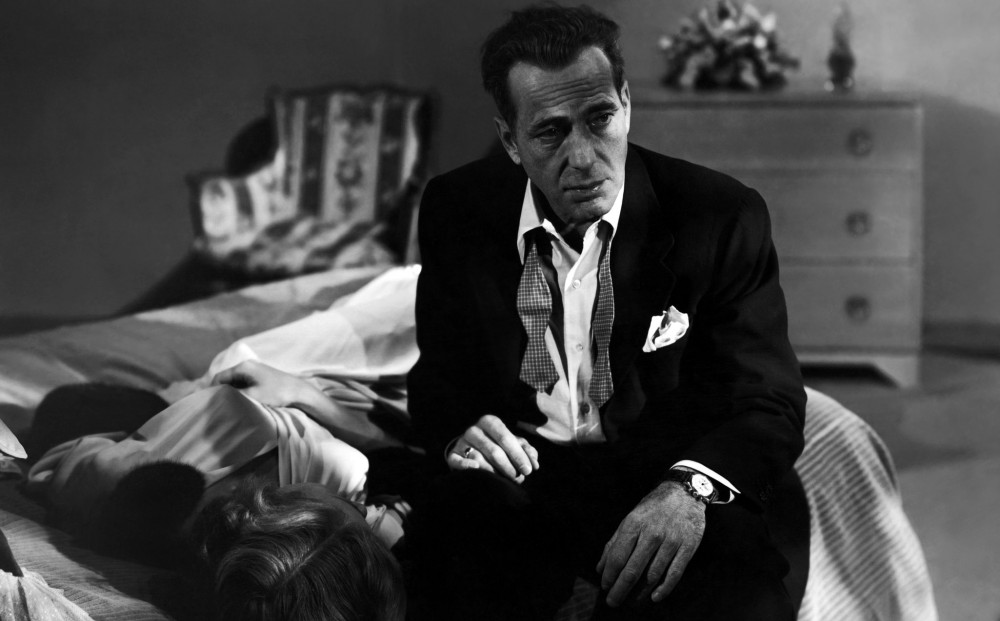
Friday's Old Fashioned: Deadline at Dawn (1946)


“Deadline at Dawn” refers to Navy sailor Alex Winkley (Bill Williams) on 24-hour leave in New York City who may or may not have killed Edna Bartelli (Lola Lane), after a night of drinking in her company leaves his memory hazy. Having until the sun comes up to prove his innocence, June Goffe (Susan Hayward) becomes his co-detective, her dance hall hostess job rendering her sympathetic to such obviously unfeigned helplessness. Based on a 1944 novel by Cornell Woolrich, Harold Clurman’s 1946 movie version sort of suggests Vincente Minelli’s “The Clock” (1945), in which a soldier (Robert Walker) on leave in NYC falls in love with a secretary (Judy Garland) and get married before he ships out again, filtered through a noir lens. That’s true up to a point, the nighttime setting heavy on shadowy streetscapes. Yet, even if “Deadline at Dawn” opens with and revolves around a murder, there is little in the way of genuine fear or suspicion. You sense world-weariness in June, especially in her introduction and Hayward’s faraway eyes, but Clurman ultimately opts for romanticism over existentialism, this version of Manhattan more akin to the Brooklyn of “Moonstruck,” a mosaic of lovesick fools, like the drunken baseball player (Joe Sawyer) outside Edna’s window and the sap in white gloves (Steven Geray) pining for June, not to mention Gus (Paul Lukas), the cabbie who chooses to help Alex and June rather than turn them in.

Lukas’s performance both does and does not work. The philosopher portion works, the Hungarian actor improbably throwing Victor Laszlo and Clarence the Angel in blender and mixing this cabbie cum philosopher. The problem, however, is that his wizened, noble, loving performance nullifies the idea that he’s capable of doing what he does, negating the big twist. At the same time, Williams’s overly polite air never convinces you he’s capable of murder in the first place, diffusing all sense of suspense. At the same time, he fails to project any of the supposed romantic spark toward Hayward or vice-versa. “Kid,” Hayward calls him more than once, suggesting she is something more like a surrogate mother. No, Alex exists more like a platonic vessel carrying all the emotional and moral failings of everyone else, and if they can just prove he didn’t do anything wrong, maybe once dawn comes, they, too, will start over as a blank slate.

Wednesday, May 17, 2023

Some Drivel On...Seinfeld's Finale

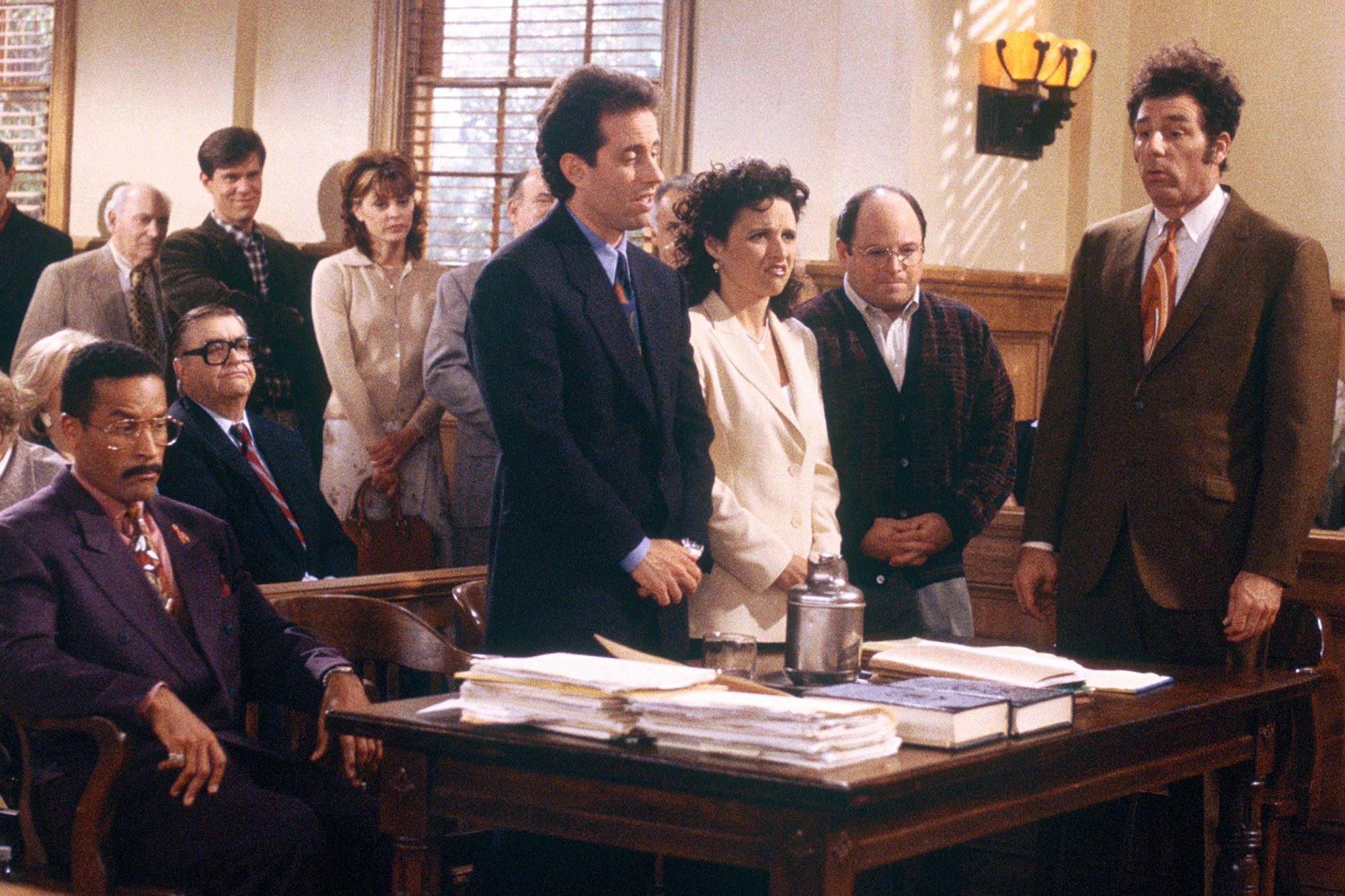
The “Seinfeld” finale in which Jerry (Jerry Seinfeld), George (Jason Alexander), Elaine (Julia Louis-Dreyfus), and Kramer (Michael Richards) go to prison after violating The Good Samaritan Law could never have been what we wanted – needed – it to be. That is partially because when it comes to television conclusions, “everybody writes their own finale in their own head,” as Seinfeld co-creator and head writer Larry David said in a 2014 interview, “and often they’re disappointed, because it’s not what they wrote.” But it is also because television endings typically involve ceremony, significance, and a kind of ultimate enlightenment whereas “Seinfeld” was a show all about the quotidian, and the trivial, and a famed No Hugging, No Learning aversion to epiphanies. “Newhart’s” finale from 1990 has long been considered a paragon of the form given its twist, the eponymous character waking up to discover the entire series was just a dream of the character in “The Bob Newhart Show” (1972-1978), uproarious if revealing, returning to the way it was, sending its viewers home in the glow of cozy nostalgia. You can imagine the May 14, 1998, audience of 76.3 million wishing the “Seinfeld” finale was all a dream too. Because it wasn’t, the conclusion, despite the high concept, felt abrasively real. Seinfeld once noted that there was “nothing really likable about (the characters) except that they remind you of yourself.” If these characters were, on some level, us, rather than feeling celebratory, we were made to feel...culpable?


Perhaps because of its polarizing legacy, I found myself thinking less of The Finale’s broader cultural impact as its 25th anniversary approached than, simply, the quality of the episode itself, one in which NBC deciding to resurrect the Jerry TV pilot of Season 4 prompts the gang to jubilantly spirit off to Paris, only for the private jet to make an emergency landing in small town Massachusetts where the quartet mocking a robbery in progress lands them in jail for failing to help and then in court where their longstanding antisocial predilections are literally put on trial. It’s important to remember that David had left “Seinfeld” as head writer two years earlier, that The Finale was his return, and that in the year before it he had been writing and directing his feature film debut, a harshly received comedy called “Sour Grapes” that was released in April 1998. Indeed, it’s noticeable just how much The Finale feels like a movie. 

For one thing, it runs an hour and fifteen minutes, an eternity for a sitcom, and contains a jarring amount of dead space, meaning moments and scenes that are strictly about advancing the plot. Those later seasons of “Seinfeld” often had a lot of plot but they tore through it at a galloping pace, always cognizant that humor came first. And though the conclusion’s most predominant move in bringing back a whole cavalcade of characters, from Babu to the Bubble Boy, wronged by our anti-heroic quartet to doom them is inspired, it also has the odd effect of repeatedly reducing our anti-heroic quartet to mere spectators in their biggest episode, fascinating in theory, but straining out considerable comedy in the practical application, leaving an episode that feels unbalanced.


It’s unfortunate because when the oversized Finale sweats the small stuff, it works to some degree. George angrily proclaiming that he’s “sick of health” when Jerry points out he’s still healthy is the one line from The Finale I’ve carried with me the last quarter-century while we are treated to the final few glorious bursts of Alexander and Seinfeld’s argumentative dynamic, both in the NBC offices and Jerry’s apartment where he lectures on the Laws of Peeing with the Bathroom Door Open. Elaine’s attempted cellphone calls to a friend in need at all the worst moments, meanwhile, is a funny thread that can’t help but lose a little gas simply on account of the episode’s length. (Kramer sort of comes across as an odd man out here, maybe because his storylines often involved harebrained schemes and the harebrained scheme here is the overarching A plot.) The Finale is never better, though, than the bookends.

It opens in the coffee shop where George’s sidesplitting skirmish with a woman (McNally Sagal, dry, really funny) in the booth behind him over her refusing to lend her table’s ketchup bottle foreshadows a fellow human refusing help as he, himself, and others, will refuse to help in just a little while. Even without what’s to come, however, this scene works in and of itself, evoking the society we live in, to paraphrase George in the legendary Chinese Restaurant episode, as crumbling, teetering. If there was an arc to the series, it was that the characters – George and Elaine in particular – seemed to get angrier as it went along, neurosis collapsing into bitterness, a sense of the characters wanting to break free from this 9-season cycle of suffering. (“I can’t spend the rest of my life coming into this stinking apartment every ten minutes,” Elaine confesses in Season 8, a line the incomparable Louis-Dreyfus imbued with genuine comic desperation, “to pore over the excruciating minutiae of every single daily event.”) In essence, that’s what the reboot of Jerry is meant to epitomize, breaking free from the cycle.

And while The Finale is sometimes an unsuccessful slog in seeing that anti-arc through, it’s what the end still suggests, the four characters in a holding cell that may as well be the coffee shop, still focusing on the trivial as they get set to endure their year-long sentence behind bars. That the show ends with a repeat of the first conversation from “The Seinfeld Chronicles” doesn’t feel lazy or even nostalgic, but crucial and pointedly cruel. Their cycle of suffering begins anew. 

Monday, May 15, 2023

Are You There, God? It’s Me, Margaret

When 11-year-old Margaret (Abby Ryder Forston) learns that she and her family are moving from the only home she has ever known in New York City to the New Jersey suburbs, she radios heaven. “Are you there, God?” Margaret asks, giving the movie its title as she proceeds to wonder if God might prevent this move to New Jersey, or if that’s too much trouble, to just ensure at New Jersey is not too terrible. It reminded me of myself at that age, quite honestly, not so much talking to a God you’re not even sure you believe in as broadcasting diary entries into the ether. Yet, if this moment evokes an essential universality, “Are You There, God? It’s Me, Margaret” is a story of pointed, refreshing specificity, of a teenage girl navigating her changing body without a road map. In way, Judy Blume’s 1970 book of the same name on which the movie is based became that road map, and director Kelly Fremon Craig honors both its timelessness and its candor by not updating the novel’s 1970 setting, suggesting things are the same as they ever were (the backdrop of our present-day book banning scourge from First Amendment con artists suggests this too), and a filmmaking style that in emphasizing the characters and their situations ensures the most prominent voice in “Are You There, God? It’s Me, Margaret” belongs, still, to Blume.


“Are You There, God? It’s Me, Margaret” begins with its eponymous character at summer camp, recounted swiftly in a blissful montage evoking the last flush of innocence before the overwhelming creep of doubt and insecurity. Then again, that doubt and insecurity does not creep up on Margaret so much as just get dropped in her lap before she’s barely off the camp bus, her mother Barbara (Rachel McAdams) advising of their impending move as they navigate by foot through traffic with luggage to her double-parked car, putting into perspective how Fremon Craig frequently employs situation to illuminate interiority. Margaret’s changing body, then, is yoked to her family’s move, meaning she must navigate two unknowns at once.

Almost as soon as Margaret walks in her New Jersey door, Nancy Wheeler (Elle Graham) from the down street asserts her presence. The introduction’s instantaneousness is acute, demonstrating how Nancy takes control of this new arrival, folding her into a clique even as Margaret eventually yearns to break free of it, growing disenchanted with their treatment of outsiders. That includes Laura Danker (Isol Young), ostracized because puberty has hit early, victimized by the very thing everybody wants, brutal irony as petty jealousy. At the same time, though, this clique functions as a safe space, even a kind of makeshift classroom, where they hunger for all the knowledge being strained out of their buttoned-up sex ed talks. The scene in which the quartet gathers around an adult magazine belonging to Margaret’s father Herb (Benny Safdie) feels like the version of the movie we’ve seen a thousand times flipped upside-down, girls trying to understand the reality of their own bodies through images of women’s bodies that have no basis in reality. 

If Margaret is adjusting, though, so, too, is Barbara, transitioning from art teacher in the city to PTA mom in the ‘burbs, volunteering for so many committees that she runs herself ragged. That this is not so much a subplot intertwined with Margaret’s main story as something akin to a parallel main story to Margaret’s is apropos, a mother struggling to define herself as something more than just that, crossing her own threshold when she finds the wherewithal to heroically just say no. McAdams’s performance is one to behold, expressing the internal anguish of emotionally struggling, echoing the slapdash nature of her furniture-less living room when she stands there opposite Nancy’s impeccably arranged mother (Kate MacCluggage), yet externally never failing to express the love and attention that Margaret needs.


Barbara has been essentially disowned by her strict Christian parents for marrying the Jewish Herb and as a result, mother and father have chosen to raise Margaret without religion, meaning the conversation she begins with God also starts something like a religion walkabout. She attends Temple, visits a Catholic confessional, even takes a turn at the Pentecostal service of a friend, never quite finding what she needs, confessing to God that she feels Him most when she’s alone, a line linking this journey to her own journey of self. Though Fremon Craig tends to tie bows on some narrative through-lines, like that of Laura Danker, who I wished the movie itself had looked at with a bit more curiosity than the Nancy Wheeler cadre, overall, “Are You There, God? It’s Me, Margaret” elides easy answers. Nature run its course, literally, a hero’s journey in which menstruation emerges as the elixir, the culmination of the quest, which feels as radical as its presentation on screen is matter of fact.

Friday, May 12, 2023

Friday's Old Fashioned: Criss Cross (1949)


Fate is typically noir’s foremost element, laying its dreaming or scheming characters low, regressing to the mean of a cruel, cruel world. It’s a cruel, cruel world in Robert Siodmak’s “Criss Cross” too, its plainly named protagonist Steve Thompson (Burt Lancaster) robbing the very armored car he drives to try and flee for greener pastures with his ex-wife Anna (Yvonne De Carlo). It goes about as well as you’d expect. The heist, though, pulled in tandem with Anna’s gangster husband Slim Dundee (Dan Duryea) feels less important to the flashback-heavy, hopscotching narrative than the way director Robert Siodmak and screenwriter Daniel Fuchs, working from a 1934 novel by Don Tracy, deconstruct the pull of fate. Back home in Los Angeles after wandering across the country in the wake of his divorce, Steve repeatedly tells us in voiceover that he hasn’t returned home to see Anna even as he seeks out their old haunts. And when he employs an analogy about getting cellophane stuck in one’s teeth to extract the apple that’s already stuck in one’s teeth, it sounds like nothing more than a daft man trying to write off his own daft actions as destiny.

Steve is that classic archetype of film noir, a sap, and it says something that the muscular, 6’2” Lancaster can so convincingly play one. The way his hair is styled in the very first scene, an illicit parking lot rendezvous with Anna makes him look younger, smaller, and Lancaster’s line readings alternate between clueless and persecuted. “You’ve got it all figured,” he says to his police buddy who’s only looking out for him that lets you know Steve hasn’t figured anything. His impending doom is magnificently amplified by De Carlo, a pantheon Femme Fatale, swooningly playful in demonstrating how Anna wraps Steve right around her finger and savage in how she reduces Steve to just a dumb box of rocks in the ultimate double cross, a turnabout made that much more painful by Lancaster’s virtual puppy dog helplessness.

De Carlo’s introduction is a dance duet (opposite an uncredited Tony Curtis) that Siodmak lingers over, a sizzling historical rebuttal to our pitifully chaste cinematic present, leaving you as smitten with her as Steve is while watching her from off to the side, a fish putting the hook in his own lip if there ever was one. It’s nearly as voyeuristic as that beginning parking lot rendezvous opening scene where, for a moment, De Carlo seems to look past Lancaster and right into the camera. I gasped. Like Steve, she’s got you.


Wednesday, May 10, 2023

In a Bleak Place


I have been reading Jeanine Basinger and Sam Wasson’s “Hollywood: The Oral History” in which they provide a full account of the motion picture industry exclusively through quotes culled from interviews with a wide range of actors and directors and producers and craftspeople down through the years. If there is one phrase most favored in the quotations of Silent and Golden Age players, it is this: “in those days.” I swear that someone must begin or end an anecdote with the phrase “in those days” at least 700 times. It means that so many of these observations are looking back on the past, infused with studio system nostalgia. It’s certainly true that the studio system was beneficial in terms of both producing quality movies and in providing a middle-class lifestyle for people who were not the stars. But pulled from the files of Two Things Can Be True at Once, management was just as stringent in dictating to labor what they could and could not do, who they could and could not work for, and a lof of people interviewed seem to have selective memories about why the studio system ultimately came apart. You might have thought that between then and now, labor and management would have found a way to peaceably co-exist, but if the arc of moral universe bends toward justice, the arc of the economic universe bends the other way. Planet Earth Laureate Bruce Springsteen had it nailed in 1978 when he sang “poor man wanna be rich, rich man wanna be king, and a king ain’t satisfied ‘til he rules everything.” Then again, really, at this point, in 2023, where everything costs more than ever and few hardly make more than they did when everything cost so much less, poor man, I think, just wants to be lower middle class. 

The Writers Guild of America, as you doubt know, has gone on strike. Cinema Romantico stands in solidarity with them. The WGA is making several demands, including staffing and wage requirements on account of their generally being overworked and underpaid, a similar ditch into which so many purported American Dreams have plunged in recent times. But the WGA is also asking for safeguards against emergent Artificial Intelligence technology being deployed to devise stories and scripts and potentially eliminate all their jobs. Oh, like so many I once had visions of the machines as our glorious deliverers of a post-work utopia where we would all be free to just read and write and sip coffee and stare into space and watch all the late-tipoff time Lakers/Warriors games because we wouldn’t need to get to bed early to get up early to get to our jobs to make the money to pay for the cable package needed to watch the Lakers/Warriors game in the first place. But for all the satisfying comforts and conveniences rendered by so much high-tech progress, no matter how many times some tech bro dismisses you as a Luddite for deigning to wonder if every single technological advance is truly for the better, it’s increasingly clear that technology and humanity are on divergent paths, professing it’s all in the name of a better, happier world even as it only exacerbates that economic divide. 

Indeed, if Hollywood bigwigs can put more money in their own pockets by implementing all-AI storytellers, they would do it in a heartbeat, and at present I suspect anyone mounting an AI is Art argument of being a management plant. To them, art is Robert McKee’s Story fed through a computer, not something to study and evaluate and create, not something in conversation with itself through the years (decades) [centuries], not something that helps explain us, but art as an end result, as one more thing that can be done via algorithm. Not that management has ever really cared that much about art, of course. In Michael Schulman’s New Yorker piece on the writer strike he quoted Lila Byock, who has written for television’s “The Leftovers” and “Watchmen” among others, as saying “What the streamers want most right now is ‘second-screen content,’ where you can be on your phone while it’s on.” You want to stick to the sunny side of the street, but what is a statement like if that not two gloomy, rain-drenched sidewalks leading nowhere? 

This all made me remember my Monet-hating friend from Manhattan, an art student with the bravery to critically consider art. It made me already feel nostalgic (“In those days, we made the art ourselves”) for when my movie critiques would elicit protestations of nitpicking, that I was taking movies too seriously, that movies are about escape, man, and it made me imagine a future where people only watch movies on second screens while paying real watching Tik-Tok or playing Candy Crush on first screens and then skim my review on the last blogspot of whatever movie was on their second screen and excoriate me for watching the movie (on my first screen) at all. 

Monday, May 08, 2023

Ghosted


Cinema, pardon me, Movies, pardon me, Streaming Content, might be about spending time in the company of Beautiful People, and Ana de Armas and Chris Evans might officially be Beautiful People (a ceremony that typically takes place in a backroom at the Met Gala), but this is true only up to a point. That beauty needs to sizzle on (your TV) screen, or that beauty needs to be turned upside down, or preferably, both need to happen. Dexter Fletcher’s Apple TV+ “Ghosted” achieves neither as farmer’s market denizen Cole (Evans) and Sadie (de Armas), a CIA agent posing as an art curator, fall in and out of and back in love while on the run from bad guys and in search of a MacGuffin that’s somehow even a notch below “Knight and Day’s” (2010) not-fabled Zephyr. “Ghosted” suggests last year’s “The Lost City,” which itself deliberately suggested “Romancing the Stone” (which looks more and more looks like a five-mic masterpiece with every passing year), but if the Brad Pitt and Sandra Bullock characters were the principals and their genders reversed. Yet if that movie was far from very good, never mind perfect, it at least conveyed its wackadoodle plot with some twinkly enthusiasm and evinced a screwball energy in its performances, two qualities that “Ghosted” conspicuously lacks and which, as much as anything, dooms its nigh two-hour running time to the watch-while-folding-laundry pile.

Chris Rock once observed that on a first date you were not meeting a person, you were meeting a person’s representative. That’s never been truer than “Ghosted” and yet rather than taking advantage of the golden metaphor contained within their own screenplay to explore such dating false fronts, the cavalcade of four writers ultimately opts for a more rote approach by tying Sadie’s relationship struggles to the loss of her mother and Cole’s to his clingy over eagerness. The former never takes flight, too earnest given the surreal context and never provided enough room to breathe for all that’s going on, while the latter suffers because Evans’s performance never emits any of the mania written into the character. (The notion of his stalking her across the Atlantic, meanwhile, is mostly elided rather than dealt with a la “There’s Something About Mary.”) If neither character quite works on their own, they are equally ineffective together, whether bickering or besotted, de Armas and Evans evincing no undercurrent of sexual crackle in either situation, such crackle being this kind of movie’s raison d’etre. Even when their characters are briefly marooned on a deserted island in the Arabian Sea, they are shot to look like air conditioning is at full blast. They’re Beautiful People; let them sweat ‘til they bleed! It’s telling how many times other characters explicitly comment on their supposed sexual energy, as if attempting to will it on behalf of a director that can’t find a way to muster it on his own, evocative of a movie that just wants the audience to accept what’s supposed to be as opposed to manufacturing it, further epitomized in the occasional big-name cameos that have no reason to exist beyond sleight of hand; look at these famous faces, never mind nothing is really here.

If there’s a cameo that works, it’s Tim Blake Nelson as the villainous Borislov, who prefers torture via insect, a character that feels baked in rather than simply about the person playing the part. Then again, he gets moved aside early, paving the way for the even more villainous Adrien Brody, whose slimy visage is never utilized in any amusing way, the sequences among bad guys all strangely straight-faced and at frustrating odds with the nominal comedy. There are some action set-pieces born of good ideas, whether a car chase by bus or a revolving restaurant moving at high speed, but none madcap enough in their rendering to be funny, none stylishly enough composed to be thrilling. It epitomizes an action slash adventure slash romantic comedy movie that in failing to meld these tones together comes across entirely muddled, taking red, yellow, and blue and running them through the moviemaking wash so that “Ghosted” comes out just one more indistinct Hollywood grey.

Friday, May 05, 2023

Some Drivel On...Jack and LeBron


The further I get from “Once Upon a Time… in Hollywood” (2019), the more I think it’s my favorite Quentin Tarantino movie, the one in which he most successfully transforms his preferred method of pastiche and self-awareness into something less gloating than moving. I’m 45, after all, halfway between 40 and 50, halfway home altogether, and OUTH is about the passage of time, told through the fading twilight of a friendship between an actor and a stuntman (Leonardo DiCaprio and Brad Pitt, respectively), of each man’s career, and of the 1960s. This is all brought home in a late movie montage in which Q.T. repurposes The Rolling Stones’ baroque slice of go-away-girl pop “Out of Time” as a goodbye to Hollywood, one that probably never even existed except in the minds of those of us who didn’t live through it, elevating that Hollywood into myth through the fantastical conclusion, suspended in “a beautiful lie,” to quote Carol (Christine Baranski) of another ode to La La Land, “Bowfinger.” If it was pure coincidence that Tarantino’s last joint was released the same summer as Bruce Springsteen’s nineteenth studio album, it proved cosmically befitting given just how exquisitely that fantastical conclusion lived out Springsteen’s title track: “the western stars are shining bright again.” For one night, at least.

--------------- 

After the most recent Academy Awards, there was a lot of talk about a conspicuous vacuum of star power that could not be filled, rendering Hollywood’s ostensible biggest night as less radiant than ever, a troubling metaphor for the whole industry. The Oscar telecasts I grew up on almost always seated Jack Nicholson right down front, and when the hosts ribbed him, it was acknowledging him as the real star of the show, to the Academy Awards as Mickey Mouse is to Disneyland. He watched the Oscars like he watched the Los Angeles Lakers, faithfully, from his courtside seat, “grin(ning) at the TV camera,” to quote Roger Ebert, “as if he expected the players to commit lascivious deeds right there on the floor.” Jack, however, relinquished his first pew at the Academy Awards a while ago, just as he mostly stopped attending Lakers games since the COVID-19 Pandemic. His courtside seat at the Staples Center Crypto.com Arena might have been generally occupied by someone else, but just like the Oscars, you could feel the void.


Nicholson has not made a movie since 2010 and there was some hullabaloo recently when some sleazy tabloid proffered images of the 85-year-old Nicholson, seemingly having just woken up and standing on a balcony. The reaction was disheartening. Disheveled and unrecognizable were a couple of the adjectives used to describe him and I mean, the dude can’t be unrecognizable, can he, if your dumbass headline says he’s Jack Nicholson and who among us, 85 or 15, doesn’t look disheveled in the damn morning. This went hand in hand with rumors about his mental state that seemed strictly that, rumors, and so which we will not dignify by repeating here.

It made me think about last September when I exited Wintrust Arena in downtown Chicago after my beloved Sky had lost a heartbreaker that would have sent them back to the WNBA Finals to try and repeat as champion. Candace Parker, their straw that stirred the drink, had not played well, not least because her coach failed to properly pace the 37-year-old’s minutes, leaving her palpably exhausted come crunch time. Walking home after the game, two teenage girls in front of me talked trash for must have been five minutes straight about Parker’s underwhelming performance.” Kids,” I wanted to pull them aside and lecture, “she’s a 37-year-old with bad knees who just played her third game in five days. Someday, believe me, you will understand.” You think you have all the time in the world, until suddenly, you don’t.

---------------


Though sports are innately a physical pursuit, professional sports often get bogged down in narrative, as LeBron James has, from future king to King to villain to prodigal son, etc., and I confess, from time to time, I could let those surrounding narratives dictate how I felt about him too, failing to grasp the fundamental truth of his athletic transcendence. My moment of clarity was the three-quarter-court bounce pass he unfurled to Kevin Durant in a preliminary game against France at the 2012 London Olympics, which fully embodied both the tangible and the abstract of LeBron, his incredible strength and acute vision and the awe invoked when he harnessed those skills. It’s the kind of raw athleticism that simply can’t last forever, and as his reign over the NBA has ineffably ended in the intervening 11 years, those overpowering moments of physical wonder waned. It’s what his made his Los Angeles Lakers first round Western Conference playoff series matchup with the Memphis Grizzlies so compelling, the latter led by Ja Morant, whose recklessly spectacular style of play demonstrates a blithe indifference to consequences encapsulating the kind of youth once possessed by a LeBron who has now re-engineered his game to fit his age, leaning heavily on smarts and savvy, on knowing his body, when to go hard, when to rest. The Lakers won, crushing the Grizzlies in Game 6 by a cool 40. Age before beauty, goat cheese, indeed.

---------------

It’s not mine to say why Jack Nicholson chose to show up at Staples Center Crypto.com Arena for Game 6, whether it was to put himself out there in public after the balcony photos or just for the chance to see his beloved Lakers close out the Grizz, but there he was. Jack is probably the one person in the world who could have walked right on the court and over to LeBron, but even LeBron knows who comes first in Hollywoodland and so he walked over to Jack, the two men half-embracing, chatting for a bit before the game commenced. LeBron entered the league in 2003, the same year Jack was last nominated for an Oscar, and now it was 20 years later, both men approaching the end in different ways, and I couldn’t help but notice that Nicholson wasn’t wearing his trademark shades. Maybe the future isn’t always so bright, but maybe that makes the present even more vivid.

Here’s to the cowboys, and the riders in the whirlwind / 
Tonight the western stars are shining bright again


Tuesday, May 02, 2023

Nothing Works Anymore

In September 2021 when most everyone in America wanted to pretend the still-raging COVID-19 Pandemic was over, AMC commissioned a $25 million advertising campaign to help spur people back to movie theaters, headlined by a minute-long Nicole Kidman-starring spot in which she rhapsodized about the movie-going experience, a spot that became ironically beloved and is still running before movies. It was somehow both an inadvertent parody of over-the-top inspirational ads and an improbable transcending of them, probably because Nicole Kidman alone could send up a cult leader while simultaneously making it feel as if you had just joined her cult in spite of yourself. “AMC Theatres,” the end credit declares, “We Make Movies Better.” I love the movie-going experience as much as anyone – maybe more than most – but still I have to ask, AMC, do you?


This past weekend was a two-movie weekend. I love two-movie weekends! And yet. Both movies were at the New City 14, formerly an ArcLight, but now an AMC. At our Saturday afternoon showing of “Showing Up,” which we attended with friends, the house lights were so low that My Beautiful, Perspicacious Wife used the flashlight on her phone so we could find our assigned seats. (Other patrons who entered after did the same.) As the Nicole Kidman AMC ad eventually cued up and she strode inside the theater up there on the screen wearing heels, explaining “We come to this place for magic,” My Beautiful, Perspicacious Wife leaned over to me and whispered something to the effect of, If she came into this theater in those heels, she would have tripped and fallen flat on her face. 

After the movie, I availed myself of the men’s lavatory, as did my friend Chad, where we discovered all the urinals – literally all of the urinals – were out of service, cordoned off by stanchions and rope. As we exited back into the lobby, Chad said to me, “Have you noticed that ever since The Pandemic nothing works anymore?”

The next afternoon My Beautiful Perspicacious Wife and I returned to the New City 14 for a showing of “Are You There, God? It’s Me, Margaret.” I once again availed myself of the men’s lavatory and once again all the urinals were cordoned off. Once again, we used the flashlights on our phones to find our assigned seats because the house lights were too low (it’s also worth noting the image of “Are You There, God? It’s Me, Margaret” projected on screen was shockingly, unacceptably dim itself), stepping in puddles of spilled, sticky soda on the floor along the way, and discovered that my seat was partially covered in...well, I honestly don’t know what. It was something gross, that’s for sure, something crusted over, that had apparently missed by the overnight cleaning crew? If an overnight cleaning crew exists? That had been there since opening night of “Jurassic World Dominion?” We tried to sit in other seats, but the showing was essentially sold out and eventually I wound up back in my original one, throwing my coat over the God-knows-what, sitting down, and trying to put it out of my mind. “Are you there, God?” I thought to myself. “It’s me, Nick. WTF, Dude?”

Saturday Night Live parodied the Nicole Kidman ad last year, amplifying the cultlike quality, and fair enough, but I’m imagining a different lampoon. “We come to this place,” Kidman says as she opens the door to the lobby and steps right in spilled soda mixed with spilled commercial frozen drink machine pina colada, ruining her pricey heels, “to step into the unknown.” “We come to AMC theaters,” she continues as she enters the restroom to discover an out of order sign hung on all eight stall doors, “to hold it for two straight hours.” She enters the theater, can’t see her seat because it’s too dark, trips and falls flat on her face. “To require emergency dental surgery immediately after our show,” she says. She reaches her seat and plops right down in vomit. “To ruin our pants,” she says through a bloody, suddenly toothless smile.

“AMC Theatres. Where Nothing Works Anymore.”  


Monday, May 01, 2023

Somebody I Used to Know


The Somebody that Ally (Alison Brie) used to know is Sean (Jay Ellis), an old boyfriend from her hometown of Leavenworth, Washington whom she left to purse big dreams of making documentary movies in Los Angeles. Those docs became reality shows instead, namely some horrifying entity called Dessert Island, on which we see her interviewing a contestant as the movie opens, putting into perspective how her character has a gift for manipulation, underscored in Brie’s countenance throughout this sequence, hardly moving but eager in the eyes, which almost seem to guide this dupe into saying what she wants. The show gets kicked to the curb, though, and Ally returns home where she runs into Sean and falls in love with him all over again only to learn he is not only engaged to musician Cassidy (Kiersey Clemons) but their marriage is this weekend(!). Rather than step inside, she gets involved, agreeing to document the wedding weekend as a means to break it up.

If it all sounds a bit like “My Best Friend’s Wedding,” hey, this is post-modern Hollywood, where that reference is explicitly made rather than simply embodied in the script that Brie and her husband, director Dave Franco, wrote together. There’s a similar sensation to that Julia Roberts/Cameron Diaz-starring 1997 rom com, true, especially in how the movie never entirely writes off Cassidy, but there’s some “Young Adult,” the Jason Reitman/Diablo Cody 2011 joint in which Charlize Theron’s monstrous writer returns home and rather than learning something new, finds her own monstrous behavior validated, almost elevated into myth. There’s a narcissistic monster lurking within Ally, that’s for sure, and though Brie is just fine in the movie’s breezy comedy scenes, like a long shot in which her character hides under a booth when Sean first spies her from across a bar, she truly comes alive in how she lets charm and malicious intent just sort of bleed into one another, where her frequent laugh shades into something devilish. You sense how people might be fooled by her even as you sense how she might be willing to take things too far. We return to that opening interview in our minds every time Ally is with Sean.

Ally’s increasing determination to blow up the nuptials, and her scenes with Danny Pudi’s smart-aleck friend of the couple, suggest a burgeoning black comedy, though the further “Somebody I Used to Know” goes, the less comic it gets and the more serious it becomes. This isn’t all bad. It ventures deeper into the emotional weeds than you might suspect, finding three people more emotionally confused than the initial Hallmark small town machinations would suggest. Yet, even if the script allows Cassidy to become a more developed character, a scene in which she and the members of her band look suspiciously at Ally from afar is telling, one of the only times we see her character through her own eyes rather than through the eyes of Ally. That’s because it’s Ally’s movie, in a way, and Brie’s too, even as the racial dynamics innately make this uncomfortable. That they’re never acknowledged only makes it more so, coming across like it wants to be a win for inclusivity but never truly seeing that a white woman as guiding light, only made ironic by a conclusion meant to emblemize stripping down even while wearing metaphorical blinders.