' ' Cinema Romantico: 1995
Showing posts with label 1995. Show all posts

Thursday, December 31, 2015

Wistfully '95: Heat

Since I could finally both drive and get into R-rated movies in 1995, it doubled as the year in which I fell head over heels in love for the experience of Going To The Movies. And so, here in the future in 2015, we will periodically re-visit a handful of the offerings to which I first paid homage in various multiplex cathedrals of Des Moines, Iowa. 

---------- 

A semi truck resting beneath a freeway overpass barrels out from its hiding spot, directly toward an unsuspecting armored car that has stopped in the middle of the road for a stolen ambulance. The semi truck rams the armored car and sends it toppling onto its side and skidding into a line of cars at a nearby dealership. Finally, the armored car comes to a stop and as it does the festive blue ribbon that had been displayed above the gleaming automobiles softly falls to the cement. That’s the moment. The ribbon falling ever so softly. People are about to get shot, bearer bonds are about to be stolen and, of course, an armored car just got jacked up, but Michael Mann, writer and director, still pays attention to the tiniest of details, over and over, throughout, the way one seemingly random word can mean all the difference, the way a pair of sunglasses removed translates that someone is not to be trifled with, the way Val Kilmer looks at the explosives salesman in the almost-opening scene that implicitly communicates he is not on the up and up, and turns them into poetry. None of his contemporaries and few of his predecessors, if I may be so bold, capture the intimate, intricate details quite like Mann, nor shape their stories so not even the slightest indispensable stroke is missing. Is it any wonder then that “Heat”, this sprawling saga of Cops and Robbers, focuses on two protagonists who are obsessed with the details?


The Robber is Neil McCauley (Robert DeNiro) whose attitudes toward female companionship and home furniture are identical (“When I get around to it”). He sees mostly everything, misses much of nothing, and adheres to a rigorous personal code so infamous that the James Franco character in “Date Night” actually quoted it. Neil can be gentlemanly, so gentlemanly that in the midst of a robbery he declares “We want to hurt no one”, but he can he also be ruthless, so ruthless that only seconds after proclaiming they want to hurt no one he smashes a bank employee’s jaw. The Cop is Vincent Hanna, demonstrative, a bit vulgar, compulsive gum chewer, played by Al Pacino so bewilderingly full tilt that his character could have only been addicted to cocaine (which he was, until Mann deleted the scene and left Pacino hung out to dry as an over-actor he would not truly become until later), passing his third wife Justine (Diane Venora) on the “downslope” of their marriage partly because he says – actually says to his wife – that he needs his angst.


McCauley’s crew is high-tech and tight-knit but admits a fifth man for the armored car take down that does not go down quite right and results in three murders that results in Hanna and his team taking the case. They seem nearly as high-tech and tight-knit and just as obsessive which, of course, yields an epic tug-of-war. In one breathless passage of time about an hour in, the film reverses its tracks three times. As Hanna closes in on his target to make the bust of the century one minor slip-up causes McCauley to pull the plug on a particular heist – leading to the most dramatic face off in cinematic history in which the two men facing off are not in the same room – which reverses when McCauley and crew cleverly unmask the identity of their pursuers which reverses when Hanna tracks down McCauley on the L.A. freeway and asks, gun nestled firmly in hand, in that memorable Pacino-an, “What do ya say I buy ya a cup of coffee?”

From the opening credits revealing the actors’ names the audience knows all along that Cop and Robber must come face to face, not simply because they are Cop and Robber but because they are Pacino and DeNiro, perhaps the two greatest actors of their era (and at the time of the film’s release not recognized as the ex-heavyweight champs they are now), and this is the first time they had ever shared the screen in the same film. Mann sets the scene in an entirely ordinary coffee shop because, as he would explain, there could be nothing to distract from the simple fact these two were squaring off on the cinematic hardwood. And it is spellbinding, both in acting and in writing and in the way the larger message becomes apparent, the fact that these two men are the same and need one another as badly as they need to eliminate one another.

But what might most be telling about this unforgettable passage is that while just about any other filmmaker, established or not, Oscar winner or never nominated, would have made it the point, the whole point and nothing but the point, Michael Mann presents it as but one more detail – however monumental – in the narrative. For such two larger-than-life figures at the core, “Heat” is about so much more than just hard-headed guys on the prowl.


McCauley’s crew includes Chris Shiherlis (Val Kilmer), a gambling junkie, married to Charlene (Ashley Judd), who have a young son, Dominic, who at times, sadly, disturbingly, seems more like a chip on a gaming table than an actual living, breathing human being. Their first scene transitions, jarringly, from lovey-dovey to full-blown argument as Chris breaks household items just to break household items and storms out. But in his next scene with McCauley, functioning as mentor, Chris says, quietly but firmly, in those of those majestic Mann lines that is age-old but so relevant: “For me the sun rises and sets with her, man.” And that’s it. That’s all we need to know. That’s why in the end, after it’s all gone terribly wrong, after he has a chance to make a clean escape, Chris goes after Charlene anyway, which leads to Charlene on a balcony and, in an instant, even after all the shit he’s put her through, waving Chris away. It’s an astonishing moment, one content with emotional truth versus logical (all that law enforcement and they can’t nab him?); it’s also miniscule, barely there, wouldn’t even register to most guys wearing the headphones and watching the dailies and sending interns for lattes, but in “Heat” this lone wave of the hand, coupled with Judd’s and Kilmer's expressive pain, wrenches your gut like real life.

Michael Churrido (Tom Sizemore) might be the most emblematic at all, the endless ex-con, in and out of prison, who has settled into the most normal life possible under the guidance of McCauley, finding a potential wife with a couple kids he seems to love, putting away money, but upon finding himself with a chance to walk away – in Sizemore’s 30 greatest seconds of screen time ‘ever’, including everything in Saving Private Ryan – declaring instead, “For me, the action is the juice.”

Is the action the juice for McCauley? Well, he does finally get around to female companionship when he hooks up with the polite but incredibly shy Eady (Amy Brenneman) who approaches him at a coffee shop, trying to Meet Cute with him even though, in her own words, “I’m not very good at meeting people.” They make a strange but strangely appealing couple, two kindred spirits in the terrifying realm of lonliness, a fact which will eventually pit McCauley one on one with his personal code.

Even then there are two more characters perhaps generally described as minor, or even extraneous, who are anything but. Don Breeman (Dennis Haysbert) is another ex-con, out on parole and taking a job as a line cook for a thankless, crooked taskmaster (Bud Cort) whose connection to the rest of the film’s mammoth story seems uncertain but will eventually fall into place. This subplot could have been forced, existing solely out of necessity, but instead in a manner of four scenes becomes a full-fledged, tragic arc that crystallizes Who We Are is What We Will Always Be and comes to a head in a sequence with no music score between Haysbert and DeNiro – “One answer. Right now. Yes or no.” – in which the camera captures a multitude of angles of the two men as it all hangs in the balance. A nothing moment becomes absolutely everything.

And then there is Lauren Gustafson (Natalie Portman), Justine’s teenage daughter, the Alice Munro of “Heat”, needy and edgy, primarily because she is neglected by her real father, who we never see, as well as neglected by Justine and by Vincent, too, as she sinks further and further into this abyss no one seems to recognize is there until her stepfather sees her sitting all alone on a bus bench in the middle of nowhere, rocking back and forth, and picks her up. The expression on Pacino’s face is only for a second but in that second we realize he is the only one able to recognize what is going and what might be about to happen except, of course, all he has is “what I’m going after” and Lauren is forgotten until it is nearly too late.

Yes, yes, yes, Hanna and McCauley will stalk each other with guns (notice how Mann’s script makes mention of the hotel as being the Airport Marquis – details, details, details), yet I can’t help but feel there is so much more to that climactic moment of the Conqueror taking the Vanquished’s hand as the stately music score swells. He got what he was going after but you hope and pray that what he’s really thinking of is that little girl back at the hospital who might survive but still needs help to live and, thus, that when he lets go of the other guy’s hand maybe, just maybe, he will let go of his angst, too.


Eleven years after “Heat” Michael Mann made the cinematic version of “Miami Vice” and in it there is a shot where the Colin Farrell character, a vice detective on the verge of going undercover, and his associates are talking with an informant and as they do, Farrell, briefly, looks out the informant’s condo window at the ocean which is just out there, you know, being the ocean. His eyes narrow as if he’s looking really hard at something and then he turns away.

In “Heat” there is a shot where McCauley, after he has met with his main man (Jon Voight, Method to the max), returns home and goes to the window and the camera focuses, intensely, on the right side of his face before the focus flips and we realize he is staring out at the ocean which is just out there, you know, being the ocean. Essentially it is the same shot in two different films. What’s out there? What do they see? I don’t think we’re meant to know. I think it’s something we can’t see, something we could never hope to see, something we wouldn’t understand if we could see.

I think it’s something only Michael Mann can see.

Friday, December 18, 2015

Wistfully '95: Leaving Las Vegas

Since I could finally both drive and get into R-rated movies in 1995, it doubled as the year in which I fell head over heels in love for the experience of Going To The Movies. And so, here in the future in 2015, we will periodically re-visit a handful of the offerings to which I first paid homage in various multiplex cathedrals of Des Moines, Iowa.

----------

Though alcoholism is a serious disease, its portrayal at the movies is often treacly, where life-threatening drinking problems can be cured in the space of a montage (“Crazy Heart”) or worse. “It’s all wonderfully romantic, especially in the movies,” the late great Roger Ebert wrote of the silver screen alcoholism, “where a little groaning in the morning replaces nausea, headaches, killer hangovers and panic attacks.” Of course, Mr. Ebert was rather famously an alcoholic, one who stopped drinking in 1979, as he outlined in his invaluable piece in the last years of his life. Mr. Ebert also was a great champion of Mike Figgis’ 1995 film about an alcoholic who drinks himself to death, “Leaving Las Vegas.” He called it a “masterpiece.” He named it the best film of 1995. Perhaps I’m overstepping my bounds but it’s not difficult to wonder if Mr. Ebert saw in “Leaving Las Vegas”, in the plight of Nicolas Cage’s Ben, a road (thankfully) not taken. “Most alcoholics continue to drink as long as they can,” Ebert wrote. “For many, that means death. Unlike drugs in most cases, alcohol allows you to continue your addiction for what's left of your life, barring an accident. The lucky ones find their bottom, and surrender.” Ben does find his bottom and he does surrender, though the waving of his white flag takes a different form.


After a table-setting sequence in Los Angeles, Ben comes to Las Vegas with the express mission of drinking himself to death. And the film does not skimp on this mission. He gets the shakes, hallucinates, injures and embarrasses himself, the whole nine yards. And the Vegas of Figgis’s film is not the tourist’s life; it’s the seedy side. Not the underbelly, mind you, but the side, like you feel as if the camera is always catching everything in Sin City that you’d be seeing just around corner or down that alley where you don’t want to look. The soundtrack underscores this vibe. Perhaps the saxophone sounds cheesy, even dated to 2015 ears, but that’s just right. No high-priced soundtrack would do; this is the soundtrack of a beggar on the corner playing jazz for your nickels.

Yet as dark as all that sounds, as realistic as its portrayal of an alcoholic’s descent is, there is a strange romantic grandeur. Ben, understand, is not romanticized, but the film also wishes to at least look toward the sunny side of the street from the dark side across the way. When Ben arrives at his hotel, it’s not the MGM Grand, it’s The Hole You’re In, and as he reads the sign and figures out the pun, he smiles. He sees the humor in it. He sees the humor in life. Cage acknowledges the complications in his character. There are moments in this film when you catch a glimpse of the Ben he most likely once was; kind, even charming. When he’s fired his boss, you can tell his boss likes him, feels sorry for him, but has no choice. Perhaps he knows Ben needs help but perhaps he knows Ben is long past the point of help. It’s time to step aside.

The story turns when he meets Sera. She’s a hooker, though her heart is not exactly woven from gold. It is battered and bruised even if, in periodic conversations throughout the film with a therapist (never seen), she cops to a good feeling from her profession, a feeling of control. Of course, she is also controlled by her pimp (Julian Sands), who is smartly moved out of the picture, as she enters Ben’s life, first accidentally and then deliberately. She comes to care for him but she’s not there just to take care of him. She’s granted her own off screen life, one that unintentionally merges with Ben’s, as if by divine intervention. Maybe it is as she transforms into an approximation of an angel called upon to watch over him, to meet him on his earthly departure. That might sound maudlin, but it’s not, the film never pandering, because its characters never pander, because they look one another in the eye and embrace their respective realities, which is a helluva lot more than you can say about a lotta people who likely fancy themselves more in touch than these two.


If movies often revolve around identity, finding it, losing it, changing it, re-claiming it, there is little in the way of an Identity Crisis in “Leaving Las Vegas.” These two people are who they are, entirely accepting of the other person’s flaws, uninterested in forcing the other to correct those flaws. Movies, of course, are not ordinarily meant to be this way because movies are supposed to chronicle some perceptible change in their characters. But that's only because so many movie characters are engaged in some sort of self-deception. “Leaving Las Vegas”, bless its soul, is a movie where no one engages in self-deception. The only moment when that does not hold true is Sera asking Ben to stop drinking. But look at the sorrowful way Shue plays the scene, and listen to the meekness in her voice when she makes the plea; she knows she's lying to herself by asking, and yet she asks anyway. And because she grasps her willful, and useless, delusion, it becomes the movie's most tragic moment.

Of course, if there is no change then that means we are simply watching an alcoholic waste away with a hooker at his side. And this is true. It's a slow descent into death, a fulfilling of Ben's quest, the anti-hero's journey. It's not easy to watch, but it's also affecting to watch, if only because in coming together Ben and Sera find, as Ebert noted, “a measure of grace” in one another. In its own weird, twisted, fascinating, beautiful way, it's as moving an explication of selflessness as a motion picture has ever captured.

That's not to say these people are good people, in a traditional sense. They have made bad decisions, perhaps, a bounty of them, but “Leaving Las Vegas” understands the difference between those decisions and their innate human nature. It sees past their respective trails of destruction without denying or softening what they have done, and, by the end, that familiar glow has nothing to do with sin city neon and everything to do with the fractured light of Ben and Sera's souls.

Tuesday, September 29, 2015

Wistfully '95: Devil in a Blue Dress

Since I could finally both drive and get into R-rated movies in 1995, it doubled as the year in which I fell head over heels in love for the experience of Going To The Movies. And so, here in the future in 2015, we will periodically re-visit a handful of the offerings to which I first paid homage in various multiplex cathedrals of Des Moines, Iowa. 

----------

“It was December 1948 and I needed money.” This is how Ezekiel “Easy” Rawlins (Denzel Washington) introduces himself. “Devil in the Blue Dress” might be noir and Easy might be its main character, but he’s no archetypal hard-boiled gumshoe; he’s just a working stiff gone unemployed, hard up for cash to keep his house. Heroes of noir are usually pulled in by the tentacles of fate, or the irresistible winsomeness of the femme fatale. Easy Rawlins, on the other hand, is pulled into the requisite web of criminal duplicitousness all on account of his mortgage.


In a sense, Easy’s house is the femme fatale of “Devil in a Blue Dress”; the abode fatale. “Man, did I like coming home to my house,” he says in voiceover, the joy in his voice palpable. To him, it’s the American Dream, the one he was promised when he came home from the war and left Texas for California to take a job in an aircraft plant. Throughout the film director Carl Franklin and his cinematographer, the as-ever impeccable Tak Fujimoto, mute the film’s color, rendering a sort of sepia-toned palette, a twist on noir’s traditional black and white. Yet the occasional frames of Easy’s house are spectacularly sun-kissed, an almost postcard paradise. When the villain turns up there unannounced it’s not just another Sudden Bad Guy Appearance; it counts for something because this is Easy’s castle and the walls have been breached.

The Bad Guy is DeWitt Albright (Tom Sizemore), a white guy with an Errol Flynn moustache, who hires Easy to find a girl with the mellifluous name of Daphne Monet (Jennifer Beals), the squeeze of the Los Angeles Mayor, Todd Carter (Terry Kinney), who’s up for re-election. Franklin has Easy sit on a bar stool while he accepts the job and keeps DeWitt on his feet. This is no accident. The White Man towering over the Black Man; the Black Man forced to accept the White Man’s faux-charity to pay the rent. This is the noticeable line of segregation throughout “Devil in a Blue Dress.” It’s a line Easy has to cross more than once, dealing with crooked police and corrupt politicians, though the film is careful never to portray him as a racial crusader, though it’s also careful to ensure we understand that the final shot of Easy and DeWitt is a reverse image of the first.

Politics is never much the point in “Devil in a Blue Dress”, at least not politics in terms of policy and genuine back and forth debate regarding issues. No, politics boils down to “dirt”, and each candidate has something nefarious on the other. Carter’s opponent, Matthew Terrell (Maury Chaykin), for whom DeWitt is actually working, is a pedophile and a smattering of photos everybody wants can prove it. Daphne Monet has these photos, or she did, until she gave them to someone else for safekeeping. DeWitt needs to find Daphne to find these photos. And Carter’s potential downfall is Daphne – namely, the secret she holds, the secret embodied in Beals’ performance.

The acting is uniformly top-notch in “Devil in a Blue Dress.” Washington’s world-weariness isn’t the sort of gravelly fatalism popularized by Bogey and Mitchum. “A chill running up the back of my neck,” he says like a man who’s saying it more literally than figuratively. He’s genuinely surprised the deeper he wades into things and overcome by resentment and anger. He’s so on the level, in fact, that he’s nearly over-shadowed by Don Cheadle as his back-in-Texas pal Mouse Alexander, sort of the Doc Holliday to his Wyatt Earp. That, I imagine, is why Mouse is hardly in the film; showing up when Easy is truly facing hard times and needs a little muscle (and a gun) and then moving on when his presence threatens to overwhelm Easy’s.


Beals was often dismissed in evaluations of the film, dismissals I’ve never understood. She plays the part with a perpetual tremble, her lips incessantly teeter-tottering between a seductive smile and quivering panic. You half expect her omnipresent cigarette smoke would be enough to knock her over. She is a woman sitting on a secret she’s desperate to conceal. And in Carter’s case she very much is the requisite femme fatale, given that the obligatory twist involves her heritage, born to a white father and a Creole mother. A relationship with a half African-American in 1948 can mean Carter’s election end and is why she walks even as she waits around to see if he’ll change his mind. He doesn’t, of course, because he can’t. This also marks Daphne more as Easy’s ally than his siren. They don’t have a sexual charge so much as a mutually righteous furor, two people wronged by a wrong-headed society.

The film never truly plunges into the abyss. By the end, the right people are alive and the right people are dead. But then, that doesn’t always equate to a happy ending. WWII certainly vanquished the Nazis and the Axis of Evil but then blacks, many of them vets just like Easy, returned home to discover segregation in terms of skin color was still alive and well. Ah, the greatest generation. This is why Daphne has to skulk off into the night and this is why the white cops driving by Easy’s house still cast a wary eye his way. The closing voiceover is tinged with a kind of pleasant defiance, Easy advising that he “sat with my friend…on my porch…at my house.” He remains the king of his castle, but the idyll has been tempered. A home’s value fluctuates.

Wednesday, September 16, 2015

Wistfully '95: Se7en

Since I could finally both drive and get into R-rated movies in 1995, it doubled as the year in which I fell head over heels in love for the experience of Going To The Movies. And so, here in the future in 2015, we will periodically re-visit a handful of the offerings to which I first paid homage in various multiplex cathedrals of Des Moines, Iowa. 

----------

This isn’t going to have a happy ending.” This is Detective William Somerset’s (Morgan Freeman) extremely early and exceedingly apt appraisal of the police investigation that gives David Fincher’s “Seven” its story. It’s a line steeped in fatalism so familiar to noir, as is the rest of the film’s set-up involving Somerset, an obligatory week away from retirement, tasked with mentoring a young detective, David Mills (Brad Pitt), as they struggle to solve a particularly macabre murder case with a nameless villain who seems only interested in taunting the investigators.


Eventually Somerset and Mills reach the conclusion a serial killer is at work, basing his actions on The Seven Deadly Sins, a potentially pretentious gimmick bundled with moderate torture porn. (There are people who tell you this movie is graphic without being graphic. That’s true of the harrowing conclusion, yes, but not the early scenes which are quite graphic even if they often come cloaked in darkness.) Yet it works by never resigning itself to a mere procedural. “Who Did It?” eventually gives way to “Why Is He Doing It?”, a much more fascinating query that is conveyed with escalating dread.

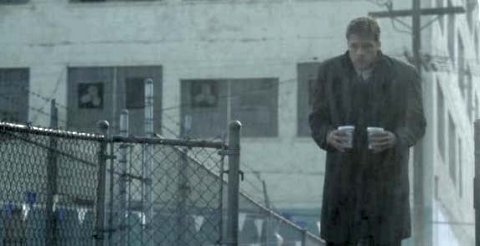
That dread is effectively captured in the film’s look, one in which Fincher and his cinematographer Darius Khondji transform New York City into a brownish cesspool of urban decay. It evokes a less futuristic “Blade Runner” as seen through a mid-90’s Instagram filter called “Septic Tank”. Rain throttles the screen in scene after scene; at one point the downpour seems to completely engulf the windshield of Mills’ and Somerset’s car. In another scene Mills stands beneath yet another deluge with two cups of coffee, helpless, which might as well be an emblem for the brewing storm that he and his partner cannot avoid.


For all the harshness of this world, however, both in its plotting and its atmospherics, a certain level of hope thrives in its principal characters, all of whom might be cut from cardboard but are nonetheless sprinkled with fairy dust bringing them to life. Freeman outfits Somerset with a reluctant gravitas, accrued over the years of seeing the worst the world has to give. Even so, even as he waits for the worst yet again, there is an occasional flicker in those eyes. When he enters the library late at night to conduct research into the man they are tracking, Somerset gives a smile and a “hello” to the guard on duty; Somerset’s in his happy place. And it speaks volumes that the movie pauses from its festival of grime to give him a happy place, one awash in the almost saintly light cast by the rows and rows of green lamps. Mills, meanwhile, convinced they can “win” this case right up until the very end, has a naïvety that’s as moving as it is terrible. One shot finds him rolling around on newspaper in his apartment with his dogs, just an overgrown kid, and the way in which Somerset takes in his young charge in this moment is heartbreaking.

So is the moment Somerset shares at a greasy spoon diner with David’s wife, Tracy, brought to glorious life by the these-days much maligned Gwyneth Paltrow. Initially her character might seem a contrivance, existing to get offed to spur the film to its end point, yet she’s so much more. She has love in her heart but has lost it in the dense thicket of this foul city; she’s caught between the weary-eyed cynicism of Somerset and the righteousness of her spouse. She is us.


You know what happens to her if you’ve seen the movie, of course, and if you haven’t, you don’t deserve a spoiler, not even twenty years later. You should see it with fresh eyes. And even to see it for the umpteenth time is to see it with fresh eyes. It’s like getting pulled back in all over again, back to the point where Tracy is in that scene at the coffee shop with Somerset, hopeful but hopeless, looking not merely for guidance, but for a spark, for someone to tell her not that everything is going to be all right (motherfucker, please) but that life is still worth fighting for.

That’s the idea that Somerset returns to in the closing voiceover in the aftermath of the investigation in the form of an Ernest Hemingway line. “The world is a fine place and worth fighting for,” he recites. Then he reckons: “I agree with the second part.” Maybe he does, but as the years go on the less sure I am that the movie around him agrees. What begins as fatalism is eventually washed away in the unseen blood of nihilism. Perhaps a song from Tupac Shakur’s album of the same year summarizes better? “Fuck the World.”

Tuesday, July 28, 2015

Wistfully '95: Waterworld

Since I could finally both drive and get into R-rated movies in 1995, it doubled as the year in which I fell head over heels in love for the experience of Going To The Movies. And so, here in the future in 2015, we will periodically re-visit a handful of the offerings to which I first paid homage in various multiplex cathedrals of Des Moines, Iowa. 

---------- 

“Waterworld” has always been discussed in terms of hugeness. It was, after all, as the title suggests, a film set predominantly on the water. That’s a mammoth undertaking since water is often less cooperative than lowly crew members at whom directors can holler through a bullhorn. The movie’s budget, which excessively exceeded estimates, was $175 million, probably the cost of a hammer and a few nails on a modern day Marvel production but the largest ever in 1995. Its shooting schedule ran over by 54 days. Its shoot primarily took place in a vast artificial seawater enclosure. Colloquially it’s still known as a floppiest of flops even if stats prove that unfounded. Its production was so extreme that director Kevin Reynolds either walked off the set before shooting completed or was fired by star Kevin Costner who took up the auteur chair, whichever you want to believe, though either one works fine for the purposes of our thesis. This is because for all its immensity, “Waterworld” itself is really quite small, the story of one man – make that manfish – who is played by Costner and just seems to wish everyone around him would go the hell away.


At one time, of course, Costner was a box office magnet. He was something of an American Everyman, so much so that even when he played England’s seminal mythic son, Robin Hood, he did so with an American Everyman accent. Yet if you look at his roles from this Costner Era just a bit closer, you’ll see emergent dabs of peculiarities. Ray Kinsella of “Field of Dreams” was a wholesome Midwesterner but he also heard voices. His Jim Garrison of “JFK” was portrayed as a hero, yet the real life man was also often termed eccentric, and Costner isn’t afraid to let that seep out of the performance too, like in the shot when he literally bounds from the staircase after kissing his wife goodnight to his study. Even his Eliot Ness, an eternal emblem of truth & justice, could, in the right light, come across less like a white-hatted winner than an odd duck teetotaler. Eventually the Costner we all know now, the seemingly apathetic introverted Costner, the one who showed up to the Emmy’s as if he would have rather been anywhere else, the daffy and disinterested Costner who spent much of “The Upside of Anger” just chilling on the couch, would have to emerge. He did, and it just happened to coincide with a $175 million behemoth.

“Waterworld’s” story turns on the polar ice caps having melted, flooding the entirety of earth and rendering the planet as one singular ocean. Yet its most memorable – er, rememberable – liquid-based image stands apart from this colossal sea. The film opens with Costner’s character, the Mariner, drinking his own urine. Well, not exactly; it’s his urine run through a rudimentary filtration system, but still. A character’s introduction is crucial and the Mariner’s introduction works less as an invitation than a repellent. And his character does repel. “It could have made me care about the characters,” the late great Roger Ebert wrote of the film, and that’s true, it could have. But it doesn’t want to. Costner, it seems, doesn’t want to. When the whole world’s a sea, you’re out to it pretty much all the time, and when you’re out to it pretty much all the time, you’re gonna be a little standoffish. You don’t get eager at the sight of people, you get suspicious, and so it’s like the instant the movie-watching audience gets settled in its seats, the Mariner’s suspicions of us arise and he pushes us away with his pee.

Not long after, the Mariner winds up at an atoll, a kind of floating city, where the local lawman solemnly explains this lone visitor has “two hours” to get what he needs and hit the watery road. “I’ll only need one,” the Mariner replies. Here’s a guy so untaken with people that when he finally encounters a whole mess of ‘em he actively wants less time around them. And as quick as the Mariner wants off the atoll, you sense the movie wants the same. From this point forward, it never feels comfortable. In the lead-up, a sequence in which the Mariner encounters a few shady characters and fends them off, the film is content to unspool its action exposition-free, letting us glean the world and the way it works by just watching it happen. And the Mariner’s almost balletic movements about his 60 foot trimaran are visually intoxicating, quite likely the film’s strongest element, to the point that when others are on his boat they just seem to be in the way, to him and to us.


If it’s a movie called “Waterworld”, though, then there has to be a Dryland, and if there’s a Dryland there has to be a map to find it, and if there’s map to find it then, hey, why not make it a tattoo on a little girl’s back because then the Mariner can encounter the little girl (Tina Majorino) who can help cheer him up (because he needs to be cheered up) and the little girl can have a mom (Jeanne Tripplehorn) with whom the Mariner can fall in love (because the Mariner needs to fall in love).

None of this especially noteworthy, just a series of passable to decently entertaining action sequences also involving a villain played by Dennis Hopper who might be partially amusing but feels like he’s still running on “Speed” fumes. For such extravagant expense, “Waterworld” never feels awe-inspiring, perhaps because deep down in the places it didn’t talk about at budget meetings it wanted to primarily be a movie about a solo sailor that couldn’t be because you can’t spend that much money on a movie that’s just about an introverted mutant manfish. And so what we’re left with feels un-involving and as glum as the costumes.

Even when the Mariner is meant to be smitten with the mother and charmed by the daughter, Costner never makes it feel convincing, like he’s play-acting, like this is what the script calls for, nothing else. It’s not accurate to say that this is when Costner stopped wanting to be a movie star because he never really wanted to stop being a movie star (see: the messianic complex of “The Postman” two years later). But maybe it’s when he stopped caring if he was Everybody’s Everyman and decided to start being a prickly ass who would demonstrate empathy only at his time and place of choosing. I can’t quite decide if that’s commendable or reckless.

Tuesday, July 07, 2015

Wistfully '95: Party Girl

Since I could finally both drive and get into R-rated movies in 1995, it doubled as the year in which I fell head over heels in love for the experience of Going To The Movies. And so, here in the future in 2015, we will periodically re-visit a handful of the offerings to which I first paid homage in various multiplex cathedrals of Des Moines, Iowa. 

----------

One thing I notice the older I get is how people in my age bracket and above can demonstrate a dismissive attitude toward the young. I want to be clear: I’m not talking about older people rolling their eyes at adolescent nostalgia. I’m talking about a profound inability to remember what it meant, and even more specifically, what it felt like to be young. If a young person is heedless and aimless and hell bent on sarcasm deflecting their own heedlessness and aimlessness it often seems as if adults critical of this heedlessness and aimlessness and sarcasm conveniently forget their own youthful heedlessness and aimlessness and sarcasm; like when you age it adds wisdom and subtracts confusion and suddenly they’re all Confucius and “tsk-tsk.” In other words, it’s the antithesis of empathy. If one cliché is that youth is wasted on the young then perhaps wisdom is wasted on the aged who know better than you do.


“Party Girl” is the one film in my 1995 series that I did not actually see in 1995. (I caught up with the film three years later during a time when I was heavy into Parker Posey’s filmography.) That would have been difficult. Even if I knew of it at the time, which I didn’t, it was a hardcore indie, and in 1995, Des Moines, Iowa was not a bastion of indie cinema. Released on June 9, 1995, it actually premiered via the Internet six days earlier, the first official full-length Internet film premiere – like, two months before Sandra Bullock explained “The Net” to those of us who didn’t really understand it. That, of course, can make “Party Girl” feel dated, and being dated is actually its ally. This is a film that takes us back, not just to an era but to a specific time in life when Personal Fulfillment seems both idiotic and just a hair's breadth away.

I’ve had people younger than me express confusion about how so many of us carry a torch for Parker Posey and perhaps that is because you had to be there - which is to say, you had be to be around in the 90’s. Panning the film at the time for the San Francisco Chronicle, Edward Guthmann wrote that Posey was “long on chutzpah and sarcasm and short on charm.” Uh, hell-o. Earth to Guthmann. It was the n.i.n.e.t.i.e.s. Get your wack-ass charm outta here cuz we ain’t having it. Chutzpah and sarcasm was what we wanted, like Alicia Silverstone in the “Cryin’” video, like Winona Ryder, like Parker effing Posey as Mary the Party Girl. The movie was set in the 80’s but I would have recognized that mid-90’s sass anywhere. She was the protagonist of Cyndi Lauper’s “Girls Just Wanna Have Fun” but played with the brassy Whatever-ism of D’Arcy.

The late great Roger Ebert wasn’t a fan. “As for Mary,” he writes, “her life is disorganized, yes, but the script could nevertheless organize its approach to her, so that the audience wouldn't feel as confused as she is most of the time.” These are not criticisms with which I can quibble, yet these criticisms, in their own way, enhance the film. I was confused when I finally caught up with it, marooned in my early twenties, confused beyond all get-out. And watching a character mirroring my confusion and venting in the bliss of late-night parties and moderate to occasionally extreme immaturities brought not so much a sense of comfort as relief.


Ebert contends that ultimately “the movie never pulls itself together.” Perhaps. Perhaps it never wants to pull itself together. It’s episodic; some episodes are like a more rave oriented “Caroline in the City” and others are like an after school special gone hella wrong. It flits from here to there, and sometimes back again, and sometimes somewhere else altogether. There’s an arc here, but it’s the arc of a twenty something who doesn't have it together and doesn't want to get it together but kinda does want to get it together. Maybe. And so the screenplay gives her an escape hatch in the form of her librarian job. She gets, loses it, but then decides she'll get it back again, studying to be one, to making something with her life that goes beyond parties.

Seventeen or eighteen years out here in the future her crusade for self-identity feels a little.....lacking. Like, the movie never quite takes her on the necessary journey to that point of true enlightenment. Yet true enlightenment, as anyone in their thirties and beyond can tell you, so rarely happens that early in your life. You're still scrounging, still carving out your identity, still thinking you can simply quit the party scene and then everything'll be hunky dory.

That's why an older person might look at Mary and shake his or her head. “She has no idea,” they might scoff. And she probably doesn't. And so what? “Party Girl” is all about those innocent days when you believe merely grasping something like The Dewey Decimal System can automatically engender true happiness. It can’t, of course, but I sure remember when I thought it could.

Thursday, June 18, 2015

Wistfully '95: Braveheart

Since I could finally both drive and get into R-rated movies in 1995, it doubled as the year in which I fell head over heels in love for the experience of Going To The Movies. And so, here in the future in 2015, we will periodically re-visit a handful of the offerings to which I first paid homage in various multiplex cathedrals of Des Moines, Iowa.

----------

There is a moment in Mel Gibson’s Academy Award behemoth “Braveheart” when Isabella (Sophie Marceau) is flouncing around the King’s Castle with her feudal version of Carrie Fisher in “When Harry Met Sally”, discussing the Scottish rogue, William Wallace (Gibson), instigating a rebellion against dastardly England. “Knowing his passion for his lost love,” Nicolette explains, “they next plotted to take him by desecrating the graves of his father and brother and setting an ambush at the grave of his wife. He fought his way through the trap and carried her body to a secret place.” Isabella swoons. “Now that is romance, oui?” wonders Nicolette. “I wouldn’t know,” replies Isabella like she’s Judy Garland in “Meet Me In St. Louis” talking about the boy next door. What strikes me most about this conversation isn’t the romantic absurdity, which I adore, so much as how we are simply left to take Nicolette at her word. We never see the story in question. As director, Gibson chooses not to lay it over the speech. For all we know, it’s made up, or a brewing folktale, passed down from person to person, like a game of medieval telephone.


That’s a significant part of “Braveheart.” Yes, we all remember the Gibson’s fiery speech in blue war paint but what’s also memorable is the pair of Scots who dismiss the notion that he is William Wallace. “William Wallace is seven feet tall,” says one. Wallace himself retorts: “Yes, I've heard. Kills men by the hundreds. And if he were here, he'd consume the English with fireballs from his eyes, and bolts of lightning from his arse.” Everyone has a good laugh. It’s a funny joke! He is William Wallace! Yet, he’s not really. He’s less the actual William Wallace, whoever the historians say that is, than the version of William Wallace that shoots bolts of lightning from his arse. Why I’m tempted to surmise that Randall Wallace’s original screenplay contained a scene where William Wallace shot bolts of lightning from his arse until Mel Gibson nicked it at the last second.

After all, “Braveheart” has been labeled one of the ten most historically inaccurate movies of all time. Or, to say it another way, as said Sharon Krossa said it: “The events aren't accurate, the dates aren't accurate, the characters aren't accurate, the names aren't accurate, the clothes aren't accurate -- in short, just about nothing is accurate.” Uff da. Here’s an article from Kathryn Warner that takes a deep dive into the historically inaccuracy in “Braveheart” surrounding Isabella and her baby - namely, that there is no way whatsoever that William Wallace could have fathered it. She points out, amongst a myriad of other damning details that are easy for anyone in the interwebs age to fact check on their own, that, uh, well, Isabella would have been a whopping nine years old at the time of real life William Wallace’s execution……and still in France. Alex von Tunzelmann offers a fairly concise roundup of the film’s fiction over at The Guardian, closing with the sort of line these kinds of lists usually employ, writing that “regardless of whether you read English or Scottish historians on the matter, Braveheart still serves up a great big steaming haggis of lies.” Sick burn.

It’s not like Randall Wallace went all high and mighty a la Ridley Scott and his “real” account of the very much mostly mythical Robin Hood. No, Wallace made it well known that his script was based predominantly on Blind Harry’s Wallace, an epic 11,877 stanza poem purported, per mostlymedevial.com, to be taken from “the writings of John Blair, a childhood friend of Wallace's who became a Benedictine monk.” The majority of it, however, seems rooted not in any kind of factual evidence, but in evidence of the heart. “Is Blind Harry true?” Wallace asked rhetorically in Lin Anderson’s book “Braveheart: From Hollywood to Hollyrood.” “I don't know. I know that it spoke to my heart and that's what matters to me, that it spoke to my heart.”


“When the legend becomes fact, print the legend.” You’ve heard that line thousands of times. Literally (figuratively), thousands. It was recited in “The Man Who Shot Liberty Valance”, John Ford’s film from 1964, one exploring the disconnect between real history and fanciful revisions of history. And at some point, fanciful revisions of history became antithetical to the movie-going experience. Print the legend instead of the fact and people flip. Twitter ignites.

And I get it. Honest, I do. There are valid points to be made about the fallout of a film’s intentions. Perhaps “Braveheart” thrust William Wallace directly into the spotlight, a place this long forgotten rebel never would have been again, but at what cost? Are misunderstandings about the real person on account of the film's messy remembrance of the facts a plague on real history? Do people watch “Braveheart” and simply assume the English are all hate mongers? I compared Wallace to Robin Hood earlier but Robin Hood, for all the modern day detective work, remains wholly a myth, a man in tights winning archery contests, Errol Flynn guffawing. Perhaps Wallace retained the right to be known as he really was just as it might be important for people to know that Emanuel Leutze’s rendering of Washington Crossing the Delaware is an oil canvas of poppycock. But then, Leutze wasn’t painting fact; he was painting the legend. So was Gibson.

I love that painting. It’s my favorite painting in the whole world. I’m a fanatic for Revolutionary War history but I’m also a fiend for romance, and why can’t the two co-exist? The Washington in Leutze’s painting is the most gallant motherfucker in the whole world, the G.W. more in line with the one that chopped down a cherry tree and hurled a silver dollar across the Potomac. And the Wallace of “Braveheart”, the one that gave an heir to Isabella and sacked York and wore belted plaid (scandal!), has more in common with that Washington. It’s not history; it’s histrionic. So what?

Wednesday, May 13, 2015

Wistfully '95: Crimson Tide

Since I could finally both drive and get into R-rated movies in 1995, it doubled as the year in which I fell head over heels in love for the experience of Going To The Movies. And so, here in the future in 2015, we will periodically re-visit a handful of the offerings to which I first paid homage in various multiplex cathedrals of Des Moines, Iowa.

----------

It’s movie obsessive common knowledge that Tony Scott’s “True Romance” co-conspirator Quentin Tarantino did uncredited rewrites to Scott’s 1995 submarine epic “Crimson Tide”, named for a football team that then was not quite as overbearing as it is now. Mr. Tarantino’s re-writes pertained not to sonar and periscopes, because that's not Q.T.'s wheelhouse, but rather to additions of pop culture, marking it a tad more accessible and a bit more humorous. One of those additions appears near the start when a couple submarine officers earnestly discuss commanders in submarine movies. They mention “The Enemy Below”, which pit Robert Mitchum as an American sub captain locked in deep sea battle with Curd Jurgens as a German sub captain. They mention “Run Silent Run Deep” in which Clark Gable and Spencer Tracy are both Americans aboard the same sub who must find a way to work together. And while both these movies inform “Crimson Tide”, rest assured, Tony Scott, the maverick who gave birth to Maverick, goes his own way.


“A maximalist,” Manohla Dargis wrote in her New York Times obituary of Tony Scott, “(he) used a lot of everything in his movies: smoke, cuts, camera moves, color.” Truth. Mr. Scott never met a formal trick he wouldn’t subsequently pile like so much coleslaw on top of a cinematic sandwich that already had two pounds of meat and fries. “Busy” never really captured his aesthetic; his camera was a day trader high on whatever you’d like and everything else. Still, what often got lost amidst his impressive deployments of frenzied style were the epic confrontations between characters. Tony Scott loved confrontations. We remember “Top Gun” for its flash and dash and Ray Bans, of course, but we remember it just as fondly for Maverick vs. Ice and Maverick vs. Jester and Maverick vs. Viper and Maverick vs. Himself. We remember Christopher Walken squaring off with Dennis Hopper in an incredible verbal tete a tete. Then there’s “Crimson Tide.”

In theory, “Crimson Tide” is a showdown between the United States and a Russian ultra-nationalist, between opposing submarines lurking in the depths of the sea. Of course, it’s not really about any of those Cliff Notes. What it’s really about is the two primary officers aboard the U.S. Naval nuclear sub, the USS Alabama (“Go ‘bama! Roll tide!”), Captain Frank Ramsey and his brand new handpicked Executive Officer Ron Hunter. It’s about slowly escalating confrontation between these two men born of an order rendered incomplete on account of a technical glitch that causes mutinies and reams and reams of splendid shouting matches. More than that, though, it’s about a confrontation between two actors, Gene Hackman raising hell as Ramsey and Denzel Washington maintaining impassioned fastidiousness as Hunter.

To be sure, Scott gussies up his films with plenty of bells and whistles, not to mention lathering it up with a prototypical booming Hans Zimmer score. There are depth charges and catastrophic leaks and missiles fired and all sorts of other traditional action-packed entrees served. Yet it never comes across as more than Simpson/Bruckheimer contracted scaffolding to provide a place where two all-world thespians can unleash verbal torrents, both loudly or quietly. It’s a friendly, hella good reminder that so often the only energy source a film requires to power it to ascendant heights is a couple acting titans. And this is why the film ends not with more missiles fired and not with WWIII, but with Hackman and Washington seated across from one another discussing Lipizzan Stallions.


It also ends with Ramsey recommending to a Naval Tribunal that Hunter be given command of his own boat, and it’s not difficult to read this conclusion as Hackman passing the baton of his own role on to his co-star. “When threatened, Hackman retreats to his glasses and clipboard,” Steven Hyden wrote in his January retrospective of the actor, “the accoutrements of command. And how does Denzel respond? I DO NOT RECOGNIZE YOUR AUTHORITY. Like that, Denzel Washington becomes Gene Hackman right before your eyes. And Denzel held on to that role in subsequent movies. Flash forward 20 years and it’s Denzel playing daddy to Mark Wahlberg in 2 Guns.”

Eh, yes and no. I'd agree with the first part, not the second. Yes, Washington has often assumed the Ramsey-ish role of charismatic elder, dealing with or imparting wisdom to or screaming at a co-star, but Wahlberg vs. Washington is assuredly not Washington vs. Hackman. Nor was Ethan Hawke in “Training Day”, a part working away from Washington’s King Kong postulating and a performance that didn't win even if its character did. Angelia Jolie took a turn as Washington's protégé in “The Bone Collector” and though she won an Academy Award a year later this was still before Angie had cracked the Jolie Movie Star Code. Ryan Reynolds in “Safe House” is like watching a Biloxi Shucker flail away against a Major League pitcher.

“For more than 30 years,” Hyden wrote, “people bought movie tickets to watch Hackman take charge.” In “Crimson Tide”, Hackman took charge and Washington had the cojones to wrestle that charge away. And now, twenty years later, Washington continues roaming Hollywood evermore intent to take overblown thrillers like “The Equalizer” in an increasingly woebegone effort to find someone willing and able to wrest charge away from him. I fear in twenty years, he'll still be searching.

Wednesday, April 15, 2015

Wistfully ’95: Mad Love

In 1995 I could finally both drive and get into R-rated movies. This meant 1995 was the year in which I fell head over heels in love for the experience of Going To The Movies and so, here in the future, throughout the year, we will occasionally re-visit a handful of the offerings to which I first paid homage in various multiplex cathedrals of Des Moines, Iowa.


----------

April 1995 would have been an, uh, interesting juncture in Drew Barrymore’s career. She was just emerging from a jaw-dropping rebellious phase of mischief and mayhem at such a tender age that she would have sent the Mean Girls scampering to the local church lock-in from fear and poised for a re-invention as a relentlessly likable kind of bohemian presence on screen aptly summarized in her forthcoming production company’s moniker of Flower Films. A woman who America’s movie grandfather Steven Spielberg tried to spur toward redemption when she posed for Playboy by sending a note that purportedly pleaded for her to “cover up” would, only a couple years later, redeem Adam Sandler with one of the most winsome performances the maudlin world of rom coms has ever seen. (Search your heart. You know it to be true.)


Of course, she still had some of that old teen rebel in her yet, evinced by her infamous appearance on David Letterman’s Late Show when she ascended his desk to, uh, well, let’s see, bid him a birthday of extravagant mirth by revealing a pair of her most precious bodily adornments. You can find this image all over the vast reaches of the Interwebs and you can access video of it at the throw of a pencil through a fake window behind you. What you can’t seem to find is the interview itself, and I admit the interview itself intrigues because I wonder if Ms. Barrymore was at the Ed Sullivan Theater to promote “Mad Love.” It’s possible that Drew was there to discuss “Batman Forever”, in which she had a small part and which opened that June, and it’s possible that she talked about “Boys on the Side”, which would have opened back in February, and it’s possible that they didn’t talk about much at all except Dave’s sudden sensory overload. But “Mad Love” was set to open in less than a month-and-a-half when Drew hopped up on that desk.

“Mad Love” might be described as a sort of grunge-era “Badlands”, a star cross’d romance of lovers on the lam in which Barrymore's Manic Depressive Dream Girl is broken out of the mental hospital by straight-laced, straight-A-earning Matt Leland (Chris O'Donnell) so they can flee, as you do, for ol’ Mexico. Oh, it might be simplistic in its view of depression, reducing so much of it to domineering machinations of meanie parents, but to watch the performances and the very real layers the two performers provide their characters counteracts all its contrivances and soppy sentimentalizing.


It’s smart enough not to simply “cure” her “affliction” on account of Matt’s selfless love, knowing full well such a battle takes more than petty larceny, gauzy looks and ninety minutes. O'Donnell is an earnest actor but finding earnest roles in an un-earnest shark tank like Hollywood can be difficult, which I suspect has led to an erratic career. Here his sweetness is laser-focused on helping his true teenage beloved get better, and he deals with her mood swings in a credible way. And even if those mood swings of Barrymore's character are sometimes manufactured to gun the engines of the plot they never feel manufactured to gun the engines of the plot because Barrymore makes them feel very much like a person lashing out against something brewing deep within her that she doesn’t understand and can’t control.

For most of the decade prior to “Mad Love” it sure seemed as if Barrymore herself was lashing out against something she didn’t understand and couldn’t control, forced to navigate the daunting culture of celebrity at too young an age essentially all on her own. It’s ridiculous to simply suggest that the character in “Mad Love” was her just as it’s ridiculous to suggest that “Mad Love” was a harbinger of Drew coming around and growing into herself and becoming the ultra-successful, down-to-earth, insanely likable woman she is. These flickering myths beamed up onto giant screens, however, have always afforded a level of wish fulfillment. Some more than others, and I can remember, as someone whose first movie-going memory was “E.T.”, featuring a seven year old Barrymore, watching “Mad Love” and wishing with all my might that Drew, like her character, would somehow, some way, at some point, be all right.