' ' Cinema Romantico: Miami Vice
Showing posts with label Miami Vice. Show all posts

Thursday, October 07, 2021

Who's a Fiend for Mojitos?


Vulture film critic Bilge Ebiri recently charted the evolution of “Miami Vice” (2006) from, as he put it, misfire to masterpiece, noting that Michael Mann’s movie version was both nothing like either the 1980s TV show on which it was based or the “kitschy, colorful snarkfest(s)” that defined TV shows as Movies of the era. No, it was something else entirely, “a dream,” Ebiri wrote, “of tortured romanticism...unbridled intimacy...downright transcendentalist focus on element over incident, where darkening skies and undulating waves and distant glimpses of lightning seem to say more than any line of dialogue ever could.” That, it goes without saying, was never going to be box office manna and it was only later, freed from “the expectations of industry journalists and box office prognosticators and audiences looking for something familiar and satisfying” that it found an audience. 

Ebiri notes that some critics fell hard for Mann’s fourth magnum opus all the way back in 2006. Not to toot my own horn, which is what one says in advancing of tooting his or her own, I knew it was a masterpiece, not a misfire, when I saw it on opening night, July 28, 2006. I wrote a rave, just a few days later, though that was Cinema Romantico’s Paleozoic Era and wild horses could not drag the link out of me. (You can dig around the blog a little bit and find it if you want.) My prose was crude and, most importantly, I did not yet have the tools in my critical toolbox to truly explain why it worked. Then again, I have spent the ensuing 15 years mostly fumbling around to explain why “Miami Vice” worked, usually falling back on bad poetry and absurd similes. The latest crack I took is as close as I got, I think, deeming it cinematic impressionism, which is a made-up term, granted, but don’t movies sometimes  exceed the lexicon as it exists? How else do you describe a movie that feels unlike anything else?

I was thinking about “Miami Vice”, actually, just last week, after watching Mann’s “Last of the Mohicans” (1992), my favorite movie, on the big screen for the first time. The last 10 minutes of that movie, but especially Alice’s denouement, were the first time a movie ever opened a direct channel to my un/subconsciousness. That, though, was not even something I truly realized until years later, probably around the time I saw “Miami Vice” and the first few moments of the opening scene plugged into my un/subconsciousness too. 
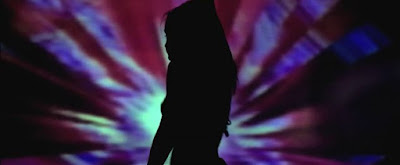

Scored, as Ebiri notes, to JAY-Z and Linkin Park’s “Numb/Encore”, the first shot is a virtual explosion of sight and sound, a silhouette dancing against all that color. 
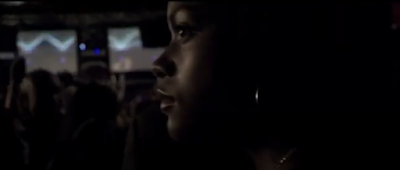

Then the shot switches to the side of the stage where people are dancing, the camera sliding from right to left behind our three intrepid members of Miami Vice. 
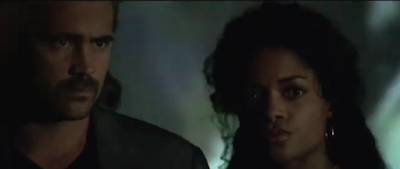

Then a cut to the front. 
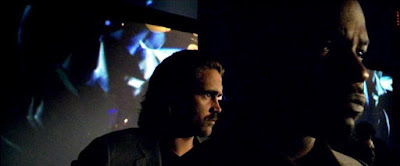

Then a cut to the side. That’s it. But, of course, that’s also everything. 

“Miami Vice” is nominally about a detective, Crockett (Colin Farrell), who gets so deep undercover that he longer knows, as his partner intimates, which way is up. He might as well be describing the viewing experience itself. Mann is asking you to forgo what you think you know about movies: how they feel, how they look, how they tell their story, if they even tell a story at all. And this opening scene is not so much an introduction as total immersion, plunging you straight into free fall, not asking you to let yourself go but clarifying you already have. 

Thursday, April 01, 2021

One More Great Michael Mann Movie Moment


This blog’s love of Michael Mann is no secret. “The Last of the Mohicans” is my favorite movie. In frequently writing about “The Insider” over the last four years I have begun to suspect that it might, just might, be The Greatest Movie Ever Made. My blog’s banner is a still from “Heat!” And so, my feelings were a little bit hurt when The New York Times failed to ask me to contribute to its Michael Mann retrospective – 40 Years of Michael Mann. 11 Great Movie Moments. – to commemorate the 40th anniversary of the director’s theatrical debut, “Thief.” Oh sure, A.O. Scott was once a finalist for the Pulitzer, but did A.O. Scott ever road trip to North Carolina to see the filming locations for “The Last of the Mohicans”? I didn’t think so.

Not kidding aside, the NY Times contributors did fine work, chief among them Amy Nicholson talking about how that look between Hawkeye and Cora, the one I have written about before, in many forms, is The Whole World in a Gaze. And I liked Ben Kenigsberg talking about “Collateral’s” suspense being rendered in light and shadow. There were, rightfully, two entries on “The Last of the Mohicans” and “The Insider”; there was even an entry on Mann’s inconsistent but undervalued “The Keep.” There was, however, no entry on “Miami Vice”, the fourth Mann masterpiece in addition to that astonishing 90s triad. How could this be? Manohla’s on staff and she gets “Miami Vice”; you couldn’t have penciled Manohla in for a quick graph? Fine, I thought, I’ll do it. [Clears throat.]


Though in making “Miami Vice” (2006) Michael Mann borrowed the underpinnings of his celebrated 80s TV show, he rejected everything else, utilizing a digital camera to virtually paint a piece of cinematic impressionism, eschewing rubbish like character and plot to chisel a movie from mood and tone and gesture and fleeting moments. In a meeting with an informant, Sonny Crockett (Colin Farrell), on the verge of having his personal and professional boundaries become indistinguishable, turns to gaze upon the ocean, the dialogue obfuscated by the crashing surf. It seems to momentarily suggest the end of all complication. Then, just like that, the moment is gone.

Friday, January 25, 2019

The Mojitos of Miami Vice (Mojito #3)


Here Detective Sonny Crockett enjoys a mojito with the apple of his eye, Isabella (Gong Li), re-proving the ancient cocktail adage that dates at least back to the dawn of the Republic of Cuba – two mojitos are better than one.

Thursday, January 24, 2019

The Mojitos of Miami Vice (Mojito #2)


Here Detective Sonny Crocket revels in the sonic pleasures of Afro-Cuban jazz and his preferred Cuban highball at the Bodeguita del Medio in Havana, birthplace of the mojito, bringing the whole thing full circle.

Wednesday, January 23, 2019

The Mojitos of Miami Vice (Mojito #1)


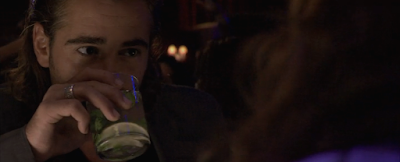
Here Detective Sonny Crocket drinks a Bacardi Mojito in the midst of a stakeout at a Miami club because even if it is said you cannot mix business and pleasure, well, while that old bromide might be true in Georgia, or Nebraska, or even Rhode Island, in Miami business mixes with pleasure, like, say, white rum with sugar cane juice with soda with lime with mint.

Tuesday, January 22, 2019

The Mojitos of Miami Vice (introduction)

The Oscar nominations were today. I probably heard them and I probably have thoughts. But Chicago is currently in a deep freeze and I am jetting off to Miami with My Beautiful, Perspicacious Wife.

I have never been to Miami. But one of my favorite movies is Michael Mann’s “Miami Vice.” I adored it in 2006 and my affection for it has only grown. It is an art film posing as action movie, as its other devotees can attest, though it is, to those of us who love it so, as meme-able as any longform sketch comedy fronting as a film. Indeed, few line readings in the new century are as pleasingly righteous as Colin Farrell as Detective Sonny Crockett explaining he is not merely a fan of mojitos but a fiend for them.


I have mentioned this before, but any time – and I do mean any time – mojitos are referenced in our everyday lives, I pitifully try to mimic this line reading to the weary chagrin of My Beautiful, Perspicacious Wife. Imagine how many times I’ll say it in Miami! (My Beautiful, Perspicacious Wife would rather not.) And that got me to thinking. Because though I plan on taking the rest of the week off, as I do these days when I go away, I do not plan to shutter Cinema Romantico. No, on Wednesday, Thursday and Friday the blog will briefly re-visit the three mojitos that mojito fiend Sonny Crockett imbibes in “Miami Vice.”

Join us, won’t you? I mean, would you rather read ANOTHER tome about what the Academy got wrong? Or would you rather go down the mojito rabbit hole? I thought so.

Thursday, June 28, 2018

Michael Mann's Miami Vice as an Art Exhibition, part 1

The DVD version of Michael Mann’s “Miami Vice” (2006) opens with the camera emerging from beneath the water to catch up with a speedboat race already in progress, though its presentation is conspicuously stripped of adrenaline such a scenario might suggest, a prologue as a slow burn. This is in contrast to the theatrical version, which is less of a gradual entry than a chaotic airdrop right into a cacophonous club scene; it’s like forgoing Harold Faltermeyer’s “Top Gun” intro and going straight to Kenny Loggins. When I saw this scene in the theater a dozen years ago, it gobsmacked me, like the “Boogie Nights” “Best of my Love”-fueled intro nearly ten years prior. When I purchased the home video version of “Miami Vice”, I sat there and watched that 90 seconds over and over and over. And of all the shots, the one I most consistently found myself drawn to was this.....


I have thought a lot about that shot over the last dozen years. Why, however, it has frequently popped into my mind is something I have always found difficult to explain. And I thought of that image on a Saturday morning last month in London in attending an exhibition at the National Gallery titled “Monet & Architecture” upon finding myself face to face with Claude’s 1872 outpouring of impressionism The Wooden Bridge. The exhibition illustrated the way in which Claude frequently utilized buildings in his work not as a means to highlight them but to highlight the way they refracted light. He also, however, as the exhibition outlined, sought to juxtapose industry against landscapes, like his Train in the Countryside, which I saw last fall at the Musée d’Orsay, where steam roils from an unseen train engine obscured by a line of lush trees. And in The Wooden Bridge a carriage traverses a bridge built during the Franco Prussian War, signaling progress, though the carriage is simultaneously glimpsed in one of those patented heartstopping Monet reflections in the water below, making it seem as if the manmade and natural worlds are colliding, or perhaps fading almost indecipherably into one another.


And because I bring everything down to movies, what popped into my head as I let The Wooden Bridge wash over me was a shot from my all-time favorite movie, “Last of the Mohicans”, this shot.....


It had kind of occurred to me, I guess, and and has no doubt absolutely occurred to cineastes more advanced than myself, but standing there in the National Gallery in that moment I realized how Michael Mann is so often using cinema as his own canvas, composing frames that could double as paintings.

And so as I gazed at The Wooden Bridge and returned to that shot of “Last of the Mohicans” in my mind, so did my thoughts turn back to the aforementioned shot in “Miami Vice”, which we return to now.


I mean, it loses something, or maybe is just viewed differently, if not seen as a moving picture, the way it begins with the camera gliding right to left behind them and past Naomie Harris’s character and then flips to a shot in front of them just as Naomie Harris turns toward where the camera is set with this incredible, ineffable No Scrubs look on her face that is the whole reason why we should see movies on big screens and not at home. But then, the camera cuts to the above shot from the side.

The two men standing rock still are juxtaposed against the whirring everything-ness in the left of the frame. These are men certain in their worldview, indifferent to the noise, which they have put behind them. Ah, but there is ambiguity in the fact that we cannot see whatever it is they are so intently focused on, and that they are rooted to the frame’s darker section might suggest that whatever it is they are so intently focused on is worthy only of trepidation. Thinking of the shot this way makes me dizzy and giddy. I want to frame it and hang it in the Art Institute and go down there and look at it every day for twenty minutes.

And that is why the Cinema Romantico plan going forward is to return to “Miami Vice” every now and again, maybe monthly, maybe bi-monthly, who knows, whenver the spirit moves us, to call up frames from Mann’s movie and treat them as if they are painted compositions hung in a gallery, our first ever movie blogging art exhibition, Parsing Miami Vice: Screen Shots on the Figurative Wall. It does not even cost extra to get in.

Wednesday, July 01, 2015

Inadvertent Aerial Transcendence

In an interview with Oliver MacMahon regarding “Runoff”, director Kimberly Levin talks about the way in which she and her filmmaking team pulled off the all-important recurring shots of a bi-plane dusting crops. She explained they needed several takes from a trio of set-ups, yet had no way to communicate with the pilot whose plane only held enough fuel for forty-five minutes, a blip of time in movie-making land. Still, they made it work, and Levin reverently deemed it “forty-five minutes of serendipity.” It made me think of another shot in a different film involving a plane.

Michael Mann, I suspect, is anti-serendipity. He has been termed a good many things in his quality-laden filmmaking career but one label that often seems to apply above all others is this: meticulous. He is finicky in his craft to the point of extreme notoriety. There is an oft-repeated claim, such as here by the esteemed Matt Zoller Seitz, that on “The Insider” Mann re-shot an entire scene because he didn’t care for the actor’s tie. It’s that sorta meticulousness. Like, you’re surprised to find out he didn’t invent a time machine to film “Last of the Mohicans” in 1757, space-time continuum be damned because authenticity matters more and the Fort William Henry needed to be the Fort William Henry.

“Miami Vice” might have been Mann at both his most meticulous and his most maddeningly out of control. His budget spiraled and his shooting schedule mushroomed as he sought to achieve his vision, causing divisiveness among the crew and cast, even making its star, Jamie Foxx, take his ball and briefly go home. A crew member quoted by Slate for a story involving the torturous process was quoted as saying how the film “was being written essentially by Michael on the fly. … That kind of indecision becomes a systemic thing. It’s hard, at the last minute, to make deals with vendors, rent a plane, to close down a freeway.” Rent a plane. Ah yes.

There’s a sequence in the film wherein our main characters, deep undercover, are transporting drugs up from South America and into Miami aboard a plane. To do so, they “pancake”, as Mann tells us on the film’s director’s commentary, by bringing their plane so close to another plane in mid-air that it looks like one aircraft on radar. It’s a snappy little sequence. None of it, though, compares to its capping shot, that of the plane, soaring above the Floridian swampy marsh and toward a horizon consumed by an immense and immaculately splendiferous thunderhead, an image that has nothing to do with anything, really, but is so elementally staggering the only proper response is breathless adoration. It’s a shot founded on the Zen principle that if one were to dissect it then it would cease to be Zen.


So, how did Mann render this shot? Did he have a copy of the weather forecast, a camera locked and loaded and a plane and pilot at the ready for a moment when a rainstorm might unleash? Did he just fly around and around for hours, waiting, hoping, and re-fueling mid-flight? Did he manipulate the atmosphere with some sort of weather machine he built from scratch in his basement? He’s Michael Mann! He must have found a way to bend nature to his will. Or, for once, were the circumstances of majestic cinema beyond his control?

If you don’t remember the artwork for Bruce Springsteen’s 1980 “Hungry Heart” single it featured The Boss himself with a just-kicking-it look on the Asbury Park boardwalk. Behind him, to the left, is a woman propped up on a bike as she leans into a phone booth, making a call. Her back is to the camera. We can’t see her face. Her identity is a mystery. At least, it was a mystery. That woman, Annmarie Solimini Adderley, it was revealed in a story for The Coaster Online that did the investigative work, had no idea she was being photographed or even any idea Bruce was there. It just happened. It’s accidentally iconic.

On the “Miami Vice” director’s commentary, Mann offers no comment on the shot. It glides by unmentioned. And so I like to think that maybe there’s nothing for him to say. Maybe those thunderheads were the cinematic equivalent of Annmarie Solimini Adderley, in the right place at the right time. Maybe even the meticulous Michael Mann, stickler of sticklers, can occasionally be the recipient of a few minutes of serendipity.

Monday, March 17, 2014

The Dozen Best Movie Drinks

"Couglin's diet: cocktails and dreams." - Bryan Brown, Cocktail

Yes. I know. Referencing Tom Cruise's critical stink bomb "Cocktail" and its drink-mixing mentor/maestro Brian Flanagan, he of the conspicuous Irish surname, in conjunction with an Irish-themed holiday is insulting. Except, not really. It's not really insulting because we all know that St. Patrick's Day in America has nothing to do with anything legitimately having to do with Ireland. It's an excuse for Americans to paint green on their faces and consume massive amounts of alcohol. Hell, most years they don't really even celebrate on St. Patrick's Day. They celebrate on the Saturday before St. Patrick's Day. It's like St. Patrick's Day observed. And any Irishman worth his whiskey knows you don't simply do your drinking on a day conveniently scheduled to avoid having a hangover on a weekday morning. Please.

Thus, in that spirit, today, on the real March 17th, Cinema Romantico offers the 12 Best Drinks Ever Drunk At The Movies.

(Disclaimer: no James Bond martinis will be included. This is because Cinema Romantico genuinely believes every drink listed below is more memorable than every single martini every single version of Bond has ever ordered and/or imbibed. Apologies.)

The Dozen Best Movie Drinks

12. The Big Lebowski

"Hey! Careful, man! There's a beverage here!"

11. The Thin Man

Nora: "Is that my drink over there?" 
Nick: "What are you drinking?" 
Nora: "Rye." 
Nick: (Picks up the glass and drinks it down.) "Yes. That's yours."

10. Titanic

"What, you think a first class girl can't drink?"

9. Out of Sight

Karen's tumbler of beloved bourbon becomes the epicenter of long-awaited physical contact between her and the handsome bank robber. 

8. Goodfellas

Paulie: "What'd you bring?"
Henry: "Bread. Peppers and onions. Salami. Prosciutto. A lot of cheese."
Paulie: "Come on, come on, what else."
Henry: (Revealing a bottle as if it were The Lost City of Z.) "...scotch."

7. Miami Vice

Go-fast boating off to Havana just to have mojitos. The life I'll never lead. Sigh...

6. Some Like It Hot

"I'm Sugar Kane. It used to be Sugar Kowalczyk."

5. Sideways

"You know, the day you open a '61 Cheval Blanc... that's the special occasion."


4. On the Waterfront

"One for the lady, one for the gent."

3. Raiders of the Lost Ark

Marion Ravenwood, 4-ever.

2. The Big Sleep

"It's raining pretty hard."
"Hey. That's right. It is, isn't it? You know, it just so happens I got a pretty good bottle of rye in my pocket. I'd rather get wet in here."
"Well....."

1. Inglourious Basterds

"There's a special rung in hell reserved for people who waste good scotch. Seeing as how I may be rapping on the door momentarily..."

Wednesday, May 22, 2013

Top 5 Movie Locations I Wish I Could Visit

Recently it was unveiled that photographer Rä di Martino had, by chance, wound up searching for and tracking down the long-ago sets used by George Lucas for the Tatooine scenes of his legendary original "Star Wars" film. Well, this got me to thinking.

It got me to thinking about how the righteous hosts of Filmspotting, Adam Kempenar and Josh Larson, the Rob Gordons of Top 5 Movie Lists, a couple months back unveiled the Top 5 Movie Locations They Wished They Could Visit.

Granted, I am no amateur when it comes to actually visiting movie locations. Everyone knows I took a pilgrimage to North Carolina to pay respect to the filming locations for "Last of the Mohicans" and on the way there I stopped to pay respect to Elizabethtown (because of "Elizabethtown") and when I visited my sister in Maine I made sure we took a detour to Bethel and Andover to pay respect to the filming locations for "The Myth of Fingerprints" and when my sister lived in Oregon I made sure we spent a day in Eugene to pay respect to the filming locations of "Without Limits."

Of course, all those are real locations that actually exist and the point of Filmspotting's list was to name make-believe places that solely exist within the movie itself that you wish you could go visit. Ah! Well, that's different!

Top 5 Movie Locations I Wish I Could Visit


5. Rick’s Café Americain, "Casablanca." Tonight they’ll be at Rick’s. Everybody goes to Rick’s. Except for me. I wanna go to Rick’s too! I do, I do, I do!!!


4. Speedboat, Gulf of Mexico, “Miami Vice.” Remember in Michael Mann's exorbitantly underrated update on the 80's TV show when Colin Farrell & Gong Li jet off to Cuba for mojitos and salsa (dancing) via speedboat? Sure, you do. I admit this location is a little difficult to pin down. I also admit this location is very much real but... Well, I could rent a speedboat. Sure. And I could pilot that speedboat from Miami to Havana, Cuba with a fetching lady to imbibe mojitos and dance salsa. But, of course, I couldn’t really do any of this. I would never make it to Havana for the mojitos because the Cubans would lock me up. If by some miracle I did make it to Havana I could never possibly dance the salsa (could we instead contort very enthusiastically but very, very badly to Kylie Minogue?). Of course, I would never get anywhere near Havana because if I tried to pilot a speedboat it would totally capsize in about 27 seconds, never mind the fact that I could never pull off Colin Farrell’s suit or convince a fetching lady to join me in the first place. And all that is why if I could be magically transported to movie location with the movie gods covering my every move I would be transported to a speedboat with a Malin Akerman-esque lady jetting off to Havana for mojitos and a salsa.


3. The Hit Pit, “Million Dollar Baby.” Never mind that Frankie Dunn would probably take one look at me, grimace and banish me to the corner where Danger is shadow boxing to pitiful effect, I would like so much just to spend a day – just an afternoon even – at his hole-in-the-wall gym. I would sit back, breathe in that disgusting aroma of sweat, gym socks, fresh blood and cheap bleach, listen to the sounds of speed bags and skipping rope. Besides, visiting Maggie Fitzgerald’s home gym would be for me like a baseball aficionado getting to set foot in the home locker room of old Yankee Stadium.


2. New York City, “The Royal Tenenbaums.” As much as Woody Allen’s “Manhattan” romanticizes that city all out of proportion, it is still showing us the real Manhattan – as in, places that actually exist. Wes Anderson’s “Royal Tenenbaums”, on the other hand, while technically being set in Manhattan envisions it is as a mythical Manhattan, a place that only exists in our imaginations. It is set on streets and at places that while being located in New York do not actually exist – such as The Public Archives and the Lindbergh Palace Hotel. This is what sets it apart. I think my favorite place to visit in NYC every time I go is The Algonquin Hotel partially because just being inside it feels like New York in the 30’s and 40’s. And really, that’s the New York I want to visit – the New York of the 30’s and 40’s. And the New York of “The Royal Tenenbaums” feels like the New York of the 30’s and 40’s but still with the amenities required by the modern unmanly man.


1. Nelson, Washington, “Roxanne.” So in the wake of the esteemed Roger Ebert’s passing I was, of course, perusing various Ebert-related bits out there on the world wide interwebs and stumbled across a Youtube video of he and the late Gene Siskel discussing “Roxanne”, one of my all-time favorites, on an episode of At the Movies. (Both of them loved the movie so much Ebert actually concluded their review by saying “We can’t even have an argument.” Awesome.) And a line of Siskel’s struck me like a bolt of Midwest lightning in May. He termed Steve Martin’s lead performance as being akin to “effervescent ginger ale.” Well, it is! It is effervescent ginger ale! But the whole movie is effervescent ginger ale and its setting – the city of Nelson, Washington – is effervescent ginger ale! Not just the scenery, mind you, which is striking or the delightfully slanted streets of a ski-town but the……the………aura. The way Martin declares “Irony? Oh, we don’t get that here” just seems to permeate every sidewalk and home and main street shop. But at the same time it’s not staid, plain-jane Eisenhower America, it’s something sweeter and truer, a place where no one seems to put on airs or masquerade as something they’re not. It comes across so tranquil, so refreshing, so much like……effervescent ginger ale.

Dammit, I want to go there.